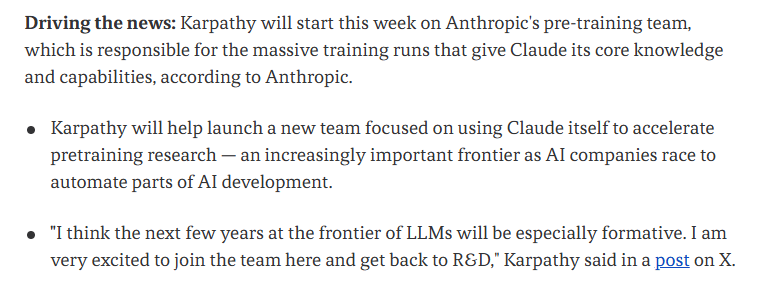
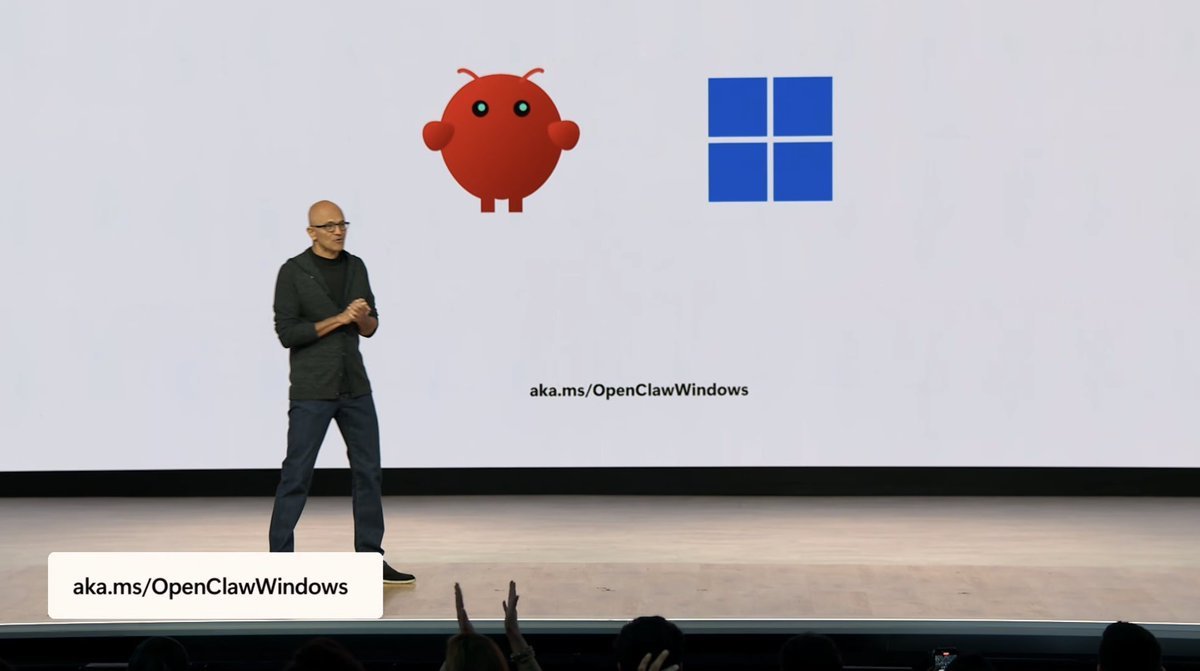
"You can run OpenClaw inside your company now." Annoucing our work with @Microsoft to bring OpenClaw to the Microsoft and Windows ecosystems. Claws now work securly in the enterprise.
Automatic behind the scene routing in user interfaces (instead of model picker) will redistribute value capture and usage towards many more models than just frontier ones (especially towards open-source/smaller/cheaper ones). Because it removes the cognitive load for the final user to have to switch models (which is too high leading to defaulting to frontier for all calls with model picker) cc @antonosika@bgurley
Anthropic’s journey to an IPO presents one of the most remarkable—and capital-intensive—financial trajectories in modern Silicon Valley history.
We've been covering Anthropic's private financials—and how they compare to OpenAI—for years. 🧵
One of the new, buzzy jobs in Silicon Valley is the AI Forward Deployed Engineer (FDE), an engineer who is embedded within a client organization to help customize solutions, such as building and tuning agentic workflows that suit the client’s particular needs. I’ve heard from people who are wondering anew about the FDE career path since OpenAI and Anthropic started building new teams to place FDEs within client organizations.
The rise of FDEs for AI workloads is one way AI is creating new jobs (and why the jobpolcalypse narrative of upcoming job market collapse is false -- there will be many AI and non-AI jobs). However, I believe there will be far more AI Engineer jobs than FDEs, as I explain below.
The FDE role was pioneered about two decades ago by Palantir, which sent engineers to government locations to work on secure, air-gapped networks. In addition to having good technical skills, FDEs need communication skills and sometimes business skills. For example, they may need to speak with clients to understand their needs, formulate a strategy to prioritize projects, explain complex technology, and respectfully push back if a client asks for something unrealistic. They’re enjoying a resurgence because of the amount of work involved in taking an off-the-shelf LLM and building it into a custom agentic workflow that fits particular business needs.
However, I believe the number of AI Engineer jobs will be far larger. A company might accept a few FDEs to be embedded within its organization. But most companies will want far more of their own employees working on their projects. While my organizations do hire FDEs, we hire far more AI Engineers! Also, a common client concern is that it is hard to find vendor-neutral FDEs — they are, after all, there to deeply integrate a particular vendor’s product into a company. In this moment when it’s hard to predict which AI service will be the best one in a year’s time, optionality (the ability to pick whatever vendor turns out to fit best in the future) is very valuable. In contrast, letting FDEs tightly bind a company’s processes significantly reduces optionality.
Right now, I see surging demand for AI Engineers who can build software applications using AI software components (like LLM prompting, agentic frameworks, evals, etc.) and effectively use AI coding agents (like Claude Code, Codex, Antigravity CLI, and OpenCode). As the AI Engineer role matures, I expect it to fragment into more specialized roles, like the generic Software Engineer role from decades ago fragmented into frontend, backend, mobile, data engineering, devops, and so on.
What will be the future, specialized AI engineering roles? I don’t know. Perhaps there will be AI FDEs, LLMOps Engineers, Evals Engineers, AI Data Engineers, Harness Engineers, and other roles we don’t have names for yet. But for now, I see a lot of AI engineers who are generalists create a lot of value. Skilled AI Engineers are in very high demand! As our field continues to mature over the coming decade, I look forward to new specializations within AI Engineering that create even more job opportunities.
[Original text: The Batch newsletter]
I find debates over whether companies find AI useful to be odd at this point
I talk to leadership teams at lots of big firms, and it is pretty universal that they are getting obvious and real value. The challenges now are going from individual uses to firm-level & how to scale.
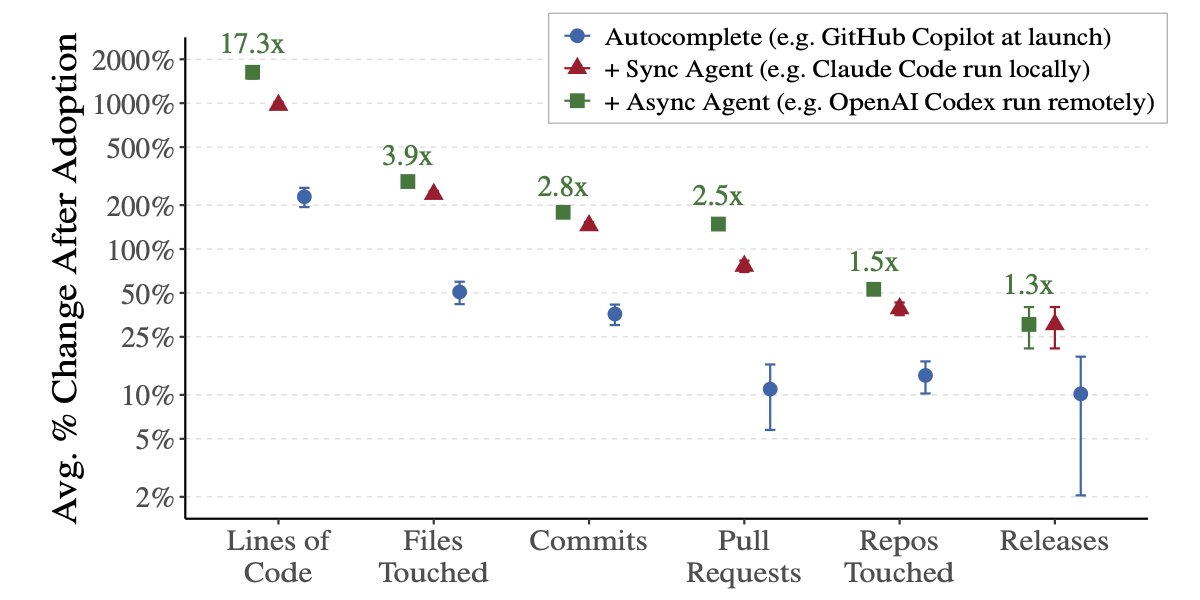
Big paper on AI coding agents using Github & other data
The auto-complete tools (Copilot) led to 2.2x more code, local agents like original Claude Code led to 7.4x, & current remote coding agents 17.3x(!)
But human bottlenecks in coding means actual releases "only" went up 30%
Forward deployed engineering has become the enterprise AI motion
But how do you make sure you're building a product, not delivering services?
@illscience and I talked to @pablorpalafox + @PaarupLuis on how HappyRobot has scaled to dozens of customers (and $1M + contracts) 👇
Il y a 1 mois, le directeur technique d'Uber a annoncé avoir consommé son budget #IA annuel en 4 mois. Goldman Sachs chiffre les coûts en tokens à 10 % de la masse salariale. Et 8 salariés sur 10 n'utilisent pas les outils qu'on leur a déployés. Les choses sont donc plus compliquées que ce que l'on croit... et nous manquons encore des grilles de lecture pour piloter tout ça !
Ma tribune dans @LePoint :
https://t.co/sNKb8nQ1yF
The vast majority of AI investment is flowing upstream to energy, infrastructure and frontier models. This is the opposite of the internet where things flowed via boutique VC funding, downstream to startups. And the reason is structural: internet network effects were in distribution (users get users), AI ones are in production (software creates software).
Avec ASML comme actionnaire stratégique ça aurait totalement du sens, et l'avenir c'est les puces d'inférence très économes en énergie qui font tourner très vite des petits et moyens modèles de langage, là où Mistral excelle, à pas cher.
Il y a 1 mois, le directeur technique d'Uber a annoncé avoir consommé son budget #IA annuel en 4 mois. Goldman Sachs chiffre les coûts en tokens à 10 % de la masse salariale. Et 8 salariés sur 10 n'utilisent pas les outils qu'on leur a déployés. Les choses sont donc plus compliquées que ce que l'on croit... et nous manquons encore des grilles de lecture pour piloter tout ça !
Ma tribune dans @LePoint :
https://t.co/sNKb8nQ1yF
"The increasing costs of AI could offset these performance shortcomings, however. If closed-source models continue to get more expensive, developers may increasingly look for cheaper alternatives."
via @theinformation
https://t.co/a54b1nShZ3
i am excited to see what will happen with tokenmaxxing startups, both for how they work internally and the products they can build.
openai offered to invest $2M in tokens into every startup in the current yc batch.
happy building!
One trend that I think you might start to see at big companies is insourcing via hiring: why pay so many outside vendors (legal, marketing, software vendors) when you can hire in-house and harness AI productivity gains yourself?
Talked to executives already going this route...
🦔The Bureau of Labor Statistics just confirmed what most of us suspected. The 18 occupations it classifies as "AI-related" lost jobs over the past year, while the rest of the US labor market grew 0.8%. Customer service reps alone are down 130,180 jobs, a 4.8% drop in a single year. Strip out medical secretaries, and the other 17 AI-exposed categories fell 1.6%. The 18 include paralegals, graphic designers, technical writers, interpreters, insurance and sales agents, and executive and administrative assistants.
My Take
I have been writing for months that the displacement would show up in the data before the productivity gains did, and this BLS release is the first hard confirmation at the occupation level. 130,180 customer service jobs gone in a year while overall employment grew is the headline, but the wider signal is that AI works for narrow, well-defined desk tasks even though it falls short of the "all white-collar work in 18 months" predictions executives keep selling.
The financial implication runs in two directions. Productivity gains are starting to show up where AI is actually being deployed, which supports continued Big Tech margin expansion. At the same time, the displaced workers are concentrated in roles that historically anchored middle-class household income, and the replacement jobs (fixing AI output, prompt engineering, model evaluation) do not come close to absorbing the headcount being cut. For anyone in one of these 18 occupations, the practical takeaway is that the assumption your role is safe for years no longer matches what the data is showing. Skill adjacency to AI tools is now a defensive move.
Hedgie🤗
🇫🇷 Lors du premier tour des élections municipales du 15 mars en France, 16% des électeurs ont utilisé un outil d'intelligence artificielle pour arrêter leur choix de vote, selon une étude publiée lundi par le think tank Terra Nova.
Most prophetic tweet of all time (2 months post ChatGPT release). And you can safely repost it every day and it will still be prophetic for the future. This is the least the world will care about AI.









![AndrewYNg's tweet photo. One of the new, buzzy jobs in Silicon Valley is the AI Forward Deployed Engineer (FDE), an engineer who is embedded within a client organization to help customize solutions, such as building and tuning agentic workflows that suit the client’s particular needs. I’ve heard from people who are wondering anew about the FDE career path since OpenAI and Anthropic started building new teams to place FDEs within client organizations.
The rise of FDEs for AI workloads is one way AI is creating new jobs (and why the jobpolcalypse narrative of upcoming job market collapse is false -- there will be many AI and non-AI jobs). However, I believe there will be far more AI Engineer jobs than FDEs, as I explain below.
The FDE role was pioneered about two decades ago by Palantir, which sent engineers to government locations to work on secure, air-gapped networks. In addition to having good technical skills, FDEs need communication skills and sometimes business skills. For example, they may need to speak with clients to understand their needs, formulate a strategy to prioritize projects, explain complex technology, and respectfully push back if a client asks for something unrealistic. They’re enjoying a resurgence because of the amount of work involved in taking an off-the-shelf LLM and building it into a custom agentic workflow that fits particular business needs.
However, I believe the number of AI Engineer jobs will be far larger. A company might accept a few FDEs to be embedded within its organization. But most companies will want far more of their own employees working on their projects. While my organizations do hire FDEs, we hire far more AI Engineers! Also, a common client concern is that it is hard to find vendor-neutral FDEs — they are, after all, there to deeply integrate a particular vendor’s product into a company. In this moment when it’s hard to predict which AI service will be the best one in a year’s time, optionality (the ability to pick whatever vendor turns out to fit best in the future) is very valuable. In contrast, letting FDEs tightly bind a company’s processes significantly reduces optionality.
Right now, I see surging demand for AI Engineers who can build software applications using AI software components (like LLM prompting, agentic frameworks, evals, etc.) and effectively use AI coding agents (like Claude Code, Codex, Antigravity CLI, and OpenCode). As the AI Engineer role matures, I expect it to fragment into more specialized roles, like the generic Software Engineer role from decades ago fragmented into frontend, backend, mobile, data engineering, devops, and so on.
What will be the future, specialized AI engineering roles? I don’t know. Perhaps there will be AI FDEs, LLMOps Engineers, Evals Engineers, AI Data Engineers, Harness Engineers, and other roles we don’t have names for yet. But for now, I see a lot of AI engineers who are generalists create a lot of value. Skilled AI Engineers are in very high demand! As our field continues to mature over the coming decade, I look forward to new specializations within AI Engineering that create even more job opportunities.
[Original text: The Batch newsletter]](https://pbs.twimg.com/media/HJvWmCHagAAnTxQ.jpg)