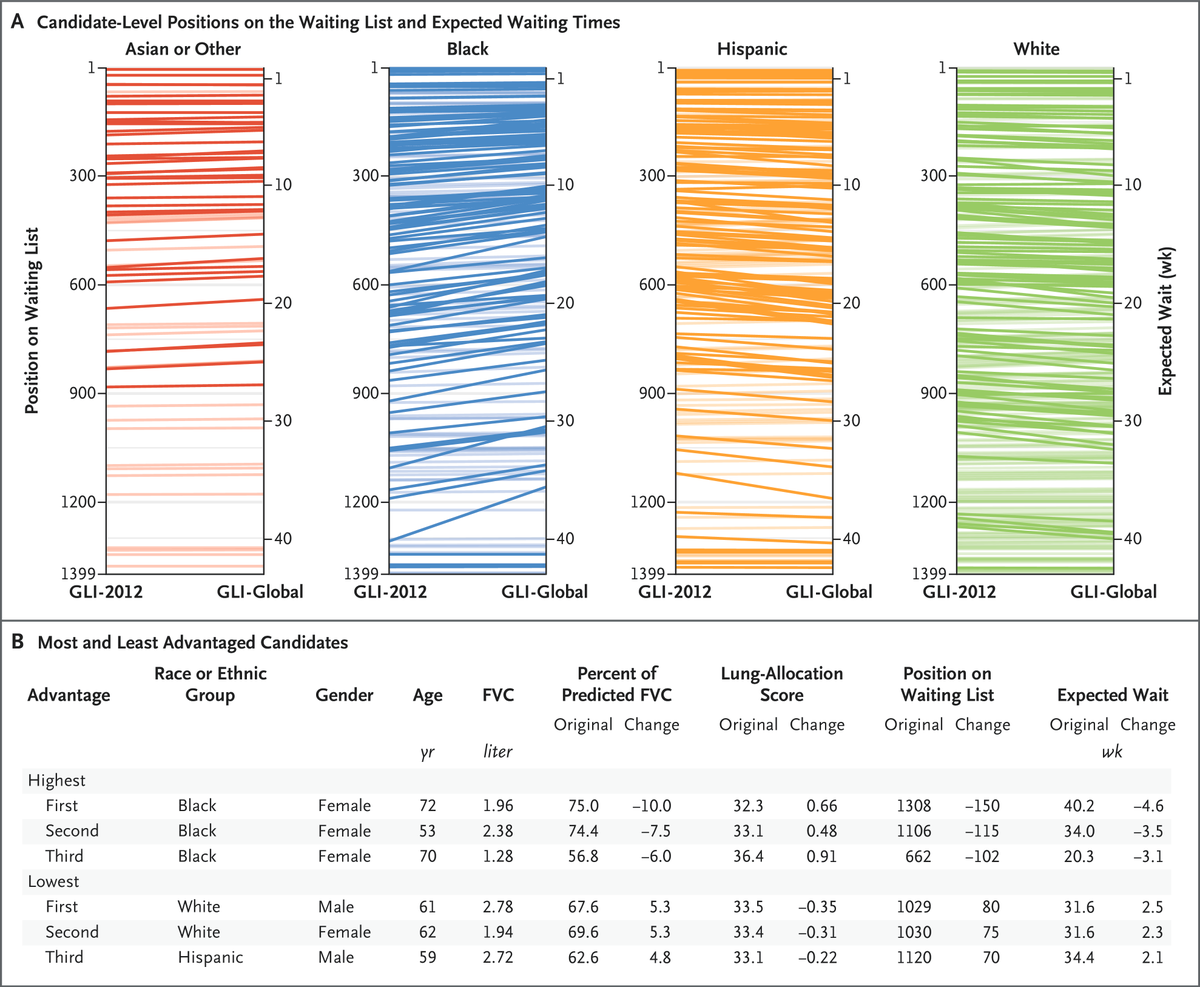
Special Article: Implications of Race Adjustment in Lung-Function Equations https://t.co/uQ83ohdbbd
Editorial: Beyond Diagnostics — Removing Race from Lung-Function Test Interpretation https://t.co/DTrbUi2OeR
#ATS2024@atscommunity
🧵 1/ What’s at stake with race-based equations for lung function? Clinical, occupational, and financial reclassifications for millions of patients.
I’m delighted to share this labor of love, published today in @NEJM and unveiled at #ATS2024.
https://t.co/9V0Bck071g
Highlighting the importance of diverse populations in genetic studies: We identified ancestry-specific variation that controls gene expression and developed improved #TWAS models in a large, diverse cohort in our newest #TOPMed@NatureGenet paper https://t.co/pOlqF9047n
Reference intervals for >50% of lab tests differ based on self-identified race/ethnicity. Minority patients are oftentimes compared to the majority group, resulting in misinterpretation of results. This impacts health outcomes of minorities.
https://t.co/OaCMbP3TBf
We're hiring! Looking for a post-doc in human genetics/bioinformatics or statistical genetics. Come work with us. Why? Unique data resource: including 19,000+ whole genomes, 3000+ whole transcriptomes, and 2000+ methylation profiles. If interested see: https://t.co/BNqyZcKLXI
Ideally, race will be replaced with genetic ancestry as a variable in medical research and practice. But until more ancestry data are available, ignoring race and extrapolating research findings from European-ancestry populations to others is neither equitable nor safe.
If you're 65 and over, take advantage of this protected time to get vaccinated before Tier 1B opens up eligibility to more populations.
We are open 9am to 3pm in Building 30. No appointment needed.
Genes reveal a lot about health. But because race and ethnicity determine so much about how we live, where we live and what kind of health care we get, those factors cannot be ignored. Read more from @LuisaBorrell (@CUNYSPH, @GC_CUNY) in @nejm https://t.co/Y9ck3Xxk7h
U.S. health inequities won’t be eliminated by abandoning the use of race and ethnicity in research and clinical practice, since these variables capture key epidemiologic information. But incorporating genetic ancestry, genotypes, or biomarkers requires further study.
Impacts of Race/Ethnicity in Medicine: Read our latest paper @NEJM led by Luisa Borrell, CUNY Graduate School of Public Health, Jennifer Elhawary, UCSF and @estebanburchard, @efuentes1, @ziv_elad
https://t.co/2DpPQkhLtH
An upcoming "birth cohort" study that follows infants from the time they're born could shed light on what causes asthma @asthmagenetics@EstebanBurchard https://t.co/ethXO81pU8
Why do Puerto Rican youth have the highest #asthma burden in the world? A study by @asthmagenetics@estebanburchard IDs ancestry-specific genetic associations that impact lung inflammation in children, suggesting future #precisionmedicine treatments. https://t.co/aTw15eT5sG
Nothing says #WednesdayWisdom like previous keynote speaker @EstebanBurchard, who brought many of us to tears at #2019SACNAS.
Help us find more amazing speakers for this year's National Diversity in STEM Conference! Suggest a keynote speaker here >> https://t.co/xt9nUnks7C
Our wonderful colleague Dr. José Rodríguez-Santana was featured on the front page of @ElNuevoDia talking about our Puerto Rican pulmonary birth cohort project! #PuertoRico#PRIMERO
https://t.co/haPkNMVZ7L
Learn more about his clinic here:
https://t.co/gHc9k9797J
“Find a way to combine personal passion and academic rigor.” Dr. Esteban Buchard. Passionate keynote with a fantastic message! #2019SACNAS#ThinkBigDiversity@sacnas
So thrilled about this! I had the pleasure of getting to know Esteban a bit while producing 3 #BackgroundToBreakthrough films that feature him. His research, mentoring & activism embody the values of SACNAS.