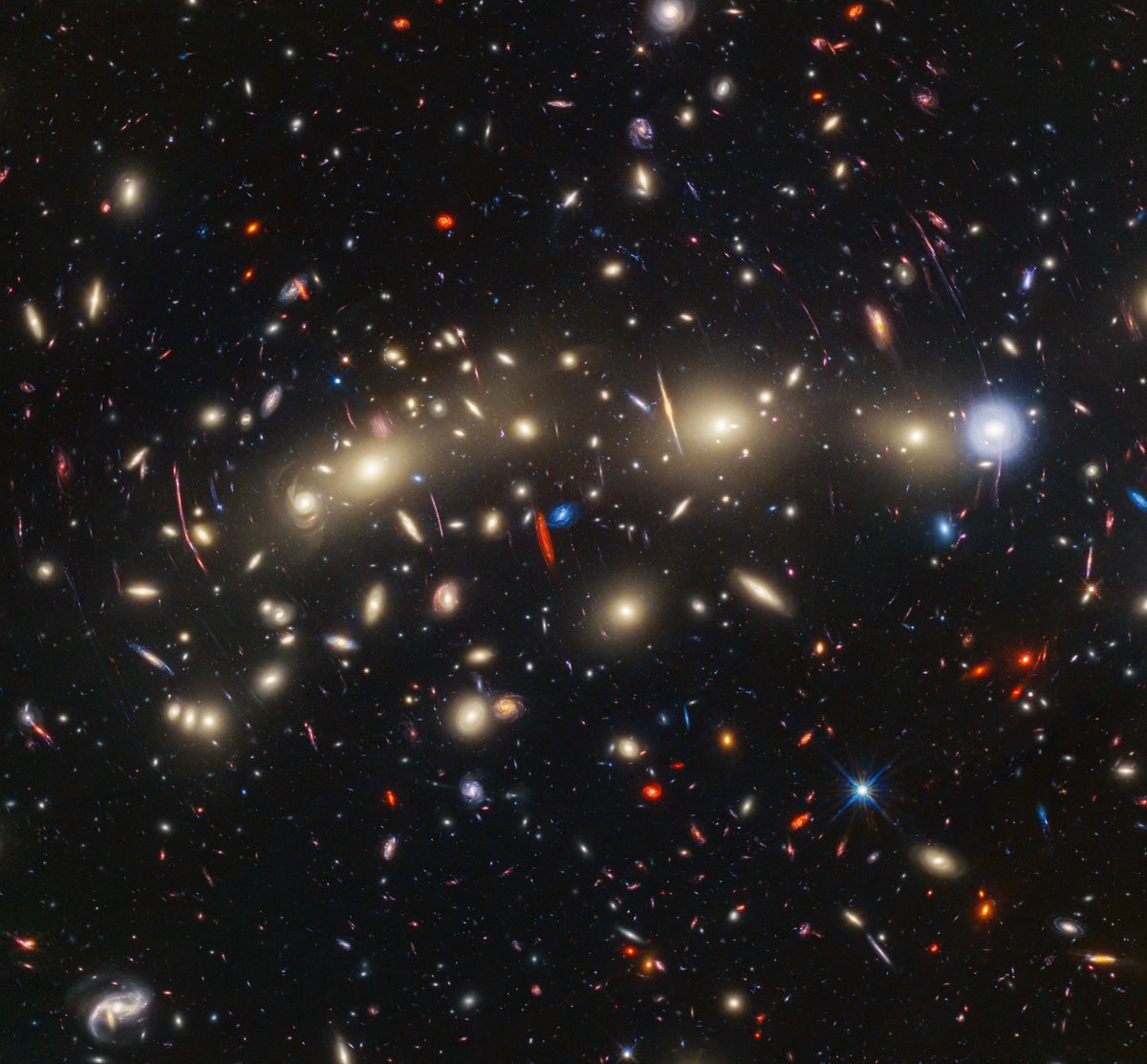
Deck the halls with a galaxy cluster? A team of astronomers including #NRCAstronomy’s Plaskett Fellow Madeline Marshall took a closer look at “The Christmas Tree Galaxy Cluster” using observations from @NASAWebb & @HubbleTelescope
Read the blog! https://t.co/4jItKzEUSg
Hubble and @NASAWebb joined forces for one of the most colorful views of our universe – ever.
This is a galaxy cluster called MACS0416, located a whopping 4.3 billion light-years away: https://t.co/9JiYegbwnd
PEARLS team! Gravitationally lensed Kaiju star! This one was named Mothra because it's in an otherwise dark region of the cluster, and moths come out at night...
@lyAaronYung Don't feel bad about complaining, that's not your name! You should be able to have the most complicated name and still expect them to get it right. And yours is so straightforward!
Hey @NatlParkService, did somebody say Fat Bear Week? 🐻
Here’s galaxy cluster El Gordo, or “the Fat One." Containing hundreds of galaxies that existed when the universe was 6.2 billion years old, it's the most massive cluster known to exist at that time! https://t.co/hqVusGKvat
Exciting observations from @NASAWebb Telescope featured in @universetoday! #NRCAstronomy Plaskett Fellow, Madeline Marshall, is part of a team whose observations are shaking up how we think about the shapes of our galaxies: https://t.co/UV6oBJeIz4
@WhataMergerJr Used to dread the first few weeks of semester because the undergrads would think our office was their physics lab because of a similar naming quirk. We drew a map to stick on the door 😅
Awesome new images from @NASAWebb dropped this morning - but before they hit your screens, they came past ICRAR PhD student Jordan D'Silva on their journey from raw data to finished picture.
Youths!
Webb observed galaxy cluster El Gordo, a cosmic teen that existed 6.2 billion years after the big bang. The most massive cluster of its era, it’s a perfect gravitational magnifying glass, bending & distorting light from distant objects behind it: https://t.co/BrYH55h77F
🐻 Lions and tigers and black holes, oh my!
This #BlackHoleWeek, we’ve created a handy guide to help you determine if what you’ve found is a black bear…or a black hole.
(Revised+accepted) paper day! PEARLS team HST+JWST analysis of dust and gravitational lensing in @galaxyzoo galaxy pair VV 191. Redone w/updated JWST calibrations; photo-z for lensed galaxy is lower, dust reddening in spiral better constrained.
https://t.co/NBRSM7n8wm
My first JWST paper is out today 🥳 We studied two quasars in the early universe (z=6.8) with the NIRSpec IFU to find black hole masses! Host Galaxies! Black hole-host mass ratios! Merging neighbouring galaxies! Outflows! So much beautiful data!!