“In science, it’s always really important to do the same or similar experiments multiple times." — Hubble Einstein fellow @astronolia
A new image confirms that the M87 black hole is the kind predicted by Einstein's general theory of relativity. https://t.co/oE1r2j3PCL
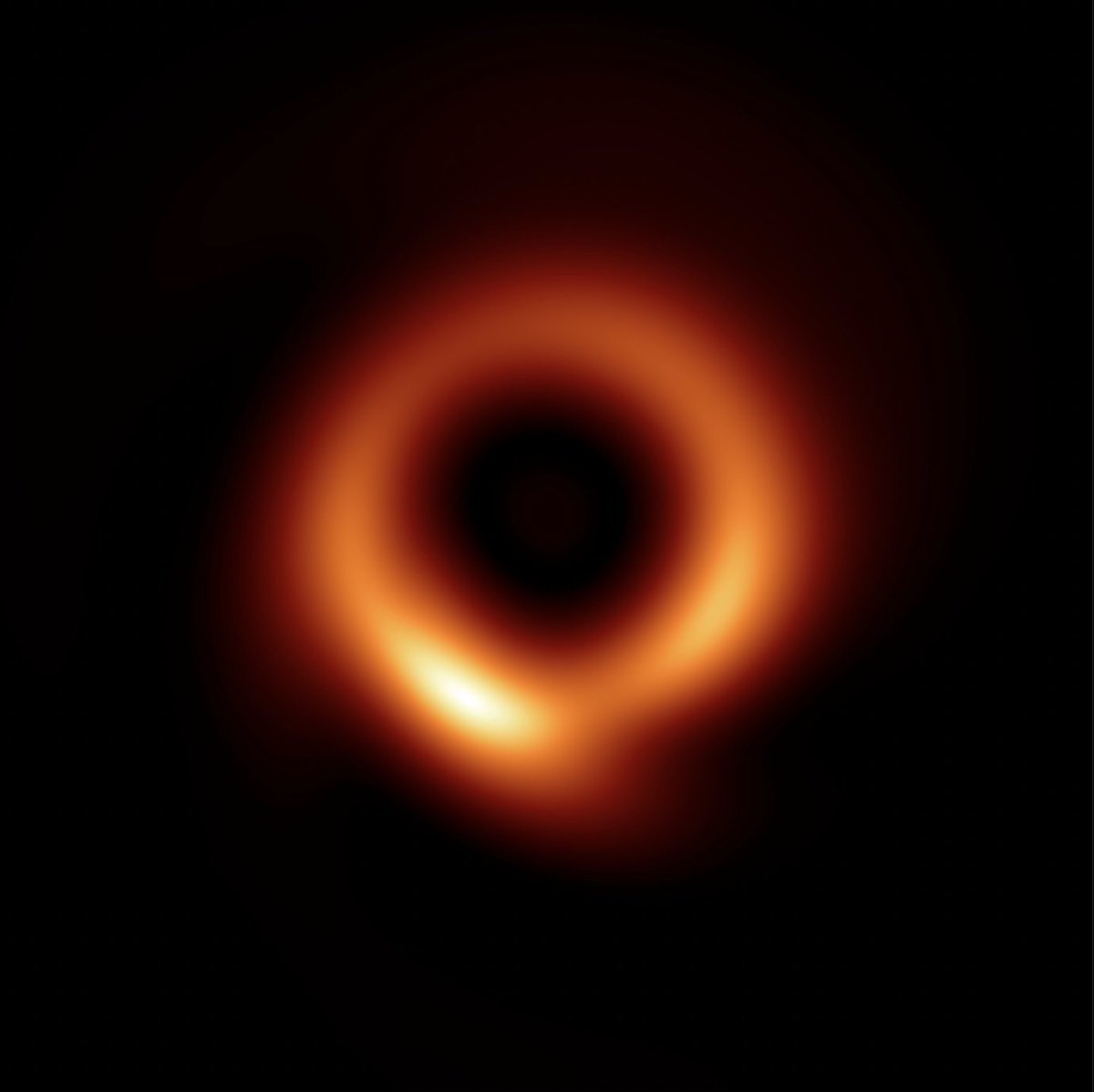
The EHT has released new images of the M87* black hole from observations taken in April 2018. The brightness peak of the ring has shifted by about 30º compared to 2017, consistent with our theoretical understanding of variability from turbulent material around black holes.
Selections from 2023: Sharpening Our Images of a Supermassive Black Hole
The first image of a supermassive black hole released in 2019 was far from the last, and new algorithms have brought the data into sharper focus. https://t.co/kUgi1pqxjo
George Wong and I built a DIY radio telescope in my garage and saw the 21 cm hydrogen line from the galaxy! Lots of work, but a lot of fun. https://t.co/oXl3gH5n6A
This November, astrophysicists from across the world visited @the_IAS for a workshop focused on improving present understanding of observations from @ehtelescope. The organizers also hosted an observing night, featuring a home-made radio telescope. More: https://t.co/H16DYf7M43
For those of you at the virtual @APSphysics meeting, I will be giving a talk at around 10:12 am EST in the EHT session (LL03:3). This talk will include an introduction to the PRIMO algorithm and the recent results as well as a summary of testing gravity results.
Wanna build a black hole with PRIMO? Here's a little bit of how we do it (skipping most of the math). This is from a paper that Lia Medeiros FA'ed as the lead for developing it. You will use sets of building blocks. Here's one - look closely. Red is + light, blue - light
📡🌍📡 After a few days of bad luck with the weather across the globe, we are starting our 2023 EHT campaign observing supermassive black holes tonight!
Picture (@gopastro ): the LMT on the Sierra Negra in Mexico is getting ready.
So excited to finally share that our paper presenting a new image of M87 is out! See press release here: https://t.co/oQWrdhw6lh paper here: https://t.co/o2wKKtdACg
@thiagosgbr Na original usamos um gaussiano para o beam. Mas aquele gaussiano suprimiu também frequências aonde tínhamos dados, então não estávamos atingindo a resolução máxima do instrumento. Aqui estamos usando um “Butterworth filter” que suprime aonde não temos dados, mas não aonde temos
🆕BLACK HOLE GETS NEW LOOK WITH MACHINE LEARNING. A team led by IAS Member Lia Medeiros (@astronolia) has produced a groundbreaking new image of the M87 black hole, achieving, for the first time, the full resolution of the @ehtelescope. Read more: https://t.co/QciNekWNjf