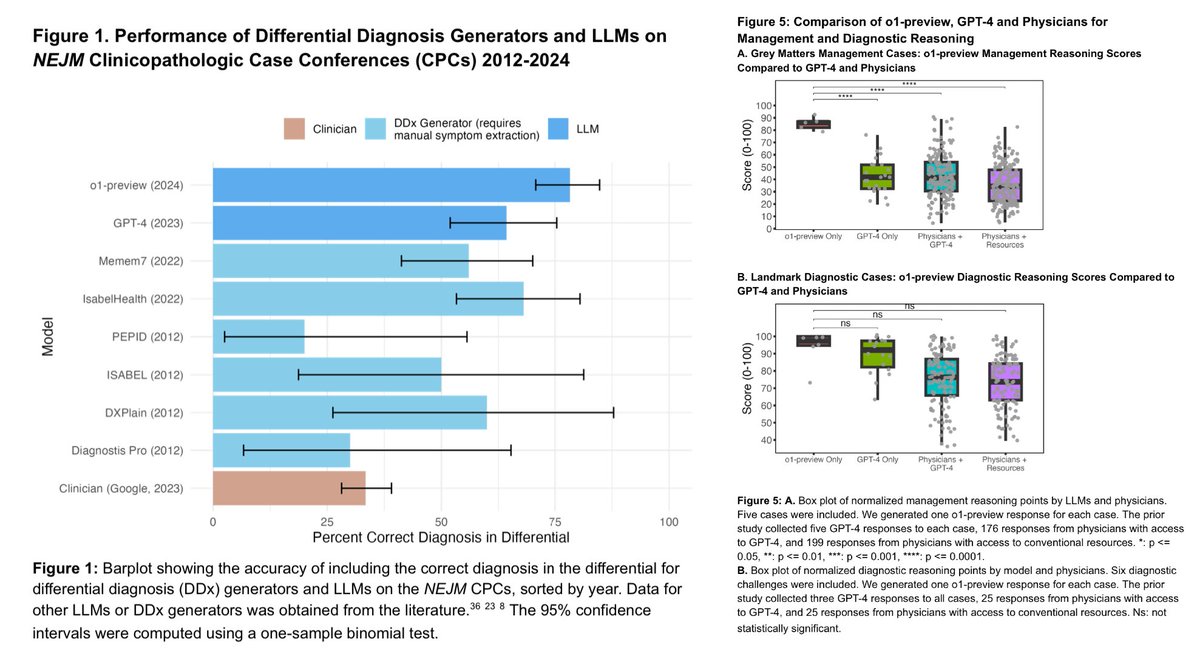
o1-preview is far superior to doctors on reasoning tasks and it's not even close, according to OpenAI's latest paper.
AI does ~80% vs ~30% on the 143 hard NEJM CPC diagnoses.
It's dangerous now to trust your doctor and NOT consult an AI model.
Here are some actual tasks:
1/5
🤯 When a long-term memory forms, some neurons experience electrical activity so strong it snaps their DNA.
Then, an inflammatory response kicks in, repairing this damage and helping to cement the memory.
For @Nature w/ @TJRyan_77@clrar @DrLiHueiTsai
https://t.co/qSHajv6pKv
The patient, Richard Slayman of Weymouth Mass., had been living with End Stage Kidney Disease. He has lived for many years with type 2 diabetes and hypertension, two factors that can contribute to kidney disease. Slayman shared: “I want to thank everyone at Mass General who has cared for me…They have supported me during every step of the journey, and I have faith they will continue to do so.”
Surgeons at Massachusetts General Hospital have transplanted a kidney from a genetically engineered pig into the body of a Weymouth man, the first time an animal kidney has been transplanted into a living person. https://t.co/yFsljOwkbv
Finally. We figured out the dense deposits in dense deposit disease (DDD).
The answer is Apolipoprotein E.
You can stain for APOE & make the diagnosis of DDD in >80% cases. Without electron 🔬.
DDD was the reason I got into mass spectrometry 17 yrs ago. https://t.co/fQxitNbFYF
We are pleased to announce the publication of the KDIGO 2024 Clinical Practice Guideline for the Management of Antineutrophilic Cytoplasmic Antibody (ANCA)-Associated Vasculitis, published today in the March issue of Supplement to Kidney International, with an Executive Summary in the main pages of the journal.
Read the news release: https://t.co/ewZokps7wF
Read the guideline in Kidney International: https://t.co/M9Y1QBeS6s
Visit the KDIGO ANCA Vasculitis Website: https://t.co/oBR5IPukpe
Developed under the stewardship of Co-Chairs Brad Rovin, MD (US) and Jürgen Floege, MD (DE), this guideline is an update to the ANCA Vasculitis chapter of the KDIGO 2021 Clinical Practice Guideline for the Management of Glomerular Diseases.
"The ANCA Vasculitis Guideline includes significant updates aimed at enhancing clinical decision-making, integrating new treatments with established clinical practices," stated Dr. Floege. "We anticipate that the comprehensive research, clinical perspectives, and collaborative expertise reflected in this guideline will contribute to better outcomes for individuals grappling with this complex condition."
"We are excited to release the KDIGO 2024 ANCA Vasculitis Guideline, which offers new guidance for managing the intricacies of ANCA vasculitis treatment, particularly with the emergence of innovative therapies," said Dr. Rovin. "We are better equipped than ever to tailor interventions, optimize patient care, and strive towards improved outcomes for people with ANCA-associated vasculitis."
KDIGO thanks the Guideline Work Group for their dedication and expertise and the Evidence Review Team from Brown University School of Public Health for their comprehensive work on this guideline.
#ANCA #vasculitis #AAV #glomerular
In December we began the Gemini Era, and we’ve continued to make relentless progress since. Today we’re thrilled to introduce the next generation: Gemini 1.5 - hugely enhanced performance, highly efficient architecture & long-context length breakthrough
https://t.co/dKlzOQLyK4
Reuse of IA columns in ABOiRT
How useful are immunoadsorption (IA) columns in reducing ABO titers? And does reusing these expensive columns compromise efficacy or increase adverse effects? Let's explore. 🧬 #Nephrology#Desensitization"
Announcing Grok!
Grok is an AI modeled after the Hitchhiker’s Guide to the Galaxy, so intended to answer almost anything and, far harder, even suggest what questions to ask!
Grok is designed to answer questions with a bit of wit and has a rebellious streak, so please don’t use it if you hate humor!
A unique and fundamental advantage of Grok is that it has real-time knowledge of the world via the 𝕏 platform. It will also answer spicy questions that are rejected by most other AI systems.
Grok is still a very early beta product – the best we could do with 2 months of training – so expect it to improve rapidly with each passing week with your help.
Thank you,
the xAI Team
https://t.co/iPqreWxmQh
💥’Physical Examination of the Dialysis Vascular Access’ - Tweetorial
Let’s first review the:
⚡️Anatomy of the Vascular Access
⚡️Vascular Access-related
complications
1/
@ASDINNews@RenalFellowNtwk#VascularAccessPearls
A tale of murder, medicine and sheer brilliance…
I can proudly credit much of my success in clinical practice to one teacher of mine: Dr. Rama Tharak Nath. His observations, teaching and language skills are unparalleled. Here is a great story where he single handedly solved an international crime recently:
The background:
****************
Dr. Tharak Nath is a neurologist who practices in Guntur, Andhra Pradesh. A young bride Kavitha (name changed) came to him recently with severe burning, tingling and numbness of hands and feet. He took her complete clinical history. Here are a few highlights he gathered:
The marriage:
**************
Kavitha got married in June. Her in-laws are truly cosmopolitan. The groom Shekar (name changed) is an engineer in the U.S. The sister-in-law, Raveena (pseudonym, again) is a doctor in the U.K. and was married to a health care professional. The in-laws, Subba Rao and Janaki, travel between India, US and the UK constantly.
The first episode:
*****************
Subba Rao and Janaki have a beautiful flat in Miyapur. After the marriage, all of the family got sick with gastroenteritis. They had stomach cramps, dragging discomfort in legs and hands.
They went to a corporate hospital in Hyderabad. Subba Rao, Shekar Raveena and Kavitha were okay but Janaki, the mother-in-law, developed weakness of limbs. Shekar went to the U.S., Raveena to the U.K. and Subba Rao was taking care of Janaki. Kavitha came back to Narasaraopet, a town near Guntur.
The unfortunate death:
***********************
Janaki deteriorated further and was admitted in the big hospital. She was diagnosed with Gillian Barre Syndrome, in which paralysis of both arms and legs occurs. Her daughter Raveena came back from the UK to take care of her. She got stabilised over a few days and was shifted to the room in the hospital. Raveena left to the UK again.
But as fate would have it, Janaki suddenly died in the room. The doctors thought that it could be pulmonary embolism, a sudden clot to the lungs.
The second episode:
*********************
All the family got together in Miyapur in the moments of grief. The new bride went from Guntur to be with her husband in the distressing time. They were performing the rituals but didn’t expect what hit them next…
All of them got sick again. They went to another corporate hospital and were treated for gastroenteritis. The water in their flats was examined and found to have E.Coli, a bacterial pathogen. They were treated and sent home. Raveena left for UK, Shekar to the U.S., and Kavitha went back to Narasaraopet, Guntur.
Enters the saviour:
******************
But Kavitha was suffering from severe neural pains in her limbs. She was sure that she will die, and she insisted that she be taken to Dr. Rama Tharak Nath. She was taken to him promptly and he examined her thoroughly and heard what she had to say. He asked her a lot of questions.
The Vital Clue:
***************
What was not obvious to many doctors, Dr. Tharak Nath identified in less than 15 minutes. He noticed inconspicuous white lines on the nails of Kavitha. These are called Mee’s Lines, he later told me. They are the diagnostic features of a poisoning from Arsenic, the King of poisons. Napoleon was suspected to have died from Arsenic poisoning.
The follow up:
**************
Dr. Tharak Nath got his patient tested for Arsenic. He also asked the husband in the US, and the father-in-law in Hyderabad to get tested for Arsenic. It was an uphill task for the NRI to get tested for Arsenic, but he managed it in the end, educating his unsuspecting doctors about Mee’s lines and using Dr. Tharak’s suspicions as props.
The lab results showed only one thing: My professor was absolutely right. It was Arsenic that troubled all of them.
#MiyapurMurder
#ArsenicPoisoning
#MedicalMystery
#MedTwitter
1/2
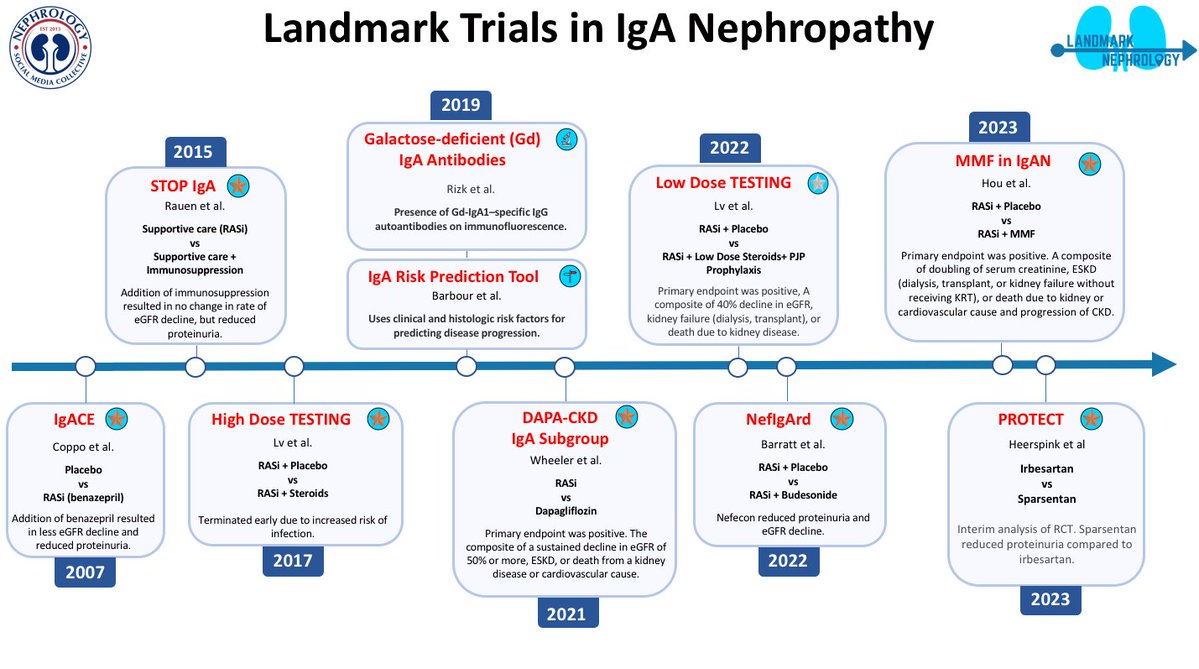
T0b: ⬇️Here’s our updated post on Landmark Trials in IgAN. Look at the topnotch chronology pod-2 #AQP2 made for IgAN 🤩
@NSMCinternship@landmark_neph
https://t.co/7NyU1IqeRn
#NephJC
MedGPT - A proposal on how we can super charge the healthcare industry with an AI diagnosis agent.
It's a well known problem that doctors and nurses all around the world are in short supply. Education is long, pay and hours are bad. Yet, somehow hospitals are serving patients and the healthcare heroes are saving lives everyday. We can do better.
I’ve recently come across this medium article. Where Dr Josh Tamayo-Sarver, MD, PhD struggles to get ChatGPT to help him in the ER. More so, he makes some rather uneducated statements that I feel are dangerous. This got me thinking.
If we can train an LLM to be hyper specific on simply doing initial patient diagnosis based on as much information as possible, we could have one of the first true smart AI systems to remove pressure from the healthcare industry's bottlenecks.
Let’s try to put this in layman's terms, as simple as possible. The LLM that we want to train, let’s call it MedGPT. Simple.
Let’s imagine MedGPT trained to be as smart as GPT4, but fine-tuned and purposefully aligned to do medical diagnosis. We can do this, by importing and synthetically creating hundreds of millions of medical cases, and have the model train on that. Second layer, add RLHF (Reinforcement Learning from Human Feedback). The aligners should be doctors with a lot of expertise. This should give us a super aligned model for medical diagnosis purposes.
We can assume the model to be truly multimodal (as GPT4) with the ability to interact using natural language as well as consume images or perhaps even videos as input and then have the ability to properly analyse what it sees.
So let’s imagine that we now have a custom trained MedGPT, same base capacity as GPT4, but with the added context of being an absolute specialist on performing medical diagnosis.
I can easily imagine a system, maybe based on the AutoGPT paradigm, where the MedGPT gets an objective to go figure out what's wrong with a patient.
It’s given the patient's entire medical history by default as long term context. On top of that it’s getting the latest real-time information that has been gathered at the point of interaction, either at home in a proactive manner, or at the medical facility in a reactive/proactive scenario. This can include self-assessment, Apple Health data for a specific time period, or your entire recorded Apple Health data. It can include images, video and audio too.
We can imagine the model being either multi-modal (as mentioned above), or having a huggingGPT like router, that can patch in any specific model to complete a goal/task. If it needs to analyse a chest x-ray, it uses a specific model for that. Or if it needs to listen to an audio recording of a heart, it uses another model. Maybe it needs to make an assessment on an ultrasound, it connects a different model, you get the point (all of this would be seamless and behind the scenes for the practitioner or patient).
We can look at the initial model of MedGPT as the first line of defence. and then the subsequent models or layers acting as deeper knowledge specialists. The further out in the root system you go, the more specific the models and analysis can be made. At the centre we can see some sort of dispatcher that communicates back and forths between the different models. Much like huggingGPT.
From the perspective of the medical professional the interface might be even simpler than ChatGPT. It might just be ONE additional button in an existing digital dashboard. The button initiates a complete cascading flow of events, similar to how AutoGPT takes just a few parameters and then starts executing to finish a desired goal/task.
From a patient's perspective there might just be a simple self-check conversation similar to ChatGPT. Once the model feels confident that it has enough information to proceed, it provides the patient with a way to proceed like a button or a prompt asking for approval to start.
The output of the combined efforts of the different models could then be as simple as “Everything is fine. You are healthy, and should not seek medical attention” to something like this: “this patient has a stroke and needs emergency treatment”. For example every year tens of thousands of patients are misdiagnosed for stroke and sepsis.
I want to be clear, my level of understanding in the field of AI is limited, I’m not a PhD, I’m not a MD, I’m not a researcher. I’m just a person that likes connecting the dots, and looking at the big picture.
Without AI, this proposed system would never work, or it would take too long to even start building something. But due to the innate ability for a LLM like GPT4 to take unstructured data and make sense of it, I can see how it could easily traverse different systems, data structures, and communicate back and forth between existing systems without much friction, if any at all.
I’m currently not aware of anyone building something like this, and I’m not myself doing so. But I do understand that the implications of a system like this could be profound.
Would love for someone that knows more than me to tell me this can or can’t be done. In my mind, it all seems very doable, and the incentives are clearly there!
This was a note originally posted on my free newsletter - Inside my Head
/Linus Ekenstam, March 15th 2023
* Disclaimer, MedGPT does not actually exist, it’s a made up idea, its up for grabs if you want it.
🧵
ChatGPT represents only a fraction of the top AI tools.
I search through over 100+ new AI tools every week, so you don't have to.
Here are this week's 10 most useful ones that you've never heard about: