Someone opened shell accounts FOR THE FIRST TIME to hide assets FOUR years after his first political office (accounts he NEVER operated “as a billionaire” before then) and we need a sorcerer to explain why. People accuse Tinubu of owning Lagos on even far less evidence oh 🤣
MAIDUGURI–DAMBOA ROAD: THE TREACHEROUS CORRIDOR.
Before I begin, let me make it clear that nothing in this account is confidential or in violation of Operational Security. The reputation of the Maiduguri–Damboa road is well known to locals, traders, travelers, and anyone familiar with this treacherous corridor.
The Maiduguri–Damboa road is of immense economic importance to Borno State. Livestock, charcoal, firewood, beans, groundnuts, watermelons, and countless other goods move along this corridor into Maiduguri every day. In the opposite direction, traders transport supplies from Maiduguri to Damboa and onward to towns such as Chibok, Askira-Uba, Biu, Gonori, and several others.
However, sustained insurgent attacks turned the road into one of the most dangerous routes in the region. Many travelers abandoned it entirely, choosing longer and safer alternatives through Yobe State.
After major clearance operations, the road was reopened to commuters, but it wasn’t a free-for-all. Every vehicle moving between Maiduguri and Damboa had to join a military-escorted convoy.
Military deployments were established along the corridor to maintain a permanent presence, secure different sections of the route, support convoy operations, and reassure travelers that the road could once again be used for daily life and commerce.
All vehicles traveling from Maiduguri to Damboa on a daily basis were required to assemble into convoys at Molai, a village just outside Maiduguri. A popular local known as “Ci muci” was appointed to coordinate the civilians ahead of movement and assist with the convoy assembly process.
Trucks loaded with produce, commercial vehicles, private cars, traders, families, and travelers would begin gathering there, waiting to be searched before the day’s movement.
My formation, 192 Echo Company, was deployed at Delwa, beyond Molai, as a Forward Operating Base. Part of our task was to secure a section of the corridor and support convoy operations.
Every morning, we’d move back to Molai to link up with the convoy before movement. We served as the rear escort team. We’d also use that opportunity to scan known hotspots between Delwa and Molai before the movement commenced.
Other formations occupied key locations such as Kumala and Bulabulin, securing major threat areas along the route, while Damboa served as the final convergence point for the convoy system.
Vehicles arriving from Damboa were searched before continuing to Maiduguri. On days when our convoy from Maiduguri experienced delays, 25TF escort teams sometimes moved the Damboa convoy as far as Bulabulin, where we’d conduct convoy exchanges to ensure travelers from Damboa could continue their journey to Maiduguri before nightfall.
It’s important to understand the environment in which all of this took place.
By this time, most of the villages between Molai and Damboa had been sacked by Boko Haram.
Entire communities had disappeared.
On many stretches of the road, the only people you were likely to encounter were soldiers manning isolated positions, the occasional escapee from captivity, or someone whose presence raised more questions than answers.
That was the reality of the Maiduguri–Damboa corridor.
Ehn ehn….Now that I’ve given you the background, let’s talk about these pictures.
Picture One
The first frame shows what would typically be the second half of a convoy movement. On some days, a convoy could consist of anywhere between 80 and 120 vehicles.
To avoid slowing down the movement, the heavy trucks were usually released first under escort by gun trucks and Armoured Personnel Carriers. The smaller vehicles would follow later and eventually catch up with the truck convoy.
If a truck broke down along the route, occupants could be evacuated into the smaller vehicles, ensuring nobody is left stranded on the road.
If you zoom into the picture, you’ll notice a white Hilux leading part of the convoy. Those were the men of F-SARS who were also involved in
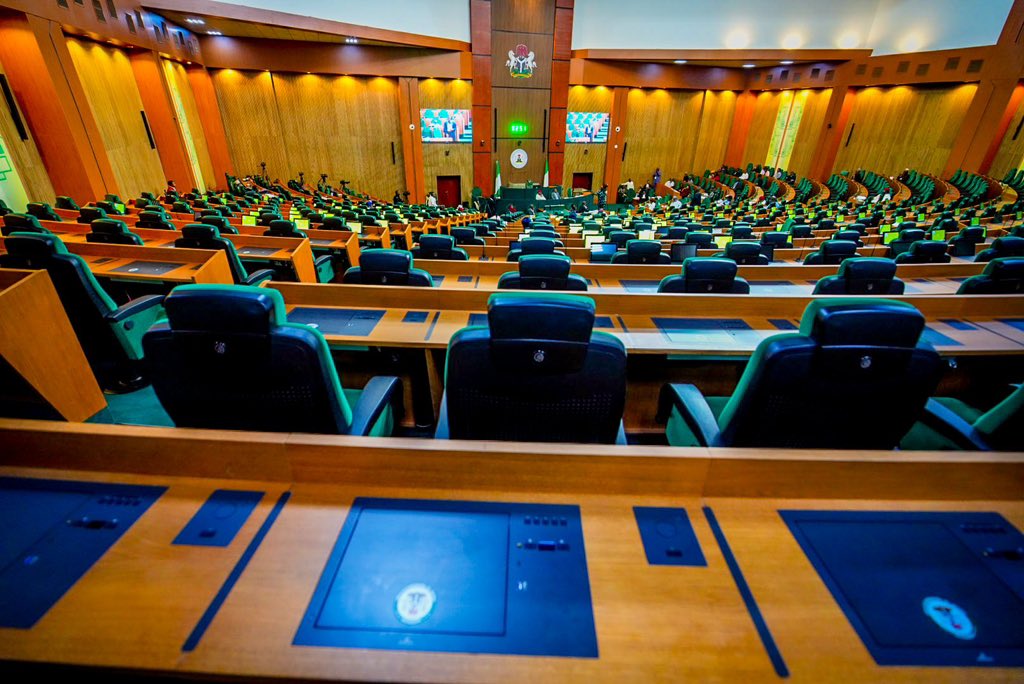
BREAKING: The House of Representatives has passed constitutional amendments to establish state police in Nigeria and has postponed other constitutional amendments to another legislative session.
Details of Proposed Constitutional Amendments for the Establishment of State Police and Federal Police
1. Establishment of Federal Police and State Police (New Section 214)
• Two distinct police bodies are constitutionally established:
• (a) the Federal Police
• (b) State Police (one per State, established by State law)
The National Assembly must pass an Act prescribing:
• Structure, organisation, administration, and powers of the Federal Police
• Framework and guidelines for the establishment of State Police
• State Police cannot commence operational policing until:
• Established by a Law of the State House of Assembly, and
• Certified as meeting national minimum standards (prescribed by an Act of the National Assembly)
• Transitional provision: Until a State Police becomes operational, the Federal Police continues all policing functions in that State. After commencement, the Federal Police handles federal policing functions and may provide assistance to the State Police.
2. Responsibilities and Non-Interference (Section 214)
Federal Police is responsible for:
• Maintenance of public security, public order, and security of persons/property throughout the Federation (to the extent provided by the Constitution or National Assembly Act).
• Similar functions within a State to the extent the State has legislative power under the Constitution.
Key safeguard against federal overreach (Section 214(6)):
The Federal Police shall not interfere with State Police operations or a State’s internal security affairs except in these limited cases:
• To contain serious threats where there is a complete breakdown of law and order and the State Police is unable to respond.
• When the Governor requests intervention.
• When a State Police is unable to function due to administrative, financial, or other problems.
Any such intervention requires prior approval by the National Police Council.
Federal Capital Territory (FCT): Fully under the jurisdiction and operational control of the Federal Police.
3. Leadership and Command (New Section 215)
• Federal Police: Headed by the Inspector-General of Police (IGP).
• Appointed by the President on the advice of the National Police Council, from serving members of the Federal Police.
• Subject to confirmation by the National Assembly.
• The IGP has command over the entire Federal Police, including contingents in States.
• The President (or authorised Minister) may give lawful directions on public safety and order; the IGP must comply.
• State Police: Headed by a Commissioner of Police (CP).
• Appointed by the Governor on the advice of the National Police Council, from serving members of the State Police.
• Subject to confirmation by the State House of Assembly.
• The Governor (or authorised Commissioner) may give lawful directions on public safety and order; the CP must comply.
• If the CP believes a direction is unlawful or contradicts general policing standards, the matter can be referred to the National Police Council (whose decision is final).
4. Removal of Top Officers (New Section 216)
• IGP: Removed only by the President on the recommendation of the National Police Council for specified grounds (grave misconduct, breach of Police Act/Regulations/Code of Conduct, conviction for fraud/dishonesty, bankruptcy, or mental incapacity). Requires two-thirds majority approval of the National Assembly.
• State Commissioner of Police: Removed only by the Governor on the recommendation of the National Police Council for similar grounds. Requires two-thirds majority approval of the State House of Assembly.
5. Funding Support (New Section 216A)
The Federal Government shall provide grants or aids to State Police on the recommendation of the National Police Council, subject to approval by the National Assembly.
6. Oversight Bodies
National Police Council (restructured and renamed from the old Nigeria Police Council; new composition and expanded functions in Third Schedule):
• Broad membership including: Chairman (Presidential appointee confirmed by NA), Attorney-General of the Federation, serving senior Federal Police officer, Attorneys-General of all States, retired Commissioners of Police (one per geo-political zone), representatives of NHRC, Public Complaints Commission, NLC, NBA, NUJ, and Traditional Rulers’ Councils.
• Key functions: Appointment and discipline of Federal Police officers (except IGP); recommending State top officers (CP, DCP, ACP) to Governors based on State PSC lists; supervising Federal and State Police activities (within constitutional limits); setting standards for training, intelligence, forensics; assisting State Police on request.
State Police Service Commission (new body established for each State in Third Schedule, Part II):
• Composition: Chairman (appointed by Governor, confirmed by State HA), representatives of NHRC, Public Complaints Commission, NLC, NBA, NUJ, retired Assistant Commissioners of Police (one per senatorial district), and Traditional Rulers’ Council.
• Functions: Recommending three qualified candidates for CP/DCP/ACP to the National Police Council; appointment, discipline, and removal of State Police officers below the rank of Assistant Commissioner of Police; other functions as prescribed by Constitution or National Assembly Act.
7. Legislative Framework (Second Schedule – Concurrent Legislative List)
• National Assembly may make laws on: establishment/organisation/administration/powers/duties of Federal Police; powers/duties of State Police; national minimum standards for both; policing standards, inspection, certification, complaints mechanisms, criminal information systems, inter-governmental cooperation, federal intervention, use of force, firearms, grants, and accountability.
• State Houses of Assembly may make laws for the establishment, organisation, administration, funding, and oversight of their State Police — but must comply with the Constitution and valid National Assembly Acts.
• States may set higher standards than national minimums but not lower.
• National Assembly laws cannot give federal authorities routine command, deployment, appointment, promotion, transfer, discipline, or control over State Police personnel (except for explicitly authorised federal intervention).
8. Other Related Changes
• Updates to various constitutional provisions (e.g., Sections 34, 35, 39, 42, 84, 89, 129, 153) to replace references to “Nigeria Police Force” with appropriate “Police”, “Federal Police”, or “State Police” terminology.
• Exclusive Legislative List adjustments (e.g., light arms for policing purposes; fingerprints/biometrics/forensics shared with State Police; Federal Police listed separately).
• Consequential amendments to the Third Schedule for the new bodies and their compositions/powers.
Repeated claims like this show how little Nigerians know about their own country. There is enough scholarship on these issues to not make broad and widely debunked claims like this.
First: The claim that the almajiri system functions as a conveyor belt to terrorism and banditry is contested by the most rigorous scholarly work on the subject and there is the work of Dr. Hadiza Kere Abdulrahman @dj_kere whose doctoral research "The Men They Become": Northern Nigeria's Former Almajirai: Analysing Representational Discourses of Identity, Knowledge and Education (2018), involved years of fieldwork and direct engagement with former almajirai. Assuming I read her work correctly, she found that the mainstream representation of the system (which has been repeated in the tweet below) is only "one possible set of articulations and that alternative meanings exist." Other research she has done found no operational extension of say Boko Haram in almajiri Qur'anic schools, and that almajiris themselves "vehemently rejected any moves to join Boko Haram activities." @dj_kere has also argued that the almajiri system's deterioration, is a product of colonial disruption and post-colonial governance failure, not an inherent feature of Qur'anic education itself.
Even in the case of Boko Haram, where the almajiri connection is most often asserted, the evidence does not support a direct causal line. We have the work of @HannahHoechner for example. She has argued in this piece here (https://t.co/XuohhpnSfN) about this. In the article she mentions that "correlation is not proof of causation: That almajirai joined does not automatically mean that almajirci made them join." There is also the 2017 paper, "The Almajiri System and Insurgency in Northern Nigeria: A Reconstruction of the Existing Narratives for Policy Direction," where research shows that "the Almajiri system in itself does not radicalize the Almajirai cohort," but that decades of bad governance have produced a large, alienated, and economically destitute youth cohort who become targets for recruitment — a crucial distinction between vulnerability and causation.
Meanwhile, Boko Haram's founder, Mohammed Yusuf, was not himself a product of the street almajiri system: according to Hussain Zakaria (for example in the US Institute of Peace report "Why Do Youth Join Boko Haram?", 2014), Yusuf had the equivalent of a graduate-level education, having studied theology at the University of Medina in Saudi Arabia, where he absorbed Salafi-jihadist ideology from transnational networks — not from classical Qur'anic schooling.
Finally, and perhaps most importantly, the conflation of Fulani banditry with the almajiri system is especially unsupported. There is ample research here. For example, in "The Other Insurgency: Northwest Nigeria's Worsening Bandit Crisis" (published in Security and Defence Quarterly 2021), the research establishes that that northwest banditry is driven by land-use conflict, Fulani pastoralist "grievances" (quotes mine- you can call it something else), climate-driven competition over grazing routes, and governance collapse — not by Qur'anic schooling of any kind.
Added to that, the Fulani ethnic militia phenomenon has its own distinct social base. If you read the War on the Rocks analysis by @jh_barnett and Murtala Rufai, they have noted that "the majority of bandits have shown little interest in adopting" jihadist ideology, with alleged cooperation between bandits and jihadists being "less meaningful than many observers assume." You can read that analysis here: https://t.co/YM22c3fPhn
As for Boko Haram's actual membership profile, the documentary record points in the opposite direction from the almajiri narrative. Again I urge people to read the USIP report "Why Do Youth Join Boko Haram?" of 2014 which documents that as early as 2004, "students, especially in tertiary institutions in Borno and Yobe states, withdrew from school, tore up their certificates, and joined the group." This account is corroborated by Human Rights Watch in "They Set the Classrooms on Fire": Attacks on Education in Northeast Nigeria (2016), which records testimony of a local imam urging believers to destroy their educational documents, with university graduates complying publicly. @HannahHoechner's own work confirms that "some members of the group used to be university graduates who tore their university certificates at the beginning of the Boko Haram propaganda" — a fact that fundamentally complicates any simple narrative linking Islamic street education to the rise of the insurgency.
Please people, read, read, read. Especially at a time like this when people are angry and making broad claims.
OFFICIAL PRESS STATEMENT
In the Name of Allah, the Most Gracious, the Most Merciful.
It is with a heavy heart but an unwavering faith in Almighty Allah (SWT) that I address our immediate community of Oyo State, and the global public.
Amidst the barrage of “get your PVC” posts these days, I acknowledge that the rhetoric is well-meaning but I'd like to put a few things into perspective:
In 2023, Nigeria had 93 million registered voters. Of these, 87 million had collected their PVCs ahead of the election.
I experienced what @Sisi_Yemmie has been saying here on the TL today!
I was coming back from an outing and decided to get a few items from Bokku Mart.
I bought only 3 items. The attendant asked if I wanted a nylon bag and I said yes.
He said the bag was #100. But why did he deduct #1700 for the nylon?
I didn’t check the receipt until I got into the car, then I remembered and decided to check.
I went back inside and asked what the #1700 was for. He said it was an error and that I had to wait for the supervisor to fix it!
This pissed me off! He could simply have given me my change instead of making me wait for their error.
Apparently the supervisor was in on it too. He came out and quickly asked the guy to give me my change.
I can’t imagine how long this has been going on! @bokkumart, call your staff to order.
Business owners, please be very involved in your business and don’t trust any staff.
#1700 is not a lot of money but imagine doing this to 5-10 customers a day!
I don’t feel any type of way about it. I know for a fact that I wasn’t cajoled, pressured, or trying to be liked by the mob while making my decision. That’s enough for me.
Like every rational person should, I made an independent assessment and arrived at a personal conclusion, that he is not competent and will not have my support.
In fact, I initially wanted to vote for him despite my reservations. But the more closely I followed him, the more convinced I became that he is not someone I want to stand behind.
Yet every time I express that view here, children of anger and wrath flood the comments, peddling lies about being paid and raining curses. I honestly don’t mind. Ironically, they freely express their own views about who they will or will not support, and I don’t descend on them with insults for it.
I have always had a mind of my own and stood for what I believe to be true. If that comes with constant outrage, tears, or people cutting me off, I’m perfectly at peace with it.
Kwara state Governor narrates the reactions of Governors when they were told that fuel subsidy will be removed and no going back.
He said that all the Governors mobilized their security councils expecting riots and protests, because backlashes were expected. He also said that before 2023, majority of the states couldn’t afford Julius Berger, but that today JB has more contracts in the states than in the FG
Infact, take a listen
Shell and other companies usually include a “technical presentation" as part of the interview process.
I had one the day before my Shell Recruitment Day.
Presented to a bunch of folks from the Technical Safety Engineering team.
One of the biggest scams in the corporate world is in that name – technical presentation – because I can assure you that the last thing they want is something technical.
I have seen so many smart candidates fall for this.
You think you impressed them.
But the next thing you get is a rejection email.
Because nobody is actually evaluating your technical skill.
They are looking for something else entirely.
(I wish they’d just be more honest about this.)🧵
“Our deepest fear is not that we are inadequate. Our deepest fear is that we are powerful beyond measure. It is our light, not our darkness that most frightens us. We ask ourselves, 'Who am I to be brilliant, gorgeous, talented, fabulous?' Actually, who are you not to be? You are a child of God. Your playing small does not serve the world. There is nothing enlightened about shrinking so that other people won't feel insecure around you. We are all meant to shine, as children do. We were born to make manifest the glory of God that is within us. It's not just in some of us; it's in everyone. And as we let our own light shine, we unconsciously give other people permission to do the same. As we are liberated from our own fear, our presence automatically liberates others.”
This is crazy man! So Tunde must keep going to slums to appeal to y’all?
He cannot build a system where he’s able to make impact at scale without being there? His life must be all about the slum?
He must not grow? His approach must not change?