Natural images often already implicitly contain depth information — hidden in bokeh effects.
Can we leverage the rich depth cue widely exist in natural images for depth estimation?
We explore this in our recent project BokehDepth (ICML 2026).
- Stage 1: A generative model produces calibrated bokeh stacks from the input image.
- Stage 2: The bokeh stacks are integrated into a depth prediction model to estimate depth.
We believe it highlights bokeh effects as an important and effective complementary cue for monocular depth estimation.
🌐 Project page: https://t.co/vcfTSHFZn6
📄 arXiv: https://t.co/gqGgesXIrO
👨💻 Code: https://t.co/KNs46UGXVu
The Bokeh Effect is so important in photography, yet existing text2image diffusion models do not support controling bokeh strength.
We introduce 𝗕𝗼𝗸𝗲𝗵 𝗗𝗶𝗳𝗳𝘂𝘀𝗶𝗼𝗻, a T2I diffusion model that supports flexible background blur control!
Project: https://t.co/YlnSETImsz
Introducing Agentic Object Detection!
Given a text prompt like “unripe strawberries” or “Kellogg’s branded cereal” and an image, we use an agentic workflow to reason at length and detect the specified objects. No need to label any training data. Watch the video for details.
Everything you love about generative models — now powered by real physics!
Announcing the Genesis project — after a 24-month large-scale research collaboration involving over 20 research labs — a generative physics engine able to generate 4D dynamical worlds powered by a physics simulation platform designed for general-purpose robotics and physical AI applications.
Genesis's physics engine is developed in pure Python, while being 10-80x faster than existing GPU-accelerated stacks like Isaac Gym and MJX. It delivers a simulation speed ~430,000 faster than in real-time, and takes only 26 seconds to train a robotic locomotion policy transferrable to the real world on a single RTX4090 (see tutorial: https://t.co/bEkIlCKqdf).
The Genesis physics engine and simulation platform is fully open source at https://t.co/DhBv7NdyqH. We'll gradually roll out access to our generative framework in the near future.
Genesis implements a unified simulation framework all from scratch, integrating a wide spectrum of state-of-the-art physics solvers, allowing simulation of the whole physical world in a virtual realm with the highest realism.
We aim to build a universal data engine that leverages an upper-level generative framework to autonomously create physical worlds, together with various modes of data, including environments, camera motions, robotic task proposals, reward functions, robot policies, character motions, fully interactive 3D scenes, open-world articulated assets, and more, aiming towards fully automated data generation for robotics, physical AI and other applications.
Open Source Code: https://t.co/DhBv7NdyqH
Project webpage: https://t.co/SBNyhFB0yn
Documentation: https://t.co/3yuBoaealV
1/n
Introducing Genie 2: our AI model that can create an endless variety of playable 3D worlds - all from a single image. 🖼️
These types of large-scale foundation world models could enable future agents to be trained and evaluated in an endless number of virtual environments. → https://t.co/1dzB2BUlWo
We’ve been busy building an AI system to generate 3D worlds from a single image. Check out some early results on our site, where you can interact with our scenes directly in the browser!
https://t.co/ASD6ZHMwxI
1/n
Today, we are excited to release FLUX.1 Tools, a suite of models designed to add control and steerability to our base text-to-image model FLUX.1, enabling the modification and re-creation of real and generated images. Learn more in our blogpost: https://t.co/J5Bc8fVGEc
ByteDance announced SeedEdit!
A new image model that can edit images with text prompts.
It allows for high-resolution editing and supports various changes like local replacements, geometric transformations, and style adjustments.
Links ⬇️
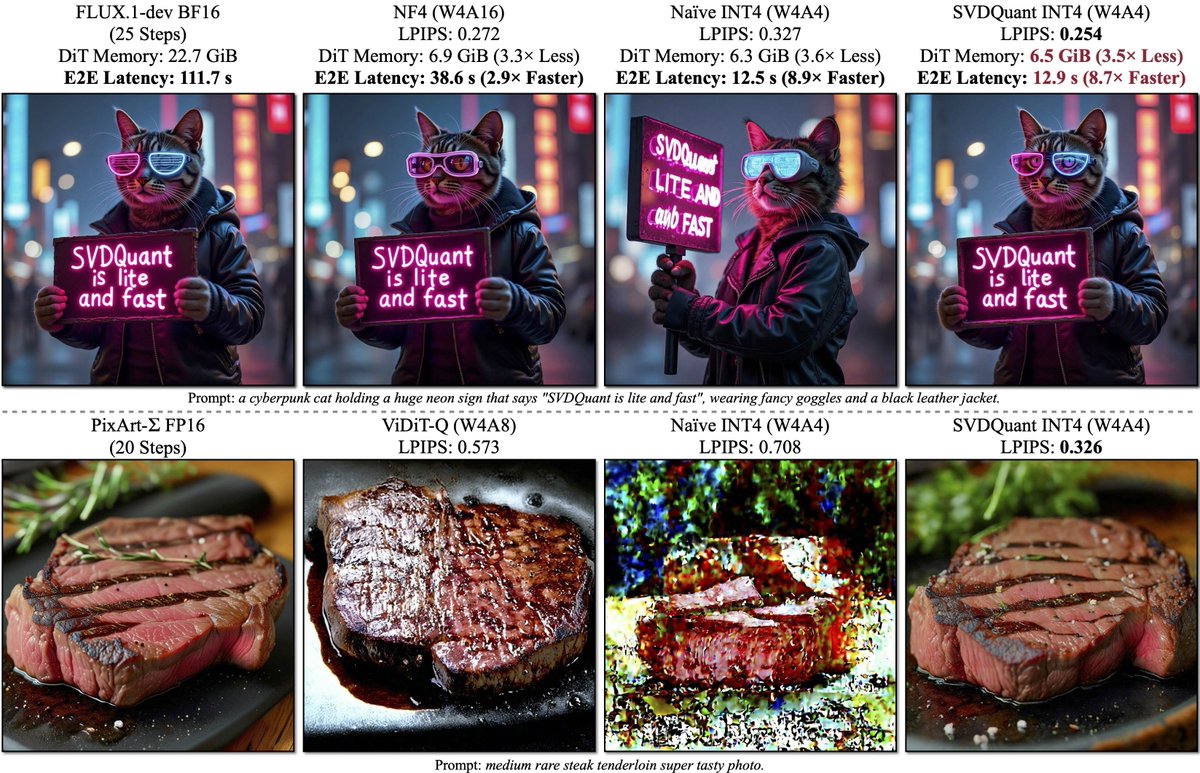
New very promising quantization work on diffusion models -- SVDQuant ⚡️
The authors provide a diffusers-like pipeline implementation which makes it easy to use.
https://t.co/LKwFVqGpER
I often speak about control in AI. But I have realized sometimes people think I mean "better prompts." So here are my thoughts on what I mean by control: We're solving graphics backwards.
The history of computer graphics follows a clear progression: first came control, then quality. It took decades to establish the right abstractions - curves, triangles, polygons, meshes - that would allow us to draw exactly what we wanted on a screen. These fundamental building blocks haven't changed much because they proved to be the right ones. From Ed Catmull's hand to modern game engines, the core principles of how we control pixels have remained remarkably stable. The fundamentals emerged not just for control, but as efficient ways to describe and render complex scenes.
Render quality was the last frontier. A cube modeled in 1987 using the first version of Renderman follows the same geometric principles as one modeled in Blender today. What's dramatically different is the rendering - the lighting, materials, shadows, and reflections that make it feel real. The industry spent decades closing the uncanny valley, building increasingly sophisticated rendering systems to approach photorealism. Of course, many graphics innovations improved both control and quality simultaneously, and the history of graphics progress is more complex than just "control then quality."
But this order wasn't arbitrary. The graphics pipeline itself enforces it: geometry defines what we want to draw, shaders determine how it looks. Even real-time engines follow this pattern - first establishing level-of-detail controls, then improving rendering quality within those constraints.
AI has completely inverted this progression.
Today's generative models achieve photorealistic rendering quality that rivals or surpasses traditional pipelines, effectively learning the entire graphics stack - from geometry to global illumination - through massive-scale training. They've collapsed the traditional separation between modeling and rendering, creating an end-to-end system that can produce stunning imagery from high-level descriptions.
What's missing is control.
While we can generate photorealistic scenes in seconds, we lack the precise control that decades of graphics research provided. We can't easily adjust geometry, fine-tune materials, or manipulate lighting with the granularity that artists expect. The deterministic nature of traditional graphics - where every parameter has a predictable effect - has been replaced by probabilistic models.
This is the inverse graphics problem: we've solved rendering before solving control. Our models can create stunning imagery but lack the fundamental abstractions that made computer graphics so powerful - the ability to make precise, intentional changes at any level of detail.
This isn't a permanent limitation. Just as computer graphics eventually solved the rendering problem, AI will solve the control problem. The question isn't if, but how. We are finding the right abstractions for controlling generative models - the equivalent of the curves, triangles, and polygons that revolutionized computer graphics before. I think the solutions might look different. New primitives for control that are native to neural networks might be the right answer rather than trying to force traditional graphics concepts into this new paradigm. Although I also think there are hybrid approaches combining traditional graphics with AI that are worth exploring.
The goal remains to provide the same level of predictability and precision that made computer graphics a foundational tool for creative expression. That's the ultimate goal, but better: real-time, cheap, and with precise control that is as intuitive and general-purpose as possible.
Control comes last this time. But it's coming.
Introducing, Act-One. A new way to generate expressive character performances inside Gen-3 Alpha using a single driving video and character image. No motion capture or rigging required.
Learn more about Act-One below.
(1/7)
Introducing Mochi 1 preview. A new SOTA in open-source video generation. Apache 2.0.
magnet:?xt=urn:btih:441da1af7a16bcaa4f556964f8028d7113d21cbb&dn=weights&tr=udp://tracker.opentrackr.org:1337/announce
Introducing Stable Diffusion 3.5, our most powerful models yet.
This open release includes multiple variants that are highly customizable for their size, run on consumer hardware, and are free for both commercial and non-commercial use under the permissive Stability AI Community License.
You can download Stable Diffusion 3.5 Large and Stable Diffusion 3.5 Large Turbo from Hugging Face and the inference code on GitHub now. Stable Diffusion 3.5 Medium will be released on October 29th.
Read more here: https://t.co/1DH1xEqfJs (1/4)