I built a **Knowledge Graph** that connects hundreds of individual concepts across three volumes of my CHANGE JOURNEYS SMB Guidebook Series.
This article explains why I did it, how I did it, and what it does. It's amazing!
https://t.co/7mchGcQzl3
🦔Nvidia spent the last two years acting like the AI industry’s bank. It invested in its own customers, promised to buy their unused capacity, and guaranteed up to $105 billion in rent on a data center built for OpenAI. Those customers then bought Nvidia chips.
This week the guy who built that loop resigned, and the CFO now running Nvidia once pushed back on an even bigger OpenAI backstop. I made a video on how the money circles, where it already cracks, and who gets hurt if it breaks. Nvidia itself has the profits to ride out a slowdown (for now...), but a lot of the companies that run on its checks don’t.
Hedgie🤗
You don't understand just how important Jensen was to the AI boom.
The biggest AI labs have built their expansion plans specifically around Nvidia, with varying levels of dependency.
3 names stand out:
1. OpenAI ($30B): Nvidia has invested heavily in OpenAI, which relies on Nvidia-powered infrastructure.
2. xAI ($2B): Elon Musk's Colossus supercomputers are built around enormous Nvidia GPU clusters with hardware & networking infrastructure closely tied to Nvidia.
3. Anthropic: Nvidia pledged $10B to Anthropic as part of a strategic partnership to expand AI computing capacity.
What's at stake:
Nvidia is both a chip supplier & major investor to competing AI labs, with much of that network built under Huang.
Huang's successors inherit $366B in future commitments!
Pretty soon we'll find out how much of it was built around Nvidia and how much depended on Huang personally...
THE IMF HAS FLAGGED $1.4 TRILLION IN CIRCULAR AI DEALS.
Big Tech is funding its own customers so they can keep buying from Big Tech.
Here is every known AI circular financing loop right now:
1. Nvidia ↔ OpenAI: Nvidia invested $30 billion in OpenAI and guarantees up to $105 billion of its Ohio data center leases. OpenAI fills those data centers with Nvidia chips.
2. Oracle ↔ OpenAI: OpenAI signed a $300 billion cloud deal with Oracle. Oracle is borrowing heavily to build the data centers for it.
3. Microsoft ↔ OpenAI: Microsoft owns about 27% of OpenAI. OpenAI committed $250 billion to Microsoft's Azure cloud.
4. SoftBank ↔ OpenAI: SoftBank invested $64.6 billion in OpenAI. OpenAI rents data centers from SoftBank's SB Energy.
5. Amazon ↔ OpenAI: Amazon is investing up to $50 billion in OpenAI. OpenAI expanded its Amazon cloud deal by $100 billion.
6. AMD ↔ OpenAI: AMD gave OpenAI the right to buy up to 160 million AMD shares for $0.01 each. In return, OpenAI buys AMD chips.
7. Google ↔ Anthropic: Google is investing up to $40 billion in Anthropic. Anthropic committed at least $121 billion to Google Cloud.
8. Amazon ↔ Anthropic: Amazon is investing up to $33 billion in Anthropic. Anthropic committed at least $110 billion to Amazon's cloud.
9. Broadcom ↔ Anthropic: Banks lent $63 billion to a special company that buys Broadcom chips and leases them to Anthropic. Broadcom backs the chips' resale value.
10. Microsoft + Nvidia ↔ Anthropic: They are investing up to $15 billion combined. Anthropic committed at least $44.9 billion to Microsoft's cloud.
11. SpaceX ↔ Anthropic: SpaceX borrowed $40 billion to buy Nvidia chips and sells the computing power to Anthropic. Nvidia is a SpaceX shareholder.
12. Nvidia ↔ CoreWeave: Nvidia owns about 11% of CoreWeave and agreed to buy $6.3 billion of its unused capacity. CoreWeave buys Nvidia chips.
13. Nvidia ↔ neoclouds: Nvidia agreed to buy $36 billion of cloud capacity from smaller AI cloud companies. They use that guaranteed income to borrow and buy Nvidia chips.
14. Microsoft ↔ Nscale, Nebius, IREN: Microsoft signed up to $70.9 billion in contracts with them. They use the money to buy GPUs.
15. Google ↔ former bitcoin miners: Google guarantees billions in leases at TeraWulf and Cipher and gets their shares in return.
16. Meta ↔ Blue Owl: A $27.3 billion data center was built through a joint company, with Meta backing it with a $28 billion guarantee.
17. Anthropic IPO: Its chip and cloud suppliers, Nvidia, Google, AMD, Micron, Broadcom and Microsoft, are buying $26 billion of its shares. Anthropic owes those same companies hundreds of billions in future spending.
When money keeps flowing, these loops make everyone's revenue look strong.
Interesting perspective. Two periodic wave oscillations with varying wavelength and amplitude, that either amplifies price (2017, 2021), or cancels each other out and flattening the curve (2016, 2025).
But does that blue line explain the prolongued deviation from the power law?
I couldn't sleep, so I finally got time to do this...
BITCOIN: POWER LAWS, LOG-PERIODIC OSCILLATIONS AND THE ROAD TO $1.9 MILLION?
I've been working on reproducing and adapting Stephen Perrenod's (@moneyordebt) research into Bitcoin's long-term power law and log-periodic oscillations.
FULL CREDIT GOES TO HIM. I simply tried to reproduce the work using Python code.
I built the entire analysis in Python, using historical Bitcoin price data, mathematical modelling and curve fitting. The result is the chart below, comparing Bitcoin's actual price against several power-law and oscillation models, with projections extending to 2032.
Here's what I did and how the model works.
1. THE DACOINMINSTER POWER LAW
First, I included the well-known Bitcoin power-law model:
P(t) = 4.42 × 10⁻¹⁷ × days_since_genesis^5.6
This provides a long-term reference curve based on the number of days since Bitcoin's genesis block on 3 January 2009.
2. PERRENOD'S GLOBAL POWER LAW
The second reference is the power-law backbone used in the Perrenod-inspired model:
P(t) = 0.00688 × t^5.848
Here, t represents Bitcoin's age in years since 3 January 2009.
This describes the underlying long-term growth trajectory before introducing the cyclical components.
3. TWO LOG-PERIODIC OSCILLATIONS
This is where things get interesting.
Perrenod's research explores the possibility that Bitcoin's price history contains recurring oscillations that operate in logarithmic time.
Rather than using ordinary cycles with fixed calendar intervals, these oscillations are based on scale invariance.
The mathematical form is:
O(t) = a cos(ω ln(t)) + b sin(ω ln(t))
The angular frequency is calculated using:
ω = 2π / ln(λ)
For my implementation, I used two scale factors:
λ₁ = 2.081
ω₁ = 8.573648
λ₂ = 1.305
ω₂ = 23.602981
The first captures a slower oscillatory component, while the second captures a faster one.
3A. WHAT ARE THESE OSCILLATIONS, AND WHY COMBINE TWO OF THEM?
Think of the power law as Bitcoin's underlying long-term growth trajectory. It provides the baseline, but it does not capture all the rises and falls around that trajectory.
The oscillations are mathematical components designed to capture recurring patterns in Bitcoin's historical price behaviour.
Unlike ordinary cycles, which repeat after a fixed number of days or years, log-periodic oscillations operate in logarithmic time. Their spacing changes as time progresses. The cycles become progressively longer in calendar time as Bitcoin matures.
This is connected to a concept called discrete scale invariance. Patterns can recur when time is multiplied by a particular scaling factor, rather than when a fixed amount of time passes.
WHY TWO OSCILLATIONS?
Bitcoin's historical price behaviour may contain more than one cyclical frequency.
The first oscillation, using λ₁ = 2.081, captures a slower-moving component.
The second oscillation, using λ₂ = 1.305, captures a faster-moving component.
Think of them as two overlapping waves operating at different frequencies. Each contributes a different pattern to the overall price trajectory.
HOW ARE THEY COMBINED?
The two oscillations are added together in logarithmic space:
O_total(t) = O₁(t) + O₂(t)
The combined price model is then:
P(t) = P_powerlaw(t) × 10^[c₀ + O₁(t) + O₂(t)]
The oscillations are not simply added as dollar amounts to Bitcoin's price. They modify the underlying power-law valuation multiplicatively.
When both oscillations reinforce each other, they can push the modelled valuation further above the underlying power law.
When they work against each other, they can reduce the modelled valuation or change the timing of peaks and troughs.
Combining them produces a more complex cyclical pattern than either oscillation could generate independently.
The idea is that Bitcoin's long-term price trajectory may be influenced by multiple overlapping cycles rather than one simple four-year halving cycle.
By combining the two frequencies, the model attempts to capture more of the historical structure in Bitcoin's price behaviour.
It also creates a way to explore how those patterns might evolve as Bitcoin moves further into the future.
4. FITTING THE MODEL TO HISTORICAL BITCOIN DATA
I used the most recent five years of historical BTC price data, from November 2021 to November 2026, to fit the oscillation coefficients.
The regression was performed in logarithmic space using least squares.
The resulting coefficients were:
c₀ = 0.184569
c₁ = -0.084138
c₂ = 0.347766
c₃ = -0.222711
c₄ = 0.151432
The two individual oscillations are:
O₁(t) = c₁ cos(ω₁ ln(t)) + c₂ sin(ω₁ ln(t))
O₂(t) = c₃ cos(ω₂ ln(t)) + c₄ sin(ω₂ ln(t))
5. THE COMBINED MODEL
The final combined equation is:
P(t) = 0.00688 × t^5.848 × 10^[c₀ + O₁(t) + O₂(t)]
In simple terms, this takes the underlying power-law growth curve and adjusts it using both oscillations simultaneously.
6. WHAT THE CHART SHOWS
I plotted six different series:
🟠 Bitcoin actual price: Historical BTC market price.
🔵 Dacoinminster power law: The long-term Bitcoin power-law reference.
🟣 Perrenod global power law: The underlying Perrenod-inspired growth curve.
🩵 Oscillation 1: The power-law baseline adjusted by the first cyclical component.
🟡 Oscillation 2: The power-law baseline adjusted by the second cyclical component.
🟢 Combined Perrenod-inspired model: The power-law baseline adjusted by both oscillations together.
The combined model produces a projected peak of approximately:
$1,889,385 in July 2030.
That is the maximum of the combined curve within the selected 2029-2030 projection window.
The model suggests that Bitcoin could enter another substantial upward oscillatory phase, with a potential trajectory towards a seven-figure valuation.
7. IMPORTANT METHODOLOGICAL NOTES
This is my own Python reproduction and adaptation of Perrenod's research framework, not an exact replication of his complete published methodology.
I used the published power-law parameters and two log-periodic scale factors, then fitted the oscillation coefficients to five years of historical Bitcoin data.
The fitted coefficients are held constant when projecting into the future. The model does not automatically refit itself as new Bitcoin prices arrive.
The further we project, the more uncertainty increases. This is a mathematical scenario, not a guaranteed forecast or a price target published by Perrenod.
FULL CREDIT to Stephen Perrenod for the original research and the framework that inspired this exercise.
His X profile:
@moneyordebt
His substack link:
https://t.co/mqAHJq0uxQ
I'll publish the complete Python code in the first comment below this post so anyone can reproduce the chart, examine the calculations and experiment with the parameters.
The question I find fascinating is whether Bitcoin's historical log-periodic structure continues to hold as the network matures.
If it does, the road towards $1 million Bitcoin could be following a mathematical pattern that deserves much closer attention.
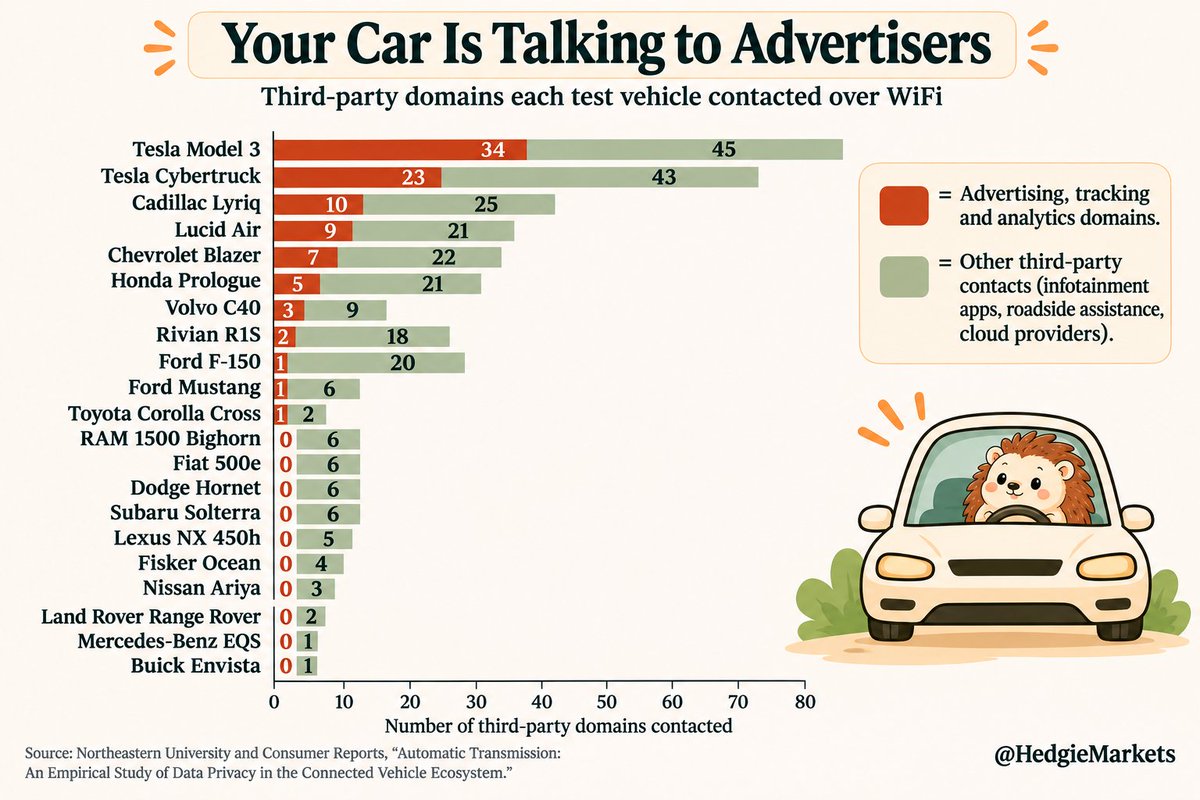
The internet for things (IoT) is alive and well and working hard in the background to map your every habit, selling it to governments and advertisers and monetizing your life without your knowledge or consent.
🦔Your car may share where you go with Big Tech. Consumer Reports had Northeastern University researchers test 21 cars and 30 automaker apps. Almost every app sent data to advertising or analytics companies, and the biggest recipients were Amazon, Alphabet, Meta and Microsoft. Seven apps sent something that could identify you, like your car’s VIN paired with your email or location.
My Take
Carmakers earn thin margins on the car itself, so your driving data looks like free money to them. GM already tried this. Back in 2024 it sent driving data to insurers through data brokers, and the FTC later barred it from sharing that data with consumer reporting agencies for five years (some drivers saw their insurance premiums jump before they knew why).
You can say no, but some carmakers make it painful. Tesla warns that if you refuse data sharing, your car could suffer “reduced functionality, serious damage, or inoperability.” Maybe the next step is a monthly fee to turn the tracking off, the way BMW once tried to charge a subscription for heated seats...
Hedgie🤗
Great read, but instead of the exultation of Bitcoin, it should have concluded with the framing epiphany: all forms of money are, by definition, just part of one collective hallucination.
Money does not exist in nature.
If every human vanished tomorrow poof! Thanos snap. Then money dies with us.
Not slowly. Instantly.
Because money isn't real. It's not gravity. It's not water. It's not some fundamental law of physics carved into the universe's source code.
Gravity pulls planets whether you believe in it or not. Water cycles through ecosystems without asking for permission. Those are natural phenomena. They persist.
Money? Money is a shared hallucination. A collective delusion we all agreed to participate in because the alternative, pure barter, was a logistical nightmare.
Look around. Animals hoard food. Birds collect shiny objects to attract mates. Squirrels bury acorns.
But they're not pricing those acorns in "nut dollars." There's no interest rate on stored seeds. No squirrel is taking out a loan to front-run winter scarcity.
That's instinct. That's biology. That's not money.
Money only exists when humans assign value to something and agree that it represents stored labor, future purchasing power, or social coordination at scale.
Without minds to recognize it, gold is just a shiny metal in the ground. Bitcoin is just dormant code on dead servers.
Carl Menger figured this out in the 1870s. Money emerges organically from human action and voluntary agreement—not government decree, not divine mandate.
Gold became money because humans decided it had the right properties: scarce, durable, divisible, portable, verifiable. We built entire civilizations around that consensus.
But here's the kicker: gold isn't inherently money without us assigning it that role.
It's just element 79 on the periodic table.
Bitcoin? Same deal. It's a digital construct we engineered because we needed better properties for a global, hyperconnected world.
But in a human-less universe? Bitcoin's ledger halts. The network dies. The protocol becomes a fossil record of a species that once tried to escape monetary debasement.
This is the part most people miss:
The evolution of money doesn't happen because it's etched into the fabric of reality. It happens because we build it. We improve it. We upgrade the operating system.
Seashells → Gold → Paper → Digital.
Each iteration solves problems the previous one couldn't. Each step is a reflection of human ingenuity, not natural inevitability.
And right now, we're in the middle of the biggest monetary upgrade in human history.
Bitcoin isn't "real" in the sense that it exists independent of us. But neither is the dollar. Neither is gold as money.
The difference is Bitcoin was engineered, deliberately, mathematically, incorruptibly, to be the best form of money humans have ever created.
21 million hard cap. No central authority. No counterparty risk. No inflation. No debasement.
It's not real because it's natural. It's real because we made it that way.
Bitcoin is the best representation of money today.
I am a Commercial Sociologist, and here is how that fits into a future dominated by AI and algorithmic attention harvesting.
This article explains some of what I do, and where I stand.
https://t.co/Vh4kLoeeC7
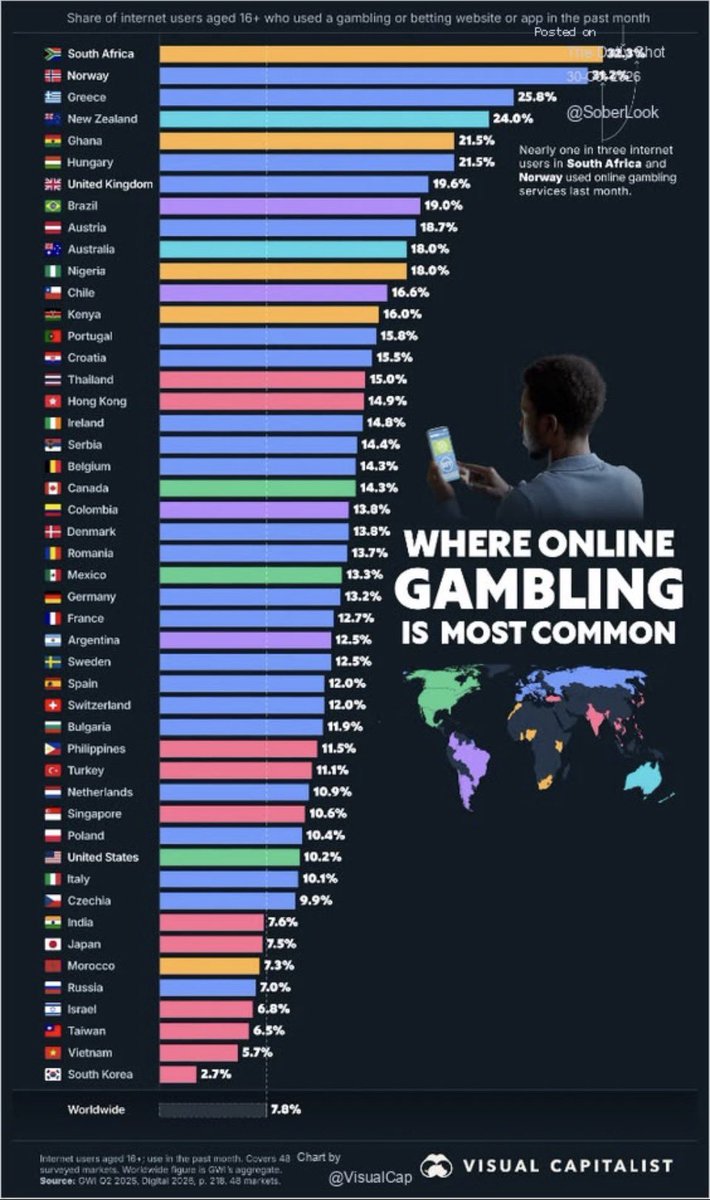
South Africa is officially the online gambling capital of the world. 🇿🇦
Nearly 1 in 3 internet users gambled online in the past month, compared to just 10.2% in the US.
This isn’t an achievement to celebrate. It’s a warning sign about financial desperation, addiction and the growing cost of living.
@sminston_with Good riddance to the paper mâché hands. Whatever one's opinion might be around 'adoption', this band of clowns are into leverage to make quick profits - they are not in for the long haul and they do not care about the principles or fundamentals.
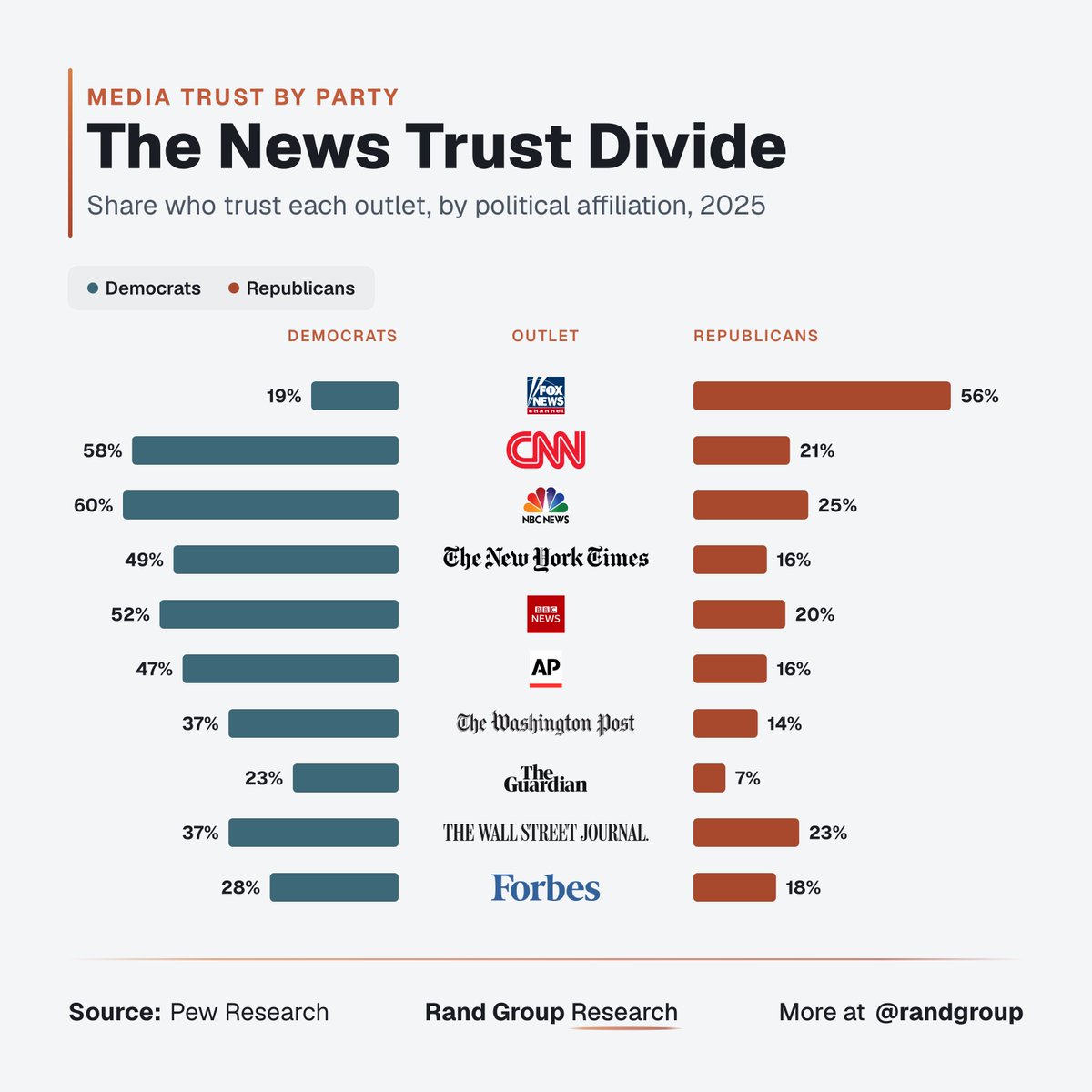
Listen to me. The most trusted news outlet in America is trusted by 60% of one party and 25% of the other.
What does this mean?
1. Every headline you read is built for one side
2. Fear sells, so the news will ALWAYS find something to panic about
3. The market doesn't care which channel you watch
No one needs this.
This is how you relinquish all your sovereignty to a machine. An external locus of control. This is slavery.
We need to teach children discipline and self-control.
The #ExtremeFearBook and the 90-day Recovery Diary are available on Amazon.
EXTREME FEAR: Trigger Stacking and the Dynamics of Chronic Anxiety - A Modular Guide to Defeating the Attention Economy:
https://t.co/FuvBEoQtbB