I have a new piece on DNA synthesis ceilings, an exciting new assembly architecture (Sidewinder), and the emerging digital-physical biology stack that is finally converging in a way that promises to make rapid biological iteration a reality
curiosity is the next frontier of building with biology
(link below 🧬)
The Magnetobiology Episode:
A company in San Francisco, called @NonfictionBio, is building proteins (like antibodies and enzymes) that can be controlled using small magnets.
In this episode, co-founder Maria Ingaramo and scientific advisor Andrew York explain how they engineered a protein, MagLOV, that responds strongly to magnetic fields, why most prior attempts have failed to replicate, and how the mechanism of magnetically-controlled proteins actually works. They also get into the “dream” use cases, like cancer drugs that activate only at the tumor, which might have a lower toxicity inside the body. This podcast is made possible by @AsteraInstitute.
I'm happy with how this episode came out. I think my interviewing skills are improving, and I'm getting better at building up context throughout the episode. Enjoy!
Search for "The New Biology" on YouTube, Spotify, and Apple Podcasts.
Timestamps:
00:00 - Opening
00:54 — Introduction
01:35 — The dream
05:38 — Why magnets vs. light or ultrasound
10:05 — The physics
17:48 — On the name "magnetogenetics"
21:25 — Birds and cryptochromes
27:09 — Why is the field filled with so much junk?
29:51 — Adam Cohen's molecule
33:24 — Markus Meister’s debunking
38:06 — The experiment
46:22 — Finding the LOV domain
54:11 — Singlets, triplets, and cysteine
56:54 — What the magnet is actually doing
1:05:13 — The conformational-change red herring
1:12:46 — The Quantum Biology Institute
1:19:31 — Founding Nonfiction Labs
1:24:38 — How to convince skeptical investors
1:29:39 — What a magnetogenetic medicine might look like
1:38:50 — First clinical indications
1:45:12 — The regulatory path
1:48:01 — What the field needs
1:54:30 — Appendix: Whiteboard lecture
Today we're announcing ESMFold2, an open scientific engine to power prediction, design, and discovery across protein biology.
The new model delivers state of the art performance on protein interactions, especially antibodies, a critical modality for therapeutics.
We have designed and validated miniprotein binders and single chain antibodies across five therapeutic targets that are important in cancer and immunology. We are seeing very high success rates, and affinities at levels consistent with therapeutic activity.
We’re also releasing an atlas of 6.8 billion proteins, and 1.1 billion predicted structures.
ESMFold2 is built on a state of the art language model that has been trained on billions of protein sequences.
A world model of protein biology emerges through language modeling.
We’ve used the techniques of mechanistic interpretability developed to understand large language models to understand the concepts ESM uses to represent proteins.
The model’s representation space has a compositional organization of features across scales, levels of complexity, and abstraction, that reflects and mirrors the understanding of protein biology developed through a century of empirical science.
This understanding emerges without prior knowledge, just from language modeling of protein sequences.
Language models are becoming a powerful substrate to understand and program biology.
The design of protein interactions is one of the most fundamental problems in biophysics, and has critical implications for the discovery of new medicines. A simple gradient based search with the model was able to discover high-affinity protein binders.
I'm excited by the potential this has to accelerate basic science and the understanding of proteins. And especially for the new avenues it opens up for therapeutic design and medicine.
i love that claude opus 4.8 is refusing to engage with some pretty basic bio questions by essentially saying it's too powerful, and things could get dangerous...?? lol
After two years in the US I'm sorry to say i've finally fallen in love with A/C.
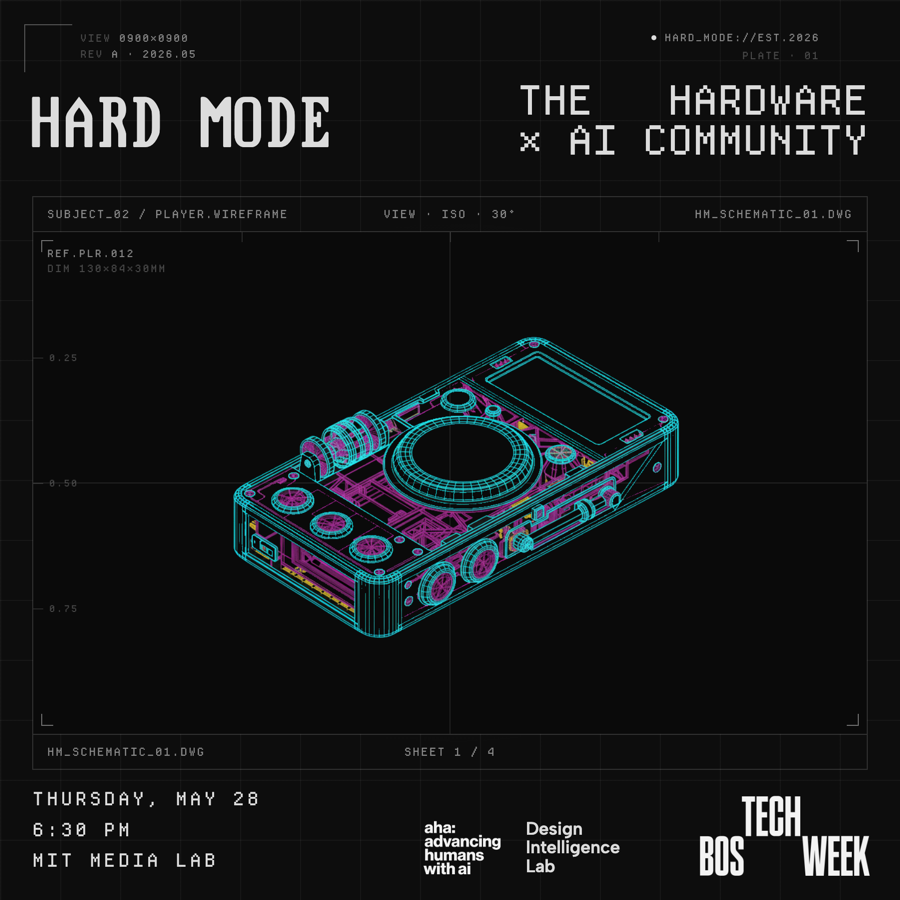
Also I'm running a Physical AI event next week at Media Lab next week for #BosTechWeek with demos from all the viral AI projects you've seen on your feed.
Get on the list before it gets full:
https://t.co/HWVQzhGWkK
Thanks for reading and sharing! I think finding this balance between adapting to existing measurement frameworks/tools vs. the more messy, less tangible dimensions of life itself will actually be a big test for modern bio. I hope you’ll also enjoy the next piece, which will explore some of the less obvious edges of this question.
@mkoeris Glad this reached you, would love to know your thoughts on this especially from your position. I wrote it thinking a lot about the post Sputnik mobilization in the US around education reform where it was being treated as a national security problem- intuition being a core pillar.
Do you believe in scientific intuition — and if so, how would you define it?
A great read today:
“Scientific Intuition in the Agentic Age
On taste, tacit knowledge, and the critical parts of scientific cognition that you can't just scale past. ”
By Ayan Abukar.
Post Sputnik, the US responded by treating education as a national security problem. In 1959 they gathered the leading scientific minds, backed by major national bodies, and held a conference in Woods Hole, MA to identify where science education was going wrong and how to reform it at scale.
4 core themes emerged, one being: “the nature of intuition”
They understood the significance of intuition. (though they ultimately struggled to define and operationalize it)
Today we spend enormous resources advancing tools and more easily measurable methods. Yet we see comparatively negligible investment in trying to understand scientific intuition itself and the important role it appears to play in Nobel worthy breakthrough ideas/generally extraordinary scientific outcomes.
In my new piece I'm confronting the critical parts of scientific cognition that you can't just scale past.
I’ve been thinking a lot about which human intelligences we’re actually aiming to replicate and optimize artificially, and which ones we seemingly reveal in the process.
The penalty is a 1-year ban from arXiv followed by the requirement that subsequent arXiv submissions must first be accepted at a reputable peer-reviewed venue. 4/
Scientists working on synthetic "mirror life" have come to realize that, if created, it could pose an existential threat to life on Earth. Can the genie be put back in the bottle? Joe Zadeh explores.
https://t.co/8NCuCdl0DI
I'm seeing a lot of criticism of these guys, which on one side I get, but on the other, the whole point of being young is that you do wake up and think you can build a company that's first goal is to cure all cancers
there's something really cool about that, even if bio folks are initially left with lots of technical question marks
FinalDose is building the first programmable drug platform - a single smart drug molecule that finds diseased cells by their DNA and destroys them. They're starting with all cancers.
Congrats on the launch, @Jeffliu6068Liu, @sklin_lite, and @liyaohuang2!
https://t.co/uKJgl7lpmR