@brunoeducsant Olha aí no paper do famoso benchmark RoboArena. A referência era para uma implementação open source de uma policy, mas como o nome era parecido, uma llm alucionou a referência como sendo um raspberry pi.
https://t.co/Lt2BvBSmzp
🤖 The next bottleneck in robotics might not be the model.
It’s the bridge. 🌉
Connecting VLMs, VLAs & JEPAs to:
→ real-world actions via tools/RL
→ semantic mapping & grounded perception
We’re still missing that translation layer. The symbol grounding problem is real 👀
One question that's been on my mind for years now is: could we use regular multimodal LLMs not necessarily trained for robotics to do the high level robotics intelligence part that VLAs and WAMs attempt to do?
The latest explosion of powerful opensource multi-modal LLMs has, IMO, begun to make this possible due both to intelligence and speed.
This is GLM 5.3 Flash, which has vision understanding, but isn't meant to be a VLA/VLM/WAM/robotics model at all, controlling an XGO mini wheeled robot quadruped with an arm & gripper.
GLM 5.3F simply has access to the robot's high level SDK for controlling movement, arm joints, open/close gripper...etc. It analyzes the frames from the camera and makes adjustments all on its own to solve the task.
Nothing was trained here, nothing fine-tuned for this task. Z AI did not make this model for robots and tbh I think they're surprised this works when I talk to them about it!
This also works quite well with DSV4F + a vision capable model like Qwen 3.8 27B. I havent tried JUST Qwen 3.8 27B, but I'm sure it works too. I like the "logic" to be a model that's as fast as possible (but still intelligent). There's also an experimental vision version of DSV4F, I'm confident that'll work too and might even be better bc the full loop might be the fastest of all with this model.
An obvious question you might wonder is: well why not use VLA or VLM? The hard part about robotics isn't object detection, that's long solved. This also isn't a solution for gait/locomotion...yet, but I actually don't think this is far away either and I've done some experimentation with LLMs in this space in the past and it does show promise.
It might actually already be here for quadrupeds, since you dont need super fast IMU readings to maintain balance. I've also tried many of the larger, more generalist, VLAs that you should be able to use with popular robots and tbh there are just so many edge cases that make things hard and not work. You gotta get the camera, lighting, task, everything *just right* or the demo fails.
This is for the actual hard part in robotics right now: intelligence, logic, and planning for all the ways the real world just simply isn't perfect.
I've trained VLAs. They're super finicky and you're always running into sim2real issues, especially around the camera. You also have to build the whole training pipeline in a simulator, and, if everything does work, you still just have a robot that does this 1 single thing after weeks of work.
If you use teleop, this overcomes the "2real" problem, but now you need to painstakingly collect teleop data, and it's only good at that specific task and that particular robot. There is a growing set of egocentric training data for "general purpose" VLAs and world action models (for humanoid form factors), but I'm really starting to wonder: Why? I think we might just sidestep this whole area of research entirely.
I didn't need any training data or special environment to work with this quadruped and arm to do the task I was after. This particular quadruped and arm doesn't even exist in the wild yet really, it's a demo build from a company launching it on kickstarter, so it's not like this robot's data exists in the LLM to any real extent.
I think this is cool as heck that this works and I am interested to see just how far I can push it.
Also this marks the first time that I've finally got a generalist solution to a task I've been trying to solve ever since I became a dad of twins: pick up toys off the ground. This is a big day!
@marcportermagee This is part of a theory that explains why the portuguese king rejected funding Columbus's expedition and instead sent him to the castillan crown: to divert them from the portuguese plans. First circumvent Africa, then explore that west land they had secretly observed: Brazil!
@marcportermagee The portuguese secretly knew that there was land west, off the horn of Africa! Due to the trajectory they were forced to make westward due to wind and currents, to try to circumnavigate Africa, Bartolomeu Dias and the portuguese King were plotting the future discovery of Brazil.
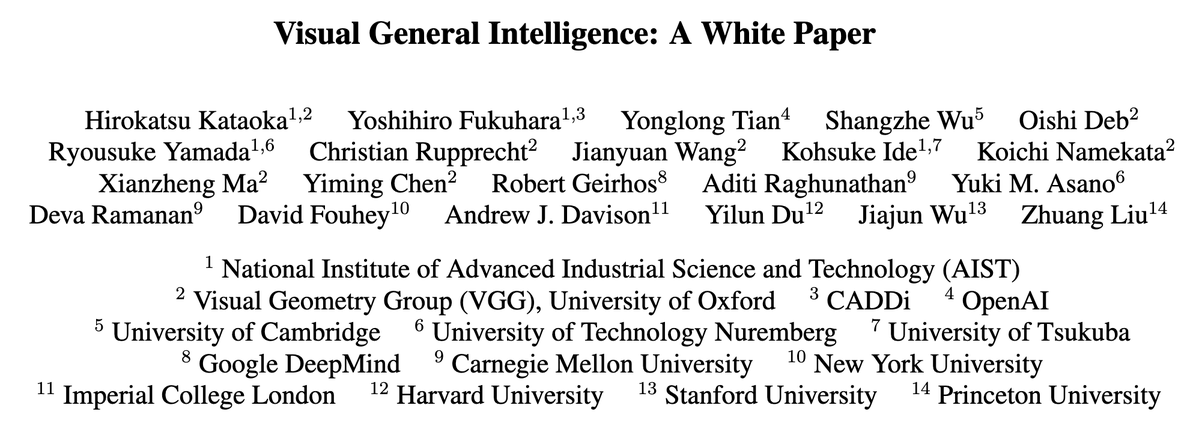
"Visual General Intelligence: A White Paper"
is now on arXiv! https://t.co/IP8e477sdM
We've discussed:
- What is Visual Intelligence?
- Can we develop it toward General Intelligence (VGI)?
In the VGI white paper, we bring together diverse perspectives on Visual Intelligence and discuss how intelligence grounded in visual modalities and experiences could develop toward General Intelligence.
Beyond proposing a single definition of VGI, we introduce, propose, and discuss different perspectives on what Visual Intelligence could be and how we could develop it toward General Intelligence.
This paper is a starting point for a broader discussion on the future of Visual Intelligence.
Many thanks to all the great co-authors!
Scientific terms should have precision. If we use the terms VLM, VLA, WAM in an indiscriminate fashion, as is becoming common in robotics, we are not helping clarity in communication. Let's keep the historical origins of these terms in mind. VLMs arose as multimodal extensions of LLMs-the training was for tasks like VQA (VIsual Question Answering). These capture the static semantics of the scene behind an image. No dynamics. World Models (e.g. @ylecun , Ha & Schmidhuber 2018) on the other hand are primarily dynamics models, which go back to control theory -1960 (Bellman, Kalman etc.) This makes them natural for robotics planning / policies- I am in a state s, what action a should I perform to get to state s'. In classical control, these models were written down a priori by modeling the physics of the system; today we think of them as learned neural networks trained from temporal data e.g. video, robot trajectories. But the concept is the same. We shouldn't mix this concept with VLMs.
Tribute to Asimo! 😮💨
One of the fastest-running humanoid robot at 9 km/h.
Since its inception in 1986, the focus has been on understanding and learning from human behavior, particularly in terms of bipedal locomotion.
Through great progress like walk stabilization control and gait generation technology, Asimo from Honda could navigate uneven terrain with stability and grace, even showing dynamic stability during running.
Furthermore, Asimo combined its physical abilities with sensors to do things like carry trays, push carts, and pour drinks smoothly.
Plus, it could recognize voices and images, making it easy for it to interact naturally with people.
We miss you Asimo!! 🥲
~~
♻️ Join the weekly robotics newsletter, and never miss any news → https://t.co/GoA3ZuwoPB
SuperMap: A Living Spatial Memory for Embodied AI
RSS 2026
Carnegie Mellon University
https://t.co/puCgcOT0Xp
SuperMap is a living spatial memory for embodied AI. It perceives the world, remembers its evolution, and supports reasoning and action. It is a training-free spatio-temporal SLAM system that builds a persistent semantic world model. It fuses high-frequency geometric SLAM with asynchronous open-vocabulary perception, producing a 4D scene graph: a queryable map carrying spatial and temporal information for every object, enabling visual-language navigation and long-horizon reasoning on real robots.