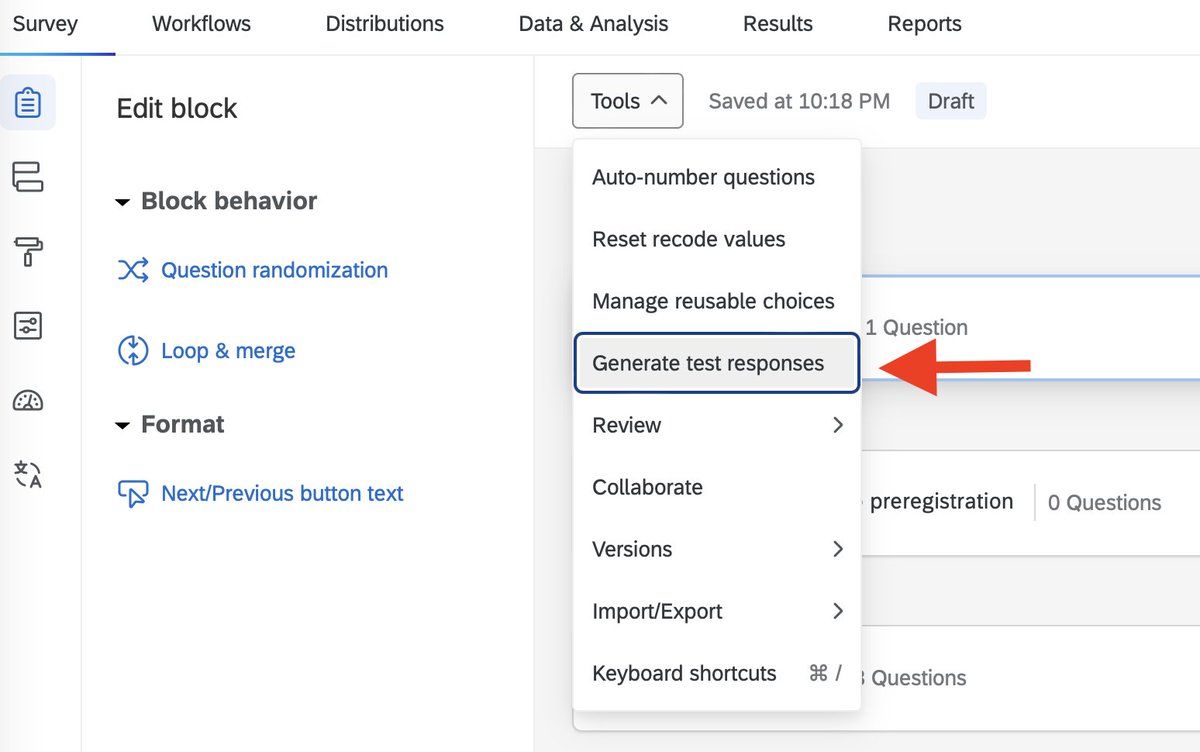
Tip for folks who do survey research with @Qualtrics : before fielding (or pre-registering), highly recommend generating test responses first. Two big reasons. 🧵
Survey researchers, this is a new initiative of mine, and right now the queue is wide open meaning any new submissions have a high likelihood of acceptance: https://t.co/eFACfex8ma
#polisci#research
Attn: Survey researchers and practitioners
Call for proposals
YouGov’s Scientific Research Group is accepting proposals for experimental research on web survey methods.
Details here: https://t.co/eFACfex8ma
This is a bad take -
Outlier polls can certainly happen, but we want pollsters to publish all their results (even the outliers). The Washington Post did a great job of acknowledging that their survey was an outlier and contextualizing it in this case.
Ignore the Washington Post - ABC poll. It’s a ridiculous outlier (Trump up 10 over Biden—laughable). My question: How could you even publish a poll so absurd on its face? Will be a lingering embarrassment for you.
@AriWRees Weather by Jenny Offill
Emily Wilson's translation of the Odyssey
A Long Petal of the Sea by Isabel Allende
Sea of Tranquility by Emily St John Mandel
Arcadia by Lauren Groff
Cloud Cuckoo Land by Anthony Doer
@pewresearch's validated voter report provides a good bookend to election reporting. It's certainly not the final word on the subject, but it definitely beats some of the post-election pontificating.
The detailed tables are particularly rich.
https://t.co/ZEJ4OlQmim
@rp_griffin I'm not saying this is what is going on here, but sometimes Pew graphics will look like this because of a "DK/Refused" category that is not plotted.
(but also, sometimes it is the problem you point out)
You can always count on Pew to pull out all the stops with these polling methodology reports. This is a really important one - the polling industry is changing quickly and the methods can be really consequential.
https://t.co/pjtFFnYTjQ
A question we hear a lot: Are pollsters changing their methods in response to falling response rates, new tech, and errors in preelection polls? Yes! Our new study finds that most national pollsters have changed or added methods since 2016 https://t.co/7mH27EMpzo
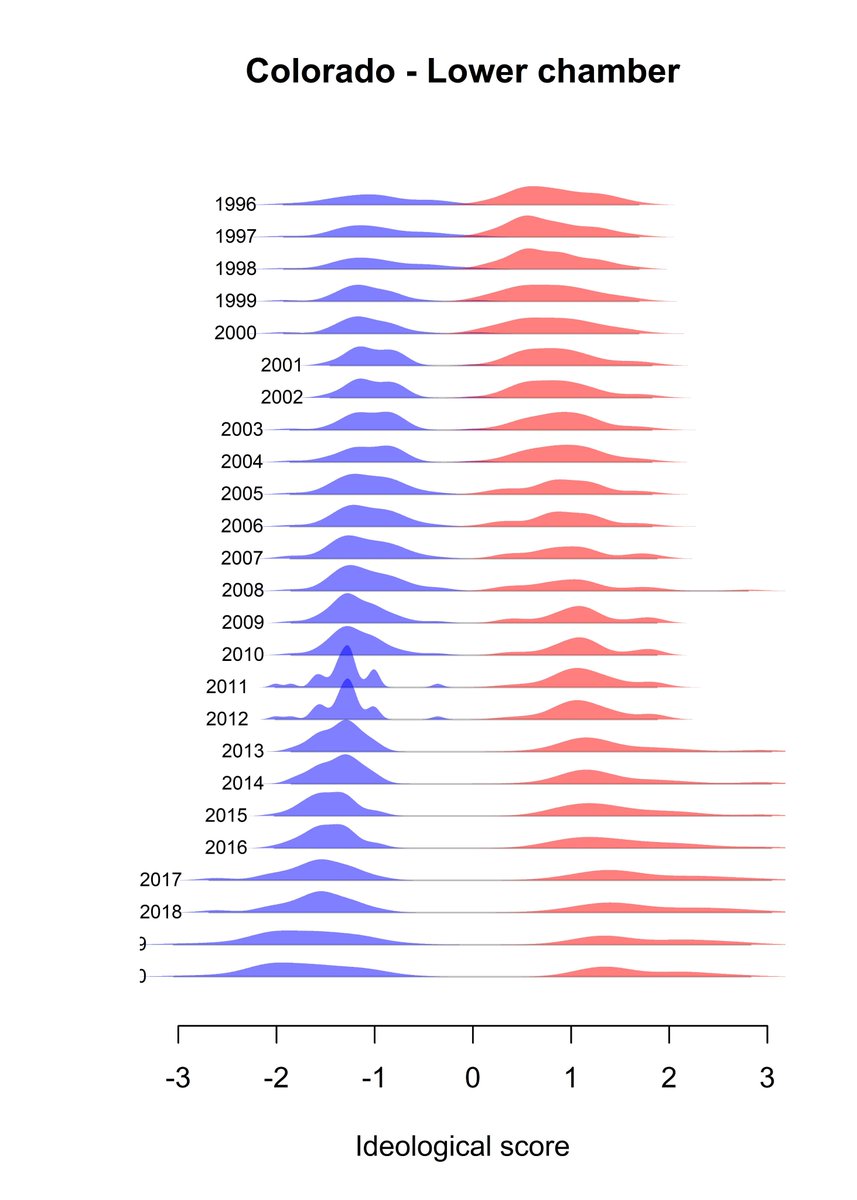
In 1996, Shor and McCarty estimate that the most conservative Democrat in the Colorado lower chamber was more liberal than the most liberal Republican and the gap between the two parties has only increased over time. (fin)
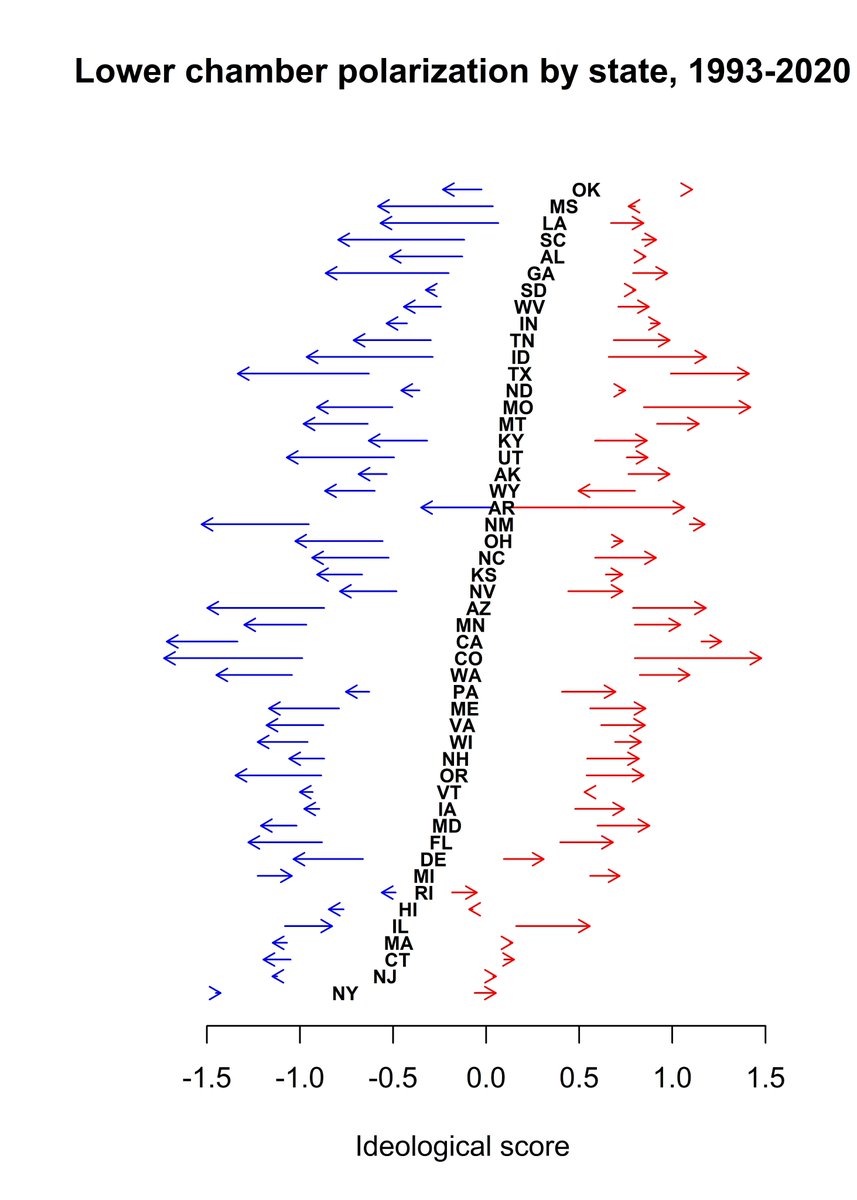
What a great resource for political scientists! I spent a little time this morning visualizing some of the trends in the data. This plot shows the change in the state parties over the past 25 years (or so). (1/8)
🚨New data posted!🚨 Today I posted an update to the individual and state-level data for the ideology estimates I've been working on with @Nolan_Mc for more than a decade. The data now goes from 1993-2020. Please download, use, enjoy, and cite! https://t.co/IctyIYGYsw
In my home state of Colorado, the picture has looked much different over the past quarter century. The parties were pretty distinct in 1996 and have only become more so over time (7/)