🚨🚨🚨 The Cooperative Election Study's 2024 vote validation data is now available for download!
Microdata here: https://t.co/KOJsaVsM4A
Or easy interactive analysis of the data on...
vote choice: https://t.co/rSTMOGysYe
demographics of voters: https://t.co/CQO2l5qoUx
the Tufts political science department has a tenured search for a scholar of civic engagement who will also become the next director of the Civic Studies program on campus https://t.co/npvCPZhIr1
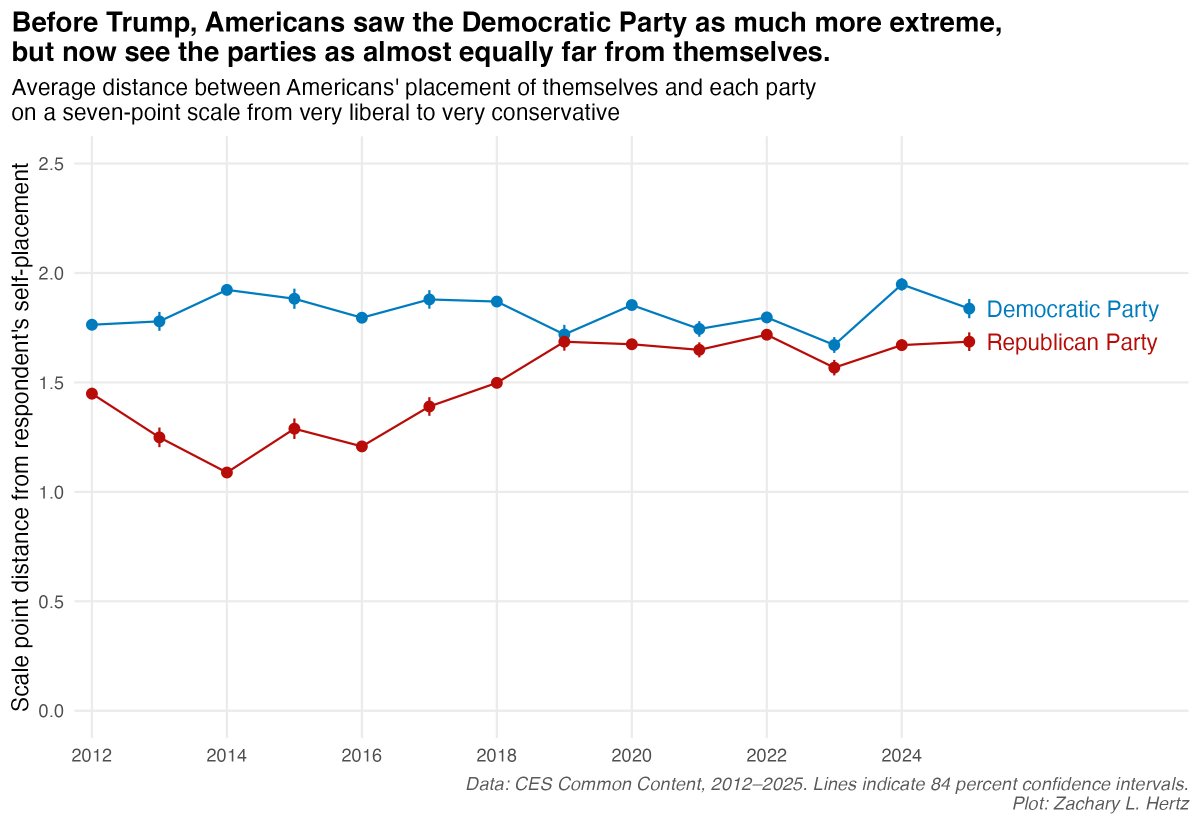
Moderation debates center on party brand — do Americans think the Democratic Party is too far left, do they think Republicans are too far right, and which party is farther? The CES asked 30-60k Americans every year, which means we can track this over time. New blog post! (1/n)
been trying to resist the urge to weigh in, but when even my soccer podcast gets involved in the to mod or not to mod debate...
i'm not surprised that when an election is so definitively a referendum on someone else (Trump), the ideology of out-party candidates would matter less
did ideology matter less in the 2026 election? particularly, did it matter less for Democratic candidates?
in the new Expecting Goals blog, Joel and I dive further into the great ideology debate with updated 2026 election results https://t.co/jJ2vnT8xNM
A first look at polls' 2026 performance from @carolinelsoler and @RuthIgielnik: "National polls this year underestimated the strength of Democrats by around 4 percentage points." https://t.co/6YruZfhhQw
@valeriecbradley yes, it only helps with past voters, but that's most of the electorate. still not sure how weighting LVs to vibes-based past vote targets is better than just sticking to the targets you actually know to be true.
i think the issue here isn't weighting to past vote, but rather at what stage those adjustments are applied. my understanding is that lots of pollsters apply those adjustments to likely voters, but then you're basically just guessing about turnout differentials 1/3
Finally, polls weren’t very good this year. They systematically underestimated democrats by over 5 points across the board, and did much worse in some key races. Pollsters need to carefully reconsider partisan weighting and recall weighting in such a fluid environment.
@valeriecbradley we know how many American adults voted for Harris, Trump, other, and how many didn’t vote. We know the same for RVs. Just look at vote counts and turnout. Straightforward. We don’t know this for LVs since we don’t know who is actually going to vote. So then it’s just guessing.
@cwarshaw@gelliottmorris I remember being at a closed door meeting of pollsters two years ago and being confused about why there was so much consternation about weighting to past vote until I figured out how they were doing it…uh yeah if you’re gonna do it that way then maybe just don’t do it
Given the debate about the impact of recalled vote weights on midterm poll accuracy, here’s an alternative approach that keeps the benefits of vote recall but has the advantage of letting responses and response rates improve those estimates. It’ll cost more $, but seems worth it.
@cwarshaw@gelliottmorris best I can discern from talking to lots of pollsters, no that’s not what they do. it’s define likely voters first and then weight to whatever they think past vote will be for that group 🤷♂️
@StoodWe there is no separate category for Arab.
in Michigan, voters were asked in a separate question (which I didn't use here) if they were of Arab or Middle Eastern decent. among those who said yes to that question 58% identified as white and 30% as other race on the race question.
@jalenb79@PolitWave I’m aware, I was just assuming people could look at the bars on the left side of the graph and see that the self identified evangelical group was gonna be mostly black
Several pre-election polls underestimated the size of the blue wave in the midterms. It likely stems from an age-old problem for pollsters: Many more people say they will vote than actually do. | @b_schaffner
https://t.co/T8jl3QYXBu