I will preface by stating that Meredith is a great school and was likely misled, but considering the question started with a declarative statement of “prediction markets currently have no regulations and are not subject to state taxes” both of which are wholly inconsistent with established NC and federal law, I would have to question the results. We literally acknowledge preemption in state statute and levy a state tax. The methodology also doesn’t elaborate on how this poll was conducted online. With a sample size of only 1,000, it is extremely important to describe the vendor or survey platform.
@WALLACHLEGAL@stevebrubaker Ordering Kalshi to disgorge earnings from federally authorized activity in other states upheld by a US COA clearly violates the commerce clause and would be an egregious extraterritorial application of the law that has no basis in reality. You have vastly missed the mark here.
Nothing is going to change. This is the same agency that projected only 600,000 people will itemize wagering losses (did they even bother to research this). Since most players receive very few w2gs, we will just continue to ignore the issue because very few people understand our tax laws and even less comply. Here in NC, gross winnings will be reported on OSB markets for the first time. This means a lot of net losing players are going to get a quick lesson on the loss of standard deduction and AGI phaseouts. This law wouldn’t last 15 minutes if Amazon was limited to 90% of expenses.
Kalshi may end up losing the preemption argument, but I am sick and tired of hearing the OSB market, the states, and their lobbyists claim it is about consumer protection or sovereignty. It is to preserve an ecosystem that promotes tax revenue over consumer fairness because “gambling” is a vice and a monopoly dictated by lawmakers/commissions that don’t have a clue. They still haven’t fixed the 90% limit OBBBA mess and now states are creating informational compliance returns so they can tax consumers on phantom income. They continue to bite the hand that feeds them, the registered player. They can’t blame anyone but themselves. At least if I lose to quant traders on Kalshi, I don’t have to choose to either pay income tax on phantom income or forfeit my standard deduction and deal with false AGI phaseouts just for the privilege of using the state market. The OSB market is terrible.
I wish that was the case but the state already gets the W2-G and the W2-G requires $2,000 and 300 times the wager. This is a quote from the Senator (ironically my state Senator) that added this. He asked me if the gambling loss deduction will fix my issues. There was no hope getting him to understand how bad this law change was. I told him I would just use the prediction market. Unfortunately the attitude in NC is that gambling is a vice, end of conversation.
This provision of SB 595 became effective when it became law (June 25 2026). Other parts of the bill don’t start until 2027. NC DOR has to request this from the operator one time per year for the prior year. A reasonable reading of the statute would suggest they should request 2025 this year, but they will likely do their first request in January 2027 for 2026. NC DOR has yet to release anything on this.
I don’t necessarily have an issue with anything you said, but it completely ignored the reason that so much volume is on sports. Sure a large part is that they provide markets in states that don’t have a licensed OSB product, but they also provide a product that is superior to the OSB market in many ways. States don’t compete, they create monopolies and a regulatory framework that puts generating tax revenue as the number one concern further proliferating that sports wagering is just a vice. OSB is full of tax rules that are beyond insane and they refuse to spend lobby money on taking care of the players that ultimately pay the bills. Naturally consumers are going to gravitate to the product that attempts to remove the negative connotations associated with wagering. The documentary didn’t show any of that, but they showed plenty of reckless degenerates up against sophisticated traders. I support the OSB market and I want to see it succeed, but when you have contempt for the registered player by continuing to pass anti-consumer laws because it is just “gambling”, don’t be surprised when that player would rather be a trader. When a State AG celebrates a win against Kalshi as pro consumer and not pro 51% taxes, people can see through the lies. Not everyone with this opinion is a quant trader trying to get rich from rec flow.
@Blue232307@Josh_Hamlet A state auditor can disallow a clearly bogus schedule C shell LLC business, assess the taxpayer state taxes, and the federal 1040 is never amended. Of course the IRS could catch it as well, but they don’t routinely share despite the sharing agreement they have in place.
The NC D-400 starts with federal AGI Line 6. I have filed public records requests for SB 595 (2026-31) to get implementation information for N.C. G.S. 105-251.2 (so far nothing). It mandates that DOR ask the operator for 1-5 but then later states may request. We don’t know what the form looks like, will the player get a copy, and is the $2,000 threshold net winnings or gross? As a side note, the original bill required the lottery’s digital instants (slots) to report the same thing, but they conveniently removed that requirement in a secret conference committee.
Fortunately, we were able to get a state deduction for wagering losses passed last month. Most state audits do not result in coordination with the IRS so there will be some hard decisions from NC players on how to proceed with their federal 1040. I suspect many will just wait for the state algo audit based on the compliance return and just pay what the state asks to avoid having to report gross winnings, lose standard deduction, and have AGI phaseouts from the federal return. Of course all of this could be avoided with a federal law or rule authorizing calendar year sessions per operator.
In that proposed rule, the IRS projects only 673,000 taxpayers will take an itemized deduction for wagering losses for tax year 2026. It is estimated that 60 million Americans engage in sports wagering with 165 billion in annual state regulated handle (this is only sports gambling). It is hard to imagine a scenario where a government agency could be more disconnected from reality. It would make no sense for the agency not to support a taxpayer using the net annual profit/loss from each online regulated sportsbook. Unlike a casino, a player can’t engage in untracked play and the report is 100% accurate (no hiding chips in your pocket). As Calvao v Commissioner pointed out, it is a huge disadvantage because a wagering loss deduction does not reduce AGI. Less than 15% of taxpayers itemize so we have millions of cases of evasion taking place because there is no way people are paying income tax on phantom income as most players are net losers. In NC, we have a new state requirement for informational compliance returns which essentially turns over your entire wagering history to the NC DOR. I realize most consumers have nothing reported as W-2G threshold are rarely met. The current rules hurt honest taxpayers the most. It is amazing to me that something so simple and common is not fixed.
Interesting analysis of how the OBBBA changes to section 165(d) may have created the ability to do a yearly session. H.R. 4304 would keep the helpful changes from the OBBA and just strike the 90%. https://t.co/UpP5XAB6QN
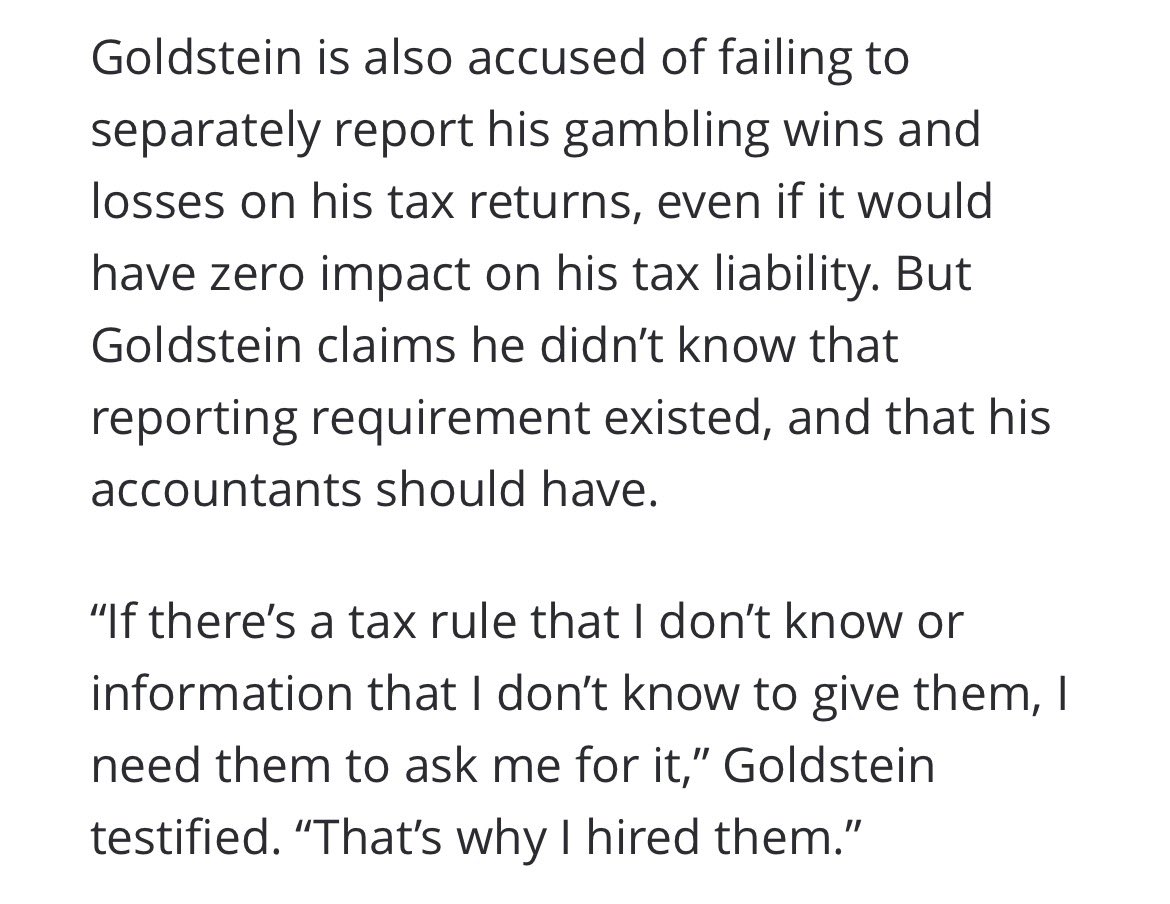
Interesting part of the criminal case against Tom Goldstein. While his conviction was based on a lot more than this, I found this allegation of evasion incredible and points to the reality that high stakes gambling is basically incompatible with a 100% tax compliance. https://t.co/JcJsu0bUrZ
@DustinGouker You have convinced me to watch, but if I have to listen to more than 30 seconds of those people in the trailer, I might not make it to your part.