@investing_law 💯. Some AI-generated client questions are fair, some are irrelevant red herrings, but either way it takes time to distinguish between the two and advise accordingly.
@AdviserCounsel The fact that most of the settled orders re: hedge clauses were commingled with other unrelated findings makes it harder to gauge whether a hedge clause issue alone could result in an enforcement referral.
@ryangloverNC Depends on the number of accounts over which the RIA has custody, but I’d ballpark $5k - $15k. Best to get a quote directly from the accounting firm.
Advisers that undergo an annual surprise custody exam are responsible for identifying the accounts for which they have custody. The independent public accountant performing the annual surprise custody exam relies on the adviser's account identification.
Failure to properly identify all accounts for which the adviser has custody resulted (in part) in an SEC administrative proceeding.
These particular settled charges involved 112 accounts that were not identified for the independent public accountant performing the annual surprise custody exam. With respect to such accounts, the adviser had some combination of:
- Signatory authority
- Power of attorney
- Trustee or co-trustee roles
- Manager, co-manager, or officer roles of LLC clients
The SEC's order also finds that the adviser failed to implement its written identity theft prevention program under Reg S-ID by not:
- Undertaking any internal review
- Ensuring that it was updated periodically to address red flags that the adviser had detected in the course of its operations
- Providing for its continued administration when it failed to involve the appropriate personnel in its oversight, implementation, and administration
SEC administrative proceedings can be particularly enlightening not only for their enforcement posture, but perhaps more importantly for their succinct summaries of the rules that were found to have been violated.
For anyone wanting a concise summary of the Custody Rule or Reg S-ID, this one is worth a read.
🔖 Administrative proceeding summary: https://t.co/spYEPlGqOc
🔖 Administrative proceeding: https://t.co/xit2HdVVW2
🔖 Custody Rule: https://t.co/qgsMnQ9jSQ
🔖 Reg S-ID: https://t.co/pRO88ZG2Z4
My first reaction to Delaware’s proposal to create a new type of legal entity - the “Artificial Intelligence Company” or “AIC”:
Can an AIC operate as a registered investment adviser?
Apparently yes, as the draft legislation states that an AIC can have “any lawful purpose… except for the business of banking”.
If an AIC actually becomes akin to an LLC or corporation, I can’t even begin to imagine how the SEC or state securities authorities would approach it from a registration, regulatory, disclosure, examination, or enforcement perspective.
https://t.co/OIbJan3W5J
The SEC is still pursuing enforcement cases for advisory agreements that include an impermissible hedge clause. Here's another example.
In short, an Adviser generally can't limit its liability for "any":
- Error of judgment
- Mistake of law
- Act or omission
- Conduct
The application of liability also generally can't be limited to an Adviser's "gross negligence" or "willful malfeasance or disregard."
Though this particular administrative proceeding also cited undisclosed conflicts of interest related to an affiliated broker-dealer's margin interest markup and cash sweep revenue sharing arrangement, the SEC's position on hedge clauses has remained fairly consistent over the last few years.
🔖 Administrative Proceeding summary: https://t.co/XjDjRJpNfP
🔖 Full Administrative Proceeding: https://t.co/rnkNORCJuK
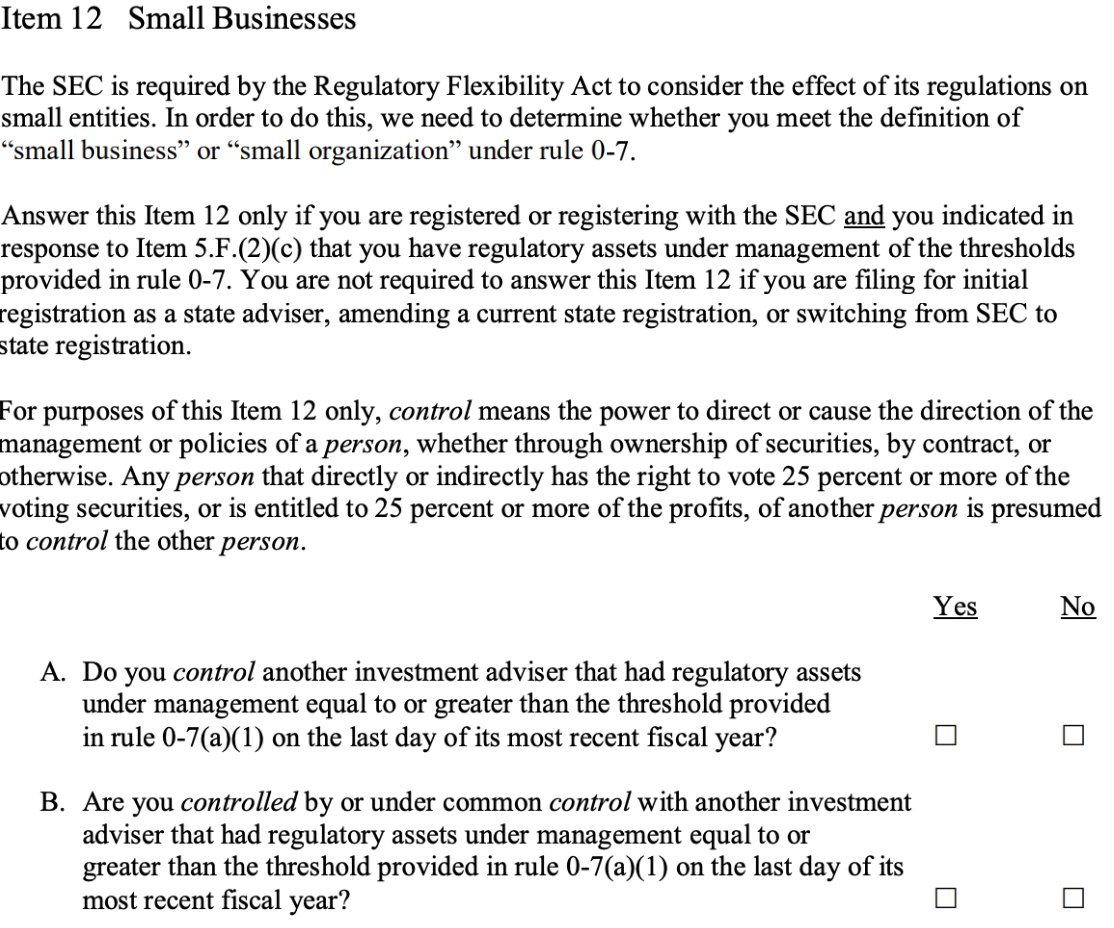
SEC-registered advisers with less than $1 billion in RAUM will now need to answer a question in Form ADV that was likely previously inapplicable.
On Nov. 4, the SEC amended the definition of "small entity" for purposes of the Regulatory Flexibility Act. A "small entity" was previously an adviser with <$25 million RAUM; now it's an adviser with <$1 billion RAUM.
The SEC is required to determine if a rulemaking is likely to have a significant economic impact on a substantial number of small entities. Now that more advisers will be deemed small entities, ostensibly this means that there will be additional scrutiny during the SEC rulemaking process to avoid a disproportionate impact on the small entities that now constitute a larger percentage of advisers overall.
The practical effect for most SEC-registered advisers is that they will likely now have to answer the revised version of Form ADV Part 1, Item 12, as part of its next annual ADV amendment (i.e., during Q1 2027 for most advisers):
"Answer this Item 12 only if you are registered or registering with the SEC and you indicated in response to Item 5.F.(2)(c) that you have regulatory assets under management of the thresholds provided in rule 0-7 [i.e., $1 billion]".
Bottom line: reassess your need to answer ADV Part 1, Item 12 when filing your annual ADV amendment in Q1 2027.
🔖 SEC Press Release: https://t.co/rPEV1GdcuP
🔖 Fact Sheet: https://t.co/O4g4nfpygu
🔖 Adopting Release: https://t.co/yaboIbMrYj
Links to the AI-related resources I mentioned during my talk at Schwab IMPACT:
--- Presidential Executive Order mandating executive departments and agencies to use the term "Super Intelligence" and "SI" in place of "Artificial Intelligence" and "AI": https://t.co/zwETeVRxjF
--- 2027 SEC Exam Priorities: https://t.co/0dUHaMdV72
--- Super Intelligence at the SEC (including the SEC's "SI Use Case Inventory"): https://t.co/SuFtj1Mo9s
--- Nov 9 SEC Roundtable on Machine-Understandable Data in the Age of Super Intelligence: https://t.co/KB9xXobPNH
--- Remarks at the Stanford University Private Capital Roundtable by Brian Daly, Director, SEC Division of Investment Management: https://t.co/BYbl8QO4vl
Excerpts:
"I work for the most pro-innovation SEC ever, and we want to encourage investment advisers and fund sponsors to utilize this technology responsibly for the benefit of the American investor."
"There is still far more trepidation about SI deployment than I think is warranted."
"Our principles-based, fiduciary duty regime adapted to the invention of television, email, the internet, and smartphones; it will adapt to SI."
--- Transcript of Brian Daly's appearance on the Paul, Weiss Waking Up with AI podcast: https://t.co/7n1kZwbzJs
Excerpts:
"The chairman [of the SEC, Paul Atkins,] has instructed us to modernize the recordkeeping rule."
"I think the biggest fear that I have about AI right now is, frankly, non-adoption."
--- SEC Regulatory Agenda re: amendments to the recordkeeping rule: https://t.co/2aJ5qcUlZp
Excerpt:
"The Division is considering recommending that the Commission propose amendments to [the recordkeeping rule] to address the appropriate scope of and identified compliance burdens related to electronic communications and to account for certain technological developments since the rule was adopted."
Tip of the cap to @Schwab4RIAs and Adam Moseley specifically for the opportunity to chat about compliance, AI (or “SI”… iykyk), and related SEC developments at #SchwabIMPACT in Boston.
Yesterday’s conversation marked the fourth and final time we had the privilege of sharing our perspectives on these topics with Schwab advisors across the country over the course of 2026. Each time, there seemed to be some new development or nuance to discuss, and I don’t see the pace of AI innovation in the RIA industry slowing down.
For those that are interested in links to the articles, podcasts, and other resources I mentioned during the discussion, I’ll separately share everything in a comment or repost as time permits.
PS - an additional shoutout is due to the Beach Street Legal clients in attendance that came up to say hi afterwards. Thank you for being part of the BSL family!
Tip of the cap to @Schwab4RIAs and Adam Moseley specifically for the opportunity to chat about compliance, AI (or “SI”… iykyk), and related SEC developments at #SchwabIMPACT in Boston.
Yesterday’s conversation marked the fourth and final time we had the privilege of sharing our perspectives on these topics with Schwab advisors across the country over the course of 2026. Each time, there seemed to be some new development or nuance to discuss, and I don’t see the pace of AI innovation in the RIA industry slowing down.
For those that are interested in links to the articles, podcasts, and other resources I mentioned during the discussion, I’ll separately share everything in a comment or repost as time permits.
PS - an additional shoutout is due to the Beach Street Legal clients in attendance that came up to say hi afterwards. Thank you for being part of the BSL family!
I wrote about what to expect and how to prepare for an SEC exam two years ago, but the recently-released SEC Exam Handbook is a primary source that succinctly summarizes the current exam roadmap.
What follows are a few interesting tidbits that I didn’t highlight in my prior article:
https://t.co/lFDSllwXle
I should have also noted that the SEC has its own dedicated website that describes how it uses "Super Intelligence" (i.e., AI): https://t.co/SuFtj1Mo9s.
It even includes a specific "repository of its use cases" in the form of a downloadable CSV file, including example vendors used. Interesting examples of how the SEC itself is using SI:
- Using machine learning/artificial intelligence techniques to predict entities with certain risk characteristics
- Transcribing, summarizing, or other efforts that improve the accessibility of a virtual meeting or interview
- Scheduling internal-to-government meetings or appointments
- Prioritizing and categorizing incoming emails
- Generating first drafts of documents, briefing, or communication materials
- Improving the quality of written communications
- Summarizing the key points of a lengthy report
- Using AI-assisted tools in word processors
- Searching for agency information using a knowledge retrieval system
- Comment letter review and analysis
- Identification of potentially manipulative trading activity in registrant data
- Using natural language processing techniques to search and analyze certain filings
- Knowledge base of federal securities law and chatbot
- Streamlining initial research
The list of uses cases is from 2025 and thus a bit stale, but suffice to say the SEC appears to embracing AI / SI in a variety of ways.
Artificial Intelligence makes its way into the recently-released 2027 SEC Exam Priorities in a few interesting ways:
AI is referred to as "Super Intelligence" / "SI"
This is in-line with last month's executive order, whereby President Trump directed executive agencies to replace “Artificial Intelligence” and “AI” with “Super Intelligence” and “SI” in official correspondence, websites, reports, policy documents, and other nonstatutory materials:
"The terminology used by the Federal Government should reflect the transformative capabilities of these technologies and the limitless opportunities they create for the American people. Accordingly, the term ‘‘Super Intelligence’’ more appropriately captures the promise, potential, and rapidly advancing capabilities of these technologies. It is therefore the policy of my Administration that, to the maximum extent permitted by law, the executive branch shall use the terms ‘‘Super Intelligence’’ and ‘‘SI’’ in place of ‘‘Artificial Intelligence’’ and ‘‘AI’’ and will not acknowledge the usage of ‘‘Artificial Intelligence’’ and ‘‘AI’’ in any applicable setting."
The SEC is "intensifying" efforts to understand SI use by advisers
Of particular interest is how SI technologies "influence outcomes and whether firms continue to comply with existing, technology neutral obligations." I read this to mean that:
(1) SI used as part of a client 'call-to-action' will be in focus (e.g., for investment or financial planning recommendations), and
(2) Advisers are expected to fit the square peg of SI into the round hole of existing rules under the Advisers Act (e.g., the Recordkeeping Rule).
SI presents enhanced cybersecurity risk
Advisers are expected to be prepared for SI-enhanced cybersecurity risks and attacks:
"The Division will focus examinations on compliance with relevant rules relating to registrants’ assessment and preparation for potential threats from SI-related cyberattacks that may affect their businesses or customers, such as SI-generated phishing messaging and synthetic or deepfake voice and video used for social engineering."
Reading between the lines, it appears the SEC will expect advisers to adapt their existing cybersecurity defenses to account for evolving SI threats, and to train internal personnel on how to identify and prevent SI-enabled phishing, deepfake, or account takeover attempts.
The Division of Exams is leveraging AI to its benefit
SEC examiners are already leveraging SI as part of the exam process, and the Exam Priorities letter signals that we've only yet seen the tip of this iceberg:
"We are undertaking a modernization initiative that is at the core of this effort, with aims of updating our processes and technology, increasing automation, reducing manual and duplicative steps, and improving usability. This includes identifying where SI-supported tools may strengthen analysis, improve workflow efficiency, or detect patterns and risks across complex datasets, while supplementing, but not replacing, staff judgment."
I suspect examiners' use of SI will become more and more apparent to examined advisers over time. Whether this will result in more voluminous document request lists or a more efficient overall exam experience is TBD.
* * * * *
The SEC's 2027 Exam Priorities have a lot more non-SI meat on the bone that I'll bite off at a later date, but the SI elements alone are worth digesting.
PS - sorry for the food/eating metaphor at the end. I hope it didn't make you lose your appetite.
PPS - OK I'll stop now.
* * * * *
🔖 2027 SEC Exam Priorities: https://t.co/0dUHaMesWA
🔖 AI → SI Executive Order: https://t.co/z6B3o116aj
Artificial Intelligence makes its way into the recently-released 2027 SEC Exam Priorities in a few interesting ways:
AI is referred to as "Super Intelligence" / "SI"
This is in-line with last month's executive order, whereby President Trump directed executive agencies to replace “Artificial Intelligence” and “AI” with “Super Intelligence” and “SI” in official correspondence, websites, reports, policy documents, and other nonstatutory materials:
"The terminology used by the Federal Government should reflect the transformative capabilities of these technologies and the limitless opportunities they create for the American people. Accordingly, the term ‘‘Super Intelligence’’ more appropriately captures the promise, potential, and rapidly advancing capabilities of these technologies. It is therefore the policy of my Administration that, to the maximum extent permitted by law, the executive branch shall use the terms ‘‘Super Intelligence’’ and ‘‘SI’’ in place of ‘‘Artificial Intelligence’’ and ‘‘AI’’ and will not acknowledge the usage of ‘‘Artificial Intelligence’’ and ‘‘AI’’ in any applicable setting."
The SEC is "intensifying" efforts to understand SI use by advisers
Of particular interest is how SI technologies "influence outcomes and whether firms continue to comply with existing, technology neutral obligations." I read this to mean that:
(1) SI used as part of a client 'call-to-action' will be in focus (e.g., for investment or financial planning recommendations), and
(2) Advisers are expected to fit the square peg of SI into the round hole of existing rules under the Advisers Act (e.g., the Recordkeeping Rule).
SI presents enhanced cybersecurity risk
Advisers are expected to be prepared for SI-enhanced cybersecurity risks and attacks:
"The Division will focus examinations on compliance with relevant rules relating to registrants’ assessment and preparation for potential threats from SI-related cyberattacks that may affect their businesses or customers, such as SI-generated phishing messaging and synthetic or deepfake voice and video used for social engineering."
Reading between the lines, it appears the SEC will expect advisers to adapt their existing cybersecurity defenses to account for evolving SI threats, and to train internal personnel on how to identify and prevent SI-enabled phishing, deepfake, or account takeover attempts.
The Division of Exams is leveraging AI to its benefit
SEC examiners are already leveraging SI as part of the exam process, and the Exam Priorities letter signals that we've only yet seen the tip of this iceberg:
"We are undertaking a modernization initiative that is at the core of this effort, with aims of updating our processes and technology, increasing automation, reducing manual and duplicative steps, and improving usability. This includes identifying where SI-supported tools may strengthen analysis, improve workflow efficiency, or detect patterns and risks across complex datasets, while supplementing, but not replacing, staff judgment."
I suspect examiners' use of SI will become more and more apparent to examined advisers over time. Whether this will result in more voluminous document request lists or a more efficient overall exam experience is TBD.
* * * * *
The SEC's 2027 Exam Priorities have a lot more non-SI meat on the bone that I'll bite off at a later date, but the SI elements alone are worth digesting.
PS - sorry for the food/eating metaphor at the end. I hope it didn't make you lose your appetite.
PPS - OK I'll stop now.
* * * * *
🔖 2027 SEC Exam Priorities: https://t.co/0dUHaMesWA
🔖 AI → SI Executive Order: https://t.co/z6B3o116aj
Yours truly will be presenting again at Michael Kitces's IAR CE Day on 8/27:
"What’s New in RIA Compliance Obligations: Reg S-P Amendments, Custody Triggers, SEC Exam Priorities, and More."
Join us to knock out your entire annual IAR Ethics requirement (6 hours) and earn 6 hours of CFP® CE (including your required 2 hours of CFP® Ethics) all in one virtual event.
https://t.co/sYQvJBMCRY
Compliance is painful, bureaucratic, and often paper-based, so it has long persisted as being manual and human intensive.
That friction has historically made compliance a graveyard for startups.
But AI may finally go from "good enough to pilot" to "good enough to trust".
In legal, broad model choice and consistently high accuracy gave teams the confidence to finally embrace AI. Many LLMs now score 80-100% on LegalBench’s 162 legal reasoning tasks.
This matters directly for compliance, because compliance is essentially applied legal reasoning under operational constraints, built on the same core tasks: reading regulatory text, applying rules to fact patterns, identifying exceptions, and flagging ambiguities.
Full piece from a16z's @jamdac and @astrange: https://t.co/niRB3jPioN
President Reagan once said, “The nine most terrifying words in the English language are: I'm from the Government, and I'm here to help.”
Over my 3 tours at the SEC, I have discovered six equally terrifying words: “We should create another disclosure requirement."
@RonaldReagan
The latest edition of On The Docket is out, and includes the following content:
• Takeaways from the SEC Reg S-P Compliance Outreach for Small Firms
• SEC E-Delivery Modernization Efforts
• Thanks to Catherine Tindall, CPA for an enjoyable conversation!
• Always Disclose Conflicts of Interest
• New York Endeavors to Tackle Outdated & Burdensome Regulations, Policies, and Practices
• SEC Adjusts the “Qualified Client” Thresholds for Inflation
• A Great Take on AI and Lawyers
• Schwab AI Summits
• SIFMA Urges SEC to Overhaul Outdated Communication Retention Rules
• Decoding the SEC’s Draft Strategic Plan for 2026-2030
• SEC Enforcement Action: Undisclosed Conflicts and Compliance Deficiencies
• SEC Risk Alert: Investment Adviser Obligations Related to Economic Conflicts of Interest
🔖 Read the content above → https://t.co/j2HaeprM92
-----
🌐 All past On The Docket editions (as well as other article, video, and podcast content) are available by visiting the On The Docket page of the Beach Street Legal website: https://t.co/g80Eji3xhf
📥 If this edition was forwarded to you, you can subscribe directly here: https://t.co/2XttiFv4cK
The same day that I posted "With respect to RIA conflicts of interest, sunshine is the best disinfectant [against an SEC enforcement action]...," the SEC's Division of Exams published a Risk Alert on "Investment Adviser Obligations Related to Economic Conflict of Interest."
Coincidence? Yes, completely.
In a nutshell, the Risk Alert highlights observed failures related to:
• The full and fair disclosure of economic conflicts of interest associated with cash management recommendations, revenue sharing, custodian / broker-dealer credits and incentives, affiliate relationships, fund share class selection, and fee markups.
• Insufficient or inaccurate fee-related disclosures, contractual provisions that did not reflect actual billing practices (particularly w/r/t fee proration and fee refunds upon termination), and policies/procedures not reasonably designed to align with actual billing practices.
And to continue to drive home the point, the Risk Alert reiterated the SEC's displeasure with prefacing a conflict's disclosure with the word "may":
“[D]isclosure that an adviser ‘may’ have a particular conflict, without more, is not adequate when the conflict actually exists. For example, we would consider the use of ‘may’ inappropriate when the conflict exists with respect to some (but not all) types or classes of clients, advice, or transactions without additional disclosure specifying the types or classes of clients, advice, or transactions with respect to which the conflict exists. In addition, the use of “may” would be inappropriate if it simply precedes a list of all possible or potential conflicts regardless of likelihood and obfuscates actual conflicts to the point that a client cannot provide informed consent.”
The TLDR takeaways are:
• If an adviser is incentivized to render advice or take an action that is not disinterested (i.e., conflicted), the adviser must specifically and transparently disclose such incentives and conflicts and how they are addressed.
• The description of fees in the brochure and client agreement must be sufficiently granular to convey how fees will actually be calculated, prorated, and charged to the client (and, of course, must be accurate).
Conflicts disclosure has been an SEC exam priority each year since 2021, and I suspect it will continue to be an SEC exam priority for many years to come.
🔖 Examinations Observations of Investment Adviser Obligations Related to Economic Conflicts of Interest https://t.co/Xe2cIT9GoA
With respect to RIA conflicts of interest, sunshine is the best disinfectant [against an SEC enforcement action].
Failing to transparently disclose conflicts of interest will continue to invite SEC administrative and cease-and-desist proceedings, as one RIA and its former CEO learned the hard way in yesterday's settled charges summarized below.
The undisclosed conflicts at issue included:
• The CEO's profit-sharing interest in a sub-adviser retained by the RIA
• The RIA's expense sharing agreement with an ETF manager that incentivized the use of certain ETFs in client portfolios
• The CIO's affiliation with other advisory firms that provided products or services to the RIA's clients
For good measure, the settled action also cites the following compliance deficiencies:
• The CEO's personal trading in an ETF that impacted the end-of-day price of the ETF
• Failure to implement its compliance policies and procedures
• Failure to conduct an annual compliance review for one year
• Failure to enforce the provisions of its code of ethics re: access persons' personal trading
• Failure to identify the CIO as an access person for purposes of the code of ethics and reporting of personal trading
A conflict's permissibility hinges on its full and fair disclosure [in Form ADV Part 2A or otherwise]. To quote the 5th Dimension, "let the sun shine in."
* * * * *
🔖 Administrative Proceeding Summary: https://t.co/2SvlSAYus6
🔖 Administrative Proceeding: https://t.co/EDxxIxH7bL