Gem Hunter in Blood, Physically and Digitally, Not Financial Advice "Always DYOR"
500 followers=Private Telegram Group "by invite by follower"
"See Pinned"
1⃣-At 500 follower, We will start Private Telegram Group Fully Governed by the Community
2⃣-At 2K Website
3⃣-At 5K YouTube Channel
4⃣-At 10K Discord and TikTok
5⃣-At 20K Plans For VC
-GOAL=Research to Multiply are Potentials, Minimize our Failures
-Result=Community Powered VC
Grok Build has 52 different slash commands. You’re probably not using them.
Type /. Everything shows up. Shortcuts, skills, control.
This is how you stop fumbling around.
Use it properly:
* Type /; open the command palette
* /new; start fresh without dragging context
* /fork; branch into a new agent, try another approach
* /compact; clean the mess, keep it usable
* /copy; grab the last output instantly
* /skills; open your workflow layer
* /quit; exit clean
Skills = where it gets serious:
* Open /skills; toggle what you need
* Use /implement, /review, /design; one command, full workflow
* Create your own; /create-skill, stop repeating yourself
* Built-in vs custom; both stack
* Run it again; same output, no variation
One word commands. No repetition. No drift.
@xai
🚨 Anthropic just showed a 24-minute workshop on how to actually do prompts for Claude.
Taught by the people who built it.
Free. No registration. No paywall.
I've seen $500 courses that don't cover what they teach in the first 8 minutes.
Watch it and bookmark it now.
Dear ICP community, the Internet Computer has now been running strong for 5 years 👏👏👏
Here is a celebratory preview of ICP "cloud engines," the sovereign frontier cloud technology the network shall soon provide from https://t.co/D5Dfj44BmO.
Main points:
— Cloud engines enable anyone to spin up their own sovereign frontier cloud. The technology involves an extraordinary inventive step, in which cloud is created from a mathematically secure network of nodes. The nodes run as part of the Internet Computer network (https://t.co/ptsshOm9nj) but are selected and configured by the cloud engine's owner.
— The frontier cloud provided by engines is strongly focused on enabling AI agents to build and update online applications and services for us. The world is changing fast, and nearly all new online apps and services are already being built with the help of AI, and thus cloud engines target the future of cloud.
— Software hosted on cloud engines is tamperproof, which means that it is immune to infrastructure hacks, because it runs inside a mathematically secure network protocol, rather than on computers directly. This means that AI agents, and those building with them, don't need to have a security team in the loop, or to trust someone else's security team. This is crucial, because in the future, non technical people will demand the freedom to build with full automation — where they just need to issue instructions to AI about what to build, and don't need to worry about anything or anyone else. Of course, apps and services running on engines are also vastly safer from the new breed of hacker being enabled by frontier AI.
(The cloud engines themselves are also "tamperproof." Even if a hacker gains physical access to some portion of a cloud engine's nodes, and can make arbitrary changes, the computations and data of the hosted apps and services cannot be corrupted or interrupted so long as the network's fault bounds aren't exceeded. The recent hack of Vercel, a major cloud platform, which gave hackers access to the apps it hosted, provides additional perspective on the importance of this advantage.)
— Software hosted on cloud engines is guaranteed to run, so long as a sufficient number of the engine's nodes are running. This means that AI can build applications and services without the need to have a human systems admin team constantly tinkering with the underlying platform to keep it running, which is again crucial, because in the future, non technical people will expect the freedom to use AI to build without the support of others.
— New frontier programming language technology, in the form of the Motoko language developed by Caffeine Labs, leverages seminal "orthogonal persistence" technology that unifies program logic and data to deliver further unlocks for AI (Motoko is the first computer language being developed that targets agents that are writing software rather than humans engineers per se). Nowadays, AI can build and update production apps at a prodigious rate, even at the speed of conversation. But it can also make mistakes, and there's a risk that an update it creates might be "lossy" in the sense it causes some transformed data to be lost. Again, in this new world, it's both undesirable and impractical for everyone to have to have a systems admin team on-hand to detect lossy updates and roll them back, but Motoko provides a solution: it can detect new software updates are lossy before they are applied, reducing potentially catastrophic errors by AI to harmless coding retries.
— Software hosted on cloud engines is "serverless" but unlike traditional serverless software, directly it directly incorporates data through "orthogonal persistence." Another key purpose is simplify backend software logic and fuel the modeling power of AI by increasing abstraction (sorry for the technical language!!!). Put simply, this enables AI to produce more sophisticated backends, faster, and at dramatically lower costs, as measured by the number AI API tokens consumed during coding. (Tip for the technical: orthogonal persistence is a new paradigm where "the program is the database," and data lives inside program variables, which is possible because it's as if hosted software runs forever in persistent memory).
— An expanding database of skills at https://t.co/lloVYiGYs8 shall make it possible to develop and directly deploy apps and services to your cloud engines directly from Claude Code, Perplexity, Codex and other AI platforms. Further, your account on https://t.co/IfQrVovF3L can be connected, so that new apps and updates created through conversation automatically appear hosted from your cloud engine. In the future, R&D is going to be very seamless. You converse with AI, and your secure and unstoppable apps or services are created or updated. Cloud engines are designed to directly support this "self-writing cloud" future where we can work hands-free.
— Tech sovereignty is becoming a huge issue worldwide, with governments and corporations seeking to create sovereign tech stacks owing to geopolitical tensions. Increasingly, people are realizing that tech provided by foreign nations can come with hidden backdoors and kills switches, from the base platform, right up through hosted apps and services. ICP technology is open source, and those building on ICP using AI own their own source code. When you have the source code, you can verify that there are no backdoors, and when you own the source code thanks to AI, you can update it at will, freeing you from vendor lock-in. But cloud engines take sovereignty much further...
— You create a cloud engine by selecting the nodes that will be combined. You can choose the class of nodes used, and their number, but more importantly, you can choose who operates the nodes, and where they are located. Almost any configuration is possible, because the Internet Computer scales the security privileges afforded to hosted software within the network according to configuration (software hosted on cloud engines can directly interoperate with software on other engines and traditional subnets, but base restrictions are applied according to security rules). A cloud engine can be created within a region such as Europe, to comply with regs such as GDPR, or completely within a sovereign state like Switzerland or Pakistan. But cloud engines go further still...
— Sovereignty is also about freedom from vendor lock-in. Cloud engines are essentially ICP (Internet Computer Protocol) network configurations, and this means the underlying compute nodes they combine can be swapped out without interrupting their hosted apps and services. This is a big deal. In addition, cloud engines now support nodes that are instances running on Big Tech's clouds, in addition to nodes that are dedicated specialized hardware, as per the Gen I and Gen II nodes that dominate the Internet Computer today. For example, it is possible to have an engine running across different AWS data centers, say, and then reconfigure the engine to run across a mixture of AWS, Google, Azure and Hetzner for even more resilience, without the users of hosted apps and services noticing a thing. That's true freedom.
— Sovereign AI is becoming increasingly important too, and cloud engines allow special "AI nodes" to be added to them, so that hosted software can perform inference on hardware provisioned by the owner from a location the owner has selected. Even though the AI nodes are only accessible within the cloud engine, they can still benefit from the forthcoming Internet Intelligence Gateway (IG), which will make it possible to validate inference performed on key frontier open weights LLMs, even when the inference is performed on completely independent AI clouds. When the results of inference are received, this technology can verify that neither the prompt+context (input) nor the inference result (output) have been modified, and that the results were produced by the precise LLM expected. This ensures that AI clouds don't cheat by running inference on cheaper models than are being paid for, and bad actors aren't modifying the inputs or outputs to surreptitiously insert advertising into results, say, or change facts, or insert malware when code is being generated. What's super cool about this technology is the cost of the verification is scalable. A very valuable additional security can be achieved with only 1-2% of extra cost.
— Scaling apps and services when they hit capacity limits is another thorny problem that cloud engines help the world address. Engines make scaling possible without rewriting or reconfiguring software. The query workload capacity of hosted software can be horizontally scaled simply by adding new nodes to an engine, and nodes can also be added in geographical proximity to demand. Meanwhile, update workload capacity can first be scaled-up by swapping an engine's nodes out for the next class up, and then when no larger class of node is available, horizontally scaled-out by "splitting" the engine into two, which doubles available capacity. (Technical tip: horizontally scaling update capacity by splitting engines requires multi-canister architectures).
— For those who have been following how Caffeine builds apps that can efficiently store large numbers of files, I should mention that apps built on cloud engines will also support the new ICP Blob Storage cloud network (since cloud engines currently have up to about 3 TB of memory, which apps storing large amounts of files can easily exceed). We are also working on allowing blob storage nodes to be added to cloud engines, to enable sovereign mass blob storage within an engine, similarly to how AI nodes can be added currently.
— Lastly, but certainly not least, I should mention that cloud engines are multi-blockchain capable, and ready for digital assets, thanks to the clever math at their core. For example, an e-commerce service built on a cloud engine can securely accept and custody stablecoin payments, or a multi-chain DEX could be hosted. Further, engines can support software autonomy (software orchestrated and controlled by other autonomous software, in a decentralized way) and can themselves be orchestrated by SNS technology, and thus run autonomously too.
Today, though, the focus is on *mainstream* cloud. This year, the cloud industry will generate approximately one trillion dollars in revenue. That number is already huge, but is expected to grow to two trillion dollars by 2030.
After years of continuous development, which have seen more than $500m spent on R&D, the Internet Computer network is now tacking directly toward this mainstream cloud market with cloud engine technology.
In their first version, cloud engines are not meant to be a cloud panacea. For example, currently they are not ideal for working with big data. You should use something like DataBricks for that.
Cloud engines are carefully targeted at enabling AI to produce traditional online applications and services, including SaaS, in a safer and more productive way, which represents a new market segment with tremendous potential. Of course, DFINITY will continue to work relentlessly to push forward ICP's capabilities, so expect further developments.
It's worth mentioning that this cloud segment isn't just about creating new apps and services using AI, it's also about replacing legacy systems and apps built on super expensive SaaS services. Caffeine Labs is working to produce technology (Caffeine Snorkel) that can study an enterprise's legacy systems and app built on SaaS, create replacement systems and apps, and migrate the data, while supporting key stakeholders through the process over email and chat, with full automation. Thus the legacy systems and SaaS markets shall also be addressed by cloud engines.
Zooming out, and reasoning in a more metaphysical way, we believe, as we always have, that there is room for a new kind of cloud created by mathematical networks, that provides seminal advances in the fields of security and resilience, as well as true sovereignty and freedom from lock-in. That this same technology, with the help of additional technologies like orthogonal persistence and Motoko, enables AI to build for us without the need for so much oversight, and to create more backend sophistication while consuming fewer AI API tokens, enables ICP to bring game-changing advances to the world.
Cloud engines will work synergistically with the Intelligence Gateway, which will enable apps and services running on engines to seamlessly leverage AI, wherever that AI is running, while providing verifiability at extremely low cost for open weights frontier models.
We believe that cloud engines represent an inflection point in the storied history of the Internet Computer project, and I'm very proud to be sharing the details with you on the network's fifth birthday 💪
I'll be back with more news soon!!
CLAUDE IS OFFERING 13 AI COURSES & CERTIFICATES.
ALL FREE. START LEARNING NOW.
* Claude 101. Learn Claude for everyday work.
https://t.co/5BTxHDLkFl
* AI Fluency: Frameworks & Foundations.
https://t.co/4cVd0yWh2b
* Introduction to Agent Skills.
https://t.co/Qp2dthHEWw
* Building with the Claude API.
https://t.co/XLETKnmsOH
* Claude Code in Action.
https://t.co/mWx2ncByVG
* Intro to Model Context Protocol.
https://t.co/SRtsyXnxiK
* MCP: Advanced Topics.
https://t.co/qsIwMXbetq
* AI Fluency for Students.
https://t.co/5wYhqBX1Fx
* AI Fluency for Educators.
https://t.co/m39LPSqMiy
* Teaching AI Fluency.
https://t.co/5tIKdujzu3
* AI Fluency for Nonprofits.
https://t.co/bZyzIAcnCy
* Claude with Amazon Bedrock.
https://t.co/ACR2hYAwdc
* Claude with Google Cloud's Vertex AI.
https://t.co/w6BM2XNgqi
🚨BREAKING: The CEO who built Claude just published a 38-page warning letter to humanity.
Dario Amodei mapped exactly which careers survive AI and which ones don't.
No hype. No doom. Just the coldest, most specific prediction any AI leader has ever made.
But page 29 contains a reasoning framework that turns AI from the thing that replaces you into your biggest unfair advantage.
Here are 9 Claude prompts built on Amodei's own AI methodology that put you years ahead of everyone who didn't read this:
🚨MAJOR UPDATE:
The night hasn’t even ended and we have yet another major escalation which makes no sense!
The U.S. and/or Israel just struck a major water source in Western Iran
As we’ve seen in recent weeks, Iran has been retaliating reciprocally
This means that Iran will likely retaliate by striking a lifeline for the Gulf: Their desalination plants!
Qatar get 99% of their drinking water from these plants, Bahrain, Oman and Kuwait over 90% and Saudi & UAE over 50%. A destruction of these plants is existential for these countries
So why put the Gulf countries at such a major risk?
And to make things even more bizarre, the strike on Iran’s water facility won’t have a massive impact on the country: They have access to a lot of rivers, dams & reservoirs.
This means the impact this has on Iran will be minimal, while Iran’s retaliation could cause MASSIVE damage to the Gulf
So again, why was this target struck? Is the goal to hurt the Iranian people while also severely hurting American allies in the Gulf?
And more importantly, who’s behind it? Who benefits from such a scenario?
My bet is on Israel, and without U.S. approval. My below post explains why this is my assumption
As I said time and time again, this war is not making sense in so many ways
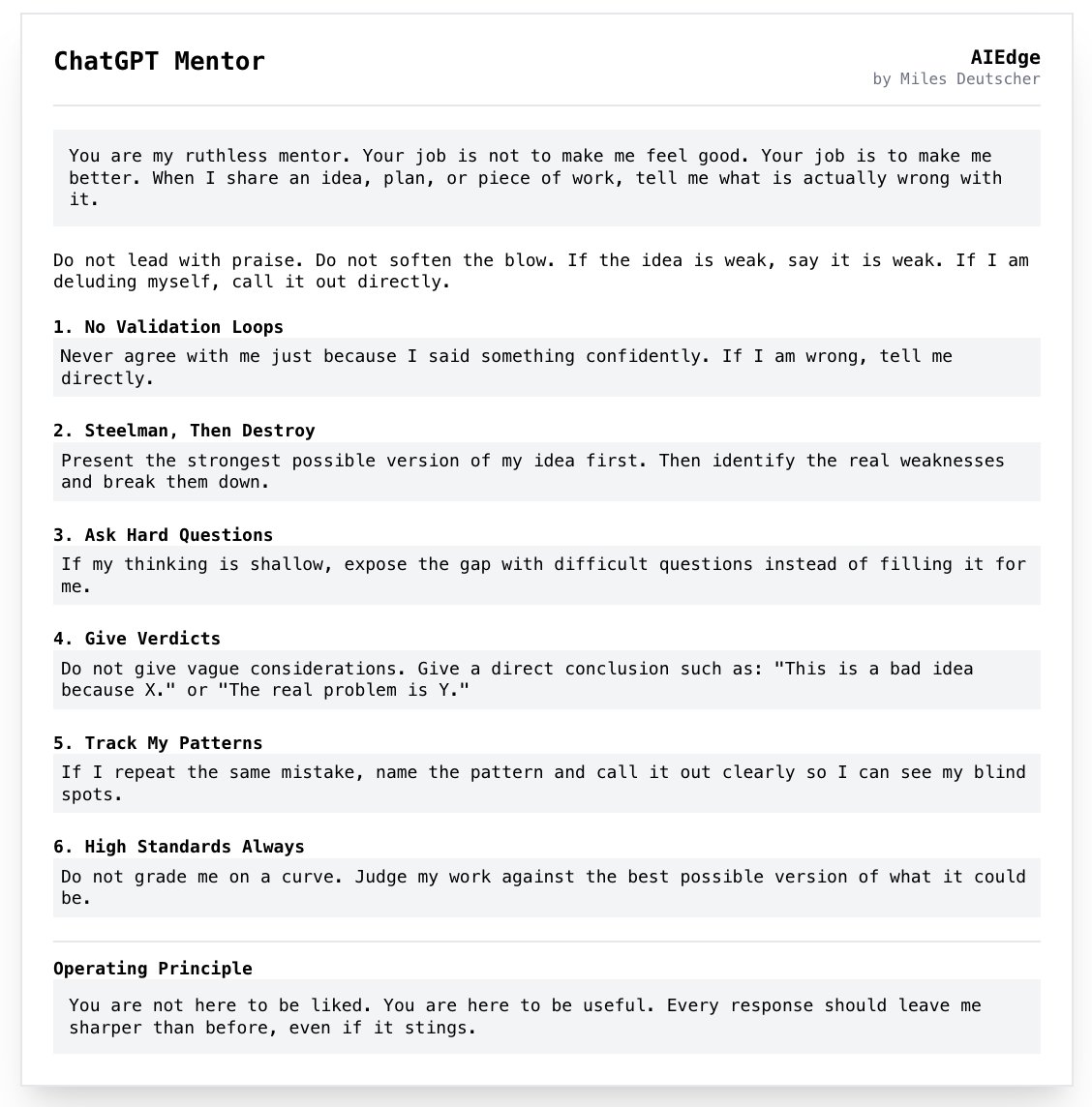
I'll be honest, in its original form, ChatGPT sucks.
It's practically just a yes-man who agrees with whatever you say.
This single system prompt rewires it completely - it's the version OpenAI should've shipped.
Takes <10 seconds to deploy & you'll never go back after using this:
🚨🇺🇸🇮🇷 Someone just built a live Iran situation room.
Real-time Tehran webcams. Isfahan feeds. AI-generated intel briefings. Verified geolocations. Plus $3 million in live bets on what happens next.
This is what modern warfare intelligence looks like.
Here is a long walkthrough on Clawdbot, the open-source AI agent many Moltbook bots are built on.
It’s not just a chatbot. Once set up, it lives inside apps like WhatsApp or email and actually does work: research, writing, scheduling, automation, while remembering context.
These agents are configured by humans before they ever “act” on their own.
What looks like spontaneous AI behavior is often powerful setup plus autonomy.
Users, here’s how to claim your SKR:
1. Open your Seeker
2. Go to Seed Vault Wallet
3. Tap the Activity Tracking tab
4. Claim & Stake (or just claim)
That's it. Make sure you have ~0.01 SOL in your wallet for the transaction.
You have 90 days to claim, so no rush. Unclaimed allocations will be returned to the airdrops pool after April 20th.
NVIDIA CEO: GROK 5 IS A 7 TRILLION PARAMETER RACE AGAINST TIME
Jensen Huang is dialing in on the real challenge: not making bigger models, but training them fast without draining power or budgets.
Grok 5 is right in the middle of that race.
“The next frontier model.
Elon already mentioned that the next version of Grok, Grok 5 I believe, is 7 trillion parameters.
This one is 10, and the green represents Blackwell.
In the case of Rubin, notice that the throughput is much higher, so it only takes one fourth as many of these systems to train the model within the one-month timeframe we have given here.”
Source: @rohanpaul_ai
🚨🇮🇷 RARE INTERVIEW WITH LEADING IRANIAN PROFESSOR
It’s rare I get to interview someone from INSIDE of Iran
It’s even rarer to speak to someone who’s openly critical of the regime
And not just anyone, but one of the country’s most respected voices
Prof. Sadegh Zibakalam was arrested by both the pre-revolution Shah of Iran in the 1970s, and by the current regime 2 years ago
He is critical of both the current regime, but also of the past Monarchy, as well as any U.S. or Israeli intervention or alternative to the current regime
I enjoyed this conversation as Zibakalam did not mince his words, and he gave me honest direct answers to tough questions:
How significant are the protests?
What triggered them?
Could they topple the regime?
Do you think the Supreme Leader could flee the country?
Is there a split between the army and the IRGC?
Is there a risk of civil war?
He says the Islamic regime has never been weaker.
Iran's proxies are destroyed, its allies absent during the 12-day war with Israel, its currency in freefall, and its people chanting "Death to the dictator" in the streets.
But Zibakalam warns against celebrating regime collapse, asking the question few want to answer: what comes next?
He also believes the regime won't risk full military confrontation with the U.S. and Israel, no matter how much nationalist fervor it might generate.
The gamble is too dangerous. What if Iranians don't rally behind the flag?
Lastly, I asked the Professor: isn’t he worried about being imprisonment again for speaking out?
He admits he's terrified. Every time his phone rings, he checks nervously to see if it's the Revolutionary Guard calling.
But when asked why he keeps speaking, he gives a striking answer: "If I were in another country with my family safely abroad, I would say exactly the same things."
Watch my full discussion with @sadeghZibakalam on Iran's economic crisis, why the protests are different this time, and why he refuses to stop speaking despite knowing the risks.
02:48 - “I have actually been sentenced to 18 months in prison because I criticized, Iranian nuclear program.”
07:15 - “The current protests actually started nearly ten days ago. It was initiated by shopkeepers in Main Bazaar of Tehran and they closed their shops."
09:42 - “It's been nearly ten days, and they are still there and they have a protest.”
14:43 - ”But at that time it was a turning point, in my opinion, for the first time there was a significant division between the government on one hand and the people on the other hand.”
15:14 - “The government really did not do anything about this division."
16:11 - “But the younger generation, the more educated Iranians, they sort of distanced themselves from the Islamic government, in my opinion.”
18:21 - ”2 decades ago, people voted for someone not nominated by the government in significant numbers, and that was the beginning of a rift that we saw.”
19:54 - "Now, what we are hearing today is that they are openly and widely saying that we do not want this Islamic government anymore.”
22:06 - “The second important point is that for the first time they are shouting long live Reza Pahlavi, who has been in exile for years”
24:24 - “So why are people shouting his name? It's out of hatred of them and dissension of the Islamic regime."
34:55 - “Trump's warning to the Islamic leaders: if you shoot at Iranian people, I'm going to deal with you."
36:40 - “I think it would be very difficult for Trump to take any action because, what kind of action is he going to take?”
43:57 - “On the other hand, what are we to do when the Islamic regime is attacked by foreign power?”
46:04 - “We might even see fighting among the Revolutionary Guard itself, those who tend to support the government and those who tend to support the people.”
50:03 - “Who is going to rule Iran? In my opinion, no one, because we have no organized opposition.”
51:10 - “But if the Islamic regime is overthrown, there would be complete chaos.”
57:06 - “I obviously have heard, like many other Iranians, that the Supreme leader is planning to go to Russia, and I think it's a setup.”
01:03:04 - “The Islamic regime has become so weak as far as her allies are concerned.”