@ViCustomerCare Hello Team, I recently got my number ported from Vi Karnataka prepaid (eSIM) to Vi TamilNadu prepaid (physical SIM).
Porting is fully over but I can't call 198 or find available plans by dialing *199#. Please help, I'm stranded and on WiFi
Stock market returns over the past 12 months:
S Korea +180%
Taiwan +130%
China +60%
Thailand +41%
Nasdaq 100 +34%
Japan +28%
S&P 500 +25%
https://t.co/K6WgakhYXW
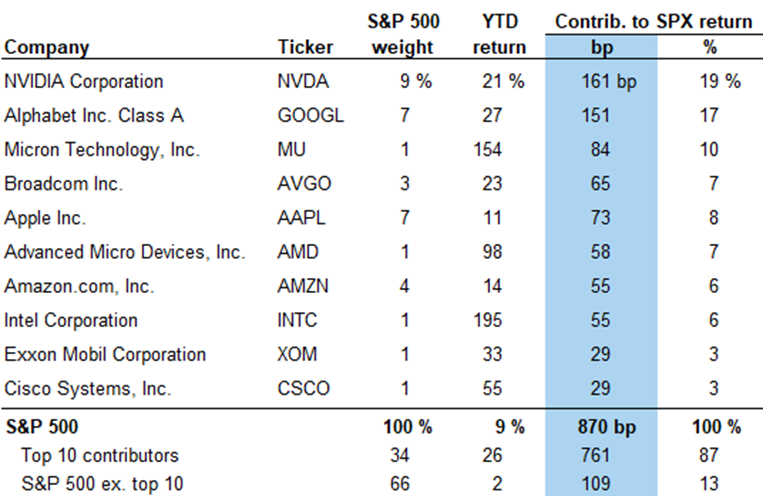
The top 10 contributors to the S&P500s returns YTD have accounted for 87% of the indexes returns.
Notably, $NVDA has driven 19% of returns, $GOOG has driven 17%, and $MU has driven 10% of returns.
If you pull out TMT stocks, the S&P500 returns go from 9% YTD to just 2%.
A mental model for working with coding agents is that they're blind squirrels running into a maze and bumping into walls. You must place the walls (verifiable constraints) strategically so that they end up in the general region you want them in.
Smartphones are not the explanation for the recent decline in fertility. Instead, they are an accelerator of deeper forces already at work.
Let’s start with the facts. Fertility is falling almost everywhere: in rich, middle-income, and poor countries; in secular and religious countries; and in countries with high and low levels of gender equality.
The decline accelerated around 2014. So, no country-specific explanation will work unless you are willing to believe that 200 distinct country-specific explanations arrived at roughly the same time.
Smartphones look like the obvious candidate: the first iPhone was released in 2007, and global adoption has been astonishingly fast.
Economists understand the first major decline in fertility in advanced economies, from 6 or 7 children per woman throughout most of human history to about 1.8, that occurred between the early 1800s and roughly 1970, well before smartphones. The main drivers were a sharp fall in child mortality (effective fertility was rarely above 3 and often close to 2) and the shift from a low-skill, rural agrarian economy to a high-skill, urban industrial one. We have quantitative models that fit these facts well.
Country-specific factors mattered too, of course. Proximity to low-fertility neighbors accelerated Hungary’s decline, while fragmented landowning structures accelerated France’s. But these were second-order mechanisms.
This is also why most economists long considered Paul Ehrlich’s doom scenarios implausible. We forecast that fertility in middle- and low-income economies would follow the same path as in the rich, probably faster, because reductions in child mortality reached India or Africa at lower income levels (medical technology is nearly universal, and most gains come from handwashing and cheap antibiotics, not Mayo Clinic-level care). Much of what we see in Africa or parts of Latin America today is still that old story.
But in the 1980s, a new pattern appeared. Japan and Italy fell below 1.8, the level we had thought was the new floor. By 1990, Japan was at 1.54 and Italy at 1.36.
This second fertility decline began in Japan and Italy earlier than elsewhere, driven by country-specific factors, but the underlying dynamics were widespread: secularization, an education arms race, expensive housing, the dissolution of old social networks, and the shift to a service economy in which women’s bargaining power within the household is higher. The U.S. lagged because secularization came later, suburban housing remained relatively cheap, and African American fertility was still high. U.S. demographic patterns are exceptional and skew how academics (most of whom are in the U.S.) and the New York Times see the world.
My best guess is that, without smartphones, Italy’s 2025 fertility rate would be about 1.24 rather than 1.14. I doubt anyone will document an effect larger than 0.1-0.2. Italy was at 1.19 in 1995, not far from today’s 1.14. The TFR is cyclical due to tempo effects, so I do not read too much into the rise between 1995 and 2007 or the decline from 1.27 in 2019 to 1.14 today. The direct effect of smartphones is not zero, but it is not, by itself, that large.
Where social media, in general, and smartphones, in particular, matter is in the diffusion of social norms. What would have taken 25 years now happens in 10. Social media are not the cause of fertility decline; modernity is. But they are a very fast accelerator.
That is why social media are a major part of the story behind Guatemala (yes, Guatemala) going from 3.8 children per woman in 2005 to 1.9 in 2025. Without them, Guatemala would also have reached 1.9, just 20 years later.
Modernity, in its current form, is incompatible with replacement-level fertility. By modernity, I do not mean capitalism: fertility fell earlier and faster in socialist economies than in market economies. Socialist Hungary fell below replacement in 1960, and socialist Czechoslovakia in 1966 (both experienced small, short-lived baby booms in the mid-1970s). By modernity, I mean a society organized around rational, large-scale systems and formalized knowledge.
Countries will not converge to the same fertility rate. East Asia is likely stuck near 1, possibly below, given its unbalanced gender norms and toxic education systems. Latin America faces the same gender problem plus weak growth prospects, so I expect something around 1.2. Northern Europe has more egalitarian family structures and might hold near 1.5. The very religious societies are probably the only ones that will sustain 1.8.
All of this could change with AI or changes in population composition. We will see. But on the current evidence, deep sub-replacement fertility is the “new new normal.” Unless we reorganize our societies, better learn to handle it as best we can.
Distilled recap of the back-and-forth with Jensen on export controls:
Dwarkesh: Wouldn’t selling Nvidia chips to China enable them to train models like Claude Mythos with cyber offensive capabilities that would be threats to American companies and national security?
Jensen: First of all, Mythos was trained on fairly mundane capacity and a fairly mundane amount of it by an extraordinary company. The amount of capacity and the type of compute it was trained on is abundantly available in China.
Dwarkesh: With that, could they eventually train a model like Mythos? Yes. But the question is, because we have more FLOPs, American labs are able to get to this level of capabilities first. Furthermore, even if they trained a model like this, the ability to deploy it at scale matters. If you had a cyber hacker, it's much more dangerous if they have a million of them versus a thousand of them.
Jensen: Your premise is just wrong. The fact of the matter is their AI development is going just fine. The best AI researchers in the world, because they are limited in compute, also come up with extremely smart algorithms. DeepSeek is not an inconsequential advance. The day that DeepSeek comes out on Huawei first, that is a horrible outcome for our nation.
Dwarkesh: Currently, you can have a model like DeepSeek that can run on any accelerator if it's open source. Why would that stop being the case in the future?
Jensen: Suppose it optimizes for Huawei. Suppose it optimizes for their architecture. It would put others at a disadvantage. As AI diffuses out into the rest of the world, their standards and their tech stack will become superior to ours because their models are open.
Dwarkesh: Tesla sold extremely good electric vehicles to China for a long time. iPhones are sold in China. They didn't cause some lock-in. China will still make their version of EVs, and they're dominating, or smartphones, they're dominating.
Jensen: We are not a car. The fact that I can buy this car brand one day and use another car brand another day is easy. Computing is not like that. There's a reason why x86 still exists. There's a reason why Arm is so sticky. These ecosystems are hard to replace.
Dwarkesh: It's just hard to imagine that there's a long-term lock-in to the Chinese ecosystem, even if they have this slightly better open-source model for a while. American labs port across accelerators constantly. Anthropic's models are run on GPUs, they're run on Trainium, they're run on TPUs. There are so many things you can do, from distilling to a model that's well fit for your chips.
Jensen: China is the largest contributor to open source software in the world. China's the largest contributor to open models in the world. Today it's built on the American tech stack, Nvidia’s. Fact.
All five layers of the tech stack for AI are important. The United States ought to go win all five of them.
in a few years time, I'm making you the prediction that when we want American technology to be diffused around the world—out to India, out to the Middle East, out to Africa, out to Southeast Asia—on that day, I will tell you exactly about today's conversation, about how your policy ... caused the United States to concede the second largest market in the world for no good reason at all.
Great discussion here between @MikePMoffatt and @SabrinaMaddeaux re AG report of massive, systemic fraud and complete non-enforcement in international student program. Absolute scandal
Report singled out India as a major source of fraudulent applications
https://t.co/KpetsYMpNZ
Don’t know about Egypt, but in one week spent in India or Israel, you’ll negotiate more deals through a combination of anger, warmth, and guile, than years of American life.
A big pivot from Ken Griffin on AI:
“Number one is, in the last few months, there has been a step change in the productivity of the AI toolkit. It is profoundly more powerful than it was just nine months ago.
And for us at Citadel, that has allowed us to unleash a much broader array of use cases for AI. And it has been really interesting to watch, to be blunt, work that we would usually do with people with masters and PhDs in finance over the course of weeks or months being done by AI agents over the course of hours or days.
These are not these are not mid-tier white collar jobs. These are like extraordinarily high skilled jobs being, I'm going to pick a word, automated by agentic AI. And I gotta tell you, I went home one Friday actually fairly depressed by this because you could just see how this was going to have such a dramatic impact on society.
When you witness it in your own four walls, when you see work that used to be man years of work being done in days or weeks, it's like, wow, like that's the first time I've seen real impact in our four walls.”
This echoes my own experience with agents and the conversations I am having with students, friends & clients. The toolkit has dramatically transformed and it feels like in finance, for the first time, AI is real.
Jane Street just showed the inside of their AI training data center in Texas.
4,032 GPUs. 56 racks. 8,000 km of fiber. liquid cooling running through every server because air cooling can't handle the heat anymore.
but the part that got me was the origin story.
Ron Minsky, who co-heads their technology group. said their first compute cluster was literally six Dell boxes stacked on top of each other at the end of a desk row. they called it "the hive."
the trading systems sat out in the room with the traders because they wanted to be able to unplug them if something went wrong.
at one point, someone vacuuming the office unplugged a live trading system in the middle of the day.
from six Dell boxes and a vacuum cleaner incident to a liquid-cooled GPU data center processing trades in under 100 nanoseconds.
that's a 20-year arc.
No smoking gun, but the preponderance of evidence points to smartphones, not economics, as the culprit for the global drop in fertility:
• In the US and UK, births fell first and fastest in areas that got 4G earliest
• Birth rates were stable in the US, UK and Australia until 2007; in France and Poland until 2009; in Mexico and Indonesia until 2012; in Ghana, Nigeria and Senegal until 2013-15
Each of these inflection points matches local smartphone adoption (see picture).
• The younger the age group, the sharper the drop.
• in-person socialising among young adults is dropping. In SK, by 50% in 20 years
• Sexual dysfunction is higher among heavy social media user
• Effect is largest in culturally traditional societies — Middle East, Latin America, sub-Saharan Africa
• Decline holds across countries hit hard by GFC 2008 and those not hit, fast-growing and not growing.
Excellent again @jburnmurdoch.
https://t.co/RYEMXD2bRM
CoreWeave had ~$31 bn of in-service PP&E as of 3/31/26. They lease their datacenters. ~$1.4bn of operating lease expense this yr for active data centers. Let's assume leasing mkt is @ ~10% cap rate so cost-equivalent to lessors: ~$14bn.
i.e., they had ~$45bn of all-in-CapEx generating revenue as of 3/31/26, 1GW active power, close to Sacks' numbers
Let's be v generous and assume they need to put no additional CapEx in service to hit their revenue guide for 2026. This assumption is wrong (they have ~$10bn in CIP), but in their favor.
Their revenue guidance is $12-13 bn.
CoreWeave all-in CapEx / revenue = 3.6x
Sacks back-of-the-envelope all-in CapEx / revenue = 1.8x at midpoint
So either CoreWeave really sucks at this or these numbers are 50% off before we even get to margins.
Nvidia has taken equity stakes in CoreWeave, Coherent, Lumentum, Marvell, Nebius, Corning, and IREN — all in four months. The more partners that build around Nvidia's architecture, the harder it is to switch. That's the moat and the risk. $NVDA $MRVL $LITE Details here: