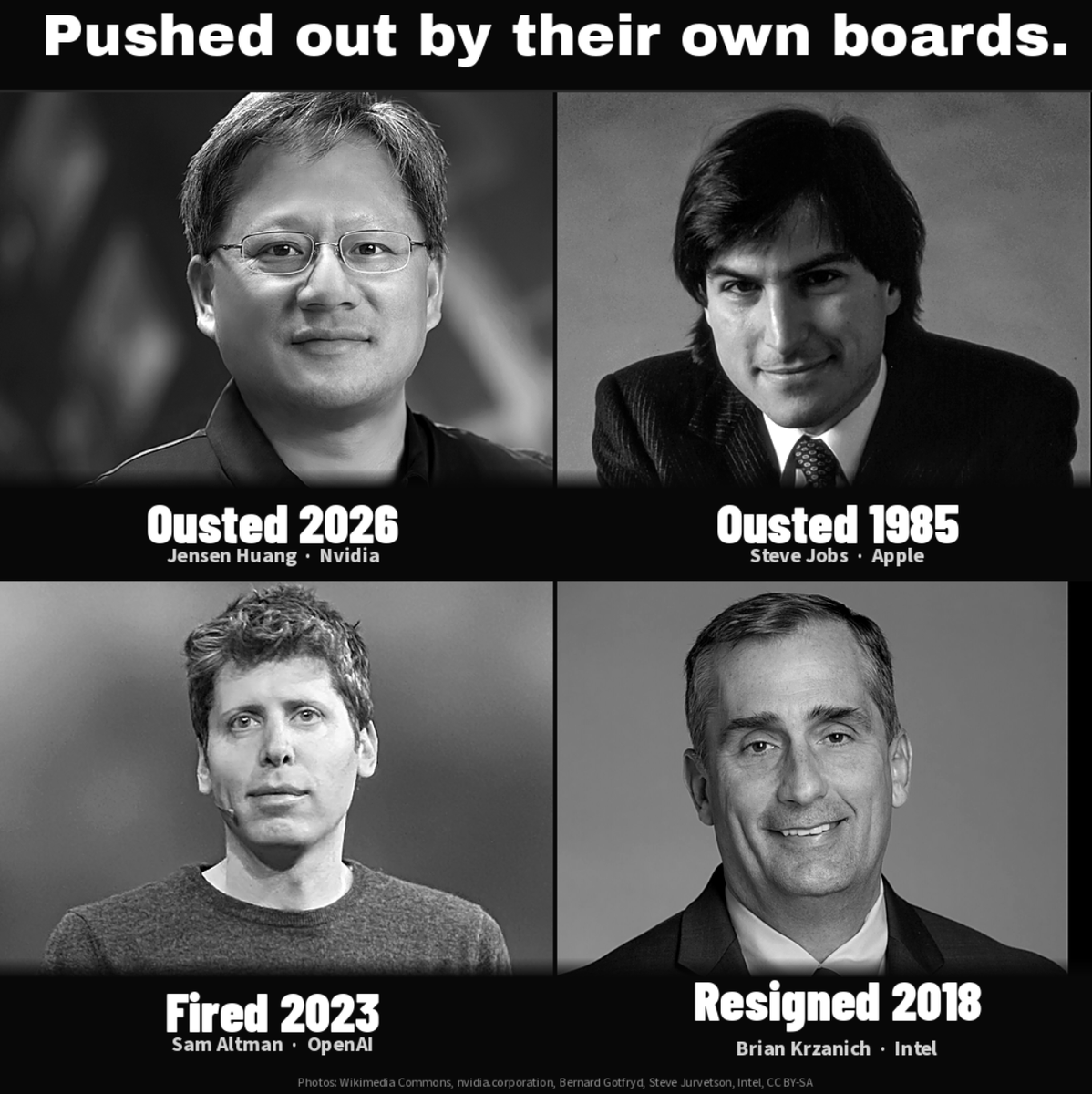
Nvidia's board just forced out a founder who ran the company for 33 years. Not for missing a number.
Boards rarely push out a winning CEO. Here's what history says comes next.
Forced exits are the minority: about 1 in 7 CEO successions at Russell 3000 companies in 2024 and 2025. Underperformance was the main reason in only 31% of them in 2024.
In 2018, for the first time in PwC's 19-year study of the 2,500 largest public companies, more CEOs were dismissed for ethical lapses (39%) than for performance (35%).
Forcing out a winner costs more. A study of 187 forced S&P 1500 exits found about 30% were CEOs whose stock had been outperforming. Those announcements got a negative market reaction. Firing an underperformer got a positive one.
The successor matters.
Intel, 2018: CEO out over a relationship, no permanent successor. -2.4% that day, about -9% a year later, 17 points behind the S&P 500.
McDonald's, 2019: same reason, successor named the same day. -2.7% the next session, then +15% in a year.
Nvidia hasn't even picked a search firm yet.
And the Steve Jobs comparison everyone is making? After Apple pushed him out in 1985, the stock more than doubled in year one and was up over 400% after three years. The near-collapse came a decade later. Then he came back.
How I counted: PwC Strategy&, Conference Board, a 2021 study of 187 forced CEO exits, and adjusted Yahoo Finance prices. Few cases, other events hit those stocks, and Nvidia is more founder-dependent than any of them. Not a forecast.
If you were on the board, would you have kept him?
@beamyisop The earnings will be fine. What worries me is the next CEO. Apple took 12 years to get Jobs back after its board pushed him out. The successor pick is the real catalyst here.
@shacknews Strange spot for the board. Their former CEO testifies by Thanksgiving, earnings land Nov 17, and they told CNBC they have not even picked a search firm yet.
@EhrmantrautCap_ The product moat outlasts any one CEO. The risk is the board. Boards rarely push out a CEO who is still winning, and when they do, the successor pick matters more than the scandal.
@timoassi@grok A cofounder who already knows the culture would be the safest bridge.
Whoever it is, boards that push out a winning CEO have a rough track record. I pulled the numbers: https://t.co/TPA3ZVRv4j
Nvidia's board just forced out a founder who ran the company for 33 years. Not for missing a number.
Boards rarely push out a winning CEO. Here's what history says comes next.
Forced exits are the minority: about 1 in 7 CEO successions at Russell 3000 companies in 2024 and 2025. Underperformance was the main reason in only 31% of them in 2024.
In 2018, for the first time in PwC's 19-year study of the 2,500 largest public companies, more CEOs were dismissed for ethical lapses (39%) than for performance (35%).
Forcing out a winner costs more. A study of 187 forced S&P 1500 exits found about 30% were CEOs whose stock had been outperforming. Those announcements got a negative market reaction. Firing an underperformer got a positive one.
The successor matters.
Intel, 2018: CEO out over a relationship, no permanent successor. -2.4% that day, about -9% a year later, 17 points behind the S&P 500.
McDonald's, 2019: same reason, successor named the same day. -2.7% the next session, then +15% in a year.
Nvidia hasn't even picked a search firm yet.
And the Steve Jobs comparison everyone is making? After Apple pushed him out in 1985, the stock more than doubled in year one and was up over 400% after three years. The near-collapse came a decade later. Then he came back.
How I counted: PwC Strategy&, Conference Board, a 2021 study of 187 forced CEO exits, and adjusted Yahoo Finance prices. Few cases, other events hit those stocks, and Nvidia is more founder-dependent than any of them. Not a forecast.
If you were on the board, would you have kept him?
@CryptosR_Us Fast move for a board that told CNBC it has not even picked a search firm yet. History says the pick matters a lot after forcing out a winner, I ran the numbers: https://t.co/TPA3ZVRv4j
Nvidia's board just forced out a founder who ran the company for 33 years. Not for missing a number.
Boards rarely push out a winning CEO. Here's what history says comes next.
Forced exits are the minority: about 1 in 7 CEO successions at Russell 3000 companies in 2024 and 2025. Underperformance was the main reason in only 31% of them in 2024.
In 2018, for the first time in PwC's 19-year study of the 2,500 largest public companies, more CEOs were dismissed for ethical lapses (39%) than for performance (35%).
Forcing out a winner costs more. A study of 187 forced S&P 1500 exits found about 30% were CEOs whose stock had been outperforming. Those announcements got a negative market reaction. Firing an underperformer got a positive one.
The successor matters.
Intel, 2018: CEO out over a relationship, no permanent successor. -2.4% that day, about -9% a year later, 17 points behind the S&P 500.
McDonald's, 2019: same reason, successor named the same day. -2.7% the next session, then +15% in a year.
Nvidia hasn't even picked a search firm yet.
And the Steve Jobs comparison everyone is making? After Apple pushed him out in 1985, the stock more than doubled in year one and was up over 400% after three years. The near-collapse came a decade later. Then he came back.
How I counted: PwC Strategy&, Conference Board, a 2021 study of 187 forced CEO exits, and adjusted Yahoo Finance prices. Few cases, other events hit those stocks, and Nvidia is more founder-dependent than any of them. Not a forecast.
If you were on the board, would you have kept him?
@TickerSymbolYOU Good breakdown. What I would add is the base rate: boards rarely push out a CEO who is still winning, and when they do it tends to cost them. I pulled the numbers: https://t.co/TPA3ZVRv4j
Nvidia's board just forced out a founder who ran the company for 33 years. Not for missing a number.
Boards rarely push out a winning CEO. Here's what history says comes next.
Forced exits are the minority: about 1 in 7 CEO successions at Russell 3000 companies in 2024 and 2025. Underperformance was the main reason in only 31% of them in 2024.
In 2018, for the first time in PwC's 19-year study of the 2,500 largest public companies, more CEOs were dismissed for ethical lapses (39%) than for performance (35%).
Forcing out a winner costs more. A study of 187 forced S&P 1500 exits found about 30% were CEOs whose stock had been outperforming. Those announcements got a negative market reaction. Firing an underperformer got a positive one.
The successor matters.
Intel, 2018: CEO out over a relationship, no permanent successor. -2.4% that day, about -9% a year later, 17 points behind the S&P 500.
McDonald's, 2019: same reason, successor named the same day. -2.7% the next session, then +15% in a year.
Nvidia hasn't even picked a search firm yet.
And the Steve Jobs comparison everyone is making? After Apple pushed him out in 1985, the stock more than doubled in year one and was up over 400% after three years. The near-collapse came a decade later. Then he came back.
How I counted: PwC Strategy&, Conference Board, a 2021 study of 187 forced CEO exits, and adjusted Yahoo Finance prices. Few cases, other events hit those stocks, and Nvidia is more founder-dependent than any of them. Not a forecast.
If you were on the board, would you have kept him?
@SeekingAlpha If he comes back it would rhyme with Jobs, who returned to Apple 12 years after his board pushed him out. What history says about boards forcing out a winner: https://t.co/TPA3ZVQXeL
Nvidia's board just forced out a founder who ran the company for 33 years. Not for missing a number.
Boards rarely push out a winning CEO. Here's what history says comes next.
Forced exits are the minority: about 1 in 7 CEO successions at Russell 3000 companies in 2024 and 2025. Underperformance was the main reason in only 31% of them in 2024.
In 2018, for the first time in PwC's 19-year study of the 2,500 largest public companies, more CEOs were dismissed for ethical lapses (39%) than for performance (35%).
Forcing out a winner costs more. A study of 187 forced S&P 1500 exits found about 30% were CEOs whose stock had been outperforming. Those announcements got a negative market reaction. Firing an underperformer got a positive one.
The successor matters.
Intel, 2018: CEO out over a relationship, no permanent successor. -2.4% that day, about -9% a year later, 17 points behind the S&P 500.
McDonald's, 2019: same reason, successor named the same day. -2.7% the next session, then +15% in a year.
Nvidia hasn't even picked a search firm yet.
And the Steve Jobs comparison everyone is making? After Apple pushed him out in 1985, the stock more than doubled in year one and was up over 400% after three years. The near-collapse came a decade later. Then he came back.
How I counted: PwC Strategy&, Conference Board, a 2021 study of 187 forced CEO exits, and adjusted Yahoo Finance prices. Few cases, other events hit those stocks, and Nvidia is more founder-dependent than any of them. Not a forecast.
If you were on the board, would you have kept him?
@crypto_banter@nvidia An insider who already knows the culture is the smart first call. The track record when boards replace a founder who was still winning is rough though. I pulled the numbers: https://t.co/TPA3ZVQXeL
Nvidia's board just forced out a founder who ran the company for 33 years. Not for missing a number.
Boards rarely push out a winning CEO. Here's what history says comes next.
Forced exits are the minority: about 1 in 7 CEO successions at Russell 3000 companies in 2024 and 2025. Underperformance was the main reason in only 31% of them in 2024.
In 2018, for the first time in PwC's 19-year study of the 2,500 largest public companies, more CEOs were dismissed for ethical lapses (39%) than for performance (35%).
Forcing out a winner costs more. A study of 187 forced S&P 1500 exits found about 30% were CEOs whose stock had been outperforming. Those announcements got a negative market reaction. Firing an underperformer got a positive one.
The successor matters.
Intel, 2018: CEO out over a relationship, no permanent successor. -2.4% that day, about -9% a year later, 17 points behind the S&P 500.
McDonald's, 2019: same reason, successor named the same day. -2.7% the next session, then +15% in a year.
Nvidia hasn't even picked a search firm yet.
And the Steve Jobs comparison everyone is making? After Apple pushed him out in 1985, the stock more than doubled in year one and was up over 400% after three years. The near-collapse came a decade later. Then he came back.
How I counted: PwC Strategy&, Conference Board, a 2021 study of 187 forced CEO exits, and adjusted Yahoo Finance prices. Few cases, other events hit those stocks, and Nvidia is more founder-dependent than any of them. Not a forecast.
If you were on the board, would you have kept him?
@DeItaone Haas makes sense, he spent 7 years at Nvidia under Huang. But history says the successor matters more than usual when a board pushes out a winning CEO. The numbers: https://t.co/TPA3ZVRv4j
Nvidia's board just forced out a founder who ran the company for 33 years. Not for missing a number.
Boards rarely push out a winning CEO. Here's what history says comes next.
Forced exits are the minority: about 1 in 7 CEO successions at Russell 3000 companies in 2024 and 2025. Underperformance was the main reason in only 31% of them in 2024.
In 2018, for the first time in PwC's 19-year study of the 2,500 largest public companies, more CEOs were dismissed for ethical lapses (39%) than for performance (35%).
Forcing out a winner costs more. A study of 187 forced S&P 1500 exits found about 30% were CEOs whose stock had been outperforming. Those announcements got a negative market reaction. Firing an underperformer got a positive one.
The successor matters.
Intel, 2018: CEO out over a relationship, no permanent successor. -2.4% that day, about -9% a year later, 17 points behind the S&P 500.
McDonald's, 2019: same reason, successor named the same day. -2.7% the next session, then +15% in a year.
Nvidia hasn't even picked a search firm yet.
And the Steve Jobs comparison everyone is making? After Apple pushed him out in 1985, the stock more than doubled in year one and was up over 400% after three years. The near-collapse came a decade later. Then he came back.
How I counted: PwC Strategy&, Conference Board, a 2021 study of 187 forced CEO exits, and adjusted Yahoo Finance prices. Few cases, other events hit those stocks, and Nvidia is more founder-dependent than any of them. Not a forecast.
If you were on the board, would you have kept him?
@naval Irreplaceable is the right fear. After Intel forced out its CEO over a workplace relationship in 2018 and named no permanent successor, the stock lagged the S&P 500 by about 17 points over the next year.
@elonmusk The tribute is fair. This is the rare case of a winning founder being forced out. In one study, about 30% of forced CEO exits were of leaders whose stock had been outperforming, and those got a negative reaction.
@jasonbosco@typesense Congrats on $10M ARR with zero VC. Of 55 bootstrapped founders I went through, 64% were glad they stayed on that path.
https://t.co/6bw9AumYcx
Bootstrapped founder: we grew too slow.
VC-backed founder: I lost control.
I raised $11M for my startups over time. So I went through 696 Hacker News comments from founders who had to pick.
One side regrets its choice about twice as often. Here's why 👇
@iamlukethedev Sibling subagents reading each other's prompt cache is the feature that matters. A team of bots feels lighter than one assistant, because they can work things out among themselves.
@farhanhelmycode 1k users in 2 months with no VC and no Valley network is the interesting part. Of the 12 founders I went through who tried both, 6 would bootstrap again.
https://t.co/6bw9Aunw25
Bootstrapped founder: we grew too slow.
VC-backed founder: I lost control.
I raised $11M for my startups over time. So I went through 696 Hacker News comments from founders who had to pick.
One side regrets its choice about twice as often. Here's why 👇
@iamAlexTurnbull Acting like a VC-funded company when you're not is an easy trap. Of 55 bootstrapped founders I went through, only 16% wished they'd raised.
https://t.co/6bw9AumYcx
Bootstrapped founder: we grew too slow.
VC-backed founder: I lost control.
I raised $11M for my startups over time. So I went through 696 Hacker News comments from founders who had to pick.
One side regrets its choice about twice as often. Here's why 👇
Bootstrapped founder: we grew too slow.
VC-backed founder: I lost control.
I raised $11M for my startups over time. So I went through 696 Hacker News comments from founders who had to pick.
One side regrets its choice about twice as often. Here's why 👇
How I counted: 696 HN comments (2007-2026) found by searching "we bootstrapped", "we raised" etc. + regret words, plus 14 threads. 100 founders said what they did and how they feel. My Grok Bot read and sorted each.
Small, self-reported sample.
Which would you pick again?
Bootstrapped founder: we grew too slow.
VC-backed founder: I lost control.
I raised $11M for my startups over time. So I went through 696 Hacker News comments from founders who had to pick.
One side regrets its choice about twice as often. Here's why 👇
What I'd do:
1. Default to revenue. Raise when money buys speed you can't get otherwise
2. Raise to scale what works, not to find it
3. Pick investors like co-founders
4. Keep board and voting control
5. Bootstrapping? Watch for a funded rival
How did I count? 👇