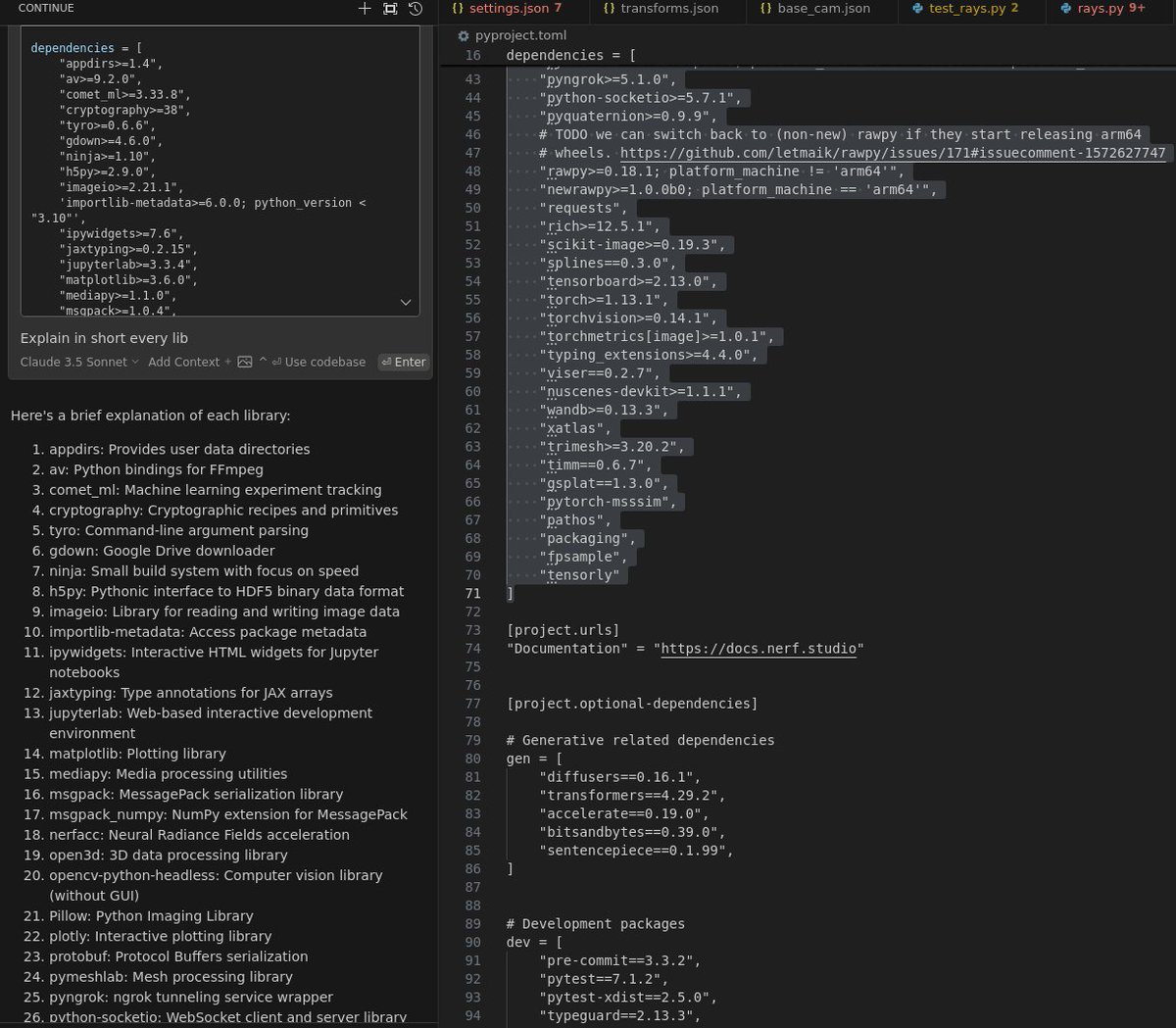
With LLMs (Claude 3.5) you still need to argue and defend the solution until it's understood, i've not expected this and thought the code comprehension of a small contained programs was solved :thinking
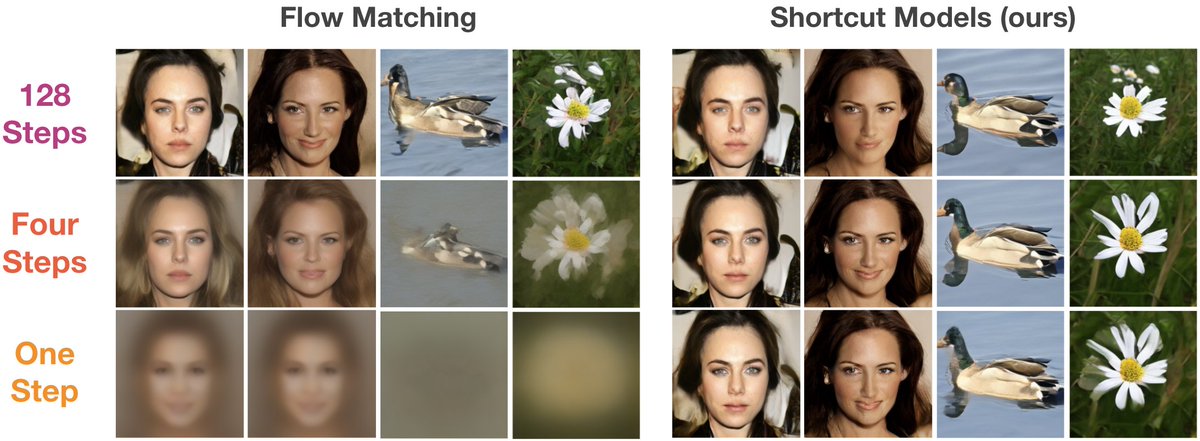
*Shortcut models* are a plug-and-play replacement for diffusion models that can generate in a single step (or more). This speeds up inference by up to 128x.
Shortcut models are trained end-to-end, and do not require a separate distillation phase or learning schedules.
What is the right benchmark for a 3D Egocentric Foundation model? We recently open-sourced a small, high quality egocentric benchmark consisting of 1) 3D surfaces 2) 3D objects. We released a simple 3D CNN baseline model called EVL: https://t.co/P3Fu57VEVQ
Try to beat our model!
How can we infer 3D-consistent poses and dense geometry in real-time given only RGB images?
𝗖𝗢𝗠𝗢 decodes dense geometry from a compact and optimizable set of 3D anchor points to enforce 3D consistency.
Project page: https://t.co/57wOkz6McV
Work with @AjdDavison
1/n
@GaryMarcus Seems like a good summary of the info from the page that it refers too https://t.co/aUHX9Uq7yy and btw, Russia troops recently took New York, after prolonged shelling.
SCOOP: OpenAI may lose $5B this year & may run out of cash in 12 months, unless they raise more $, per analysis @theinformation.
Investors should ask: What is their moat? Unique tech? What is their route in profitability when Meta is giving away similar tech for free? Do they have a killer app? Will the tech ever be reliable? What is real and what is just demo?
⚡️ Excited to share that I am starting an AI+Education company called Eureka Labs.
The announcement:
---
We are Eureka Labs and we are building a new kind of school that is AI native.
How can we approach an ideal experience for learning something new? For example, in the case of physics one could imagine working through very high quality course materials together with Feynman, who is there to guide you every step of the way. Unfortunately, subject matter experts who are deeply passionate, great at teaching, infinitely patient and fluent in all of the world's languages are also very scarce and cannot personally tutor all 8 billion of us on demand.
However, with recent progress in generative AI, this learning experience feels tractable. The teacher still designs the course materials, but they are supported, leveraged and scaled with an AI Teaching Assistant who is optimized to help guide the students through them. This Teacher + AI symbiosis could run an entire curriculum of courses on a common platform. If we are successful, it will be easy for anyone to learn anything, expanding education in both reach (a large number of people learning something) and extent (any one person learning a large amount of subjects, beyond what may be possible today unassisted).
Our first product will be the world's obviously best AI course, LLM101n. This is an undergraduate-level class that guides the student through training their own AI, very similar to a smaller version of the AI Teaching Assistant itself. The course materials will be available online, but we also plan to run both digital and physical cohorts of people going through it together.
Today, we are heads down building LLM101n, but we look forward to a future where AI is a key technology for increasing human potential. What would you like to learn?
---
@EurekaLabsAI is the culmination of my passion in both AI and education over ~2 decades. My interest in education took me from YouTube tutorials on Rubik's cubes to starting CS231n at Stanford, to my more recent Zero-to-Hero AI series. While my work in AI took me from academic research at Stanford to real-world products at Tesla and AGI research at OpenAI. All of my work combining the two so far has only been part-time, as side quests to my "real job", so I am quite excited to dive in and build something great, professionally and full-time.
It's still early days but I wanted to announce the company so that I can build publicly instead of keeping a secret that isn't. Outbound links with a bit more info in the reply!
Our paper "Foundations of Spatial Perception for Robotics: Hierarchical Representations and Real-Time Systems" has been published in the Intl. Journal of Robotics Research (IJRR): https://t.co/UQYfHWKiHa
In conjunction with the IJRR paper, we are pleased to announce ... [1/n]
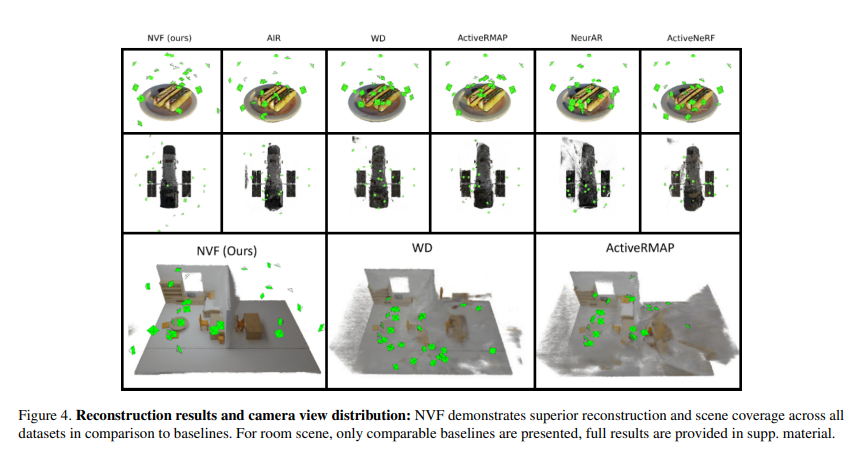
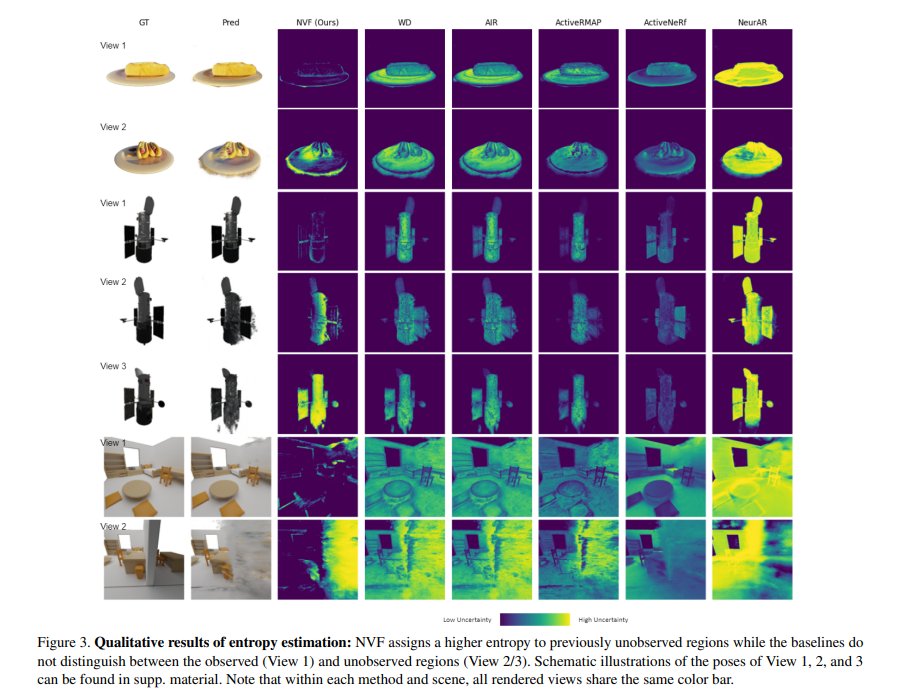
Neural Visibility Field for Uncertainty-Driven Active Mapping
@ShangjieXue, Jesse Dill, Pranay Mathur, @fdellaert, Panagiotis Tsiotra, @danfei_xu
tl;dr: visibility->uncertainty estimation;distribution of a color along a ray->GMM->entropy->next best view
https://t.co/qHNVcNumt5
I'm back to building! Excited to share I've started a company with @pariljain and @lukeholoubek. We're building bots that do chores so you don't have to. Everyone is busy. Bots can help.
So many things compete for our time - commutes, longer working hours, and the complexities of modern life. Our team has spent years building robots (including the self-driving kind) that give people some of that time back, and we're taking that a step further with this company.
We've raised $150m from an amazing group of investors and entrepreneurs, led by @natfriedman, @danielgross, and @nabeel. Also including @QuietCapital, @patrickc, @collision, @eladgil , @byersblake, @fiftyyears, and many more.
More to come soon! Follow our progress here @thebotcompany.
📢A new learning-based approach to SfM: #ACEZero
No img-to-img matching, optimises image-to-scene correspondences directly. Needs no pose priors. Works on unordered image sets. Efficiently handles thousands of images.
Paper: https://t.co/Zc83YpoXpY
Page: https://t.co/kutgb81eFV