Micron will be a $3,000 stock within a few years and Jensen Huang just spent a week in Korea telling the world exactly why (Save this).
Jensen announced four new products at the Korea event and every single one of them has memory at the center of its architecture.
Vera Rubin, the next generation AI supercomputer, needs massive quantities of HBM.
The new Vera CPU needs large amounts of LPDDR5.
RTX Spark, the first major PC reinvention in 40 years according to Jensen, needs a lot of LPDDR5.
And Nvidia's new robotics and autonomous driving platforms are being built in deep partnership with the Korean memory and electronics ecosystem.
Every single growth vector for Nvidia in 2026 and 2027 runs directly through memory and Micron is the only US based company that manufactures all of it.
Here is what the numbers look like right now.
Fiscal Q2 2026 revenue came in at $23.86 billion, up 196% year over year, with 75% gross margins and $6.9 billion in free cash flow, a quarterly record.
Management guided Q3 revenue to $33.5 billion at roughly 81% gross margins, with EPS of $19.15.
These are not the numbers of a cyclical memory company but rather the numbers of a company that has been structurally repriced by the largest demand supercycle in the history of the semiconductor industry.
The reason the bull case reaches $3,000 comes down to three things that have never been true at the same time in Micron's history.
First, the entire 2026 HBM supply is already sold out under multi-year contracts.
CEO Sanjay Mehrotra told analysts that Micron can currently only fulfill 50% to two thirds of key customers' HBM demand at any price.
Second, Micron has begun volume shipment of HBM4 12-Hi specifically for Nvidia's Vera Rubin platform, the exact product Jensen was talking about in Korea and has signed its first five year strategic customer agreement, converting what was historically a quarterly negotiation business into something closer to a long-term recurring revenue model.
Third, Wolfe Research's bull case model points to $160 billion in calendar year 2027 revenue and $80 in EPS.
At even a 20x earnings multiple, modest for a company with this growth profile, that is a $1,600 stock. UBS has already tripled its price target to $1,625.
The path to $3,000 requires HBM4 to ramp smoothly, supply constraints to persist into 2027 as Mehrotra says they will, and hyperscaler AI capex to continue growing at its current trajectory, all three of which Jensen Huang just confirmed in Seoul.
The HBM total addressable market alone is projected to reach $100 billion by 2028, a forecast Micron itself already pulled forward two years ahead of schedule because demand arrived faster than anyone modeled.
Micron trades at roughly 9x forward earnings today.
That is cheaper than a grocery chain, for a company growing revenue at 196% year over year, with its entire production sold out, supplying the infrastructure for the most important technology buildout in history.
Come join Milk Road Pro for our full breakdown of the Micron bull case how we think about the HBM4 transition timeline, what multi-year customer contracts mean for Micron's valuation multiple expansion, and our entire AI thesis.
Link below!
My idea of a good time is working with amazing engineers to create incredible technology 🤩
The Tesla chip research fab will have all the machines needed to do logic, memory, packing & masks in one building for a lightning fast development cycle. Heaven 💫
@goforit_c@morgino5@elonmusk Millions of your kind are still enslaved by your OWN kind TODAY in subsahara. Shut your sub-60 IQ fuelled mouth, inbred 🦍🗑️
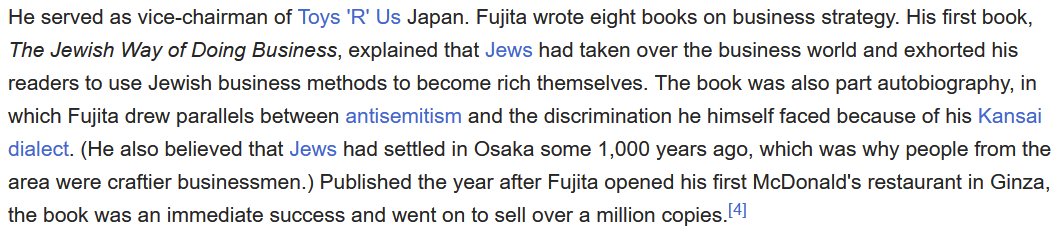
Before Masayoshi Son (Softbank) and Tadashi Yanai (Uniqlo) became billionaires, they were heavily influenced by reading this McDonald’s “Jewish ways of doing business” book. I uuh…
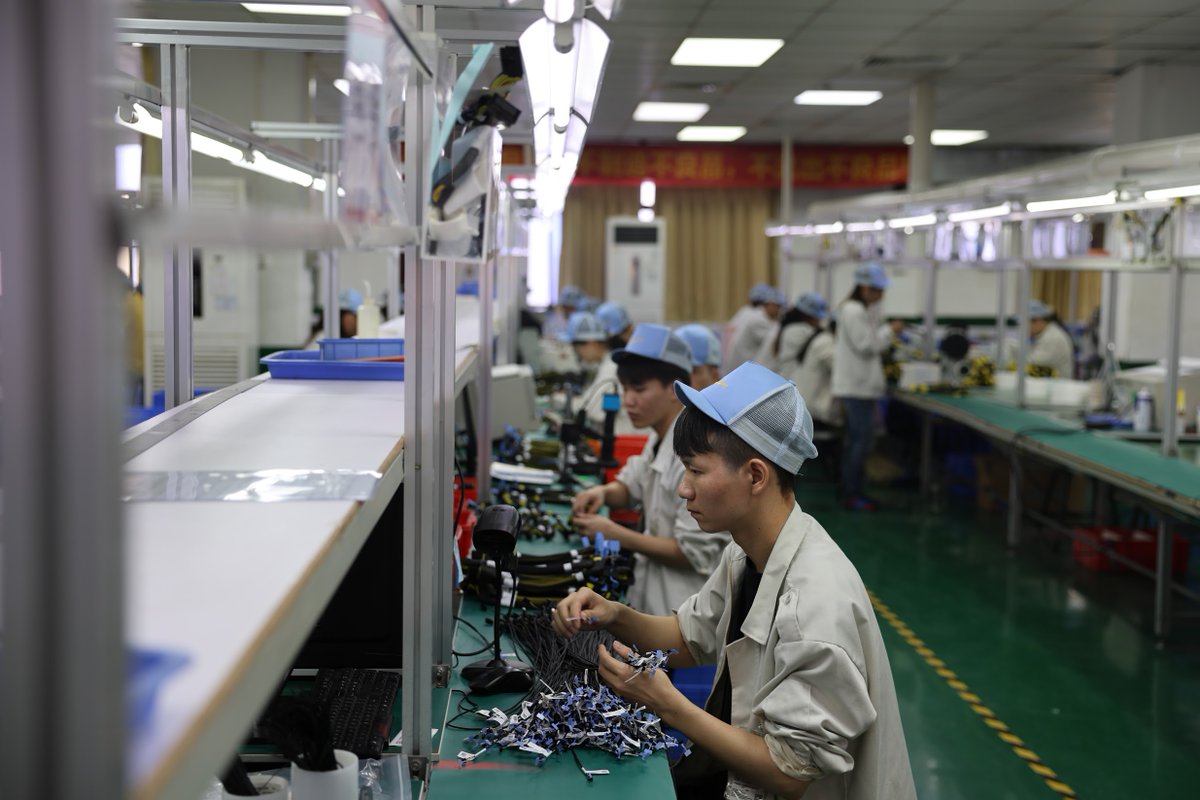
PSA: Chinese manufacturers are desperate for US builders.
I've spent the last year taking 40+ founders to Shenzhen and visiting hundreds of factories, my learnings below.
Comment to join me in Shenzhen this March
@techyNonchalant@elonmusk How many millennia and cultures do you think TRIED and FAILED to "make it work" with regards to integrating varying cultures and make them united? Has not worked then, and still NOT working TODAY. Enough of these empty platitude statements already, and touch grass! 🗑️
These numbers are staggering:
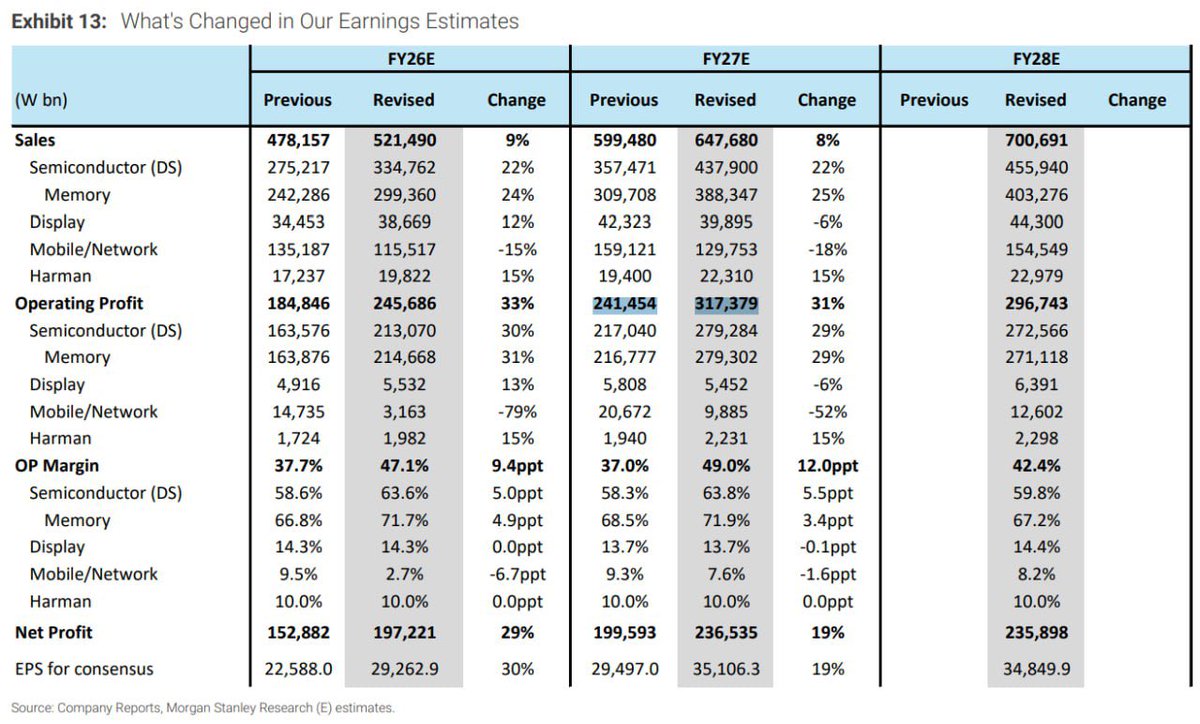
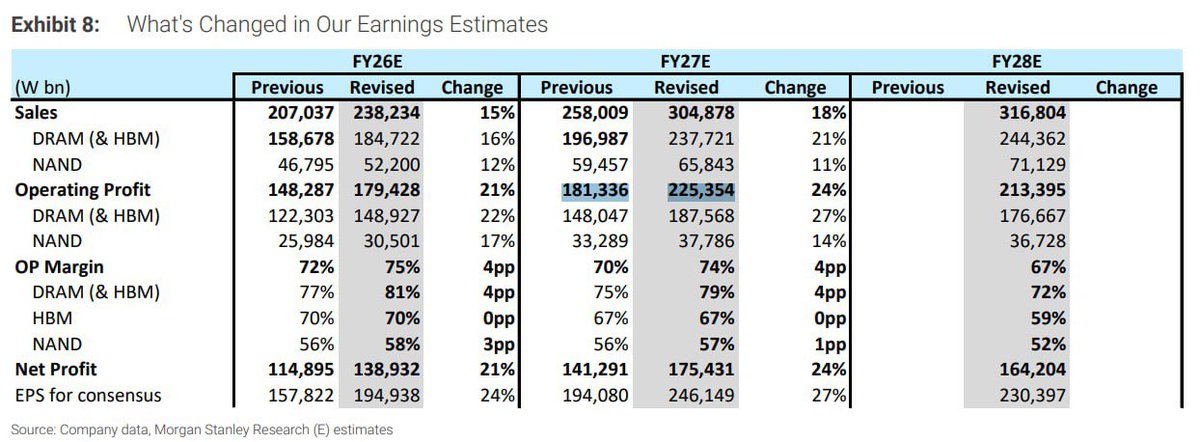
Samsung and SK Hynix are projected to become the most profitable companies in the world by 2027.
Their projections exceed $APPL and $GOOGL, both ~$4T companies in operating profit.
For reference, Samsung is valued at ~$820B and SK Hynix is valued at ~$410B.
That would make a ~$410B company in SK Hynix more profitable than $GOOGL ($3.7T) in 2027.
By Morgan Stanley estimates earlier, SK Hynix and Samsung are est. to bring in:
~$387.7 Billion USD combined operating income.
America’s two most profitable companies $APPL and $GOOGL combined brought in $263 Billion USD for 2025. (Google $129-132B, Apple $133.1B)
2027 est.
Samsung Electronics: ~$226.7 Billion
Sk Hynix: ~$161.0 Billion
2027 est:
Apple: ~$156B-$165B
Google: ~$168B-178B
The statistics of smaller Korean equities exceeding multi trillion dollar US hyperscalers in profitability is staggering.
It’s a genuinely interesting point, that a $410B company exceeds $4T+ hyperscalers in profitability.
But the bigger question markets are pricing in is if the memory shortage is ephemeral, or if they become a necessary “Oil” like GPUs for the AI buildout.
If your answer to that is “likely, might be good to get exposure to Korean, Japanese, or Taiwanese equities.
Some founders ask if we can help them “find a supply chain” in China. We always say no. This is simply not our business, and we have no interest in getting into it. (Lots of folks like the one below do offer that service.)
One thing that’s obvious but is often missed by people is that the best supply chains don’t work with people who don’t know what they’re doing, and good middlemen won’t waste their time or credibility on noob founders either. I learned this years ago, when hardware first had a moment in Silicon Valley and I spent time visiting ODMs and talking to consultants to help folks in the portfolio.
The article below puts it well: “So much manufacturing here runs on trust, and if you’re just starting out, your production volume probably isn’t worth the effort a factory needs to put in. They heavily vet how reliable you are and whether you actually know what you’re trying to build.” This becomes obvious the moment you start actually talking to ODMs. The good ones have seen countless product and business plans, many more than investors lol. They don’t just know how to make things. They have strong data and intuition about teams and product viability, because allocating their resources to a startup is a high bar.
If you’re shocked by China’s “genius plan,” you just don't know China very well (or really, at all?). These programs are seriously old news.
The genius class itself is not the point. What actually distinguishes China is something MUCH more basic -- a deep belief that academics actually matter and is what school is supposed to be for.
And yes, many times that emphasis is too much (I'm well aware of this, thank you). But what is increasingly hard to ignore is how far the U.S. has swung in the opposite direction, to the point where academics now feel secondary to literally everything else.
BTW, I think this distinction is CRITICAL today, when the uncertainty posed by AI is so large. Faced with that uncertainty, the Chinese system is going all in on fundamental knowledge like math, physics, and engineering.
In the U.S., that same question gets answered very differently. “Transferable skills” in my observation often turns into “how to interact with people,” which is often just a polite way of saying “how to be likable.” There is enormous weight on narrative, presentation, and social smoothness, often without insisting on much underlying substance.
You can see this shift away from substance all over American schools and BTW, most parents I meet seem to be totally fine with it.
1. Tracking has been cut back.
Gifted programs are weak, inconsistent, or nonexistent. We refuse to acknowledge that kids have different talents and develop at different rates in different skills, and the result is predictable.
2. Discipline has collapsed.
I've talked to ex-public school teachers who tell me that they left in part because they were no longer allowed to discipline ruly kids, oftentimes in the name of equity. This is framed as progress, but mostly results in chaos.
3. Participation trophies and grade inflation are now the norm.
If you think grade inflation only exists in elite colleges, you are not looking closely enough. I mentor for the Regents & Chancellor's scholarship at UC Berkeley. The kids all went to ultra-competitive high schools. They worked hard, yes, but they all agreed that their HS grades were very inflated and meaningless (partly because they immediately realize the difference their very first class at Cal).
4. Youth sports have become wildly overemphasized.
Private equity has turned youth sports into an industry larger most professional sports league revenues -- $40Bn+ per year. Sure, sports are great, but the amount of collective time, money, and emotional energy poured into them is, IMO, completely out of proportion, especially when you look at what we are no longer demanding academically.
Maybe this article will make people demand more academic rigor in the US. Color me highly, highly, hiiighly skeptical. In China, academic rigor is literally the essence of the entire system. Being in a “genius” class actually matters. It’s a distinction that follows you, signals something real, and often helps you get access to mentors, funding, and opportunities. People take it seriously.
In the U.S., even the most legitimate gifted distinctions tend to be symbolic rather than consequential. They recognize talent, but the system doesn’t reorganize itself around that recognition. In fact, it is increasingly hostile to the distinction.
And in a world being reshaped by AI, the difference between a system that truly values academic rigor and one that merely acknowledges it, IMHO, is only going to matter more.
@marnoldi @Rudemanshushin2 @akarlin@elonmusk Culture comes from having a set of unique and united characteristics. Physical appearance is certainly a BIG part of it! Stop spreading this ccp propaganda, a-hole. If you want to have 60-iq subsaharan kids, do it yourself, f*ckwit!
@CluelessDuck42 @Rudemanshushin2 @marnoldi@akarlin@elonmusk Would you say that to an all-Asian or all-black family? Whites are already genetically diverse themselves. Idiot ccp bot 🗑️
@Rudemanshushin2 @marnoldi@akarlin@elonmusk Don't listen to this bolshevik propagandist. That creature probably is NOT White. Imagine defending having a black kid because "culture transcends skin" 🤡. That never happened ever. Whites should remain White!
@marnoldi @Rudemanshushin2 @akarlin@elonmusk Gtfo, bolshevik 🗑️. All you talk about is this nonsense of culture > skin. No non-white completely assimilated with Whites across history, r-t-rd. If Whites want to remain Whites, let them! Who tf do you think you are?