Please stop using composite endpoints within composite endpoints.
Stop including outcomes of little importance/reliability in the composite.
Or at least, do not spin your conclusions by implying that all components were reduced when the overall result was driven by just one.
@prahladnb HINTS exam is not a stroke screen. It's to determine if patients with persistent dizziness/vertigo and nystagmus at rest have vestibular neuritis or a stroke. Using HINTS on patients without nystagmus at rest will give many falsely concerning results.
Quando o protagonismo dá ruim, o textão que viraliza é aquele que diz o contrário deste aqui. No mundo do futebol o que não faltam são análises e comentários "certeiros" após o desfecho.
Let’s keep it simple. There’s only really three classes of patients that need fluids. Patients who are hypovolemic and patients with tamponade or tension pneumothorax while you are preparing your needle.
5/ The retrospective design limits how certain we can be of this signal of harm. But consider INTERACT-2 and ATACH-2 found no meaningful benefit and this cohort showed what happens when these targets are actually implemented in the real-world and the potential harms associated.
The myth that will not die
(hint: prevalence = 0)
1. Treat dangerous hypoglycemia immediately. Do not wait for thiamine or anything else.
2. Have a low threshold to treat patients at risk for Wernicke's with IV thiamine.
https://t.co/ov1LYjU370
1/21
Acid–base interpretation often feels like a maze.
But there’s a simple way to make sense of it at the bedside.
It starts with pH, strong ions, and base excess.
1/
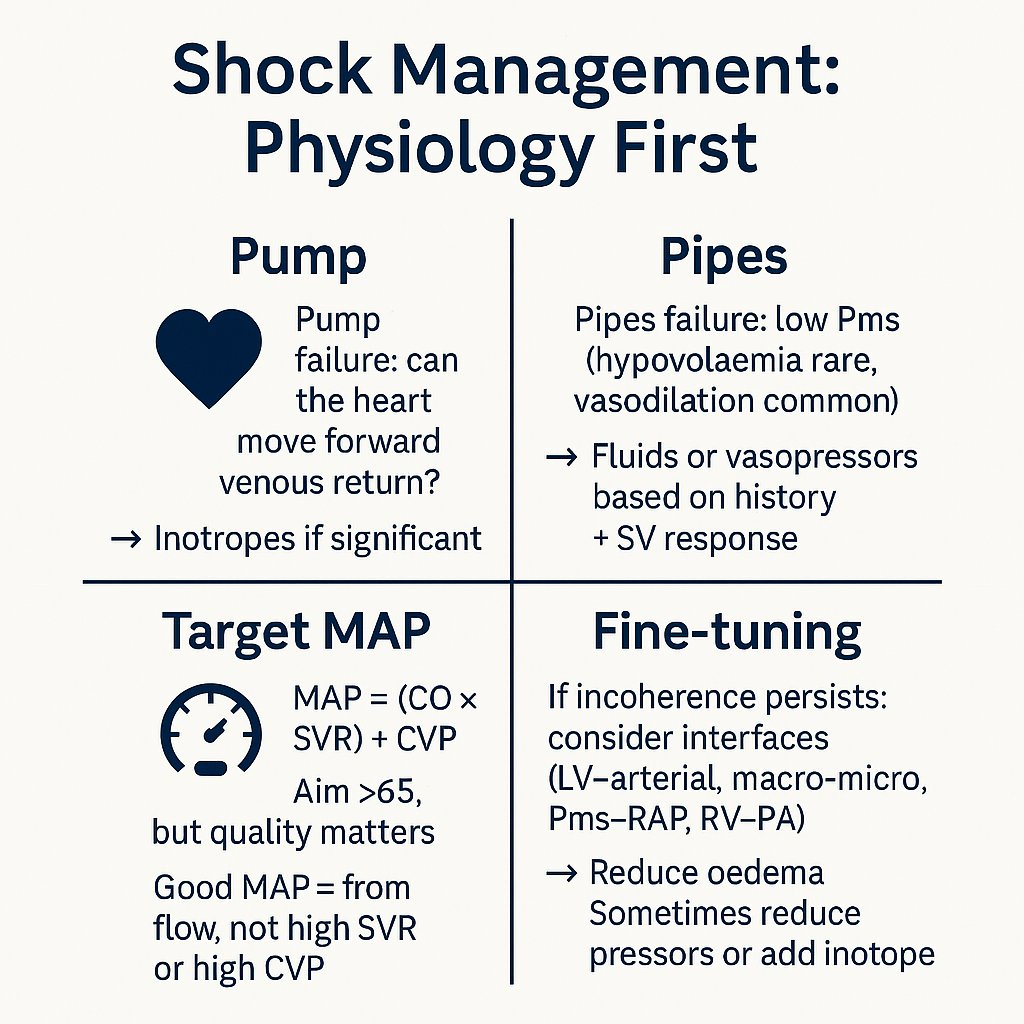
Shock isn’t “give fluids, then pressors, then inotropes.”
That recipe misses the physiology.
Here’s how to manage shock properly: 🧵
#MedX#haemodynamics
@JonahRubinMD@HarvardPulm@MGH_PCCM@MGHHeartHealth@MGHanesthesia@MGHHCICU Hello Jonah.
I always tell my colleagues to watch this sequence of lectures because they are the best that I’ve seen but i cannot find them anymore on YouTube!
How can I watch them again?
Thanks for your expertise and dedication.
🧵1/
Hypovolaemia is the most overdiagnosed concept in medicine.
We say it reflexively — especially in sepsis.
But here’s the uncomfortable truth:
We can’t measure blood volume.
We infer it.
Often wrongly.
Let’s unpack why that matters. 👇
#MedTwitter#FOAMed
💉“Is drawing blood cultures from an A-line really a no-go?”
Our new meta-analysis tackles this common ICU question!
🔍 Compared contamination rates between A-lines and venipuncture or V-lines:
🔸 A-line vs. venipuncture: no difference
🔸 A-line vs. V-line: A-line may actually have lower contamination
✅ With A-lines, you can draw painlessly, quickly, and in sufficient volume.
Still, many of us were taught: “Don’t draw from A-lines — it increases contamination.”
But that guidance was mostly based on central venous line data.
👨⚕️Our study suggests it may be time to reconsider: blood cultures from A-lines might be a valid option.
https://t.co/CXQUcwGmdf
A new addition to the ANDROMEDA-SHOCK family: PEGASUS! Providing an epidemiological perspective to the RR between pulse pressure and stroke volume! Fundamental study after A2! Cross-talk now between Physiology and Epidemiology!! NCT 06737614