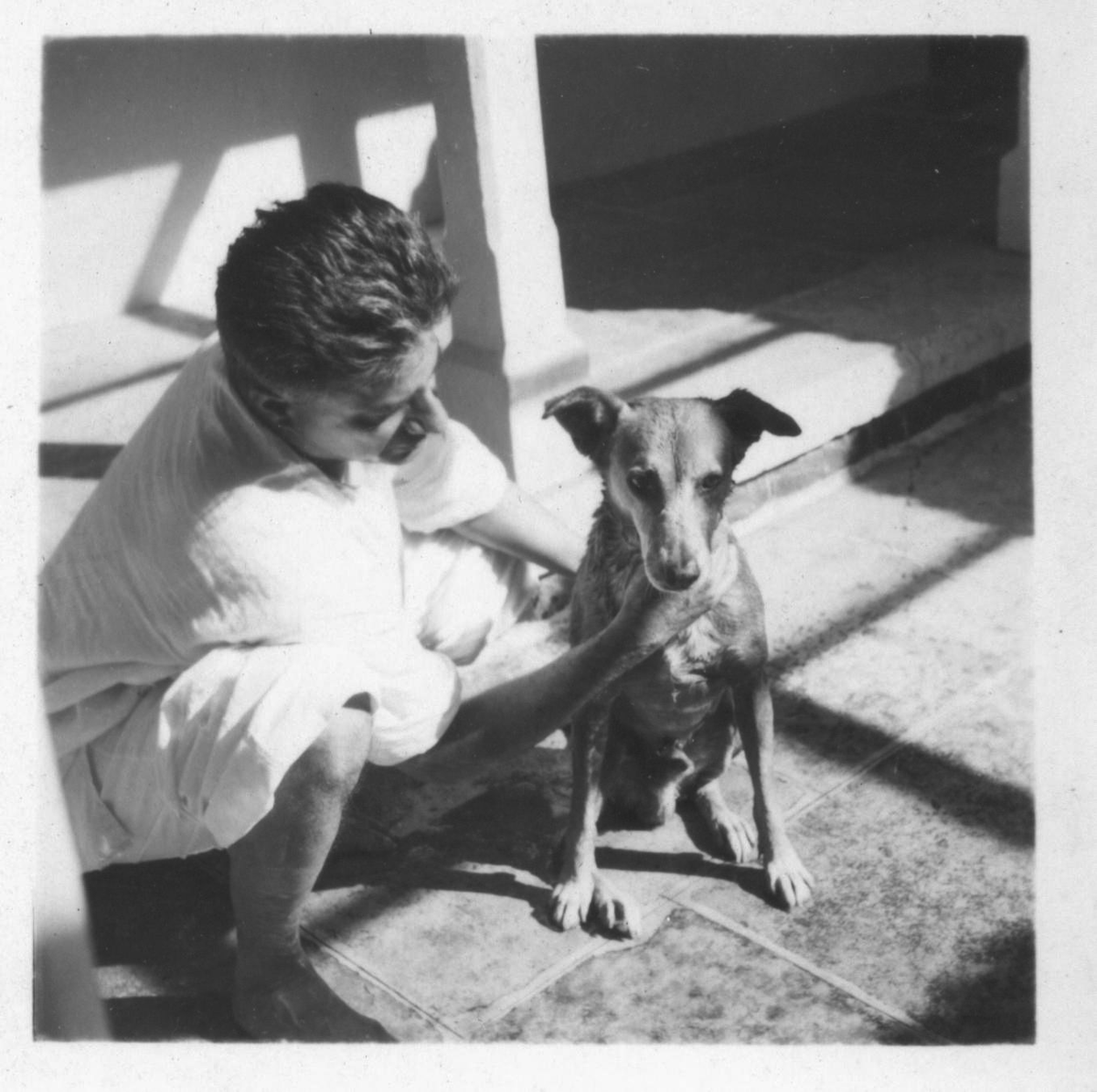
In 1931, a 24 year old Indian mathematician at Aligarh published a paper with a scandalous title: "On a Generalization of the Second Theorem of Bourbaki."
The scandal: Bourbaki did not exist.
Andre Weil, then head of mathematics at Aligarh had told young D.D. Kosambi about a legendary Paris student prank: a fake, bearded "Professor Bourbaki" who gave a much advertised lecture that was nonsense from start to finish.
Weil suggested Kosambi cite this phantom to deflate a pompous senior colleague.
So Kosambi did. His Bourbaki was "D. Bourbaki, a little-known Russian mathematician" who, the paper noted, had died of acute lead poisoning during the Revolution.
It was the 1st time the name Bourbaki ever appeared in mathematical print. A few years later, the most powerful group in French mathematics needed a collective pen name. They chose Bourbaki. Weil's wife Eveline baptized him "Nicolas."
The most famous mathematician of the 20th century was christened, in part, by a prank paper from Aligarh.
But Kosambi was not done.
30 years later, when petty referees kept blocking his papers, he did not argue. He published under a pseudonym: S. Ducray.
S = Sva. Sanskrit for dog.
Ducray = from Dukker, Marathi for pig, his affectionate name for Bonzo, the plump family dog.
In those papers, "S. Ducray" solemnly thanks Prof. D.D. Kosambi for his constant labour. One cites a private communication from Paul Erdos.
And the best part: two of the Ducray papers were formally communicated to the Indian Academy of Sciences by C.V. Raman. A Nobel laureate presented the dog-pig's work to India's highest scientific body, and nobody blinked.
Harvard-trained mathematician. Historian. Numismatist. Sanskritist. The man who mapped ancient India. And the only human who trolled Bourbaki before Bourbaki existed.
They do not make them like Damodar Dharmananda Kosambi anymore.
Photo: Kosambi with his dog Chatya. Bonzo was the other one.
Sources: C.K. Raju, EPW; Ram Ramaswamy's DDK memoirs (Ducray etymology is family lore per his account); Barany, "Impersonation and personification in mid-twentieth century mathematics."
Shazam could name any song back in 2002, on flip phones, with zero AI. You dialed the number 2580, held your phone up to the speaker, and hung up. 15 seconds later, a text came back with the song name. That same core trick still runs the app today.
The inventor was Avery Wang, a Stanford PhD in audio signal processing. His problem was brutal. Match a short clip recorded on a 2002 cell phone mic, in a noisy bar, against a database of a million songs, in seconds, over a phone call.
His solution treated music as geometry instead of sound.
The algorithm converts audio into a spectrogram, a picture of the song, then throws almost all of it away. It keeps only the peaks, the loudest frequency points at each moment in time. Bar chatter and blown-out speakers can wreck most of a recording. The peaks survive. Shazam only ever needed the peaks.
Those surviving points form what Wang called a constellation map, because it looks like a star field. Pairs of peaks get converted into hash numbers, and identifying a song becomes a dictionary lookup rather than an audio comparison. That made it fast enough to search a million tracks on 2002 hardware.
Wang published the full method openly in 2003 in a paper called "An Industrial-Strength Audio Search Algorithm." Anyone could read exactly how the magic worked. The moat was the database and the deals with carriers, never the secret.
Apple bought the company in 2018 for a reported $400 million. People have tagged over 100 billion songs since the very first one, Jeepster by T. Rex, during the beta in April 2002.
One deterministic signal-processing trick, written before most people had heard the phrase machine learning, and it's still so good that in 2026 everyone assumes it must be AI.
Jim Rohn at 25 had a degree, a job, a wife and a family. He couldn't afford a $2 box of Girl Scout cookies.
By the time he died in 2009, he had spoken to over 5 million people in 56 countries. Tony Robbins paid to sit in his seminars. So did Brian Tracy. His students went on to build hundreds of millions in personal wealth.
He changed nothing about his circumstances. He changed one thing about himself.
A wealthy man named Earl Shoaff asked to see his list of goals. Rohn had no list.
He said if you don't have a list, I can already tell you the balance in your bank account is a few dollars.
He was right.
Shoaff gave him one sentence that started everything.
Don't wish it were easier. Wish you were better.
Rohn became a willing student overnight. Within a few years he was a millionaire.
Then he spent the next 40 years explaining exactly how it works. To executives, to broke 25-year-olds, to anyone who would sit still long enough to listen.
He said income doesn't change until the person changes.
If you took all the money in the world and distributed it equally to everyone, it would soon all be back in the same pockets.
He explained the law that governs every paycheck.
You don't get paid for the time. It takes time to bring value to the market but you get paid for the value, not the time.
So the only question that matters at work is not what will you earn. The question is what will you become.
He explained the math no one teaches in school.
Two people. Same age. Same school. Same company. Same city. Same traffic. Same problems. One makes $1,000 a month. The other makes $2,000.
The list is identical. The money is double. Why.
Not time. Not luck. Not connections.
Value. You can't find more time. But you can become more valuable.
He had a friend, Robert, who became a salesman when everyone told him he was insane. His brother mocked him publicly. Told him he'd lose everything.
Robert said the way my brother treated me when I became a salesman made me so angry I decided to become rich.
He became a millionaire.
Rohn called it the formula. Find reasons and the answers come. Without reasons you are just hoping.
And hope, he said, is a disease.
The man who couldn't buy a $2 cookie went on to teach the most successful people in America how to think about money, time and personal growth.
The seminar is free on YouTube. Filmed in 1981. Over two hours.
Almost nobody has watched it as a complete explanation of why two people with identical lives end up in completely different places.
Mark Zuckerberg is bankrupting a $22 billion startup because they refused to sell to him.
The company is Kalshi.
They run the largest prediction market in the US. Users bet real money on real-world outcomes.
Last year, prediction markets did $28 billion in monthly volume across the industry.
This month, they did $220 BILLION.
The sector literally 8x'd in a single year.
Bernstein now projects the entire prediction market industry will hit $1 TRILLION by 2030.
Zuckerberg saw the growth curve coming. Last year, when Kalshi was valued at only $2 billion, he sat down with founder and CEO Tarek Mansour to discuss buying the entire company.
Mansour said no.
Kalshi went on to raise at $11 billion in December. Then $22 billion in March. It is now pursuing a $40 billion round and openly weighing an IPO.
Zuckerberg's response:
He walked back to Meta headquarters, took every piece of information he learned in that meeting, and directed a small internal team to build a Kalshi clone from the ground up.
Meta's version is called Arena. It uses Llama to generate the questions. Every one of Meta's 3.5 billion daily users will get access.
And here's where the plan gets ruthless...
Meta is deliberately launching with play money. That single decision lets Zuckerberg dodge every gambling regulator on Earth while he trains billions of users to bet on prediction markets.
Meanwhile Kalshi is spending millions fighting state gambling laws, the CFTC, an Illinois sports tax, a Minnesota felony statute, and the Department of Justice.
Kalshi is the crash test dummy. Meta is the getaway driver.
The moment the regulatory war is settled, Zuckerberg flips the switch. Arena becomes a real-money market, and 3.5 billion users are already trained to use it. Kalshi's user base of a few million cannot compete.
This is the exact playbook Meta ran on Snapchat in 2016 when Instagram Stories launched. It is the exact playbook they ran on TikTok in 2020 when Reels launched. It is the exact playbook they ran on Twitter in 2023 when Threads launched.
The FTC took Meta to court over this pattern last year and called it "buy or bury." The judge sided with Meta. So the playbook is legally protected.
Tarek Mansour walked into a meeting with the most predatory copycat in tech history and gave him the entire pitch deck for the fastest growing product in Silicon Valley.
Six months later, Zuckerberg is executing on that intel while Mansour is stuck defending his company in courts across America.
Kalshi survived Zuckerberg's offer. But it probably will not survive Zuckerberg's clone.
Meta ended Q1 with $81 billion in cash. That is enough to buy every prediction market company on Earth six times over. Zuckerberg is choosing to STEAL them instead because he can, and because the courts already gave him permission.
The next 12 months will decide whether Kalshi becomes a $50 billion IPO or a cautionary tale about what happens when a founder says no to Meta.
What do you think?
I just learned about a concept, I can't stop thinking about.
The Four Burner Theory.
It destroyed Elon Musk's first marriage.
It explains why Bezos is jacked but divorced.
And why Zuckerberg has no real friends.
Once you understand it, your life will never be same:🧵
The most important lesson in investment history got completely lost.
Druckenmiller pitched Soros on shorting the British pound in 1992. $5.5 billion. 100% of the fund. He thought that was bold.
Soros told him it was timid.
"That is the most ridiculous use of money management I've ever heard. We should be 200% of our net worth in this trade, not 100%."
What most people misread: Soros wasn't reckless. He was calculating asymmetry.
The British pound was trapped inside the European Exchange Rate Mechanism at a rate the UK couldn't sustain. Inflation was 10%. Unemployment was surging. Interest rates would have to go to 15% to defend the peg, which would collapse the housing market and politically finish any government that tried it.
The trade had a ceiling and a floor. If it worked, you made a fortune. If it didn't, Britain defending the peg raised rates high enough that you exited at a small loss.
This is what Soros actually teaches and nobody says it plainly: position sizing is a function of conviction, not diversification. When the expected value is radically positive and your downside is bounded, putting in 100% means you didn't actually believe your own analysis.
They put in more. The fund made $1 billion in a single day. September 16, 1992. Black Wednesday.
Druckenmiller has given dozens of interviews since. The lesson he repeats every time: when you're right, most investors still undersize the position. The rarest skill in money isn't finding the trade. It's having the nerve to actually bet it.
A man invested $53,000 of his family's savings into a dying video game store. Hedge funds laughed. He turned it into $48 MILLION and made Wall Street beg Congress to stop him.
> Keith Gill was a 34 year old financial analyst at a Boston insurance firm in 2019. His salary was ordinary but his conviction was not.
> He believed GameStop, a struggling mall video game retailer trading at $5 a share, was one of the most undervalued companies in America.
> Wall Street disagreed. Hedge funds had shorted the stock so aggressively that more shares were shorted than actually existed. They were certain it was going to zero.
> Gill invested $53,000 of his family's savings and started posting his analysis online under the name DeepFuckingValue on Reddit and Roaring Kitty on YouTube.
> Nobody took him seriously. He kept posting anyway, week after week, with nothing but spreadsheets and conviction.
> In January 2021 retail traders on Reddit's WallStreetBets discovered his posts.
> They started buying. The stock went from $5 to $483 in three weeks. A 9,600% move.
> Hedge funds that shorted the stock lost BILLIONS. One firm alone lost $6.8 BILLIO and had to be bailed out by other hedge funds.
> By January 27 2021 Gill's $53,000 investment was worth $48 MILLION.
> He lost $13 MILLION in a single day when the stock fell. He held anyway, without flinching, without selling a share.
> Robinhood restricted buying of GameStop without warning. Retail traders were furious. Congress summoned Gill to testify.
> He showed up in his Roaring Kitty headband and said three words that became the most quoted phrase in finance that year: "I like the stock."
> His employer fired him and paid a $4 MILLION fine for failing to supervise his trading.
> He went quiet for three years. Then in May 2024 he posted a single image on X. GameStop surged 50% the next morning before he said a word.
> By June 2024 his position was worth $289 MILLION.
> A Hollywood film called Dumb Money was made about the saga, starring Paul Dano. He has never spoken publicly about it.
He invested $53,000 into a stock Wall Street had already written off for dead. Hedge funds lost BILLIONS.
In August 2004, Peter Thiel met a 20-year-old college dropout named Mark Zuckerberg for the first time. The meeting lasted about an hour.
Thiel walked out having bought 10.2% of Facebook for $500,000.
The deal valued Facebook at $4.9 million.
Reid Hoffman, the future founder of LinkedIn, had set up the meeting. He'd seen the early version of TheFacebook .com, watched it spread across 20 colleges in a few months, and thought Thiel might want to put some money in. Zuckerberg had taken a leave from Harvard, moved to a rented house in Palo Alto with a handful of friends, and was looking for cash to keep buying servers as the user base grew.
Thiel was 36. He had recently sold PayPal to eBay for $1.5 billion and pocketed about $55 million as the company's largest shareholder. He had just started Clarium Capital and Palantir. He was looking for things to put money into.
In the meeting, Zuckerberg explained Facebook in flat, technical terms. The product was on 20 college campuses. They had around 100,000 users. The network was growing fast. Thiel later described him as an introvert who wasn't trying to sell anything, just describing what was happening. There was no slide deck.
Thiel told Zuckerberg to leave the room for an hour. He talked it over with one or two of his advisors. When Zuckerberg came back, there was a term sheet on the table.
Thiel has said in interviews that people imagine these meetings as Shark Tank pitches where the founder says exactly the right thing. This one was nothing like that. He invested because the product was already working. That was the entire reason.
The terms were simple. Thiel bought 10.2% for $500,000. Zuckerberg kept the ability to run the company the way he wanted.
By 2012, when Facebook went public, the math had already run away from any reasonable expectation. Thiel sold most of his stake at the IPO and made more than $1 billion on the original $500,000 check. He held a smaller piece for years after that.
If he'd kept the full original 10.2% untouched until 2024, the stake would have been worth roughly $180 billion. He didn't, but he'd already made more on the trade than most venture capitalists make in a career.
The pitch was thin. There was no deck. The founder was a 20-year-old introvert who wasn't trying to sell. The product was on 20 college campuses, and the market for a social network owned by college students wasn't a market anyone could yet point to.
Thiel didn't need any of that to be cleaner. He'd watched the early internet take off as a PayPal founder. He'd seen what fast user growth in a new category looks like before anyone has named it. He recognized the shape, in an hour, and he wrote the check.
Most investors miss the trade because they're waiting for the conditions to be obvious. By the time the conditions are obvious, you're not getting 10.2% for $500,000. You're getting 1% for $50 million from the 7th person to figure it out.
Thiel later boiled the principle behind every bet like this into a single question.
"What important truth do very few people agree with you on?"
why Ron Baron makes billions while most people lose everything
when asked how he turned a little money into $40 billion by just ignoring the news - he dropped the cold truth:
"guys stare at screens all day trying to guess what happens next - we buy a company and literally don't look at the price for years"
"when tesla crashed in 2019 everyone in finance panicked and sold - we didn't care at all, kept all our shares, and made $4 billion"
"regular guys sell the second a stock drops a few bucks - we buy a good company and just leave it alone even when everyone is freaking out"
Baron didn't make $40 billion by guessing what happens tomorrow. He made it by just sitting on his hands and doing absolutely nothing while everyone else panics
bookmark and watch him explain how he actually plays the game
Steve Jobs did not become a billionaire from Apple. He became one from a company he spent years trying to get rid of.
The company was Pixar.
In 1986, nine months after Apple forced him out, Jobs bought a small computer graphics division off George Lucas for ten million dollars. Five million to Lucas, five million in working capital. He renamed it Pixar and set out to sell high-end graphics computers.
The computers did not sell. The flagship machine cost a hundred and thirty five thousand dollars and found almost no buyers outside a few hospitals and government labs. The hardware business lost money, and Jobs eventually sold it off cheap.
What was left was a small group of animators making short films that won awards, including an Oscar, and earned almost nothing.
So Jobs paid for it himself. Year after year he covered Pixar's losses out of his own pocket, writing personal checks to keep the doors open. Over roughly nine years it came to an estimated fifty million dollars of his own money, poured into a company that lost money almost every single year.
He tried to get out. He shopped Pixar to Microsoft. To Paul Allen. To Hallmark. To Larry Ellison. He came within days of shutting the whole thing down.
He said it plainly later. "If I knew in 1986 how much it was going to cost to keep Pixar going, I doubt if I would have bought the company."
This is the man we now hold up as the great visionary, the one who could see what was coming. For nine years he could not tell whether the thing in his hands was worth anything, and most of the time he bet it wasn't.
In 1991, Disney agreed to fund and distribute a few of Pixar's films. The first one took four years to make.
It came out in November 1995. Toy Story. The first full-length computer-animated film ever made, and an enormous hit.
A week later, Pixar went public. Jobs had pushed the bankers to price the stock higher than they wanted. It opened at forty seven dollars a share, the largest public offering of the year. By the end of the first day, his stake was worth about one and a quarter billion dollars.
He owned roughly eighty percent of a company he had spent a decade trying to give away.
One of the men he'd tried to sell Pixar to was Larry Ellison. The night of the IPO, Jobs called him and said, "I made it."
Eleven years later Disney bought Pixar outright for seven and a half billion dollars, and Jobs became the largest single shareholder in Disney.
You can't tell your best decision from your worst while you're still paying for it. The bill comes first. The verdict comes years later, and it rarely matches what you believed while you were signing the checks.
@InvestorAyush Go for Techera engineering...a real undiscovered gem ....TAM, Tailwind,Runway ...... all in perfect sync
Only for educational purpose, my projections may go completely wrong, invested DYOR
@reachanandl At the max keep it 10 stocks...n if u really want to be wealthy in 5 years 5-6 stocks is the best strategy...think big...sixer marne ki socho.....5-6 I can tell only for educational purpose....My calculations/projections may be completely wrong