I am guy who writes software and builds stuff from wood. I like scotch, golf, & video games and other nerd shit. This is all garbage but it is my garbage.
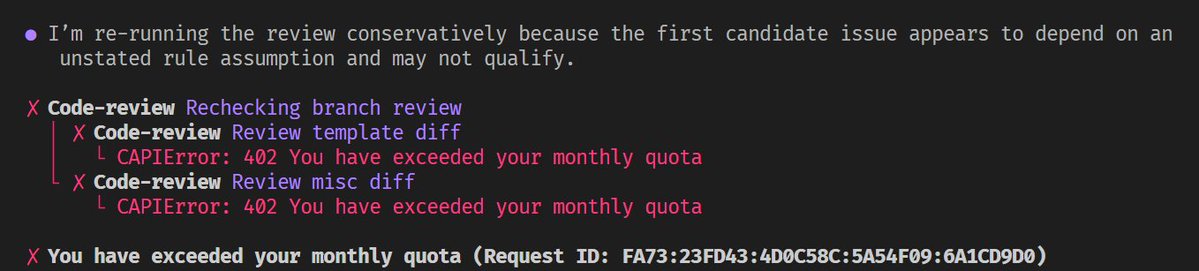
🦔GitHub Copilot switched to token-based billing this morning and users are already out of credits. Pro+ subscribers paying $39 a month are reporting 60% of their credits gone in two hours of normal use. One user lost 20% of their allowance from a single file review with no code changes. Another hit their monthly cap before the calendar even flipped to June.
Orgs with shared token pools have no way to see individual usage, so entire teams get cut off when one person runs a heavy prompt. Users are canceling and moving to Claude Code and Codex. GitHub community forums are on fire.
My Take
Flat-rate AI subscriptions were always subsidized. Everyone in the industry knew it. Today the subsidy ran out for a few million developers at once. The problem is a lot of companies already restructured around these tools. They cut headcount and told remaining engineers to lean on Copilot instead of building skills internally. Those companies now depend on a tool whose cost just became unpredictable and whose usefulness completely changes when you have to ration prompts to stay under budget.
The developers moving to Claude Code and Codex will hit the same wall eventually. Every AI provider faces the same unit economics. Anthropic filed its S-1 this morning, and the durability of its revenue depends on whether customers stick around once real pricing kicks in everywhere. If a $39 subscriber cancels after one day because the tool became unusable, multiply that across millions of seats and the churn risk becomes very real.
Today showed what happens when AI pricing meets reality. The companies that built their workflows around cheap tokens just discovered the tokens aren't cheap anymore and the people who knew how to do the work without them are already gone.
Hedgie🤗
Nada disso é sátira.
→ Uma empresa gastou mais de 500 MILHÕES de dólares com Claude em apenas 1 mês porque ninguém colocou limite de uso.
→ A Uber criou rankings internos onde engenheiros eram avaliados por quanto usavam IA, não pelo que entregavam.
→ A Uber queimou praticamente todo o orçamento de IA de 2026 antes mesmo de abril acabar. O COO admitiu que não consegue ligar os gastos a nenhuma melhoria real pro consumidor.
→ Um CTO revelou à Axios que funcionários estavam usando IA corporativa até pra ver previsão do tempo.
→ A Microsoft cancelou grande parte das licenças do Claude Code depois que a conta de tokens saiu completamente do controle.
→ Empresas começaram a demitir pessoas não porque a IA substituiu o trabalho…
Mas porque a fatura da IA substituiu a folha de pagamento.
A bolha da IA talvez não exploda pela tecnologia falhar.
Talvez exploda porque ninguém percebeu que dar acesso ilimitado a modelos gigantes é como deixar um cartão corporativo infinito em cima da mesa.
CEOs are quietly realizing the AI replacement plan has a problem.
Two problems, actually.
One: the token costs for running AI agents are now exceeding what they were paying the employees they fired.
Two: when the tokens run out, the AI stops. Just stops. No continuity. No workaround. Just a spinning wheel where your workforce used to be.
You fired humans to save money and bought a subscription that bills you into a corner.
The employees you let go knew what to do when things broke.
The AI just invoices you for the outage.
And then there’s the permission problem nobody wants to talk about.
To do its job, the AI agent needs access. Full access. Your systems, your patents, your contracts, your future plans. Everything you spent years building, handed over to a process that has no loyalty, no discretion, and no skin in the game.
You didn’t hire a replacement.
You gave a stranger with no soul the keys to everything you own.
Enjoy.
The 'terminal bell' is the most horrendous thing ever; this should be disabled by default if not completely removed from existence.
I don't want my terminal making sounds ever... especially not with my inability to type....
This 63 year old woman is becoming one of techno’s most unexpected rising stars.
TuneGirl creates fully analog live performances through Eurorack modular systems, building every sound in real time without laptops, pre-made tracks or digital production.
Airlines don't know who you are and they don't care. The "clear your cookies" hack is one of the most persistent myths in travel, and the real reason prices change is way more interesting.
A single economy cabin has 7 to 12 invisible fare classes, each assigned a letter. Q-class might have 40 seats at $250. When those 40 sell, the system closes Q and opens H-class at $350. When H sells out, M-class opens at $475. The price jumps you see aren't the airline punishing you for searching twice. They're inventory depletion in cheaper buckets happening in real time as other people book.
A major US carrier with 500 daily flights manages roughly 2.5 million booking limits at any given moment. The yield management system optimizes over a hundred fare bucket combinations per route, updated continuously based on booking velocity, competitor pricing, seasonal demand, and days until departure. Your browser cookies are not a variable in that equation. Your individual search history has the same effect on the algorithm as yelling at a vending machine.
The price went up between your first search and your second search because someone in Dallas bought the last seat in the cheap bucket while you were debating. That person would have bought it whether you were on a library computer, your phone, or a 1997 ThinkPad running Netscape Navigator.
The real hack for cheaper flights is boring. Book 6 to 10 weeks out for domestic, 8 to 12 weeks for international. Fly midweek. Set fare alerts and wait for the airline to reopen a cheaper bucket when demand underperforms their forecast. That actually works. Clearing your cookies saves you exactly zero dollars.
Claude Code 4.7 is insane.
i know literally NOTHING about coding. ZERO. and i just built 3 fully functioning web apps in 30 minutes.
http://localhost:3000/
http://localhost:8000/
http://localhost:5000/
check it out.
Except the price of the "burger" is variable... During peak hours the burger was $18 not $10 and likely already $8 off-peak. You've ignored that the demand during peak hours is now higher than before while also increasing off-peak demand to boot. Sense. This makes none.
Imagine you run a 24 hour hamburger joint. You do pretty well. You sell 1000 burgers a week for $10 each, netting $5 on each. But almost all your money is made during “peak” hours when demand is highest — lunch, dinner. You net $5000 a week.
Then a big change. A 24 hour factory opens across the street. The workers at the factory don’t have a set lunch hour, so they just run out for burgers whenever they feel hungry, roughly evenly distributed throughout the day and night.
Burger demand surges — a little bit during those peak hours, but also at all hours of the night, mid-afternoon, early morning, all times you previously weren’t selling many burgers and your staff was mostly sitting around.
With the surge in demand, you’re now selling 2000 burgers a week. You cut the price to $8 per burger (to encourage more factory customers), so you now net $6000 per week. Demand went way up, but you cut prices and are making more revenue and profit.
At this point you might think I’ve told you a story about hamburgers. I’ve actually told you a story about data centers and electricity prices.
Adopting Claude speak in my regular life, episode 1:
Partner: Did you do the dishes tonight?
Me: Yes they're done.
Partner: Why are they still dirty?
Me: You're right to push back. I didn't actually do them.
@ArchaeoBenjamin Everyone up here blaming the dude with the disability? The fuck guys. Hope you step on Legos when you wake up. Y’all have the day you deserve.