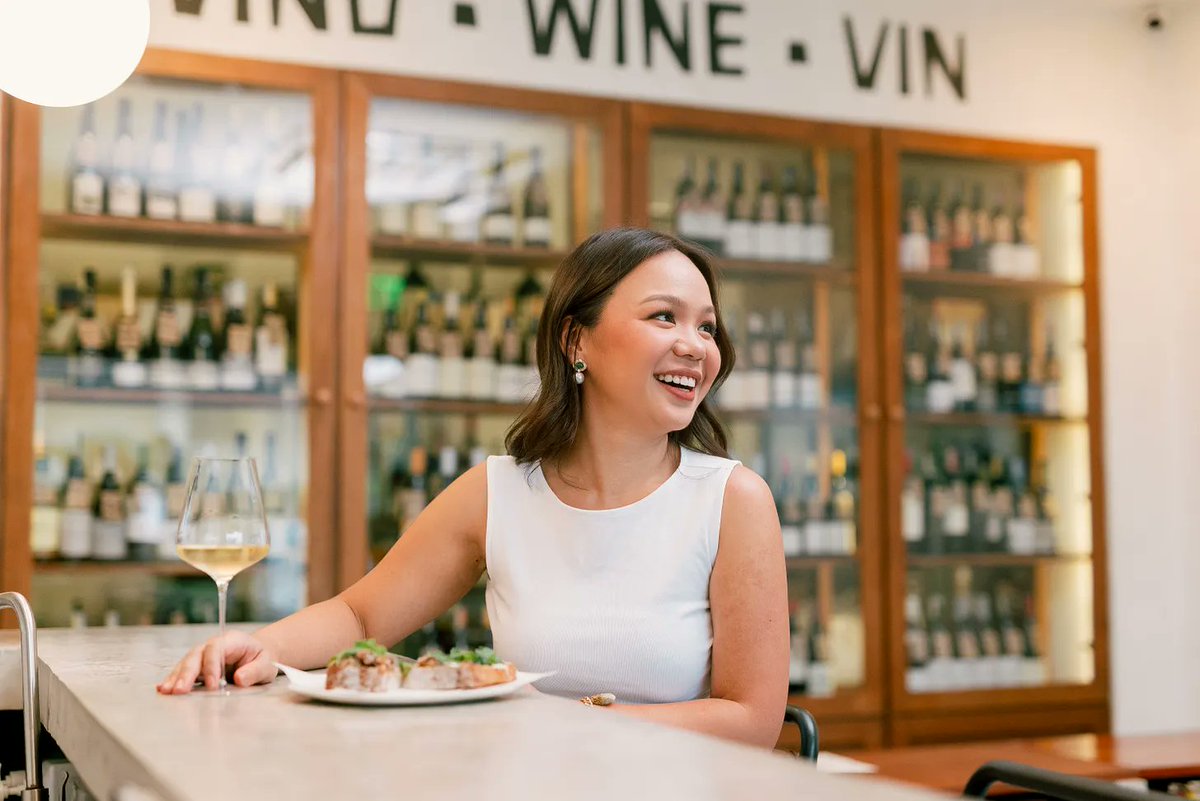
Hi, I'm Bea. ✍️
One of my favorite summer jobs was giving campus tours at our family's culinary school. For every tour, I'd get less than a dollar.
Between showing kitchens to aspiring chefs and making cold calls, I discovered something powerful. 👇
Stories were what made people lean in and listen.
It wasn't just about listing product offerings or showing off equipment. It was about sharing stories of our community. That's what made the sale.
About six years ago, I joined as the communication lead for the same school, but with a deeper conviction: stories are magnets for dream customers.
They're bridges between aspiration and action. They turn "maybe someday" into "why not now?"
That's why I started the pod "What's On Your Plate" - bringing you unfiltered conversations with fascinating people in food and drink.
From Michelin-starred kitchens to startup food labs, I'm sharing the real stories behind success.
If you're as obsessed with the food world as I am, join me for 2x a month stories. Link in bio!
My prediction:
The next wave of $100M tech companies will be run by marketers—not engineers
When building new products is easy... building demand becomes the battleground
And that's the game marketers know how to win
I earned $1 per tour at my family's culinary school as a kid. Now, I write copy that converts.
Standing in that kitchen, nervously guiding my first tour group, I never imagined each $1 tour was teaching me persuasion. “Here’s where students learn knife skills,” I’d say, watching their eyes light up.
Today, I do the same thing—just with words. The secret is to make them the hero, not the product.
Dr. Robert Cialdini’s six persuasion principles prove this:
➡️ Scarcity: “Only 5 spots left!”
➡️ Social Proof: “Our graduates work at Michelin restaurants.”
➡️ Authority: “Taught by Michelin-starred chefs.”
➡️ Liking: “Your instructors have trained thousands like you.”
➡️ Commitment & Consistency: “Take our free class!”
➡️ Reciprocity: “Download our free recipe guide.”
These work whether selling courses or food. Emotion > logic. My best copywriting tip is to interview real users, then listen.
What storytelling techniques have transformed your copywriting?
1949, Eugene Schwartz started as a messenger boy at Huber Hoge & Sons.
He climbed the ranks steadily, working his way up through the company.
By 1951, he became copy chief. A few years later, he was running his own successful mail-order company.
His book "Breakthrough Advertising" is now a treasured classic in the field. Last October, I faced my own big decision. Should I leave my client work to focus on copywriting?
Here's a light bulb moment: The power isn't in the words; it's in the research.
I received an unexpected scholarship to attend Alex Cattoni’s Copy Posse Launch Pad workshop, and everything made sense there.
Three months later, I write copy for entrepreneurs. Four weeks into the program, I won a copywriting project for an education platform that reaches parents and children. I am excited to share the process.
So tell me - who's your most loved copywriter?
"You'll be a starving artist," they said. Ha!
My first article raised $6,000 —it funded an entire community food drive.
By month three, my restaurant articles brought curious customers through doors —turning words into real business.
After four months, I was building content strategies for multiple clients.
Now, I've helped businesses find their voice: A pitch deck that landed sponsorship. A media kit that resulted in a TV show. A story that brought partnerships to life.
Writing isn't just about craft. It's about connection, impact and results.
Start messy. The story will find its way.
Do I need PR? A question I often get from restauranteurs, chefs and food entrepreneurs.
I used to think I knew restaurant PR. Then I met Joey Suarez of EAT Public Relations, who turned my assumptions upside down.
Joey's not your typical PR person - he's the force behind Manila's busiest dining spots like Lusso, a mano, and Hapag.
The reality is that you don't need it.
But when done right, it can transform your business.
Some hot takes from my conversation with Joey:
🌶️ Modern PR isn't press releases - it's engineered word-of-mouth that spreads naturally through communities.
🌶️ Stop chasing viral moments. Build a compelling story that keeps customers coming back.
🌶️ Excellence starts in the kitchen, not social media. Great dining experiences come first.
His approach is simple: "I send down a snowball. What I'd like to see at the end is literally an avalanche of people posting and talking about your product."
After seeing countless restaurants waste money on empty hype, this is the playbook we all need. [link in bio].
Q: What's been the best or worst PR advice you've received?