everyone's racing to build ai. almost nobody's talking about who's supposed to check it before it reaches the public
a new proposal wants to change that, and the most interesting part is who's asking for the rules
broke it down in this week's frontier watch. full episode below 👇
@decodeoblivion
Airdrops that pay for Discord roles get farmed.
Tim's alternative: score what wallets actually do onchain, the way Scroll and Linea did. @evaoltida's warning: more and more of those wallets will be AI agents.
AI can help you build an app in a weekend.
But can it help you find people who actually want it?
That’s the bigger challenge for AI-native founders.
In this episode, Addy De La Cruz explores why understanding the problem and reaching users matters just as much as writing code.
Worth watching if you’re building with AI.
@decodeoblivion@evaoltida@SerStaxx
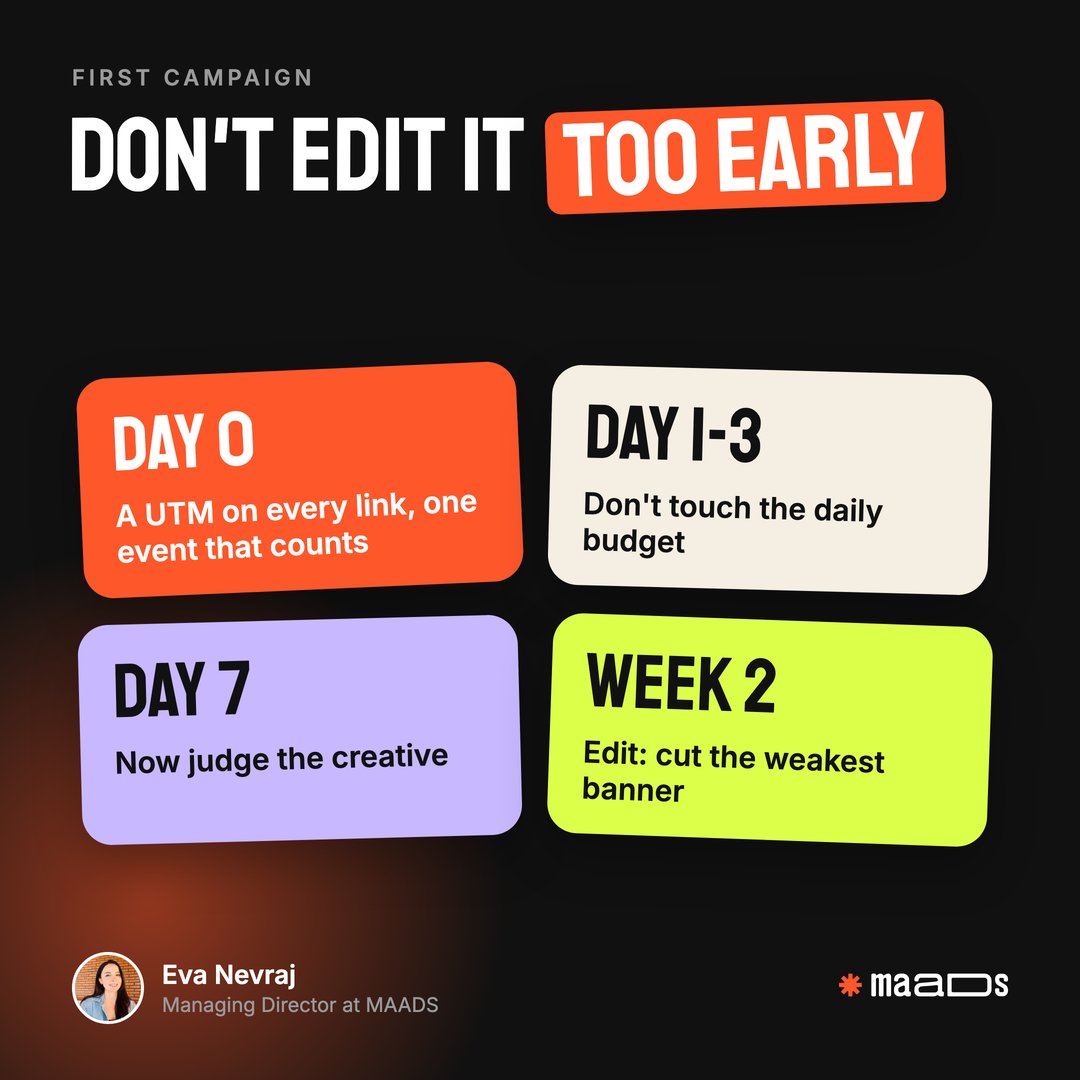
a common mistake on a first campaign is editing it too early.
the ctr looks low on day one, someone swaps the banner, someone else cuts the budget, and by day five nobody can tell what worked.
what we ask for in week one is simple. a utm on every link before launch.
one event that counts, a sign-up or a deposit, and the rest ignored for now.
three days of data before touching the daily budget, and a full week before judging a creative.
week two is for edits. by then there's enough data to know which banner and which placement to cut.
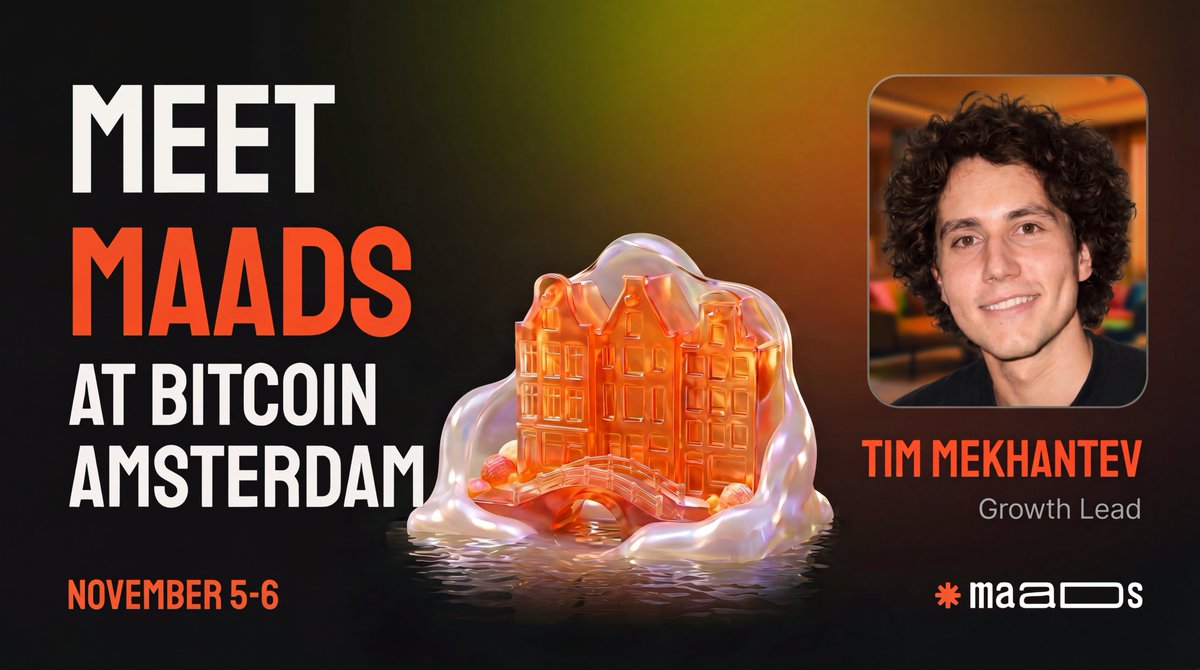
Bitcoin Amsterdam (@bitcoinconfams) runs 5-6 Nov at the SugarFactory. Tim from our team starts a day early, at @BitcoinForCorps on the 4th.
If your Q1 launch plan still has blanks and you'll be there, DM us. Tim would rather go through it over coffee than on a call.
$102 billion went into ai startups in q3, 64% of all venture funding worldwide, according to crunchbase.
early-stage rounds were $40.6 billion of that, up 25% from a year ago.
the early-stage number is the one i look at. that's thousands of ai products getting ready to launch over the next year, and most of them will go after the same early adopters through the same newsletters and launch days. recently funded ai teams are one of the groups we decided to focus on at @maads_hub , and this is a big part of why.
getting noticed in that crowd will cost more every quarter.
according to our own analytics on @aads_network , people who signed up after finding us through chatgpt became paying advertisers 7.8% of the time between january and early october.
from google organic search it was 3.3%. volume is still small.
google sent about twenty times more sign-ups. my read is that people coming from ai assistants arrive further along. they asked a specific question, got a short list of names, and showed up ready to try. ranking on google still matters.
being the name an assistant gives when someone asks where to advertise a crypto product matters now too.
during the @OzakAGI presale we tested two messages against each other.
one was about crypto security. the other was about real-time ai intelligence.
the ai version drove significantly more interaction, on the same placements. those placements were web3 dashboards and defi trackers, so an audience that cares a lot about security.
on paper the safety message should have won there. overall the campaign ran 8 creatives at a 0.32% ctr, and cpm held steady at $12.
the messaging test is the part i'd take into any launch though. people in crypto already assume the crypto part.
what got them to click was what the product actually does for them.
@maads_hub
q4 is when most crypto and fintech budgets get spent, and when a rejected ad costs the most days.
here's where the big platforms stand, from their own policy pages.
google allows exchanges and software wallets only in listed countries, with a local license and google certification.
in the eu that means mica casp authorization, and since august, iceland, liechtenstein and norway are on the list on the same terms.
since june, certification applications go through your google ads account instead of the help center. ico presales, defi trading protocols, unhosted wallets and unregulated dapps can't advertise anywhere.
meta needs prior written permission and a recognized license for exchanges, lending platforms and wallets that let people buy, swap or stake.
storage-only wallets, education and news don't need it. linkedin still lists crypto ads as restricted. most of this isn't secret. what hurts is finding it out in week two of a campaign.
before you sign with an agency for a launch, there are four boring things worth checking.
first, whose traffic it is. if every placement is bought from someone else's network, find out how fast they can move budget when a channel stops working.
then the first two weeks, get the plan with dates, because if it still says "strategy" on day ten, you have your answer.
third, who actually works on the account day to day. the person on the sales call is often not the person writing your ads.
and the case numbers, one case with a ctr and a cpm you can ask about tells you more than a wall of logos.
@maads_hub
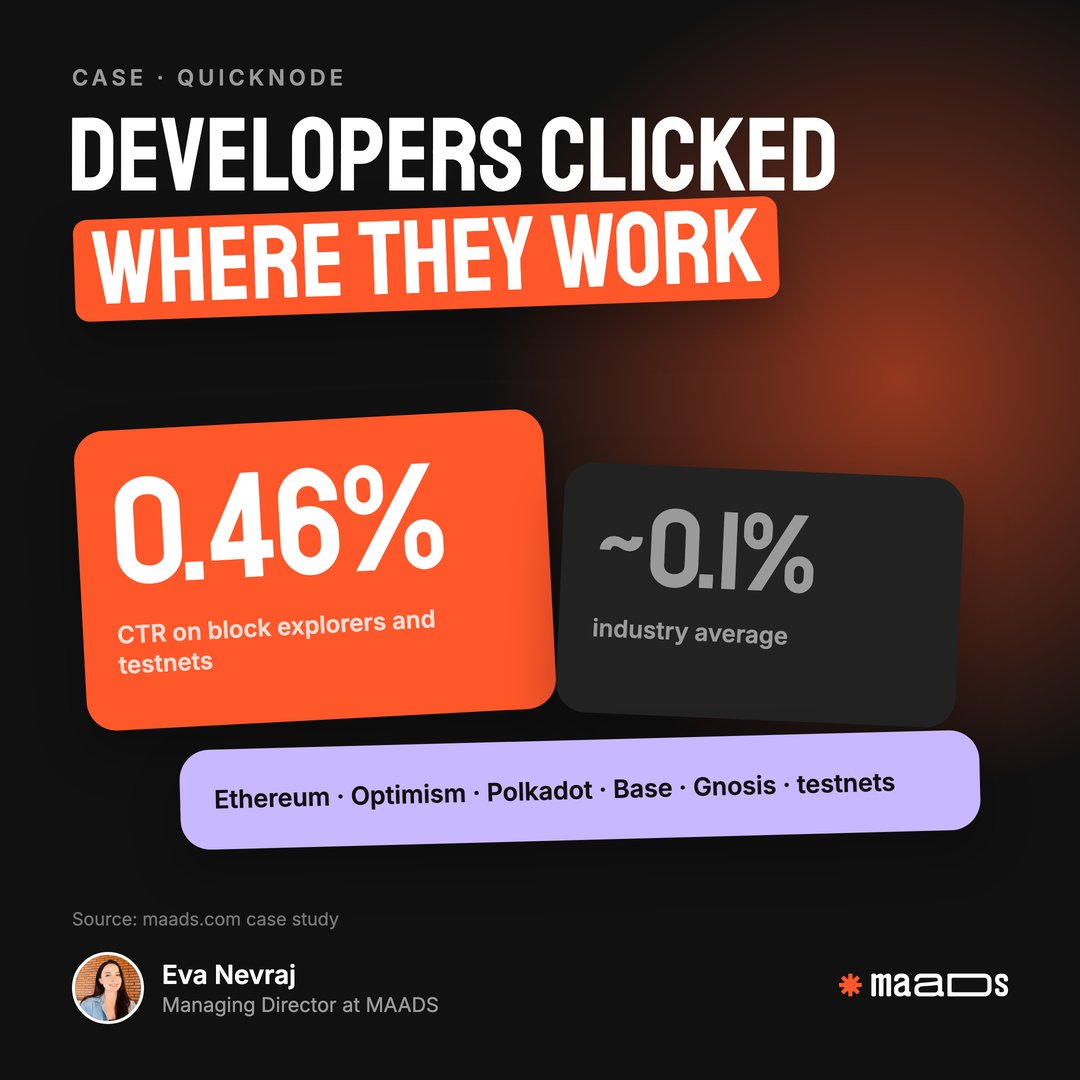
@Quicknode got a 0.46% ctr from web3 developers, against an industry average of about 0.1%.
developers are a hard audience to reach. most of them aren't on regular ad platforms in any useful way, and they skip anything that looks like marketing.
so we put the ads where they actually work: block explorers for ethereum, optimism, polkadot, base and gnosis, testnets included. that's where developers go to check their smart contracts.
we ran it through @slise_xyz , our own platform, at a $3 cpm, and kept a/b testing the creatives until the best version brought cost per click down about ten times. someone looking at a testnet transaction is already working on exactly the thing quicknode helps with.
keep, kill, or reinvent?
timur and i put crypto growth tactics up for debate in our new frontier watch episode: influencers, airdrops, affiliates and ambassadors.
what brings users who stay after the rewards end?
which tactic would you rethink?
@coinsbee ran at 0.58 percent click-through and $1.15 a click. those are ordinary numbers in ordinary advertising, which is exactly why i keep pointing at them.
in crypto they are not ordinary, the category usually makes you trade acceptance for economics. you can advertise, but you pay a premium for being somewhere that will take you, and the traffic quality is whatever it turns out to be.
getting normal web2 unit economics inside a restricted category is the thing we are actually selling. access is not rare, plenty of people have access. access that survives contact with a spreadsheet is.
which is why we have been taking on restricted wellness and fintech work this year. the mechanics are the same. a big platform says no, or says maybe, the founder burns three months finding out which, and somebody needs to know on day one which doors are open.
cases with the full numbers are on https://t.co/pIfaoaozLA
the most common thing i see after a raise: eight months of engineering, then a board question about pipeline.
it is not a product failure. round closes, hiring starts, the roadmap fills up, marketing becomes a thing to do properly later. later arrives in month eight.
by then attention costs more than it did when you started, and whoever was talking on day one is two years ahead on being the name people know.
if you have just raised: find out what an ai says about your category, run cheap tests on three channels before committing to one, and get a founder posting. none of it needs the full budget.
about forty percent of the email contacts you scrape are actually sendable.
you export a list of ten thousand, run it through a verifier, and six thousand are catch-alls, spam traps or people who left two years ago. sending to them does not just fail. it damages the infrastructure you will need later.
the benchmark a guest gave me for a decent b2b campaign: two to four thousand emails per meeting booked. his best ever was one positive reply per two hundred and fifty, and that came after months of narrowing down to the icp of his icp.
not who buys from him, but who buys from his clients.
most companies have not defined the first one.