Have weather forecasts seemed less accurate lately? There's a major contributing factor: nearly half the morning weather balloons in the Lower 48 are "missing."
This is an ongoing crisis that is degrading critical severe weather forecasts that we all rely on. It's having real, tangible impacts on degrading forecast quality.
If you work in transportation, agriculture or commerce, this should matter to you.
Regardless of the causes, this negatively affects people of ALL political backgrounds. Weather affects everyone. And it's impacting ALL of us negatively.
We can't look at weather balloon data that doesn't exist. We can't pump nonexistent data into models. We can't rely as heavily on models that don't "know" what's happening above our heads.
This is especially concerning for severe weather forecasts. We can't go 18 hours without ascertaining how the atmosphere is layered, how much storm fuel has built up and if severe thunderstorms are going to erupt. The Storm Prediction Center has even acknowledged forecasting frustrations in at least one public bulletin.
As an atmospheric scientist myself, I can say firsthand – the forecasts I'm able to offer you are less accurate than they would otherwise be. I'm not able to predict severe weather with the confidence I normally would. That is extremely concerning.
The United States is "supposed" to launch balloons at 0Z and 12Z ideally – a.k.a. around 7 a.m. and 7 p.m. Eastern time. That's not happening. Many sites, due to staffing issues stemming from broader political and organizational issues, have pushed to 18Z, or early afternoon. That's not helpful for morning severe weather forecasts. In other words, you get less lead time. Less advanced notice. Quicker ramp-ups and ramp-downs to the forecast.
We're not able to get jet stream, temperature, moisture or wind profiles of the atmosphere each morning like we otherwise would.
Moreover, the World Meteorological Organization encourages 12Z soundings; that data is shared via the Global Observing System (GOS) under the World Weather Watch (WWW). That's not happening.
Fun fact: The 1998 paper that introduced Google and PageRank to the world ends with this acknowledgment:
"Supported by the National Science Foundation under Cooperative Agreement IRI-9411306. Funding also provided by DARPA and NASA."
Sergey Brin was on an NSF Graduate Fellowship. Larry Page was a PhD student on the grant.
Google—now worth $2 trillion—exists because American taxpayers funded "the Stanford Integrated Digital Library Project."
Not a startup garage myth. A government grant.
Every time someone says public research funding "picks winners and losers" or "crowds out private innovation," remember: the most dominant technology company of the 21st century was incubated entirely with public money, inside a public university, by researchers on federal fellowships and grants.
The private sector didn't see it coming. VCs passed. The government funded it anyway—not because it would become Google, but because fundamental research into information retrieval seemed worth understanding.
That's the point. You can't predict which grants will change the world. You fund the science and let researchers explore.
The internet (DARPA). GPS (DoD). Touchscreens (CIA/NSF). mRNA vaccines (NIH). Google (NSF/DARPA/NASA).
Public investment in basic research isn't wasteful spending. It's the seed corn of the entire modern economy.
BREAKING: Sugars essential for life have been found in pristine asteroid Bennu samples collected by NASA’s OSIRIS-REx spacecraft. Combined with previous detections of amino acids and nucleobases, we see that life’s ingredients were widespread throughout the solar system: https://t.co/Tb3HpwZG9J
More on the study led by Yoshihiro Furukawa of @TohokuUniPR⤵️
Ursula Le Guin: “A child free from the guilt of ownership and the burden of economic competition will grow up with the will to do what needs doing and the capacity for joy in doing it. It is useless work that darkens the heart. 1/2
Remember when we brought pristine asteroid samples back to Earth? The first big science is in!
The samples suggest that the early solar system had widespread conditions and ingredients for life. Here's how we know: https://t.co/PHPjpaWgWs
Fences and roads are big impediments to wildlife, says wildlife conflict expert Nicki Frey, but Utah is ahead of the curve when it comes to creating wildlife crossings.
@QCNRUSU@usuextension#wildlife#conservation#coexist
https://t.co/DfEM31us0o
New & #OpenAccess in @ESAMonographs: The trophic cascade involving Yellowstone wolves, elk, and aspen is primarily driven by predator-induced reductions in elk density rather than changes in elk behavior
https://t.co/VeOLRUG6QJ
With #OpenData in @datadryad#NSFFunded@NSF
Today on Fox News Sunday: "Tim Sheehy now in multiple accounts has lied about whether he was shot in combat. He said he was, now it turns out he shot himself accidentally while visiting a national park in the United States. So he's under a ton of fire in Montana." #mtpol#mtsen
WINTER CARNIVORE FIELD JOBS (4)
❄️ My team at the USFS Rocky Mountain Research Station is hiring 1 crew leader & 3 crew members to conduct winter mesocarnivore surveys. We are using snowmobile surveys & cameras to detect many cute critters! ❄️
Crew lead:
https://t.co/vVvGoj7aby
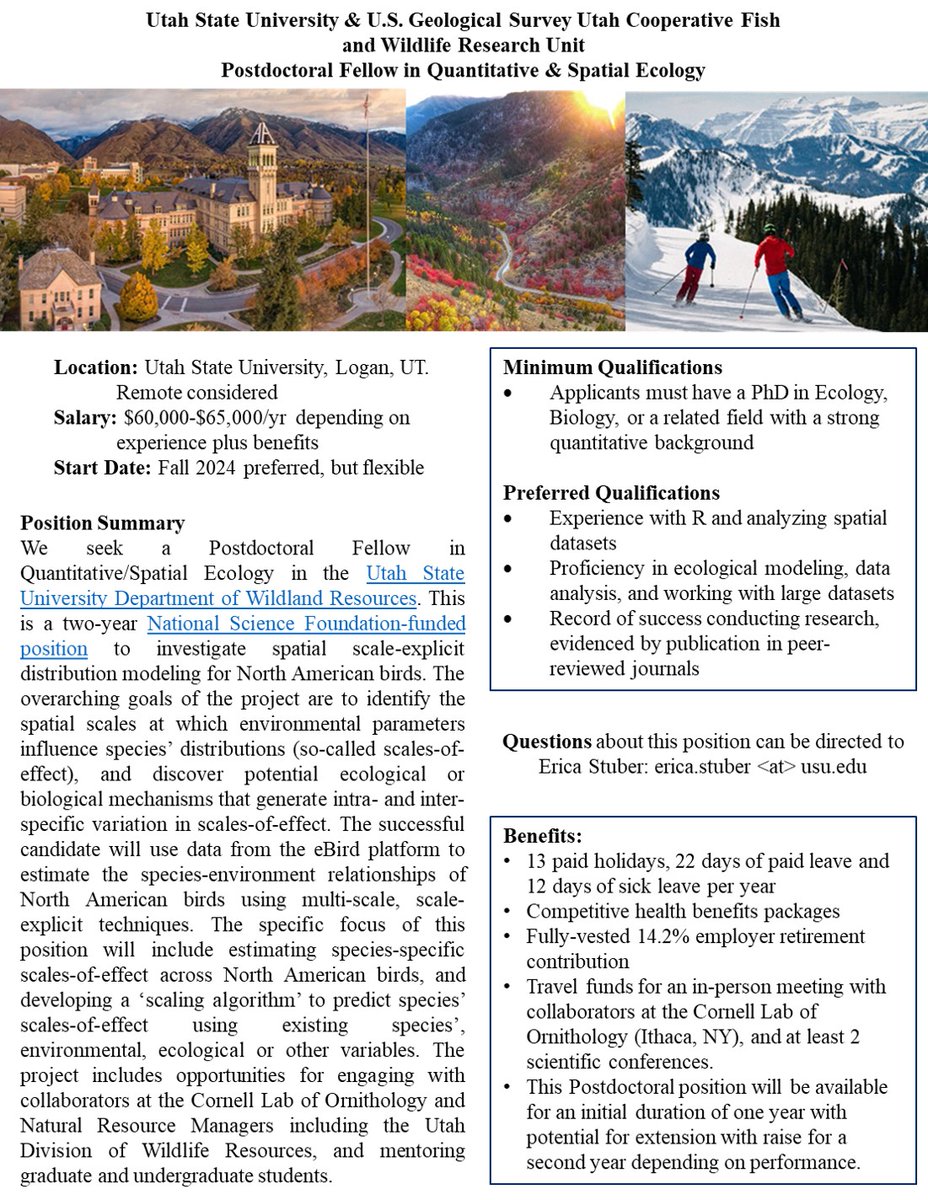
Please RT‼️ I'm recruiting an #ecology PhD student for a fully funded 4 year NSF assistantship to study species-environment relationships in North American birds using @Team_eBird#CitizenScience data. #BirdTwitter. DL 30 Sept. see: https://t.co/0HzChqFkgd
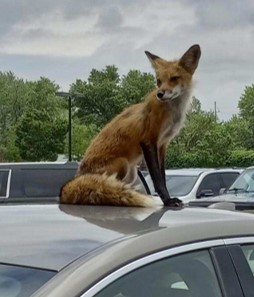
👀 I'm looking for researchers studying urban red foxes🦊 in Asia & North Africa who may be interested in a global collaboration. Please RT or reply with any names of folks I should email. Thanks! (pic for more looks)
Top ten hazards to avoid when modeling species distributions: a didactic guide of assumptions, problems, and recommendations https://t.co/GR2wBRSZUQ #review#guidelines#SDM#ENM@NordicOikos @WileyEcolEvol