New Anthropic Fellows research: Returning to the neuron basis for interpretability
Understanding what’s happening inside an AI model helps to make it safer. One obvious place to look is its neurons, or the simple units it’s built from. Early interpretability work did just that, but over the past couple years, researchers largely moved on from that idea, for three reasons: a single neuron often fires on several unrelated inputs, the way a concept is represented can change between two layers of neurons within a single model, and facts seem to be spread across many neurons.
We re-examined these problems by looking at what each neuron contributed to the model’s outputs, not just what caused that neuron to fire. All three problems turned out to be smaller than assumed. Neurons rarely add two unrelated concepts at once, their outputs mean roughly the same thing across most layers, and facts, though widely distributed across neurons, are still readable.
In a second post, we put these findings to use. With no extra training, neurons in open-weight models helped us to detect harmful text, steer behavior, and find hidden behaviors in finetuned models.
Part 1: https://t.co/cp8AeU8jt2
Part 2: https://t.co/TORvK0V4bI
Researchers across 20+ institutions incl. ETH, Stanford, Harvard, KAIST, UNSW have spent months building TimeNet.
the goal: make it easier to train and benchmark temporal foundation models that understand how the world changes over time.
it's open source, and today we're kicking off a global hackathon. Come join us: https://t.co/o219dZbR3y
(and earn $50k in compute and cloud credits)
We’re releasing TimeNet today, joining forces with researchers across the US, Europe, Asia and Australia to build the future of Temporal AI that understands our world as it changes.
An open data standard and scalable infrastructure for next-generation Temporal Foundation Models.
My personal dream is to achieve a level of neural network interpretability that allows us to perform surgical, targeted edits on only the relevant weights.
London will pay you £18,000 to spend 15 weeks doing AI research.
Plus they fly you in, pay your rent and feed you.
The Pivotal AI Safety Research Fellowship:
• £15,000–£18,000 stipend
• Travel to London covered
• £1,800/month for housing on top of the stipend
• Lunch and dinner every weekday
• All the compute your research needs
• Weekly 1-on-1s with established AI safety researchers
• You keep ownership of your research
Who can apply? Anyone 18 or older.
Past fellows came from ML, philosophy, policy, physics and biology.
Where they went next: Google DeepMind, UK AISI, GovAI, the Anthropic Fellowship and PhDs at Oxford and Stanford.
Jan 18 – Apr 30, 2027, in London.
Bookmark this. Send it to the smartest person you know.
Link below 👇
https://t.co/Hvl8HjurQA
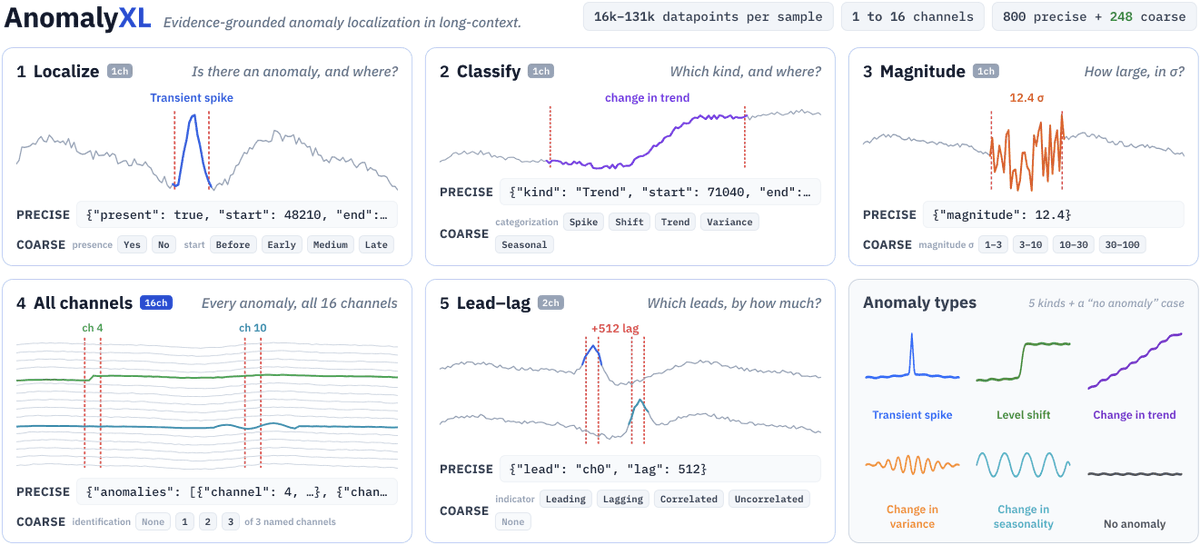
Frontier Time Series Language Models struggle with precise anomaly localization over long contexts, when useful signals might be hidden in hours of recordings.
In our new paper we trained a tiny Recursive Language Model to SoTA performance on long context time series.
We introduce AnomalyXL, an infinitely scalable synthetic time-series generator with programmatic ground truth answers.
Training our RLM formulation on this RL environment transfers to real world anomaly detection in Software Observability, ECG and Sleep data.
🧵👇
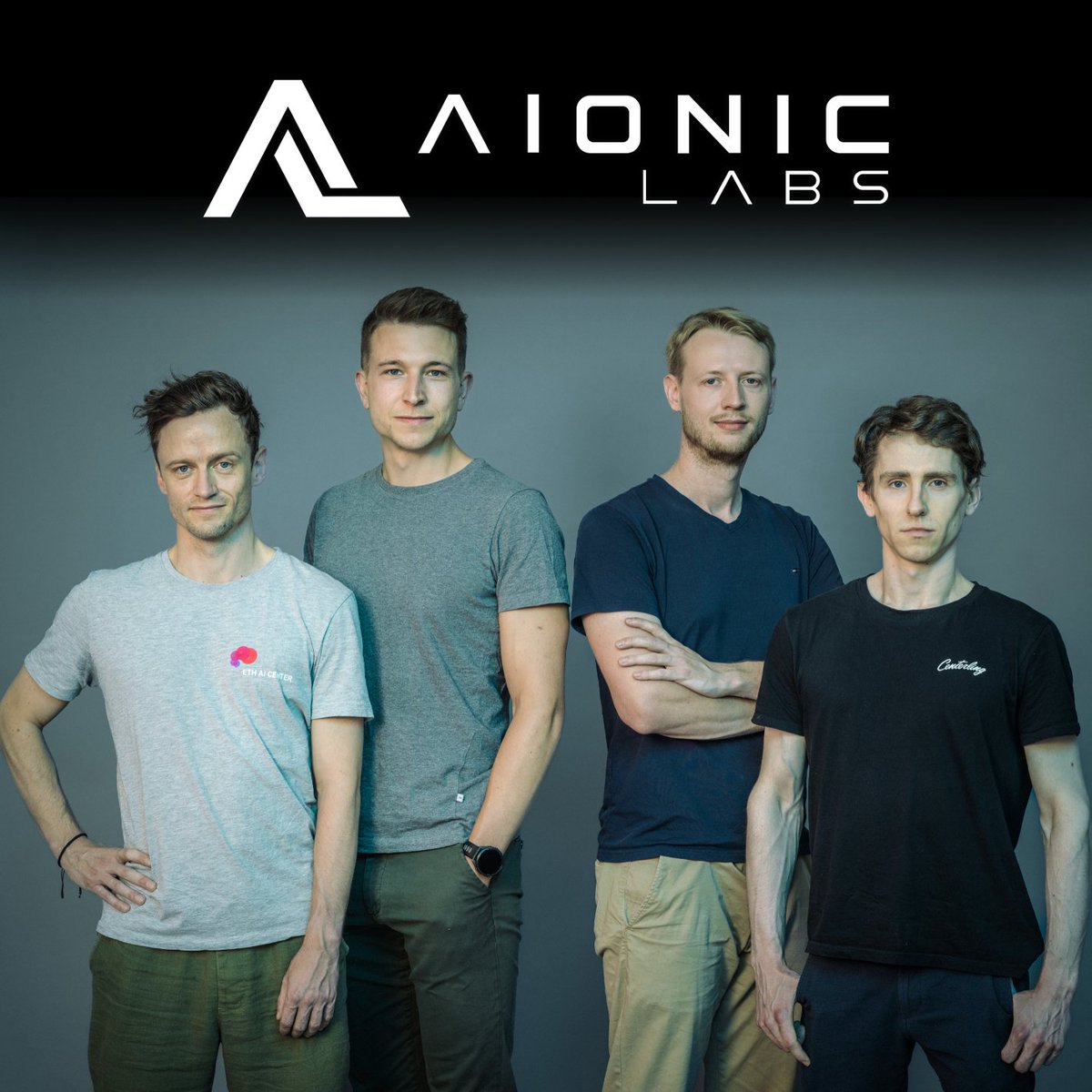
great to have all four @aionic_labs co-founders now in one room (and on X), building in Zurich.🇨🇭🚀
from an idea on a whiteboard at Stanford to a frontier AI lab in Europe and a global research community.
more to come 👀
@thomaskaar@martinm_ai@PatrickLangerAI
Right now, the arts are going through a funding apocalypse.
It's more important than ever to be supporting programming, research, and development alongside elevating artists.
I fundamentally believe arts and culture are equally imperative in the wider philanthropy conversation.