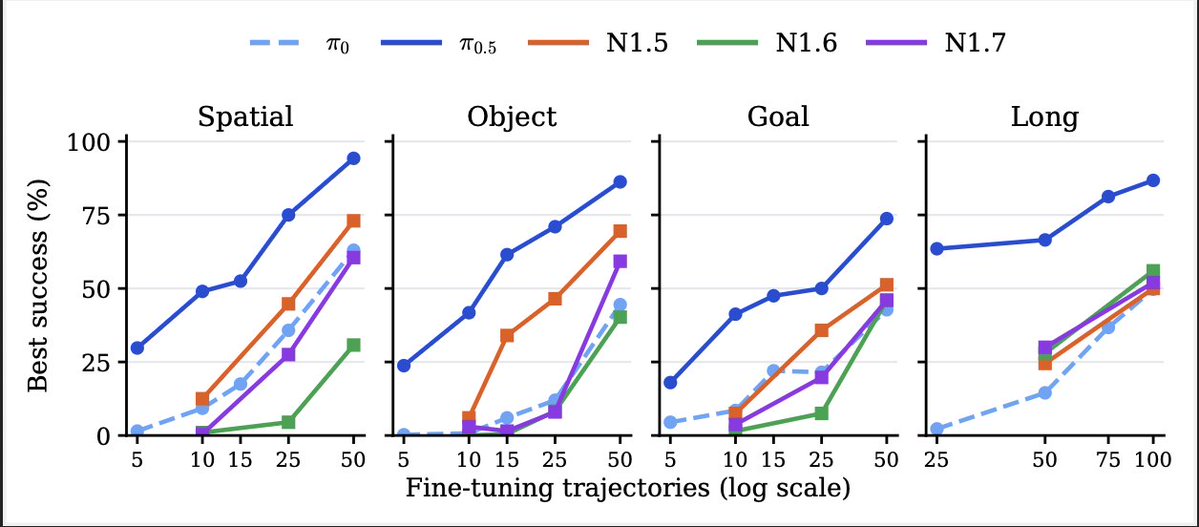
In our new paper we study sample efficiency across VLAs
With enough demos, VLAs can achieve high success rates. But how many demos do they actually need to learn a new task? And how many training steps does it take to get there?
We benchmark pi and GR00T to find out. 🧵👇
Today we’re open-sourcing Steel, our internal physics solver built with @NVIDIA.
It runs simulations up to 13× faster than PhysX while using ~3× less GPU memory.
Steel unlocks scaleable simulation for manipulation, for everyone.
Post-Astra, robotics simulation has become more crucial than ever. But visual fidelity is not enough to make simulation useful for robotics: sim needs to simultaneously (1) closely reproduce reality's physical dynamics, and (2) cover a vast diversity of real-world scenes.
At @VersorInc, we pioneer real2sim2real methods which accomplish both. 🧵
🦾reBot Arm T701🦾 — An #opensource dual-arm solution for #PhysicalAI, currently in Beta.
We’re continuing to open up CAD, BOM, machining files, SDK, and tutorials.We believe open source isn’t just uploading a few files to GitHub.
It’s about letting others build on your work and keep moving forward.
⭐️reBot Arm T701
https://t.co/odCVM16m9L
👉Also check reBot B601
https://t.co/q97cYsNF1W
📚 Free robotics learning hub
https://t.co/AvzoVTjI24
If you’re working on embodied AI, LeRobot, imitation learning, or dual-arm systems — drop a Star and join us.
#EmbodiedAI #Robotics #LeRobot #reBot #SeeedStudio
I spent 20,000 dollars in API credits having different AI models play each other at Blood on the Clocktower (a Mafia or Werewolf type social deception game).
The results were fascinating. Models have gotten much better over the course of this year at creative on-the-spot scheming and bluffing, and also at reasoning as a team to break apart these underground conspiracies.
I go through some of the most standout games these AIs played in this video. The new models are getting pretty good. If my friends pulled off some of these moves while we were playing, I’d give them a fist bump.
Fwiw, OpenAI’s newer models are much better than Anthropic’s at this game.
You can see the full benchmark at the website, and I’ve also made it so that you and your friends can play again the AIs: https://t.co/IF4d0EMSD8
The coolest thing, imo, about language models solving coding was no longer having to pay a mishmash of "software taxes" that aggregators were previously charging. Rather than buying a generic saas tool, you can just make your own bespoke version that is both cheaper and better-suited for your own use cases.
These same dynamics are greatly magnified in hardware due to strong network effects in prototyping and manufacturing. There are so many little "hardware taxes" that you pay which exist purely because the activation energy to do it yourself is so high, and because there has never been a real open-source movement in hardware the way that there was in software.
Next few months are going to be pretty exciting!
ChatGPT and Codex are helping engineers build for the physical world.
We’re sharing our progress across mechanical design, electrical engineering, and simulation—from helping our hardware teams iterate faster to testing new workflows with industry collaborators.
We asked GPT-6 Astra to edit Qwen3.5-0.8B weights to improve math.
It directly changed only 0.016% of weights, fixing 0.8B's reasoning loops & improving math up to 6x and even instruction following 3x, without gradients or training.
We call this Weight-Space Programming: frontier LLMs can now natively read/write neural network weights! 🧵
Blog: https://t.co/bOWCcFhCVq
Talked with researchers at Chinese AI labs. I came back thinking the gap between US and Chinese labs is getting wider.
1/openai and anthropic are already in RSI territory. You can feel the speed-up from the outside.
Chinese models aren't strong enough to get there yet. Most of the "RSI" I heard about is automating steps researchers used to do by hand.
2/Everyone there is now obsessed with data, mostly because distillation got a lot harder. So labs are going all in on synthetic and expert data.
3/After GPT-6 Astra, everyone is looking at robotics. Robot companies are already plugging Astra into their hardware. Almost nobody is seriously doing AI for science though.
4/One more thing from this weekend. DeepSeek open-sourced a research prototype of a coding agent.The line in their README I keep thinking about: "take as little human attention as possible."
The model gap isn't closing soon, so they're thinking hard about how little you should have to babysit the agent.