@Jason Jason, you’ve watched Bitcoin grow since 2011. It’s now a $1.6 trillion success and the world’s most valuable digital asset. Digital Capital is the killer app. Preserving wealth across generations is a bigger ambition than entertaining a dinner party. The orange tie stays.
The more you help others the calmer your mind will be. You will be able to overcome misdeeds committed in relation to others. Familiarizing your mind with kindness and compassion yields peace of mind, which makes you happier and even improves your physical health.
Bitcoin priced in gold is reinforcing my view that the next Bitcoin cycle will be the strongest we have ever seen. The dollar thesis I wrote about below and the growing hunt for scarcity in an AI-driven world of abundance both point toward a powerful structural tailwind for scarce assets. The BTC/gold ratio adds another important signal: within that expanding scarcity trade, Bitcoin may be beginning to reassert its relative leadership and reclaim the title of fastest horse.
The case starts with two structural forces driving more capital toward scarcity. The first is the dollar. As I wrote earlier this week in the post below, I believe the dollar is likely entering a secular leg lower, with the U.S. Dollar Index (DXY) showing the long-term structure behind that view. Bitcoin has never experienced that macro environment before, and it would create a tailwind unlike anything in its history.
The second is the growing hunt for scarcity in an AI-driven world of increasing abundance. With intelligence becoming cheaper and more abundant, many things investors historically valued because they were scarce, including knowledge, software capabilities and many traditional corporate moats, become easier to replicate. Capital will increasingly place a premium on forms of scarcity that cannot be manufactured away, and scarce assets like Bitcoin, gold and silver stand to benefit substantially from that shift. This is also a structural macro force Bitcoin has never had at its back before.
Together, those forces will drive substantially more capital toward scarce monetary assets. Gold will benefit. Bitcoin will benefit. My strongly held long-term view remains that Bitcoin will be the fastest horse in the global debasement and scarcity trade, and the BTC/gold ratio is the way to see when that leadership is showing up in the market. If Bitcoin is outperforming gold while capital flowing into both assets is expanding, the opportunity becomes significantly more powerful than either tailwind on its own. Over the last two years, BTC/gold has also been a remarkably strong leading indicator of Bitcoin itself.
Bitcoin topped against gold in December 2024, while Bitcoin didn't top against the dollar until October 2025, nearly a year later. Bitcoin kept making new highs in dollar terms, but had already stopped making new highs against gold. For an emerging monetary asset, that matters because bull markets are reinforced by incremental capital, liquidity and the reflexivity that comes from being the asset investors increasingly want to own. In hindsight, BTC/USD was signaling strength while BTC/gold was showing that the underlying bull market was becoming increasingly fragile. Eventually, that fragility showed up in the dollar price too.
That helps explain why sentiment became so negative during this bear market despite the drawdown in dollar terms being relatively mild by Bitcoin's historical standards. The bull market that preceded it never delivered the kind of relative leadership Bitcoiners expect. Bitcoin reached new dollar highs while underperforming gold and then rolled into a bear market from that weaker underlying position. A mild nominal drawdown can still feel brutal when it follows a bull market that never delivered on the fastest horse thesis.
The bottom has given us a similar signal in reverse. Bitcoin bottomed against gold in February 2026, while Bitcoin didn't bottom against the dollar until July, roughly five months later. That is a major reason I kept discussing BTC/gold during the first half of this year at the True North event during Strategy World, at Bitcoin Prague and at times on The Hurdle Rate. The ratio had called the deterioration well before BTC/USD and was beginning to look like it might be forming a bottom even while Bitcoin remained weak in dollar terms. It was one of the signals I was watching for evidence that the broader Bitcoin bear market might be closer to ending than the dollar chart suggested.
There was another important difference from prior Bitcoin bear markets: capital markets remained largely open and broader equity markets remained strong, making new all-time highs. Historically, Bitcoin bear markets have often occurred alongside much weaker conditions across risk assets. This time, the weakness was far more concentrated in Bitcoin and the Bitcoin-related ecosystem, which made the improving BTC/gold signal even more interesting.
What makes this week particularly interesting is that Bitcoin has now broken out against both the dollar and gold. The breakout has been explosive. A meaningful retracement from here would not surprise me, but it may not happen at all. If it does, my expectation is that any meaningful dip will be bought aggressively, and my conviction is very strong that the Bitcoin bear market is over. If BTC/gold was again the earlier signal, seeing both relationships now turn higher together gives me more confidence in the next 12 to 18 months and in the much larger opportunity that could unfold over the years ahead.
A weaker dollar alongside continued monetary debasement, combined with the growing hunt for durable scarcity in an AI-driven world of abundance, will create an extraordinarily favorable backdrop for scarce assets. Relative performance within that trade will help determine where incremental capital and liquidity flow. When Bitcoin is the fastest horse, it will attract a disproportionate share of that capital. Stronger relative performance will deepen liquidity, greater liquidity creates more optionality, and that optionality will attract still more capital. If these structural forces expand the overall scarcity trade while Bitcoin simultaneously reasserts leadership against gold, Bitcoin will likely be capturing a growing share of a growing pool of capital.
That setup has me more bullish on Bitcoin today than I have ever been. Gold has thousands of years of monetary history behind it, while Bitcoin combines absolute scarcity with global liquidity, portability and a monetary network capable of moving and settling value anywhere in the world, 24 hours a day. The combination of a secular dollar decline, an AI-driven hunt for durable scarcity and Bitcoin reasserting relative leadership would create a setup Bitcoin has simply never had before.
This framework has heavily influenced how we built Strive. When we think about risk, we do not only think about surviving a severe Bitcoin drawdown. With an emerging asset that has the upside potential we believe Bitcoin has, we think the bigger risk is being too conservative: either not being bullish enough or being bullish but structuring the company in a way that prevents the common equity from maximally participating when the upside scenario arrives.
That is why we have been staunchly opposed to the idea that acquiring, investing heavily in or primarily focusing on building cash-flowing businesses is the optimal way to maximize total returns relative to Bitcoin itself. If your underwriting says Bitcoin will appreciate substantially, waiting for future cash flows to buy Bitcoin means buying less Bitcoin at higher prices. A cash-flowing business likely looks safer, but if monetizing that economic value today and buying more Bitcoin produces a higher expected total return across the scenarios you believe are most likely, then the more conservative cash-flow strategy ends up underperforming from a total-return perspective.
Across a probabilistic range of outcomes, we believe the expected total return of $ASST is maximized by driving Bitcoin amplification as high as we can responsibly support while maintaining strict capital discipline, including no debt, no margin requirements and no financing structure that creates a forced-liquidation mechanism. The structure looks optically simple, which was intentional, but the real work is underwriting both sides of the distribution: how much downside can the structure survive, and how much upside are you giving away if Bitcoin performs the way you believe it ultimately can?
If the macro thesis plays out, the setup becomes unusually powerful. The scarcity trade itself is expanding, Bitcoin will likely be capturing a growing share of that growing pool of capital, and $ASST is designed to amplify Bitcoin exposure on top of that. You effectively have three reinforcing layers of upside working together: a larger opportunity set, Bitcoin taking more share of it, and our common equity amplifying the Bitcoin return.
That is why we care so much about getting the structure right. The upside is not simply Bitcoin going higher. It is Bitcoin becoming the fastest horse inside an expanding scarcity trade while $ASST is structured to amplify that outcome as much as we can responsibly support.
The bear market has allowed us to test that design in real time. Particularly as Bitcoin approached its weakest point, we continued buying aggressively, including nearly every week over the last few months before this breakout. We built the structure to remain durable through difficult Bitcoin environments while preserving high amplification and the ability to deploy capital when the opportunity becomes most attractive, and we now have a real track record of it doing exactly that.
There is another part of the bear market I find particularly interesting in the context of BTC/gold. Bitcoin bottomed against gold in February, roughly five months before it bottomed against the dollar in July. ASST also bottomed in February, well before much of the broader Bitcoin-equity complex reached its lows around July. I don't think that timing was coincidental.
In both cases, the market seems to have been showing the turn first in the places most levered to improving liquidity and risk appetite. BTC/gold was beginning to signal renewed strength in what I believe will be the fastest horse in the debasement trade, while ASST was beginning to strengthen as a highly amplified expression of that same thesis. As confidence in Bitcoin improves and capital moves further out on the risk spectrum, our structure, amplification and liquidity are designed to make $ASST a natural place for incremental capital to flow. The timing of those two turns is another reason I find the parallel so interesting.
It is one thing to underwrite a structure on paper and another to see both the balance sheet and common equity perform through a real drawdown. I believe our ability to create and sustainably support high Bitcoin amplification, backed by the capital structure and liquidity needed to maintain it through different market environments, is what will ultimately support a leading valuation relative to our Bitcoin holdings. The bear market was for building this performance engine, and we now have substantial liquidity in both our common and preferred equity, a capital structure built without debt or margin, and a company positioned for the type of Bitcoin environment I believe is developing.
Dollar weakness and monetary debasement, AI-driven abundance and the bitcoin:native/gold ratio are telling us different but complementary things. The first expands the broader monetary opportunity, the second increases the premium on forms of scarcity that cannot be replicated away, and bitcoin:native/gold helps tell us how much of that opportunity Bitcoin is positioned to capture relative to the other scarce monetary assets competing for the same capital. Any one of those developments would be constructive on its own. If they continue moving in the direction of the thesis together, Bitcoin will be entering the most favorable macro and relative-performance setup of its history, creating the potential for a level of upside over the next several years that we simply have not seen before.
TLDR: YOU ARE NOT BULLISH ENOUGH^2
Il y a 13 ans, pour 100M€ t'avais Gareth Bale qui avait marqué 31G/A en 33 matchs.
2026 t'as Savinho 2 buts en deux ans en championnat.
Vous rendez-vous compte?
7 places in Europe that are underrated today, pre-hype. The "next Abruzzo", if you want.
Let me tell you a story. Ten years ago, if you were not Italian, you had probably never heard of Abruzzo. Now you have.
Same with Portugal fifteen years ago. I live here, and a friend of mine with a rent budget above €5,000 a month left Lisbon because he could not find the quality he wanted for that price point. Lisbon, okay? Not Monaco.
Arriving early is not the only thing that matters.
But arriving late, for sure, is.
Thread 🧵
Saylor x BTC Drama
Fwiw I sat down for more than 2 hours with Saylor about 2 weeks ago
This usually enables me to “feel” what kind of person is in front me , something that you can’t if you arent in the room with us. I’ve done 173 of those interviews over the last 3 years and this has enabled me to develop a good intuition, although there are no certainties ever (especially in this industry)
My intuition tells me that Saylor is a genius and is always a few chess plays ahead of everyone else. This is not new to his Bitcoin journey, it’s been true for 35 years at least. Watch the podcast below and you’ll understand what I mean
Imho, we have a bunch of monkeys on this app who havent done the work properly and are shouting for engagement and maybe because they are angry because they are losing money while their non crypto pals are outperforming them (enormously) by buying AI stocks or simply DCAing the Nasdaq for years
And then we have Saylor who is an engineer and understands financial engineering way better than the little monkey “traders” or “KOLs” on this app
$BTC isn’t going down because of Saylor, although it’s always helpful to have a scapegoat for one’s poor investment/ trading / financial decisions and lack of long term thinking- every cycle needs a scapegoat.
BTC is going down because it’s in a bear market.
I’ve been wrong in the past and am not a financial engineer by any means but I have developed a pretty good gut feeling after interviewing the biggest people in the industry - in a room - for more than 3 years. Saylor is truly built different and on another level of both intelligence and humility - that most could only dream of (myself included)
I truly believe (and know for a fact) that the majority of the people on this app have no idea what they are talking about and on top will say they bought the dip or the crash (whatever comes next) once the sentiment turns in the next few weeks or months
Je crois qu'on ne mesure pas ce qu'Elon Musk est en train de construire avec X.
Tous les médias de l'histoire ont été couplés à une culture, une langue, une bulle géographique. Le Monde parle aux Français. Le NYT parle aux Américains. NHK parle aux Japonais. Chaque média filtre le réel à travers le prisme de sa culture locale.
X est en train de devenir le premier média de l'humanité. Pas d'un pays. De l'espèce.
Je le vis en temps réel. Mes posts en français se font RT par des Japonais, répondre par des Brésiliens, citer par des Américains. Des conversations qui n'auraient jamais existé il y a 5 ans. Un libertarien français qui débat avec un ingénieur de Tokyo et un entrepreneur de Sao Paulo sous le même tweet. Pas traduit par un éditeur. Traduit instantanément par l'IA, en un clic.
Les bulles de filtre culturelles sont en train d'exploser.
Et je pense qu'on sous-estime massivement les effets composés de ça.
Quand une idée peut traverser un océan en 3 secondes, quand un argument sourcé posté à Paris peut être vérifié par un économiste à Singapour et amplifié par un développeur à Austin dans la même heure, le coût de propagation d'une bonne idée tend vers zéro.
Et c'est catastrophique pour un type d'acteur très précis : les médias qui ont construit leur business model sur le monopole de l'information locale. Ceux qui pouvaient raconter n'importe quoi sur "ce qui se passe ailleurs" parce que personne ne pouvait vérifier.
Quand un journaliste français écrit que "le modèle américain ne marche pas", maintenant il y a 50 Américains dans les réponses avec des sources. Quand un éditorialiste dit que "le Danemark prouve que le socialisme fonctionne", il y a un Danois qui explique que le Danemark est 10e en liberté économique mondiale.
Le fact-checking n'est plus un département. C'est un effet réseau.
Les médias honnêtes n'ont rien à craindre de ça. Les médias qui vendaient une narration protégée par l'ignorance géographique de leur audience vont avoir un problème existentiel.
Parce qu'on ne peut plus mentir à l'échelle locale quand le monde entier regarde.
A subtle but important shift has occurred at @Strategy and @Strive, where there has been a clear emphasis on preserving and improving the credit profile of Digital Credit, even amidst Bitcoin volatility.
Historically, the focus was simple: maximize Bitcoin per share. That is certainly still the goal, but it is now being balanced with something more scalable, which is building a credit product that the market trusts in all conditions. You can see this in the actions they have taken. They have built USD cash reserves, added Digital Credit onto the balance sheet itself, and continued to acquire Bitcoin, including through common equity issuance. Each of these decisions strengthens coverage, reduces perceived risk, and improves the overall credit profile.
That behavior is important, especially in drawdowns. Over the last six months, as Bitcoin has experienced volatility, these companies have focused on strengthening the credit rather than increasing risk. If the market internalizes that this credit becomes more durable as Bitcoin moves around, then the risk profile changes. The product remains attractive even in weaker markets.
That is where the feedback loop begins.
Stronger credit profile leads to greater trust. Greater trust pulls in more fixed income capital. That capital flows into Digital Credit. That capital then gets deployed into Bitcoin. That creates a structural bid for Bitcoin.
As Bitcoin rises, balance sheets strengthen further. Coverage improves. The credit becomes even more attractive. More capital flows in. The feedback loop continues.
At the same time, higher Bitcoin prices increase the attractiveness of Amplified Bitcoin exposure. That expands mNAV premiums and improves the ability for these companies to raise capital efficiently, which ultimately feeds back into more Bitcoin acquisitions.
So you end up with two reinforcing loops, one through credit and one through equity, both pointing in the same direction.
If this dynamic continues, then Digital Credit could start to tap into the global fixed income market in a meaningful way. Even small reallocations from that market into Digital Credit could have a massive impact.
This is why it feels like we may be approaching an inflection point for global Bitcoin adoption. It could happen quickly if the market fully understands the model, or it could take time as Digital Credit builds a track record and proves itself through market volatility.
Either way, this is a very important moment in how serious capital begins to flow into Bitcoin.
@chamath If AI compresses terminal value and makes every moat temporary, capital will rotate to assets with no disruption risk. Bitcoin is Digital Capital - scarce, neutral, and impervious to AI disruption. $BTC should be the primary beneficiary of this shift.
🔥THIS IS INSANE: STRATEGY RAISES $1 BILLION IN A SINGLE DAY WITH STRC/MSTR?!?🔥
Right now we are looking at an estimated 4,322 Bitcoin acquired today and that is IF they captured only 42% of the volume over $100.
That is over $303.2 MILLION DOLLARS from STRC in ONE TRADING SESSION.
Now, with raising this kind of money, Strategy can do one of two things.
Hit the MSTR as well to keep Bitcoin amplification depressed and buy more Bitcoin... OR they can lay off the ATM and increase the Bitcoin amplification behind your MSTR shares.
Using last week's MSTR/STRC issuance ratio, if they did the same today, that is $727.86 MILLION RAISED from MSTR in ONE TRADING SESSION.
$303.2 M + $726.86 M = $1.03 BILLION IN ONE DAY.
BILLION WITH A B.
THIS IS THE BIGGEST STORY IN FINANCE AND THE WORLD IS STILL ASLEEP.
IT WOULD BE A SHAME IF EVERYBODY FOUND OUT ABOUT THIS AND HOW YOU CAN MAKE 11.5% RETURNS WITH CLOSE TO ZERO VOLATILITY.
THIS IS THE ULTIMATE BITCOIN SINGULARITY:
Did you know you can retire with just $869,565 and NEVER WORK AGAIN?
Forget the 4% Rule.
That old advice said you needed $2.5 million to retire and safely withdraw $100,000/year.
That’s dead.
Because STRC pays an 11.5% dividend, tax-deferred, and it's paid monthly.
That means $869,565 = $100K/year in passive income.
No selling. No stress. No Wall Street roulette.
Just dividend checks. Every month.
STRC is turning early retirement from a pipe dream into a plan.
✅ Retire in your 30s or 40s
✅ Keep your lifestyle
✅ Live off dividends forever
Why grind for decades to save $2.5 million...
When you can hit $869K and walk away?
Buy STRC. Pocket the yield.
Exit the rat race.
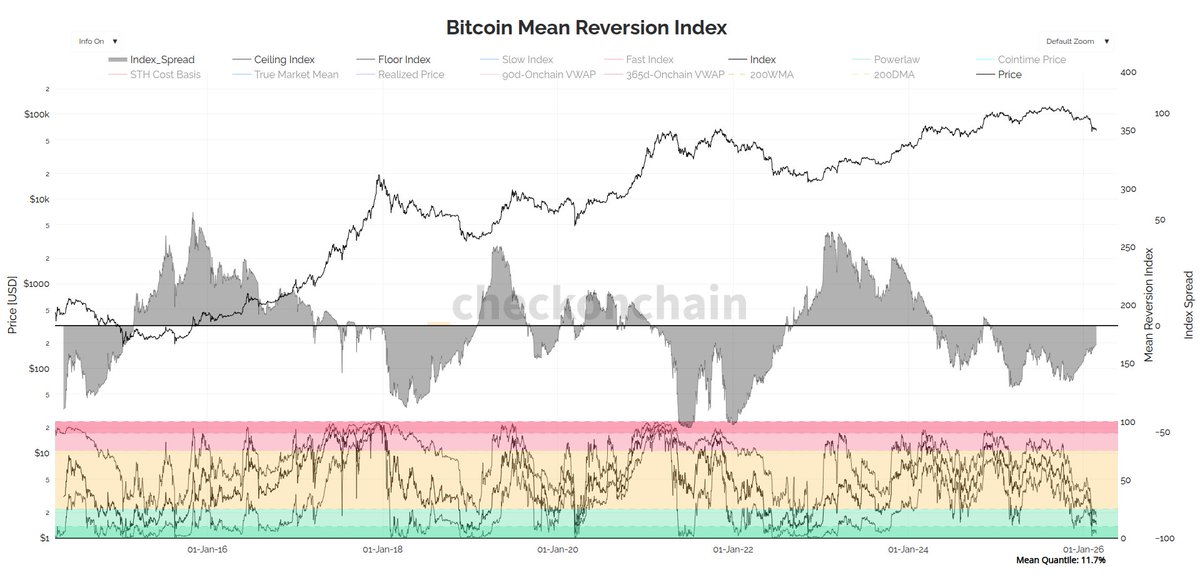
Every mean reversion model, from technical to onchain is trading within bottom formation levels, typically seen after the price capitulation event (which Dec 2018 and Jun 2022 were examples of).
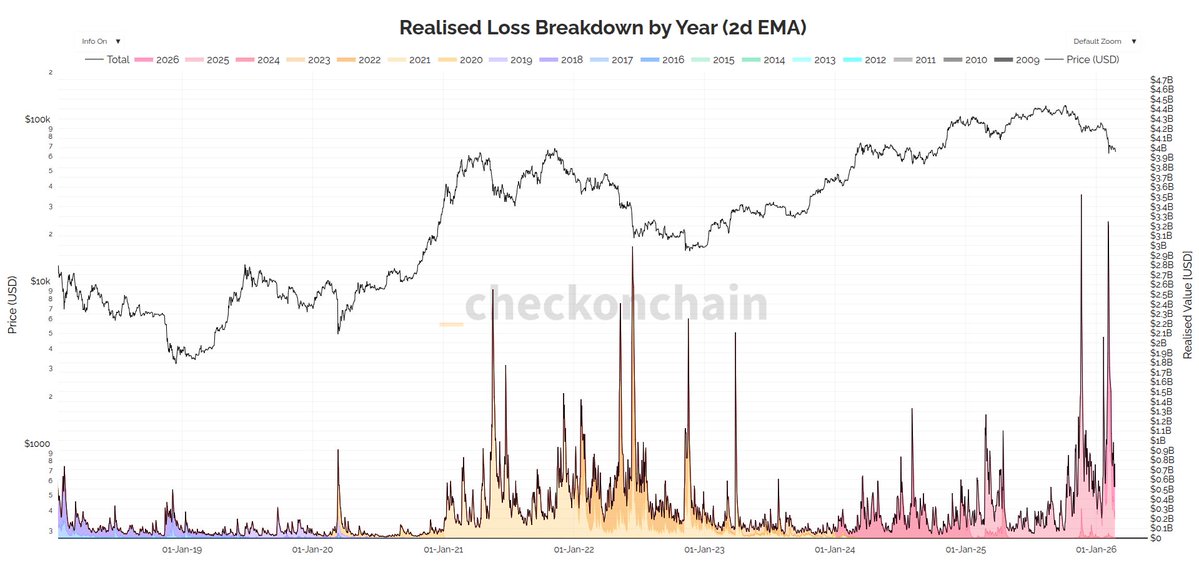
Both sell-offs in Nov and Feb are in the hall of fame of Realised Loss onchain. Not the biggest in relative terms, but by far the largest in USD terms, over $7.5 Billion over just those two days.
We're in the bottom 20% of the most conservative, and bottom 5% of the most aggressive deviations from any sane anchor model.
Either Bitcoin is dead, will no longer mean revert, and all your models are broken...
...Or you should be ignoring the bears, staying very humble, and quietly DCA stacking sats from here on.
Price pain is largely behind us imho, however time pain likely remains. It will claim many who don't want to see the rest of the movie.
We often experience retests of the lows, leaky price charts, powerful rallies...and then lower lows...often with a final capitulation event to book-end the time-pain chapter of the bear.
In my view, even though this sounds horrific, it is unlikely we have anywhere near the aggressive rate of decline, nor depth of decline as has already occurred in Nov'25 and Feb'25. The hard part of the drawdown is most likely behind us.
The difference between $17.6k in June 2022, and $15.6k in Dec 2022...was six months (the price delta is frankly irrelevant for any long-term investor).
There is no rush, but these Bitcoin prices are temporary. How temporary we do not know, but it's tremendously oversold, and there are few statistics I am aware of that suggest otherwise.
The bears will spend the next few months liquidating their trading accounts trying to short the bottom of a painful chopsolidation range. The bulls will do the same by getting too hopeful at the range highs.
Investing is a game of picking great assets, accumulating at low prices, and then being patient as fuck.
The 200-week MA is at $58.5k, a mere bees dick below the $60k low we already set. There are still folks out there who want to haggle over the missing 3%.
The Realised Price is at $55k, which from first principles, should stop being visited over time, as it deviates due to unrealised profit in lost coins (a topic for another day). We've already cleared every excess leverage level down to $60k, no stop losses survived February's move.
This is the time to stay humble, and stack sats.
If you're not actively accumulating Bitcoin at this stage, then when? Don't fantasise over lump summing the exact bottom wick. You will be too scared to do it on the day.
Buy the whole bottom. Dollar cost average for the next six months, and remove your emotions from the problem at hand.
A final note; ignore the bears. They will perpetually revise their targets lower and lower, and get plenty of clicks for doing so. Humans love bear-porn because we're wired to avoid risk.
This is literally what a de-risked setup looks like for Bitcoin.
Ignore the bears, they lack ambition.
I have taken a position in Strive / $ASST.
Average price $7.92.
Today's revelation of $127.2 million in cash reserves was the final piece in the jigsaw for me.
The market has overreacted to the 1-20 reverse split... not realising that the usual rule of thumb does not apply here.
Annual dividend obligation for $SATA = ~$53.3mil which means USD coverage is 2+ years.
Only $10 million in debt remaining from Semler Acquisition.
I am not a fan of buying multiple Bitcoin Treasuries in the same jurisdiction but the US is the exception.
The second largest bitcoin-backed fixed income product in the US is still a trillion dollar opportunity. Fund managers need to diversify and can't have all their AUM in one product.
Feeling good about my entry here.
Happy to be on board @ColeMacro@PunterJeff@mikealfred@IIICapital 🫡🚀