there will be 100x more ppl trying to be creators & get a large following than there are now very soon on every platform. the macro reasons are quite obvious.
& everyone will be heavily competing in a extreme zero sum game which is attention because ai is driving all of the value up the stack.
this also unfortunately means ppl will do even more wild things, make up things, copy others etc just to gain market share if you will.
e.g. if you search on youtube for virtually anything you’ll already feel the saturation like crazy.
buckle up.
More Americans believe we’ll colonize the moon before we fix K-12 education. This is a policy problem.
We have been building a solution that’s already trusted by many of the Fortune 500 as well as 1/3 of federal and state elected officials in the United States.
Organizations are more impacted by policy than by financial markets. Yet financial markets have been real-time for decades, and policy markets are still nearly impossible to follow.
@StateAffairsUS has raised over $70M from @rabois, @khoslaventures, @foundersfund and others to fix that.
We are creating the world’s first real-time knowledge graph for policy and regulatory markets. This platform is foundationally built on non-partisan journalism and the collection of on-the-ground data that isn’t digitally accessible.
In the future, we believe every executive will watch policy markets the way they watch financial markets. Instead of reacting to regulation, they’ll navigate it proactively.
Policy should iterate at the speed of our most innovative industries.
@scottbelsky love "proof of craft". I think it's why people resonate towards content creators (who show their work) over polished Netflix shows. Vulnerability is one of our last human fingerprints.
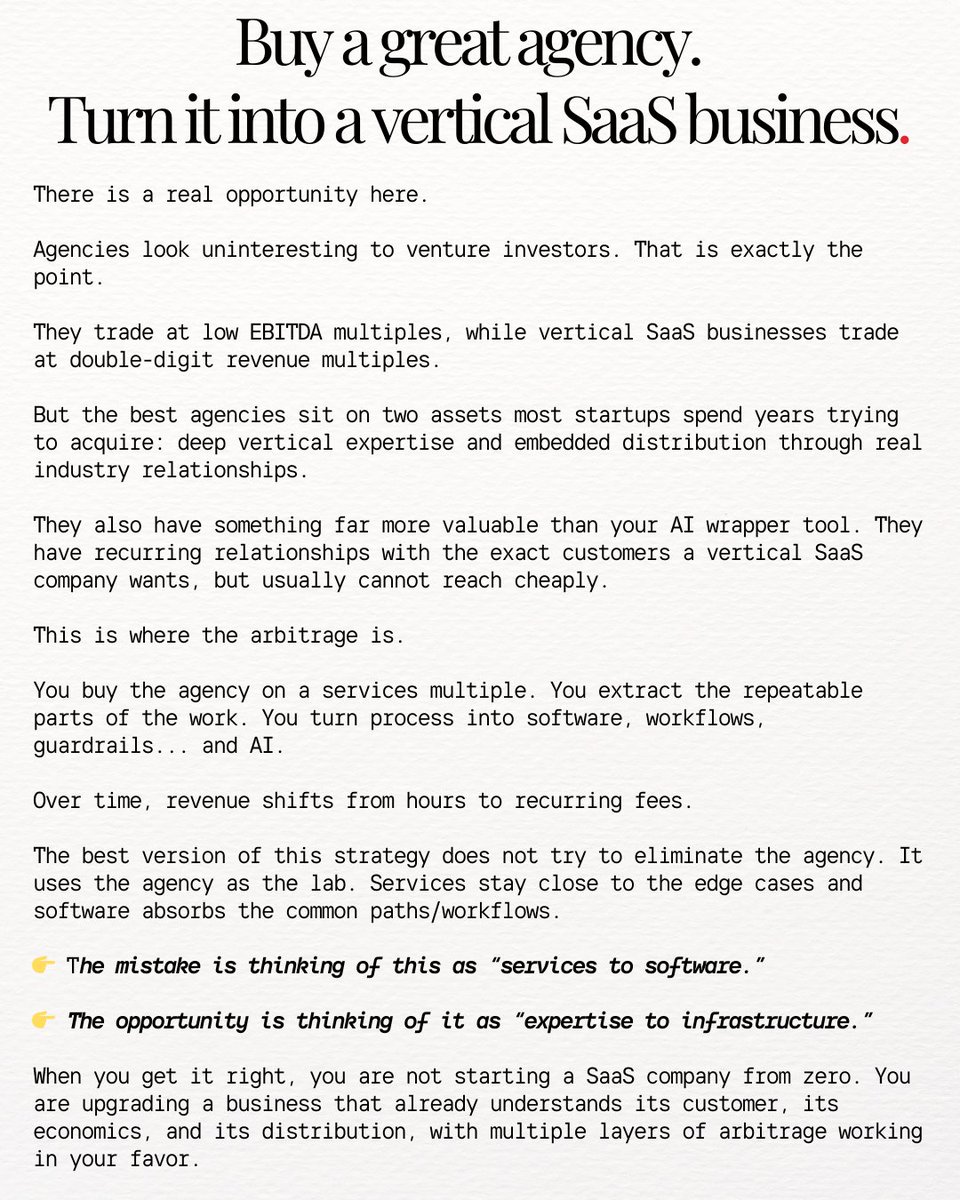
The fastest way to build a $100M company is to buy a great agency.
Productize it. And turn it into a vertical SaaS business.
There is a real opportunity here.
Agencies look uninteresting to venture investors. That is exactly the point.
They trade at low EBITDA multiples, while vertical SaaS businesses trade at double-digit revenue multiples.
But the best agencies sit on two assets most startups spend years trying to acquire: deep vertical expertise and embedded distribution through real industry relationships.
They also have something far more valuable than your AI wrapper tool. They have recurring relationships with the exact customers a vertical SaaS company wants, but usually cannot reach cheaply.
This is where the arbitrage is.
You buy the agency on a services multiple. You extract the repeatable parts of the work. You turn process into software, workflows, guardrails... and AI.
Over time, revenue shifts from hours to recurring fees.
The best version of this strategy does not try to eliminate the agency. It uses the agency as the lab. Services stay close to the edge cases and software absorbs the common paths/workflows.
The mistake is thinking of this as “services to software.”
The opportunity is thinking of it as “expertise to infrastructure.”
When you get it right, you are not starting a SaaS company from zero. You are upgrading a business that already understands its customer, its economics, and its distribution, with multiple layers of arbitrage working in your favor.