🚨: The US just introduced a tax proposal that could KILL DeFi as we know it.
The U.S. Treasury and IRS just released proposed cryptocurrency regulations, that may deem DeFi applications like Uniswap, 1inch, Curve, MetaMask etc. to be brokers & be forced to implement KYC...
Just dropped my latest feature.
I show it's possible to work out more than 15,000 personal crypto wallets from last year's Celsius filing — all tied to real names.
Today these wallets hold around $900 million. At peak prices, they held more than $3 billion!
A thread (1/10) 🧵
in law/policy debates, what I really struggle with these days is justifying special (lighter) rules/regs for DeFi/smart contracts when the best narratives have been eroded by years of teams, communities and users not caring about trust minimization and at times willfully advocating for more trustful solutions in order to maximize financial returns
smart contracts were portrayed to regulators, legislators & policymakers as immutable, always-available, permissionlessly creatable and accessible 'public goods', b/c this is indeed how they initially were on Ethereum 1, but this is no longer the case for I would guess a majority of smart contract apps with real users
now we have:
-->widespread multisig-managed proxy upgradeability on ethereum
-->many chains with smart contracts that are mutable-by-default (no need for a proxy upgrade pattern) (Cosmos/Tendermint chains, Solana, etc.)
-->rollups that are centrally controlled (with some checks/balances to prevent outright theft, but yes still centrally controlled)
-->gen 2 L1s with state rent & other features that ensure there always needs to be a team invested in keeping that smart contract available (Solana)
-->many chains that require permission to deploy a smart contract on them (app-chains)
-->smart contracts that may be immutable on one chain (eg Ethereum) but are necessarily mutable/multisig-controlled on all other chains/rollups, b/c the 'governance hub' can only be on one chain & chains/rollups are bad at talking to each other
-->many teams use pure rights reservation (no license), BSL or even completely black-box code so that competing or replacement deployments are not possible without their permission, and in the latter case (black box code) users do not even know what code they are entrusting their assets to (Curve (no license), Uniswap (BSL), Kujira (black box code))
-->on solana, the situation can be especially bad, as every token is a subcontract of a contract deployed by a certain team (rather than just being an interface 'standard'), and that contract can be both proprietary and black box...if I understand correctly, Metaplex team can rug every NFT on solana ...
-->even for immutable smart contracts with DAO governance, there is often a multisig that has 'veto authority' over governance (Aave, NounsDAO, etc.)
there can still be forms of trust reduction etc. in all of this (the idea of an FTX in smart contract form is much more trust-reduced than the real FTX-a fully black-box custodial platform)
and certain combinations of facts (eg, copyright reserved code but the smart contracts are immutable and guaranteed available) are less pernicious than others
but the bottom line is that the tradeoffs are much more subtle compared to the story typically given to regulators, policymakers and legislators and, worse, "blockchain/crypto/DeFi" is viewed as one space to regulate all together but can strike dramatically different trust / policy tradeoffs within it
it is going to be very tough to get good legal outcomes for the industry if things keep going like this...we will indeed turn into CeDeFi and devs & other ecosystem players indeed will be fiduciaries as @angela_walch predicted...
With our highlighted speakers announced, here is all the info out now!
📆🔥 SAVE THE DATE! Oxford Blockchain Conference, 18th June!
👉 Grab a ticket here! https://t.co/7xpLLkzMID
(It's FREE for students!)
The current draft of the EU anti-money laundering regulation (AML-R, 2021/0239[COD]) is not final, but once it is and the regulation enters into force, it will be directly applicable in all Member States.
It addresses "DAOs" and "DeFi".
Here's what the draft says:
👇
1/10
Probably nothing... I just applied to Alchemy University (@AlchemyLearn) to earn my free web3 degree!
Applications are open to everyone! LFG!!! https://t.co/OowaK4ObNM
Big shoutout to all who joined our GCR gathering last night, hope you had a blast! To those feeling a little hungover from all the @EthereumDenver's activities, gm 🫠
🧵..
GCR EXCLUSIVE 2023 OUTLOOK REPORT IS LIVE 🔥
We're going over:
◇ GCR 2022 portfolio health
◇ 2023 Outlook by Deal Leads
↳ @JoyceInNYC
↳ @ArthurZubkoff
↳ @nonfungie
↳ @TheJinKang
↳ @mikleinad
↳ @cosmo_jiang
Read the full report on our website:
https://t.co/VBmt2iZEbs
We are a community of Investors, Innovators, Explorers. We are You.
🔵 Curious
🟡 Committed
🟠 Confident
We are a community that shapes the future of investing through the fusion of capital, decentralization, and research. So let's.
Invest Together.
https://t.co/Tg29vXJMPp
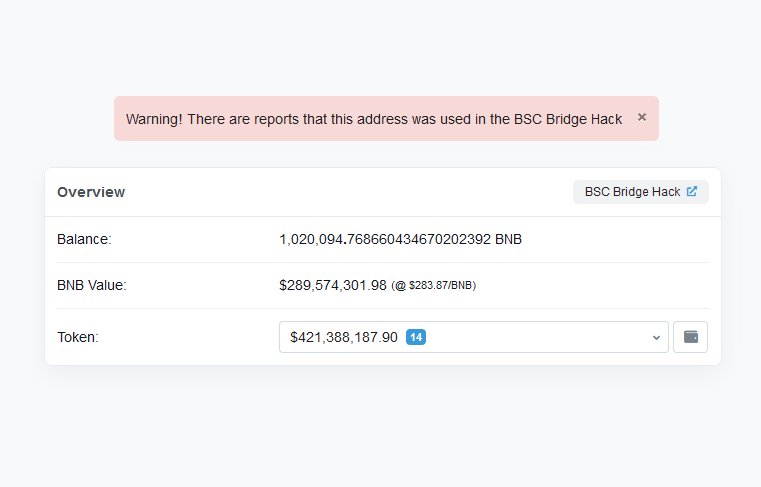
Five hours ago, an attacker stole 2 million BNB (~$566M USD) from the Binance Bridge. During that time, I've been working closely with multiple parties to triage and resolve this issue. Here's how it all went down.
🚨 The CFTC has filed a complaint against a DAO for violating the Commodity Exchange Act 🚨
"Defendant Ooki DAO... is an
unincorporated association comprised of holders of Ooki Tokens... who have voted those tokens to govern... the Ooki Protocol."
https://t.co/5iNuVvGW0d
Learn about the exciting projects that have been selected for #Web3 Stars Accelerator Program Vietnam 🇻🇳
With a thriving #developer community in the country, we're looking forward to the innovations on the way.
#BNB