Octodad and yet, surprisingly, younger than @dalmaer; lover of fine pies. Building, advising, parenting. Ex: Google, Walmart, Palm, Mozilla, Ajaxian, etc.
So many people have iterated into this spot, I wonder how much the harnesses and models are steering us all in this direction. This pattern just sort of emerged in my building over the past month — and it’s glorious.
I've changed how I work over the last few weeks.
I now have one lead agent for each area of focus, running all the time, and a chief of staff agent that oversees them. Each lead manages its own sub-agents that write code, test it, chase reviews, and coordinate with team members.
Everything I need to decide or review comes into one prioritized queue, a simple local web app. Each product review includes screenshots and a video demo of the feature. I clear the queue in batches, mostly by voice and keyboard shortcuts. The leads also bring back ideas I hadn't considered.
Working from one queue, instead of switching between dozens of chats, has cut a lot of mental overhead. The system keeps learning my preferences and distilling my judgment into a "Brian brain," so its recommendations and first drafts get better before they reach me. The goal is fewer corrections per change.
Every change still goes through the same human review and security checks. It is eliminating tasks, not human judgment.
What an exciting time to push the frontier of productivity, especially as we build the economy for agents (agentic finance). We should all keep pushing in this direction.
@JoshuaEbner I’m ET (similar to mosh) > Mac Mini > herdr TUI, + the Claude Code & Codex CLIs. I’m a simple man. I have Rex and Herdr macOS, but... can’t seem to shake the CLI.
@bryced8 The new game is monitoring my token spends vs. quotas, and when over-pace to exhaust before the reset, deciding what to do. Add more capacity? Pause some swarms? Try to find efficiencies?
Super fun.
...all the rest of them. Herdr includes a skill + API that teaches agents how to discover other sessions, organize them, and communicate with each other.
That’s really all you need. I’m experimenting with a custom dashboard and some other workflow on top, but you don’t need that.
I’ve never quite understood the appeal of software that gives you a blank canvas and building blocks to make your own tools.
I’d rather use a purpose-built product from a team whose judgment I trust, or build something custom for my exact needs.
The awkward middle ground makes you do the design work, but limits you to someone else’s building blocks.
And in companies, everyone ends up building their own systems, leaving the organization to deal with the complexity.
With AI making custom software easier to build, that tradeoff feels increasingly hard to justify
This is def the case for non-software now, too. Watching my spouse use Claude with Chrome for her tasks, she is getting so much household / family management stuff done.
It’s a little bittersweet, knowing this will soon become the new societal baseline. But for now it’s 🔥
This sounds extreme and I wouldn’t have believed it even a year ago, but we’re starting to see plenty of examples of productivity gains that are an order of magnitude or two above output levels pre-AI.
With the right harness, a deep understanding of your domain of what you want to build, likely a relatively new codebase (with some exceptions), a fluency of how to work with multiple agents at once, and a setup that makes it so you can test and deploy with limited friction, outputs on this level feel realistic in coding.
What’s crazy is this gap doesn’t appear to be diminishing over time. You’d think that we’d see a convergence in the lines because of AI, but it turns out the more depth you had before -and willingness now to take a different approach- gives you crazy leverage. And that is only compounding as the models can take on larger work and harder problems.
Right now this is most pronounced in software engineering for the obvious reasons. But there’s no reason we don’t start to see this in a number of other computer-use-sensitive domains like other scientific fields, AEC, finance, cyber, and more. Going to get quite wild.
@ctatedev@lekterable Same with this too. Too easy to tailor to one’s very specific way of working to reach for someone else’s — and so fun to work out for one’s self how to run the factory.
I have so many things I’m building, and that I want to build, that it feels expensive whenever I’m not overseeing the factory.
If I know one of my swarms is blocked on a decision, it’s _really_ hard to do something else; I feel distracted and uneasy.
🤔
Earlier in my career, I was a consultant, and one of my clients paid me a high rate for unlimited daily hours. It was exciting, but it quickly felt a bit unsettling: I started to price every non-work activity at that rate, and so everything (e.g., watching a movie) felt expensive.
AI has brought back that feeling.
Tasklet now has an iOS app!
Delegate work to your team of AI agents, wherever you are. Put them to work across your tools and the web, set up automations, build custom dashboards, and collab with your team. All from your phone.
Here's what you can do with the app 🧵
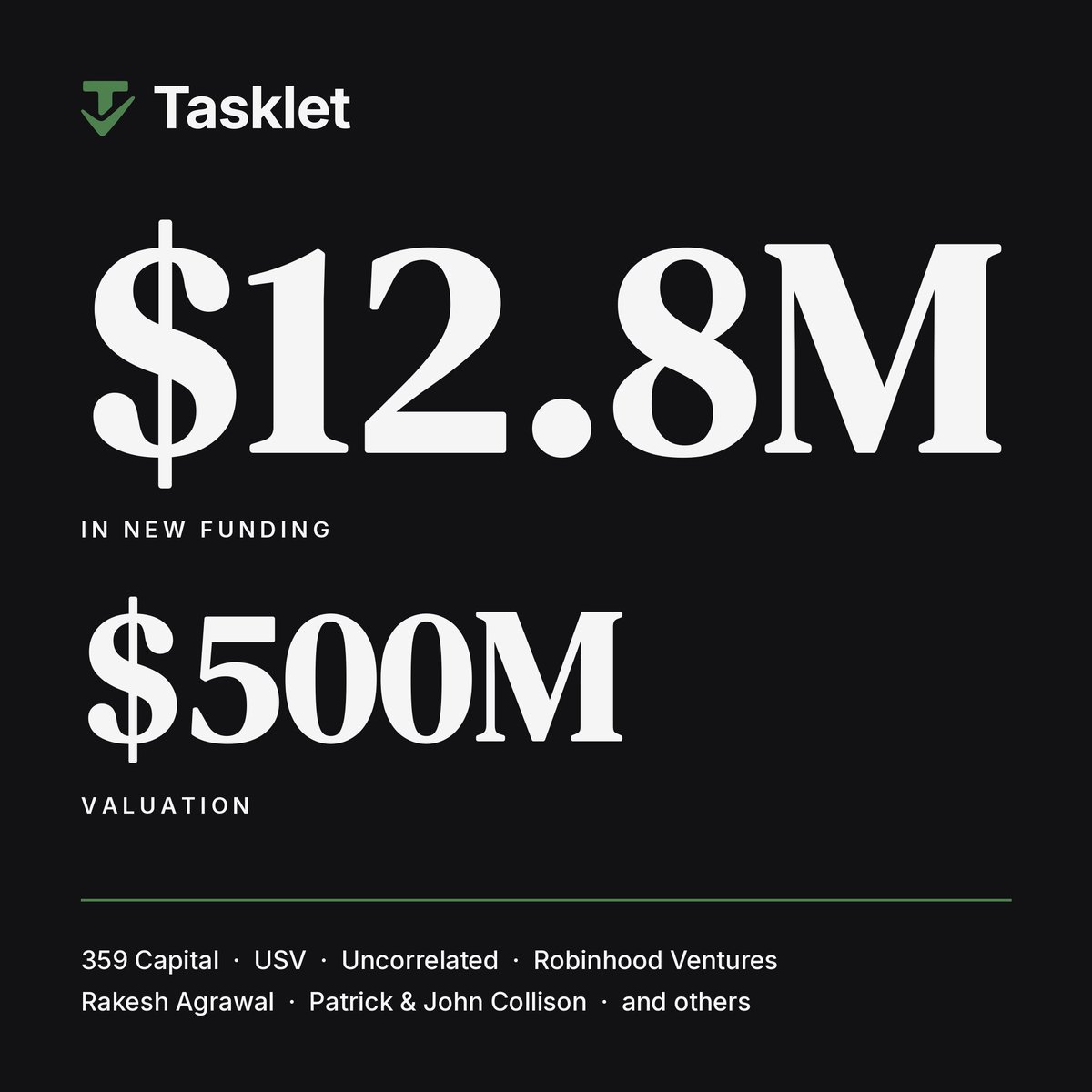
Today, I’m excited to share we’ve raised an additional $12.8M at a $500M valuation.
Muse, Instinct, Grokbot, Dots, etc are great for consumers, but businesses need more if they want to delegate real responsibilities to AI.
@TaskletAI is built with collaboration, automation, security, and control at its core, and our model-agnostic harness & cloud infrastructure gives you the best value for every AI dollar you spend.
Investors in the round include @usv, @359Capital, @salil, @RakeshAgrawal, $RVI, @patrickc and others.