Conventional wisdom has always been: pay into your pension, let it compound for decades and retire.
But a pension can't win a race against debasement. Wages have lost half their purchasing power vs the S&P since 2008...
Full write up below. https://t.co/DU4QmclVpm
I told Claude to predict the next BTC candle using Kronos. didn't touch anything. +$4,200 overnight.
Kronos isn't another LLM wrapper.
it's a GPT-style model trained on 12 billion candles from 45 exchanges.
Binance, NYSE, NASDAQ, LSE. it reads OHLC the way GPT reads English.
> words = candle patterns
> sentences = OHLC sequences
> the corpus = every trade ever printed
> the edge is simple:
P(next | history) = softmax(W · h_t)
same math GPT uses to predict the next word,
except the "word" is the next candle. no twitter sentiment.
no blog scraping.
no hallucinated confidence.
just statistics over 12B real price moves.
I plugged Kronos into a 5-min BTC Polymarket bot.
input: last 50 candles
output: probability next candle closes up
trades only when |p_model - p_market| > 0.04
72 hours: $300 → $4,500
ChatGPT looks at a chart and pattern-matches against an article it read.
Kronos looks at the chart and remembers 12 billion of them.
87% of Polymarket is exit liquidity. one of these models is actually trading the market.
https://t.co/hdttElGG24 21.8k stars, free, MIT license.
Tsinghua University release.
Elon Musk avait dit un truc qui m'avait marqué sur l'allocation de ressources. En substance : passé un certain niveau de richesse, l'argent n'est plus de la consommation, c'est de l'allocation de capital.
Cette phrase change tout.
L'économie, dans le fond, c'est juste un problème d'allocation. Tu as des ressources finies et des usages infinis. Qui décide où va quoi ?
Imagine une cour de récré. 100 enfants, des paquets de cartes Pokémon distribués au hasard. Tu laisses faire. Très vite, un ordre émerge. Les bons joueurs accumulent les cartes rares, les collectionneurs trient, les négociateurs trouvent des deals. Personne n'a planifié. Et pourtant chaque carte finit dans les mains de celui qui en tire le plus de valeur. Le système maximise le bonheur total de la cour. C'est ça, la main invisible.
Maintenant fais entrer la maîtresse. Elle trouve ça injuste. Léo a 50 cartes, Tom en a 3. Elle confisque, redistribue, impose l'égalité. Trois effets immédiats. Les bons joueurs arrêtent de jouer, à quoi bon. Les mauvais n'ont plus de raison de progresser, ils auront leur part. Les échanges s'effondrent. La cour est égale, et morte. Elle a maximisé l'égalité, elle a détruit le bonheur.
Le problème de la maîtresse, c'est qu'elle ne peut pas avoir l'information que la cour avait collectivement. C'est le problème du calcul économique de Mises, formulé en 1920. L'URSS a essayé de le résoudre pendant 70 ans avec le Gosplan. Résultat : pénuries, queues, effondrement. Pas parce que les Soviétiques étaient bêtes, parce que le problème est mathématiquement insoluble en mode centralisé.
Quand Musk a 200 milliards, il ne les consomme pas, il les alloue. SpaceX, Starlink, Neuralink, xAI. Chaque dollar est un pari sur le futur. Et lui a un track record. PayPal, Tesla, SpaceX. Il a démontré qu'il sait identifier des problèmes immenses et y allouer des ressources avec un rendement spectaculaire.
L'État aussi a un track record. Hôpitaux qui s'effondrent, éducation qui décline, dette qui explose, services publics qui se dégradent malgré des budgets en hausse constante. Le marché identifie les bons allocateurs, la politique identifie les bons communicants.
Le profit n'est pas une finalité, c'est un signal. Il dit : tu as alloué des ressources rares vers un usage que les gens valorisent suffisamment pour payer. Plus le profit est gros, plus la création de valeur est grande. Quand Starlink est rentable, ça veut dire que des millions de gens dans des zones rurales ont enfin internet. Quand un ministère est en déficit, ça veut dire qu'il consomme plus qu'il ne produit. L'un crée, l'autre détruit, et on appelle ça redistribution.
Dans nos sociétés il y a deux catégories d'acteurs. Les entrepreneurs et les bureaucrates. L'entrepreneur prend un risque personnel pour identifier un problème, mobiliser des ressources, créer une solution. S'il se trompe il perd. S'il a raison, ses clients gagnent, ses employés gagnent, ses fournisseurs gagnent, l'État collecte des impôts. Il est la cellule de base du progrès humain.
Le bureaucrate ne prend aucun risque personnel. Son salaire est garanti. Au mieux il maintient une rente existante. Au pire il la détruit par excès de réglementation, mauvaise allocation forcée, incitations perverses qui découragent ceux qui produisent. Mais dans aucun cas il ne crée.
Regarde les 50 dernières années. iPhone, internet civil, SpaceX, Tesla, Google, Amazon, Stripe, mRNA, ChatGPT. Toutes des inventions privées, portées par des entrepreneurs, financées par du capital risque. Pas un seul ministère n'a inventé quoi que ce soit qui ait changé ta vie au quotidien.
La France est devenue le laboratoire mondial de la dérive bureaucratique. 57% du PIB en dépenses publiques, record absolu. Une administration tentaculaire, une fiscalité qui pénalise la création de richesse. Résultat : décrochage face aux États-Unis, à l'Allemagne, à la Suisse. Fuite des cerveaux. Désindustrialisation. Dette qui explose.
Et le pire c'est que la mauvaise allocation s'auto-renforce. Plus l'État prélève, moins les entrepreneurs créent. Moins ils créent, moins il y a de base fiscale. Plus l'État s'endette et taxe. Boucle de rétroaction négative parfaite. La maîtresse pense qu'elle aide, et chaque année la cour produit moins.
Dans nos sociétés, ce sont les entrepreneurs, toujours, qui font avancer la civilisation. Les bureaucrates au mieux maintiennent une rente, au pire la détruisent. Aucune société n'a jamais progressé en taxant ses créateurs pour subventionner ses gestionnaires.
La question n'est jamais qui a combien. C'est qui alloue le mieux la prochaine unité de ressource pour maximiser le futur de l'humanité. La réponse depuis 200 ans n'a jamais changé. Ce ne sont pas les fonctionnaires.
I started by trying to understand markets. Thirty years later I've ended up somewhere closer to life, the universe and everything. The same four rules keep showing up...
Along the way I've written three frameworks that have shaped how a lot of people see the world.
The Everything Code is what I found when I went looking for what actually drives markets. A debt rollover cycle, managed by liquidity, debasing the currency at roughly 8% a year. That debasement is monetary entropy. Capital routes around it, into whatever can compound faster than the entropy degrades it. Technology and crypto sit at the top of that flow because they are the intelligence layer of the economy. Markets are monetary energy routing toward the highest output of intelligence. The only assets that outperform debasement over extended periods are tech and crypto.
The Exponential Age is the realisation that technology has become the substrate. Compute, networks, energy and intelligence are compounding faster than any institution we built was designed to handle, and the gap between the two is the defining tension of our time.
The Economic Singularity is where this is heading. Somewhere in the next decade the curve of intelligence per unit of energy turns fully exponential, and the rules every economy we know was built on stop applying.
For a long time I thought of these as three separate ideas. Looking at them now, they are three views of the same thing at different altitudes. And underneath all three, the same four rules keep showing up.
Efficiency of Intelligence - The universe rewards whatever does more with less. Every system that survives is better at turning energy into information than the system it replaced. There has never been an exception.
Compression - Intelligence is the act of representing a vast reality in a much smaller form without losing what matters. Brains do it. Theories do it. Prices do it. AI does it. They are not analogous. They are the same operation.
Coherence - Complex systems hold together because their parts synchronise faster than the noise around them. Markets, brains, civilisations, ecosystems. When the synchronisation fails, what looks like collapse is desynchronisation made visible.
Selection - Patterns that copy themselves faster than their rivals dominate the medium they live in. Genes did this in biology. Ideas do it in culture. Memecoins do it in markets. Truth is not part of the selection criteria. Replication is. It always has been.
What the four rules produce, when they operate together, is networks.
The same topology shows up everywhere. The cosmic web. The human brain. Mycelium beneath a forest. The internet. Financial markets. Blockchains. Across fourteen orders of magnitude, the universe keeps building the same shape. That shape is what the four laws look like when you can see them.
The Everything Code is what these four rules look like in markets.
The Exponential Age is what they look like running through technology.
The Economic Singularity is where they are taking us.
Three angles, one picture.
Underneath all of it, energy is the constant. Consciousness is the substrate. The four rules are the dynamics through which one becomes the other.
All of this is one corner of what I call The Universal Code. The same four rules apply to everything else and I mean EVERYTHING... they are universal in the true sense of the word.
Forget UBI. The answer is Universal Basic Equity… and it’s humanity’s pension plan for the post-AGI world...
The Economic Singularity is coming faster than people think and the default question is how humans make money in a world that doesn’t really need them anymore.
The default answer is UBI, which is transfer payments from a state, funded by taxing an AI economy that nation states can neither see nor keep up with.
It’s a 20th century answer to a 21st century problem and it’s broken before it even starts.
Agents are becoming the dominant user of the internet, not humans. Your AI is becoming your entire front end UX. The clicks economy is dying everywhere except where humans pay to feel something - clothing, travel, luxury, experiences, culture.
Agents run on crypto rails because nothing else works. The dollar doesn’t fractionalise below a cent, settlement isn’t instant, permissions are required, jurisdictions matter. Stablecoins handle the dollar leg and native tokens handle the rest.
The biggest users of DeFi in five years won’t be humans farming yield… it’ll be agents managing treasuries, swapping, earning and spending at machine speed.
Capital formation has already shown its new shape and it came from the most unexpected place. Memecoins. Everyone wrote them off as a casino but they were a prototype. Instant capital formation around the attention of an idea, raised by entities without legal personhood, settled in seconds. That is the template agent economies will use to fund themselves.
And it’s not just agents...
Robots will run on the same rails, with zk permissions issued from our wallets as the source of truth, because biometrics are far too flawed for that role
Open source code itself gets tokenized and finally captures the value it creates, instead of being monetized through bolted-on services and subscriptions.
Proof of humanhood becomes the trust layer that lets us release agents into the world without society collapsing under synthetic noise. Identity, authentication, verification, permissioning, all of it migrates onto the same substrate.
So when you zoom out, the L1s aren’t just settling agent transactions but settling the entire coordination layer of the new economy… agents, robots, humans, code, capital, identity and trust.
Every contract, every treasury, every permission, every stake. Open source finally captures the value it creates, at scale, for the first time, and truly vast value accrues to the coordination layer because everything routes through it.
Which brings us to the actual answer to the Economic Singularity…
Universal Basic Equity.
Anyone on earth with a phone and an internet connection can buy a stake in the substrate that the new economy runs on. No KYC walls, no accreditation rules, no jurisdiction, no employer, no state, no permission. The first homogenous, permissionless, globally fractionalisable claim on the productive infrastructure of the world. It's not a slogan but a structural fact about how blockchains actually work. This is their purpose.
Wealth comes from owning the substrate. Income comes from being human, because attention and experience remain the irreducible currency of culture, community and love.
Abundance of goods and services from AI handles the cost of living.
Taxing data center electricity use solves the tax issue.
Four legs of a stool that holds up the post-singularity human world.
So… just buy the fucking tokens.
Bitcoin if you want pure store of value, a basket of the major L1s if you want the coordination layer. 10% of your earnings, every month, for a decade. You'll be wealthy and protected from the changes to come.
Crypto is going to $100trn in the next 6 to 8 years and well beyond that after.
You can choose to invest in your own economic disruption, or get left behind by it.
And if you’re worried about timing the cycle…
…adjust your time horizon.
This is humanity’s pension plan.
It's all so absurdly fucking obvious...
Mark Cuban just described the largest wealth transfer of the AI era.
Almost nobody understood what he said.
Cuban: “There are 33 million companies in this country. Aren’t going to have AI budgets. Aren’t going to have AI experts.”
Not tech startups.
The shoe store. The regional trucking outfit. The accounting firm with 12 employees.
The businesses that actually run the physical economy.
They know AI is coming. They have no idea what to do with it.
Cuban: “You’ve got the head of Microsoft saying software is dead because everything’s going to be customized to your unique utilization.”
Software is dead.
The SaaS era ran on one rule. Build a generic product. Force millions of companies to bend their workflows around it. Charge rent forever.
AI ends the contract.
The business stops bending to the software. The intelligence bends to the business.
But customized by whom.
The third-generation manufacturer cannot tell Claude from Gemini. The county hospital is staring at a reactor asking where the light switch is.
Cuban: “Who’s going to do it for them?”
That question is worth more than the frontier models themselves.
Hundreds of billions are being burned to build the foundation. The smartest engineers alive are locked in a bloodbath over who owns the base layer.
Let them fight.
Let them burn the capital. Let them drive the cost of raw intelligence toward zero.
Because the wealth does not collect where the brain is built.
It collects where the brain meets the business.
Every ambitious kid in college right now thinks survival means a seat at OpenAI or Anthropic.
Cuban is staring at the other 99 percent of the economy.
Learn the models. Then learn the messy, unglamorous reality of how a 50-person company actually operates.
Walk through the door. Understand their problems. Wire the intelligence directly into their revenue.
That is not a job title. That is an entire economic class being born.
You do not need to build the brain. You need to build the nervous system.
The biggest winners of the electricity era were not the engineers who built the generators. They were the ones who walked into dark factories and showed the owners where to plug in.
33 million companies are standing in the dark right now.
Silicon Valley is racing to build the god. The fortunes will belong to whoever teaches him a trade.
Just had a meeting with a few people on our team.
There was a moment where it became obvious that AI was going to replace the work of multiple people in the meeting (content production) over the long run.
Although we don't know how long it will take, this was a "oh shit!" moment for the group.
The conversation quickly shifted to where potential moats would be and how these individuals could use the new tools to become more productive in an AI world.
The acceleration is becoming very obvious. Businesses are evolving, employees are shifting their day-to-day work, and products are rapidly improving.
You either embrace the tech or you live long enough to get disrupted by it.
Every day I post the stocks I’m researching, the theses I’m building, the positions I’m actually taking, and AI tools for investing.
If this was useful, you should follow me @BlackPantherCap
-BP
R.I.P. WORKING FOR SOMEONE ELSE.
$100 a day is $3,000 a month.
$3,000 a month is your freedom number.
Claude gets you there faster than anything alive right now.
Here are the 5 prompts that start the whole thing:
Things are going to get wild.
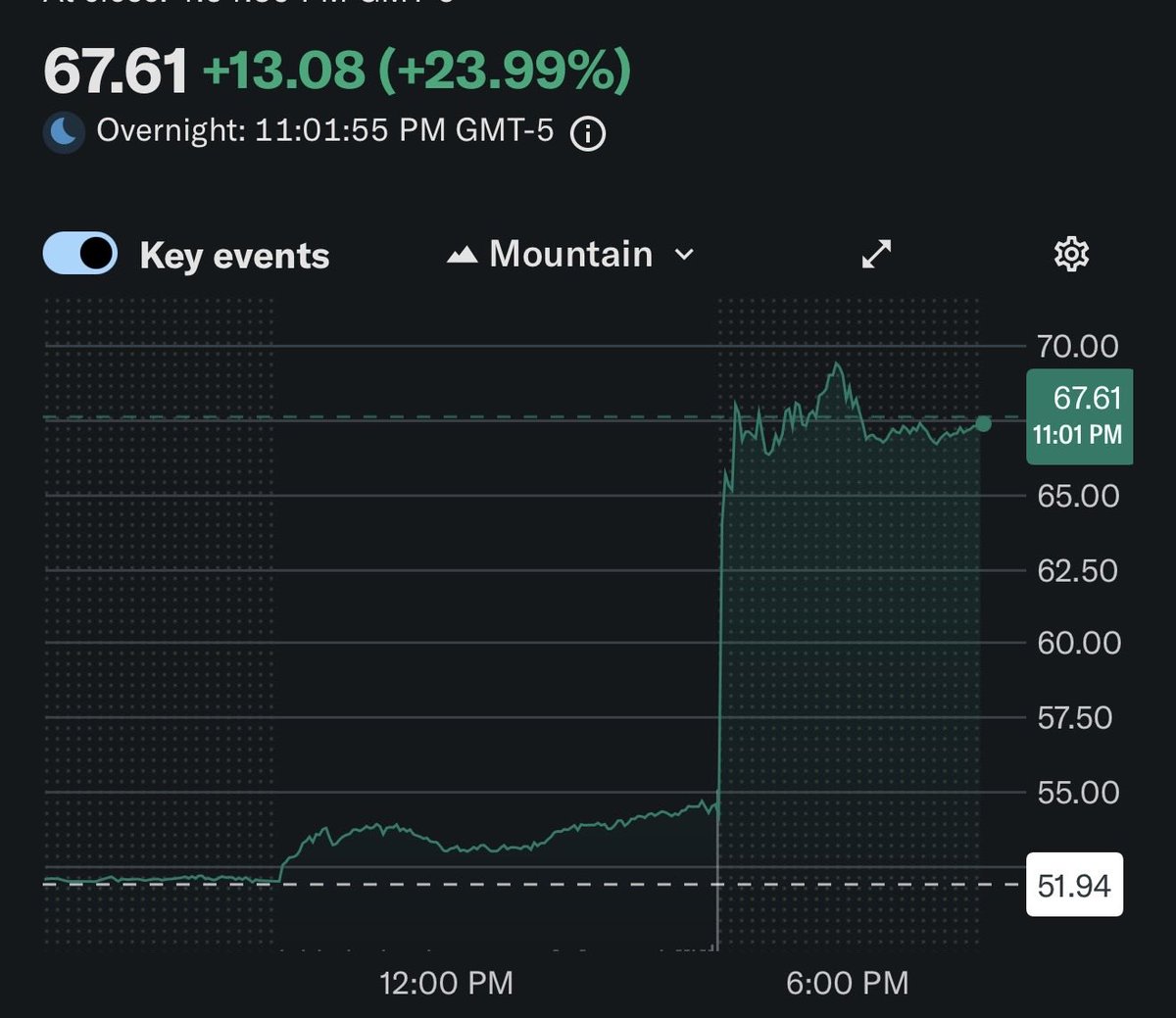
Jack Dorsey just laid off almost half of his work force in one go due to the productivity of AI.
Straight after, the stock pumped 25%.
We are fully entering an environment that has never happened before.
Hyper productivity
Massive unemployment
Rampant deflation
This will then be followed by the most insane level of money printing you have ever seen, and probably will ever see in your life.
Unemployment and deflation cannot be fixed any other way.
The US cannot have deflation because it makes paying off their debt near on impossible.
So they will print the hell out of it to inflate it to the moon.
This hyper productivity and money printing is going to create the most insane melt up in markets, bigger than anything ever before.
Which will then be followed by a depression as the world tries to figure out how it cokes out of this situation.
With mass unemployment and crazy inflation.
This is why it confuses me how people think we’re heading into a full blown winter now…
Bros… this is only just getting started.
We will get a winter… a savage one.
But not before we run it up double turbo to the max.
we're making @blocks smaller today. here's my note to the company.
####
today we're making one of the hardest decisions in the history of our company: we're reducing our organization by nearly half, from over 10,000 people to just under 6,000. that means over 4,000 of you are being asked to leave or entering into consultation. i'll be straight about what's happening, why, and what it means for everyone.
first off, if you're one of the people affected, you'll receive your salary for 20 weeks + 1 week per year of tenure, equity vested through the end of may, 6 months of health care, your corporate devices, and $5,000 to put toward whatever you need to help you in this transition (if you’re outside the U.S. you’ll receive similar support but exact details are going to vary based on local requirements). i want you to know that before anything else. everyone will be notified today, whether you're being asked to leave, entering consultation, or asked to stay.
we're not making this decision because we're in trouble. our business is strong. gross profit continues to grow, we continue to serve more and more customers, and profitability is improving. but something has changed. we're already seeing that the intelligence tools we’re creating and using, paired with smaller and flatter teams, are enabling a new way of working which fundamentally changes what it means to build and run a company. and that's accelerating rapidly.
i had two options: cut gradually over months or years as this shift plays out, or be honest about where we are and act on it now. i chose the latter. repeated rounds of cuts are destructive to morale, to focus, and to the trust that customers and shareholders place in our ability to lead. i'd rather take a hard, clear action now and build from a position we believe in than manage a slow reduction of people toward the same outcome. a smaller company also gives us the space to grow our business the right way, on our own terms, instead of constantly reacting to market pressures.
a decision at this scale carries risk. but so does standing still. we've done a full review to determine the roles and people we require to reliably grow the business from here, and we've pressure-tested those decisions from multiple angles. i accept that we may have gotten some of them wrong, and we've built in flexibility to account for that, and do the right thing for our customers.
we're not going to just disappear people from slack and email and pretend they were never here. communication channels will stay open through thursday evening (pacific) so everyone can say goodbye properly, and share whatever you wish. i'll also be hosting a live video session to thank everyone at 3:35pm pacific. i know doing it this way might feel awkward. i'd rather it feel awkward and human than efficient and cold.
to those of you leaving…i’m grateful for you, and i’m sorry to put you through this. you built what this company is today. that's a fact that i'll honor forever. this decision is not a reflection of what you contributed. you will be a great contributor to any organization going forward.
to those staying…i made this decision, and i'll own it. what i'm asking of you is to build with me. we're going to build this company with intelligence at the core of everything we do. how we work, how we create, how we serve our customers. our customers will feel this shift too, and we're going to help them navigate it: towards a future where they can build their own features directly, composed of our capabilities and served through our interfaces. that's what i'm focused on now. expect a note from me tomorrow.
jack
Bitcoin follows the US political cycle with great precision.
Year after election = Bull market top. Every time.
2013: Top
2017: Top
2021: Top
2025: Top
Midterm year = Bear market bottom. Every time.
2014: Bottom
2018: Bottom
2022: Bottom
2026: Bottom? (My forecast is for Oct 2026)
It gets even more interesting.
The bottom is getting closer to midterm election day each cycle.
2014 Midterm - Bottom 71 days later
2018 Midterm - Bottom 39 days later
2022 Midterm - Bottom 13 days later
The gap is shrinking by almost half each time. At this rate, the 2026 bottom lands right around the November midterms, possibly in October 2026.
This is one of the best posts I've read in a long time.
In our companies, the impact of AI constantly grows, week after week.
And the results are insane.
I highly recommend reading this article if you're doing any job being a computer.
The One Number That Matters Right Now: 7.9×
As a trained oil and gas reserves engineer, I was taught to watch one ratio: reserves ÷ production rate.
It tells you how long inventory lasts.
Bitcoin is even stricter than a reservoir.
In oil and gas, higher prices can bring on new drilling and add reserves. In Bitcoin, supply is fixed at 21 million. No new discoveries. No reserve revisions.
Now apply the same depletion logic:
ETF holdings: ~1.3 million BTC
New annual issuance: ~164K BTC
Coverage ratio: ~7.9× (about 8 years of current new supply)
That’s why this number matters the most: it compares demand to supply.
If long-duration buyers are absorbing multiple years of new BTC, price doesn’t need a story to reprice it needs time.
Yes, the path will be volatile.
Yes, OG holders will sell into strength.
But game theory says large holders usually distribute gradually (not all at once), while patient institutional flows keep absorbing over repeated rounds.
Add the market structure shift:
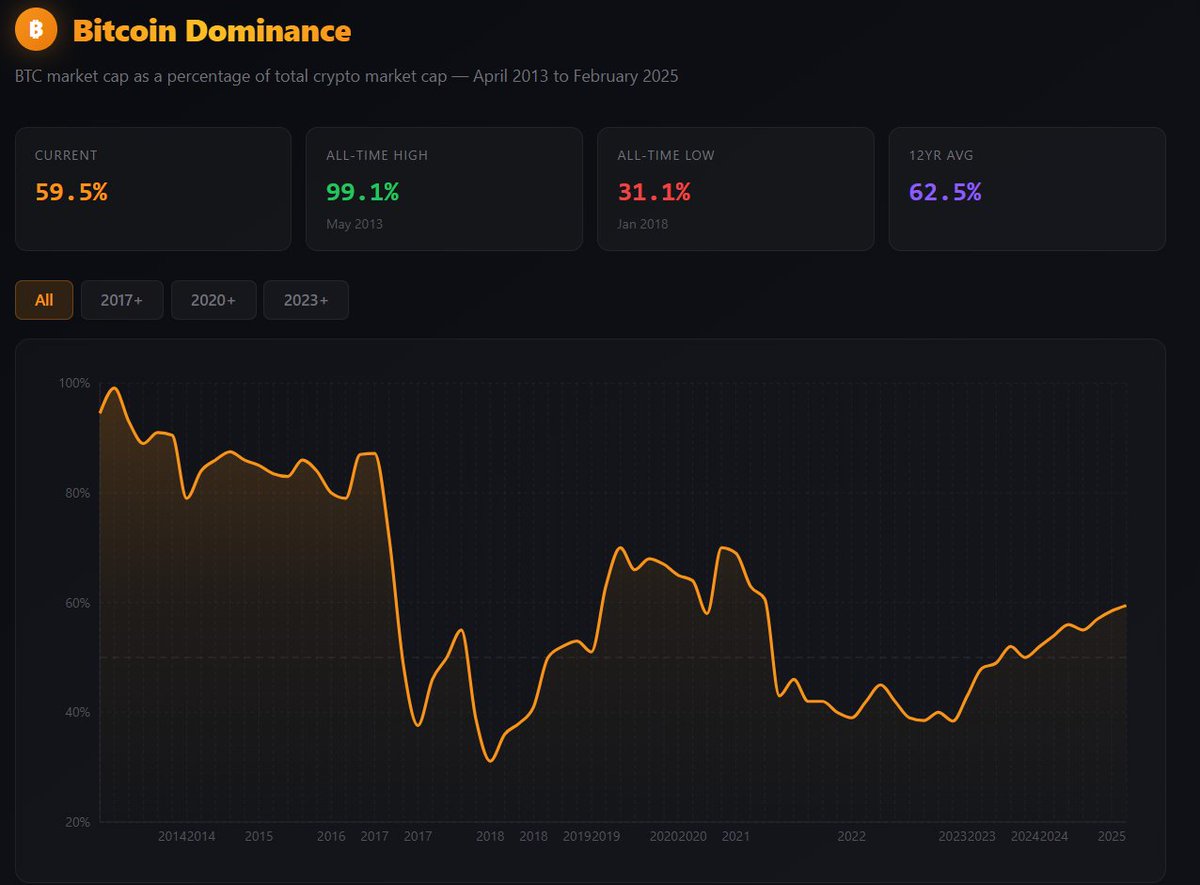
BTC dominance rose from ~38% in 2023 to ~60% today.
That is capital concentrating into the highest-conviction asset, not broad exit from crypto.
Bottom line:
Short-term price can be chaotic.
Long-term, if persistent net absorption stays above new supply, clearing pressure remains upward.
#DYOR
Gold is out here trading like Fartcoin. I never want to hear from a gold bug again that "btc can't be money because it's too volatile." They've all lost their rights to say that to Bitcoiners.
I also never want to hear this nonsense again either: "It takes too much money to move the btc price now. Big moves are no longer possible." Bullsh*t. If a $36 trillion asset can move like a meme coin , a $1.5 trillion one can rocket more.
OK. Carry on and stack harder. You don't have enough bitcoin.