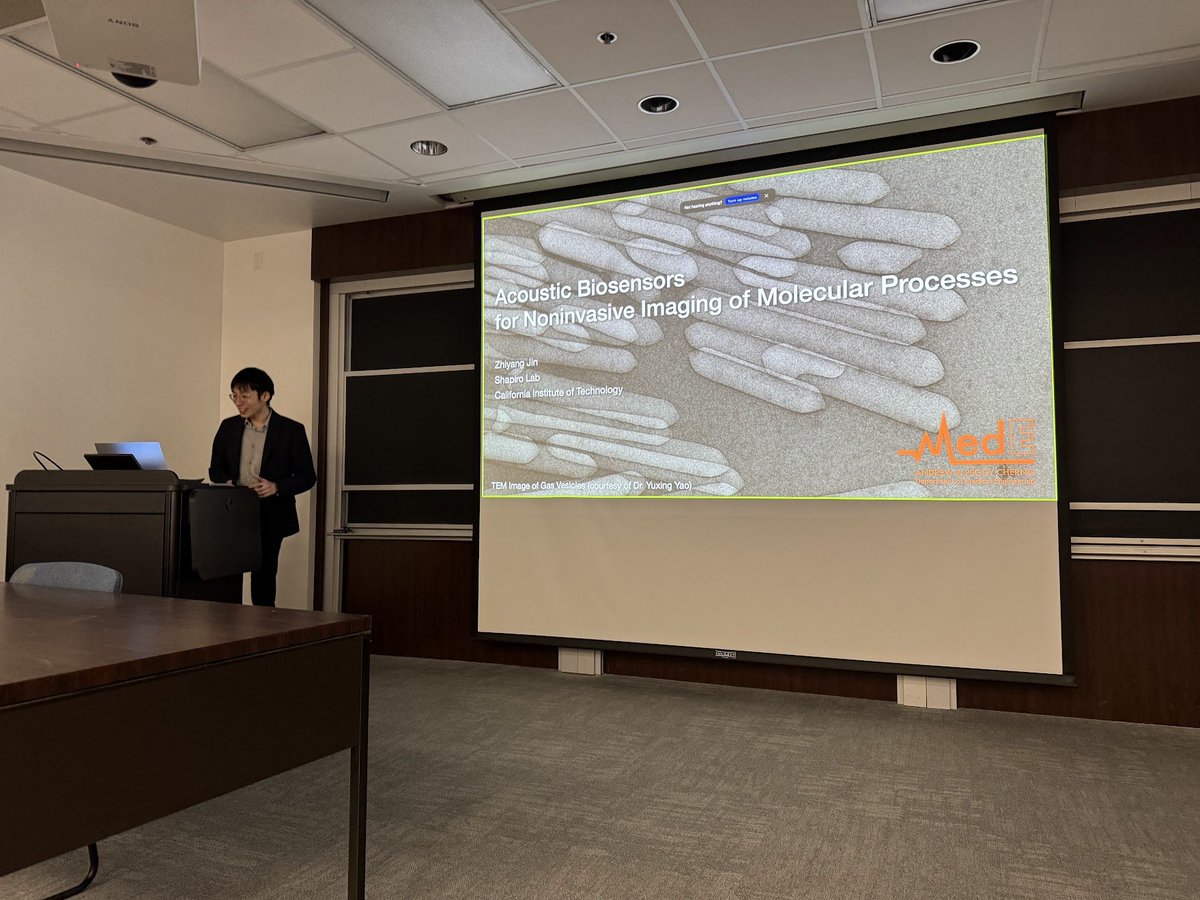
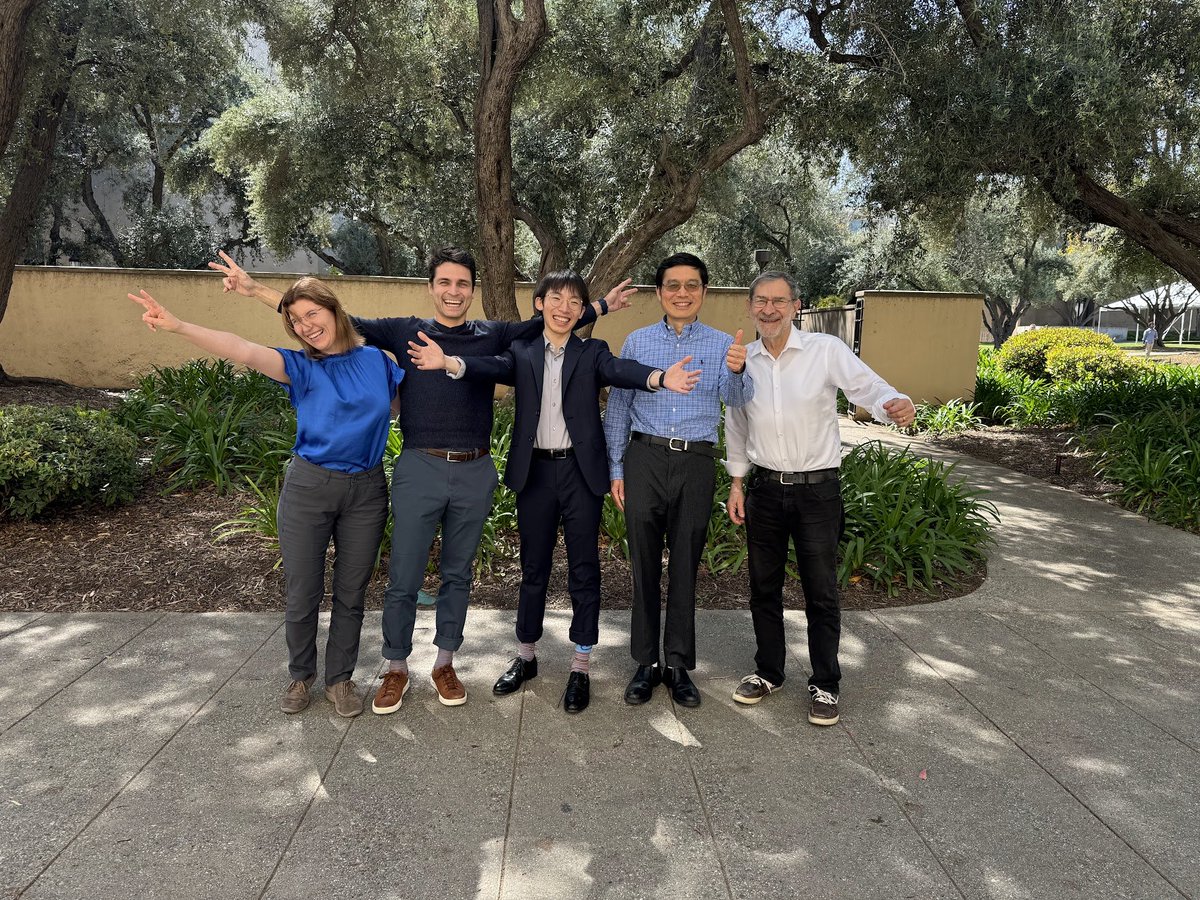
Congrats to Dr. @ZhiyangJin on a phenomenal PhD thesis defense on acoustic biosensors! 🎉
Zhiyang's work broke fundamentally new ground in connecting ultrasound to dynamic cellular signals such as proteases and calcium.
Can you evolve an acoustic protein? Yes, but first you have to invent a system for high throughput acoustic screening!
Congrats to @robertchurt, @ZhiyangJin and colleagues on this advance in biomolecular ultrasound. #gasvesicles
https://t.co/rpT5m9eKvk
#gasvesicles are tiny gas-filled organelles that serve as flotation devices for microbes, and microbes pack them in a beautiful honeycomb pattern to maximize space-saving. What is the protein that regulates this process, and what is the role of #condensate? See our paper @NatureMicrobiol, and cheers to all the collaborators @lingchongyou, Ashutosh Chilkoti, Yifan Dai, and @alexholehouse.
Can’t wait to take the next step with @motifneuro!
This funding will allow us to launch the first clinical trial with magnetoelectric-powered implants - a new architecture for neuromodulation.
Credit to team at Motif and the supportive environment at Rice and the Launchpad!
Where do #gasvesicles live in a mammalian cell?
The cytoplasm, as we can see w/bioorthogonal labeling w/FlAsH!
Congrats to Erik Schrunk, co-sr auth @di_wu_ & co on a fractional labeling method that may also be useful for other protein nanostructures.
https://t.co/r9tJH5XQBN
A paper from my PhD is officially out today at @NatureNeuro where @SumnerLN and I demonstrate a closed-loop ultrasound-based brain-machine interface (BMI)!!
Link to paper - https://t.co/IlpcDYkjHr
A #tweetprint. 🧵1/12
Forest Neurotech is hiring!
Three roles on the engineering team (Palo Alto, CA)
- Principal Mechanical Engineer
- Principal Electronics Systems Engineer
- Principal Engineering Program Manager
@ all my Neurotech friends -- please share 😊
https://t.co/tjTBLdr9fG
Can we image intracellular calcium with ultrasound?
Yes, w/ultrasonic reporters of calcium - URoCs!
Congrats to @ZhiyangJin and co-authors on creating the first genetically encoded acoustic biosensors of this universal cell signal based on #gasvesicles.
https://t.co/cXqHM3awH4
Magneto-gas vesicles, protein nanostructures with enhanced ultrasound signal and sensitivity, enable the non-invasive, long-term and quantitative monitoring of the mechanics of three-dimensional tissues and animals @yonsei_u@mikhailshapiro@IBS_media https://t.co/u3DKCWVLS1
Excited to start my new journey as an Assistant Professor @DukeEngineering Most sincere gratitude goes to my supervisors and mentors: @JulianRimoli , Rafael de la Llave, Michael Ortiz, @mikhailshapiro, Ravi... and thanks to many incredible colleagues at Georgia Tech and Caltech
Can a living material made of bacteria sense when it's too cold and make a chromophore to heat itself up with sunlight? 🌞 Yes, using thermal bioswitch circuits!
Congrats @LealiaXiong, Michael Garrett and collaborator Julia Kornfield on this paper.
https://t.co/t401vEemGD
New technologies to study the hallmarks of cancer! Congrats @mijinee_hi and @magdalinipan and colleagues at @MSKCancerCenter on putting together this terrific review of micro/nanotechnology approaches to investigate tumor ecosystems, in Nature Cancer. https://t.co/sQfAi5RCjK
🚨🚨🚨New paper🚨🚨🚨
@Matt___Nguyen et al. found that NPs exit solid tumours through the lymphatics in a size dependent mechanism, and proposed a new mechanism of NP delivery to tumours called the Active Transport and Retention (ATR) principle 🥵🌶️
https://t.co/VUUW69JsHT
Excited to share our study on the blood interactions of GVs! Special thanks to @ko_polymer for developing the surface functionalization chemistry and @ben_stordy@TheChanLab for their work on the protein corona!
What's the bloody mechanism behind the ultrasound contrast dynamics of #gasvesicles in circulation?
Congrats to @bill_ling and collaborators at @Caltech and @TheChanLab on finding out!
https://t.co/hHqWMEP8R2
#gasvesicle requires a coordinated effort of 7-20+ proteins to assemble. As a first step to unravel this intriguing process, we constructed a systematic protein interaction map and hypothesized proteins in each assembly stage. Big cheers @ManuelIburg & co.
https://t.co/dQ31rf9QfD
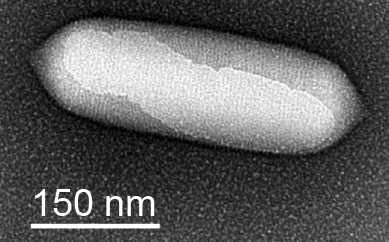
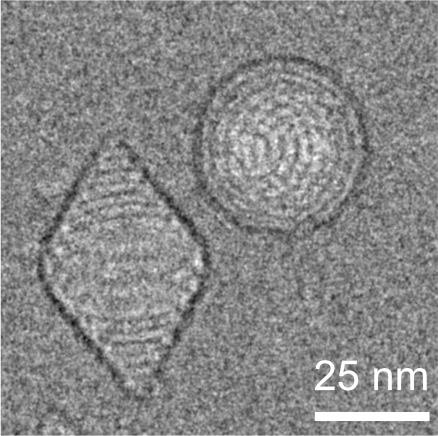
We have shrunk #gasvesicleto the size of a virus, and to our knowledge, these are the smallest stable, free-floating bubbles made to date. Check out the 50-nm GVs and our demo of their penetration to lymphatic tissues. Congrats to @QionghuaS@ZLi44to91.
https://t.co/wFicnmztZm
Honey, we shrunk the #gasvesicles!
Congrats to @bill_ling et al on a new class of Truly Tiny ultrasound agents with dimensions of ~60nm. They're small but mighty - producing ultrasound contrast, seeding therapeutic cavitation, and getting into tumors. https://t.co/kaTV7EtRrA
Microbes pack #gasvesicle into tight bundles to save their cytosolic space, and yet the molecular mechanism underlying this process remains unknown. Now we may know why. Grateful to our collaborators Chilkoti Lab and @lingchongyou. More detail -> (1/n)
https://t.co/RaoxlllC5k