Critically, image preprocessing and the handling of readily available parameters can be adjusted during AI development/deployment, offering a means for mitigating bias from an AI standpoint more generally. (8/n)
Excited for "Acquisition parameters influence AI recognition of race in chest x-rays and mitigating these factors reduces underdiagnosis bias" to finally come out in @NatureComms https://t.co/N4iQJIq90x (1/n)
There are many sources of bias and this approach is not sufficient, but it points to the importance of these "boring" factors and the potential of using AI to elucidate biases in clinical datasets to then reduce AI bias itself. (7/n)
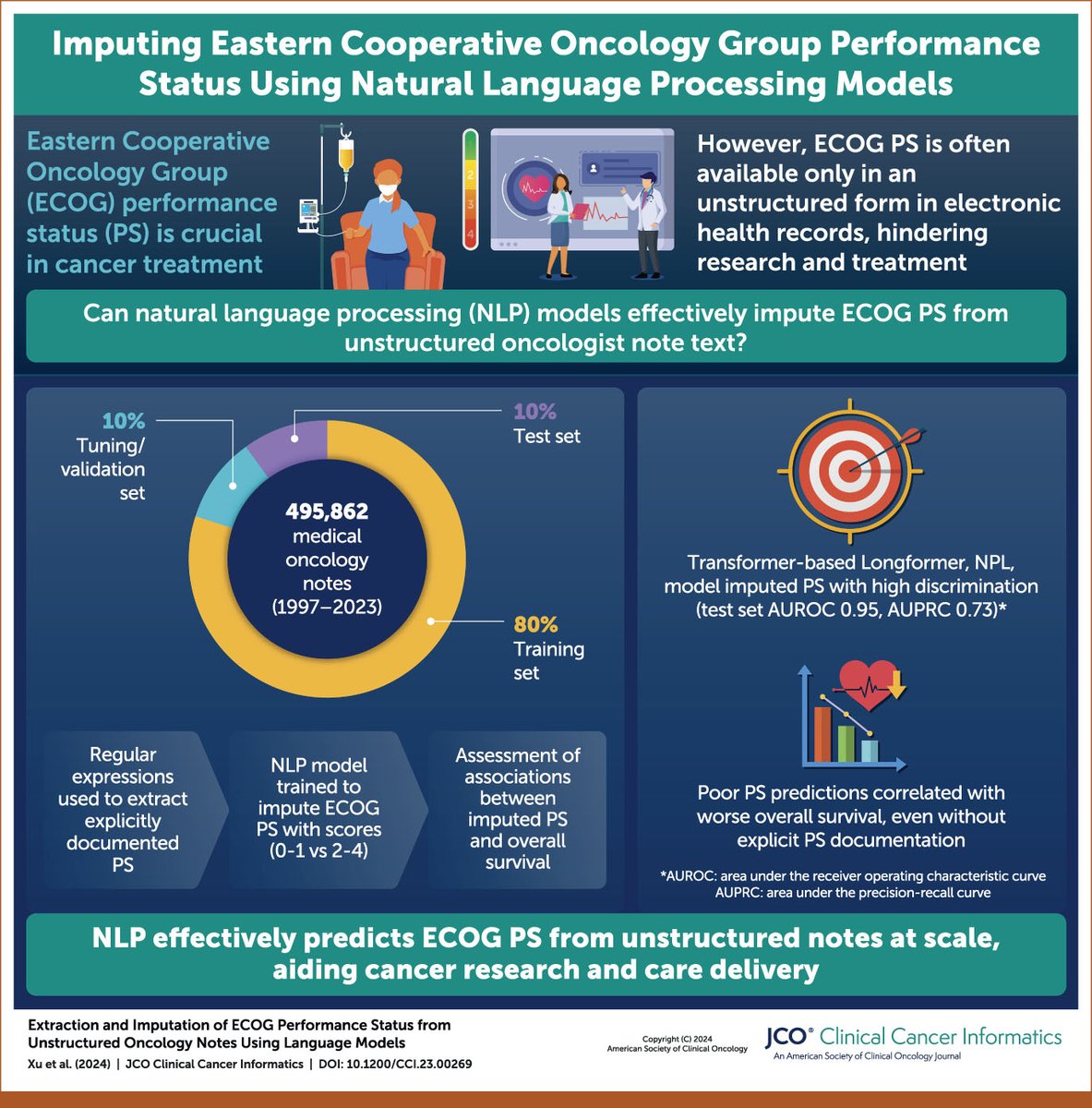
1/ Out now in @JCOCCI_ASCO! AI models can accurately impute performance status from clinical notes (AUROC 0.95), even when it's not explicitly documented. @kenlkehl@bill_lotter@DanaFarber_GU https://t.co/PpNuCCaEpE
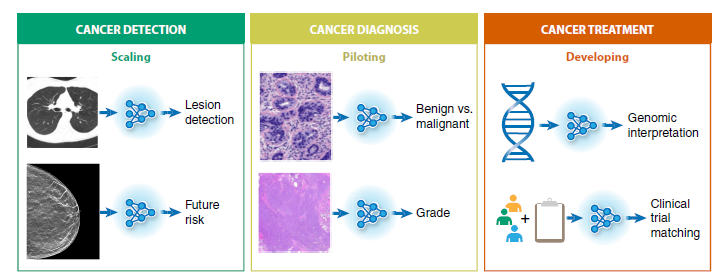
New review in the May issue of Cancer Discovery—
Artificial intelligence (AI) in oncology: Current landscape, challenges, and future directions, by @bill_lotter, @ecerami et al.
https://t.co/HUaxFX62Ze
@dfcidatascience@harvardmed
We're pleased to announce @LorenzoTrippa's promotion to Professor, @DanaFarber & @HarvardBiostats . Dr. Trippa is an expert in developing and using statistical approaches to accelerate new discoveries in #cancer treatment.
https://t.co/D8Poc3cyJ4
A curated database of @US_FDA-cleared #ArtificialIntelligence products for medical imaging indicates a high prevalence of triage systems, variability in basic output characteristics, and often limited #explainability of AI predictions.
https://t.co/1h6ECKNuY0
New work with @stephmcnamara & @PaulYiMD. We study explainability & intended use in FDA-cleared AI for medical image interpretation. We create a curated database and find a high prevalence of triage devices, meaningful variation in basic outputs, and often limited explainability
The clinician-AI interface: intended use and explainability in FDA-cleared AI devices for medical image interpretation https://t.co/MjOtmY4GBj #medRxiv
Overall, our paper emphasizes the potential of using multimodal foundational models for intuitive, language-based explanations of visual tasks and dataset auditing (4)
New paper with excellent (high school!) student @shoagarwal to be presented at ML4H. We use a pre-trained vision-language model to represent a new vision task as a linear combination of words: https://t.co/PzgSkF1Po7 (1)
To functionally assess explainability, we perform a pilot reader study and find that the AI-identified words can help non-experts perform a medical task above chance levels (3)