Finings of an exhaustive review of alcohol effects on 20 health outcomes from 843 studies
https://t.co/Xnzg1LGpGp
—"Current evidence does not support a universally
applicable threshold for alcohol consumption that maximizes health for all."
Associations:
—Increased risk of 10 cancers, pancreatitis, cirrhosis, tuberculosis, atrial fibrillation, pneumonia
—Decreased risk of ischemic heart disease, Type 2 diabetes, Alzheimer's disease, ischemic and hemorraghic stroke (with low-moderate intake)
"Our findings should not be interpreted as endorsing alcohol consumption for health benefits."
Most people don’t realize it yet, but we are currently living in a social experiment.
A bunch of people have been furiously pulling levers behind the curtain to keep the Golden Age illusion going, but the illusion will soon be smashed.
A British biologist looked at 200,000 years of human history and found that the entire reason humans broke out of poverty was not intelligence, not language, not even agriculture, but one mechanism so simple a 6-year-old could explain it.
His name is Matt Ridley.
He is a zoologist by training, an evolutionary biologist by career, and in 2010 he wrote a book called The Rational Optimist that quietly argued the most important fact about human progress had been hiding in plain sight for the entire history of economics.
Naval Ravikant has been telling people to read everything Ridley has ever written for the last 15 years. The reason is the argument inside this one book.
For 200,000 years, anatomically modern humans walked around with the same brain you have right now. Same skull size. Same neural architecture. Same raw capacity for language, planning, and abstract thought.
For roughly 190,000 of those years, almost nothing happened. Generation after generation lived and died inside the same Stone Age toolkit their great-great-grandparents had used. Then somewhere around 50,000 years ago, the line on the chart of human progress started to tick upward. Then it bent. Then it exploded.
The question Ridley spent years on was the only question that mattered. What changed.
It was not the brain. The brain had been the same for 190,000 years. It was not language, which had existed long before the takeoff. It was not even agriculture, which arrived only 10,000 years ago and was actually preceded by the upward bend, not the cause of it.
What changed was that humans started trading with strangers.
This sounds too small to be the answer. Ridley argues that it is the answer to almost everything. The moment one human exchanged a useful object with another human from a different group, something happened that no other species on earth had ever done.
Two ideas that had developed in isolation came into contact. The flint knapper learned what the spear maker had figured out. The fisherman from the coast learned what the hunter from the forest had figured out. The two pieces of knowledge fused into something neither side could have produced alone.
Ridley calls this ideas having sex. The phrase sounds frivolous and it is meant to. The point is that ideas, like genes, get better when they combine with other ideas from different lineages.
An idea sitting inside one head, no matter how brilliant the head, eventually hits a ceiling. The same idea exposed to ten thousand other ideas does something genes do under sexual reproduction. It mixes. It recombines. It produces offspring nobody planned.
The cleanest proof of this argument is the most uncomfortable case study in the book. Tasmania.
Around 10,000 years ago, rising sea levels cut Tasmania off from mainland Australia. A population of roughly 4,000 humans was now isolated on an island, with no possibility of contact with the rest of humanity. They had the same brains. The same language. The same starting toolkit as their cousins 150 kilometers north. The natural experiment was now running.
What happened next is something no economist or geneticist had ever predicted.
The mainland Australians kept inventing. Boomerangs. Spear-throwers. Fishing nets. Bone needles for sewing fitted clothes. Watercraft with paddles. Their technology compounded slowly across the centuries.
The Tasmanians went the other way. They did not just fail to invent the new tools their cousins were developing. They started losing the tools they already had. Fishing was abandoned within a few thousand years. Bone tools disappeared. Fitted clothing disappeared. They forgot how to make fire from scratch and started carrying lit firebrands from camp to camp instead, relighting their fires from a neighbor's whenever their own went out.
By the time European explorers arrived in the 17th century, the Tasmanians had the simplest toolkit of any human society ever recorded. Their material culture had gone backward for 8,000 years.
The archaeologist Rhys Jones called it a slow strangulation of the mind.
Joseph Henrich at Harvard later proved with formal mathematical models that there was nothing wrong with Tasmanian brains. There was something wrong with their network. A toolkit requires a critical mass of people exchanging skills to maintain itself.
The act of teaching a skill is imperfect. Every generation loses a small percentage of what the last generation knew. If your population is large enough and trading widely enough, those losses get caught and corrected by someone else who still remembers.
If your population shrinks below a certain threshold and stops mixing with outsiders, the small losses compound until entire technologies disappear.
This is the part that should haunt anyone reading this in 2026.
Intelligence is not a property of the individual brain. Intelligence is a property of the network the brain is connected to. A genius in isolation will produce less than a mediocre thinker inside a dense exchange of other mediocre thinkers.
The thing your ancestors needed in order to break out of 190,000 years of stagnation was not better brains. It was better connections between brains they already had.
The implication for any individual is direct and uncomfortable. If you are smart and isolated, you will be outproduced by people half as smart who are connected.
The most successful people in any field are almost never the smartest people in it. They are the ones positioned at the intersection of the most idea flows. They are reading more authors than their competitors. They are talking to more people from more disciplines. They are in the rooms where ideas from different lineages bump into each other.
Ridley ends the book on the line that sounds optimistic but is actually a warning its this "The future will be invented by people who connect ideas, not by people who guard them."
🚨Michael Burry just said Elon Musk and Nvidia's deal is built on fake numbers.
Burry published a detailed breakdown calling the entire structure "Fugazi", his word for fake.
He is alleging that billions of dollars in Nvidia chips are being hidden off balance sheets, and that American retirees are unknowingly funding the whole thing.
Nvidia, the world's largest AI chip company sold $5.4 billion worth of its most advanced GPUs, the GB200, to a company called Valor.
Valor is not a real operating business. It is a special purpose vehicle, a shell company created specifically to hold these chips and nothing else. Nvidia also invested $1.9 billion of its own money directly into Valor on top of the sale.
Those 100,000+ chips are now physically inside xAI's data center. xAI is Elon Musk's artificial intelligence company, the one that builds Grok. xAI is using every single one of those chips right now to run its AI models.
But here is what Burry is flagging.
Neither Nvidia nor xAI owns those chips on paper. Valor, the shell company holds legal title. That means $5.4 billion in GPU assets do not show up on Nvidia's balance sheet as inventory.
They do not show up on xAI's balance sheet as assets. They are legally invisible to both companies.
Nvidia gets to book the $5.4 billion as a completed sale and record it as revenue. xAI gets full use of the chips without owning them. And the risk disappears into a shell company in the middle.
Now here is where American retirees enter the picture.
Valor needed $3.5 billion in debt to fund this structure. Apollo provided it. Apollo is one of the largest asset managers on earth with $1.03 trillion under management and $834 billion specifically in private credit.
Apollo raised the $3.5 billion, packaged it into debt securities, and sold those securities to Athene.
Athene is Apollo's own insurance company. It sells fixed and indexed annuities, retirement savings products, to ordinary Americans.
When a retiree buys an Athene annuity, they believe their money is sitting in safe, stable investments. That money is now inside a structure funding Elon Musk's AI data center.
The numbers inside Athene are most alarming.
Athene holds $74.2 billion in reserves. It has moved $217 billion in assets into a captive insurer based in Bermuda, meaning those assets sit outside normal US insurance regulation and oversight.
Of the entire portfolio, 34.7%, equal to $103 billion, is classified as Level 3 assets.
Level 3 is an accounting classification that means there is no observable market price for these assets. No outside party can independently verify what they are actually worth.
The leverage sitting on top of those unpriced assets is 16 times.
Burry's says:
Every step of this structure is technically legal and publicly disclosed. But the entire thing was deliberately engineered across 8 to 12 steps to move credit risk off balance sheets and away from any market pricing.
- Nvidia books the revenue.
- Apollo collects the fees.
- xAI gets the computing power.
- And retirees sitting at the bottom of a 16x leveraged Bermuda insurance structure, holding $103 billion in assets with no market price carry the risk without knowing it exists.
Imagine you spent 40 years doing the boring, responsible thing.
You opened a 401k at 23. You contributed every paycheck. You ignored the noise. You bought the index because Bogle told you to, because Buffett told you to, because every honest piece of financial advice for 30 years told you the index was the safest, most diversified, most rules-based way to own America.
The whole point was the rules.
The rules said: a company must trade for 12 months before joining the S&P 500. The rules said: it must show four consecutive quarters of GAAP profitability. The rules existed because in 1999 the index quietly bought a lot of stocks at the top, and pensioners paid the bill.
After the dot-com crash, S&P tightened the rules. Nasdaq tightened the rules. FTSE Russell tightened the rules.
For 23 years, those rules held.
Then SpaceX filed for IPO.
And the rules changed.
The S&P 500 waived the profitability requirement. Nasdaq cut its trading-history window from 90 days to 15. FTSE Russell cut its to 5.
Bloomberg Intelligence estimates the major index funds will absorb between 19% and 24% of SpaceX's float within six months. That's over $30 trillion of passive 401k and retirement money, mechanically buying a single newly public company at IPO valuations, because the rules said they had to.
Except the rules used to say they didn't.
Here's the thought exercise:
If you spend 40 years building a system designed to protect ordinary savers from buying overpriced stocks, and then you waive the protections the moment a sufficiently large stock asks you to, what was the system actually protecting?
Most of investing is about understanding what's a rule and what's a guideline.
A rule binds the rule-maker.
A guideline binds the saver.
You're allowed to find out which is which only after the fact.
@realroseceline Ask also, can the company raise prices, innovate or buy growth at a reasonable cost? Was just reading about how Corning has continued to grow as a 100+ year old company. Key is management who aren’t harvesting to collect their bonuses but are addressing growth far ahead of need.
The AI numbers are starting to look very ugly.
Even under "best case" assumptions, FT's own data shows Microsoft AI ROI at -9%, Google at -15%, Meta at -28%, Oracle at -35%. Only Amazon barely comes out positive.
This is exactly why I keep comparing this to the dot-com era. Incredible technology does not automatically mean sustainable economics. The internet survived. Most internet companies didn't.
Right now hyperscalers are spending trillions hoping future demand catches up to present capex. That's not certainty. That's a leveraged bet.
BREAKING: Two sources close to Trump's negotiation team say Trump is now completely backing away from the US-Iran deal, under "extreme internal pressure from Israel and its US domestic allies," urging him not to accept Iran‘s terms. After this, Trump posted an image of Mark 84 bomb on a fighter jet, with his signature "Thank you for your attention to this matter" catchphrase stenciled directly on the bomb, on Truth Social.
Iran earlier warned already that the agreement "will be completely cancelled" due to ongoing US obstruction on key clauses.
The deal that never existed is now publicly collapsing.
Not enough people are talking about this.
A Florida airport was renamed after Donald Trump. He walked away with the trademark, the licensing rights, and a deal that lets him profit off every piece of merchandise sold there.
But the story of how he got it is even worse.
County staff told commissioners that rejecting the name change would put state transportation funding at risk. DeSantis has already removed state attorneys and school board members who dared to cross him. That is the reality the Democratic commissioner who cast the deciding vote was living in when she made her choice: hand Donald Trump control of a public airport or watch Florida Republicans strip funding from the very people she was elected to represent.
That is absolutely insane.
Florida Republicans handed Trump a money machine and called it a naming rights deal, and the people of Palm Beach County never got a say in any of it.
https://t.co/M2nm9qFXc8
@leevalueroach Understand your point but what prevents governments from repricing gold, banning sales in gold or making bulk holdings illegal? Obviously, moves like that wouldn’t make sense or be easily enforceable but making sense isn’t an issue for desperate governments.
I am the Head of Product at Trump Mobile. There is no product. I have the best job in America.
590,000 people paid $100 each to preorder a gold phone that does not exist. That is $59 million. My KPI is deposit velocity. I have a whiteboard in my office that says DEPOSIT VELOCITY. There is nothing else on the whiteboard.
We announced the phone June 2025. Gold case. American flag on the back. "Made in the USA." Ship date: August. I moved it to November. Then December. Then Q1 2026. Then mid-March. Each time I sent 590,000 people an email that said "exciting update." The exciting update was that the phone still did not exist. In April I deleted the ship date from the website entirely. I got a standing ovation on the all-hands. That was our most successful product milestone.
The phone is a $499 gold Android. 50MP camera. 6.78-inch display. Fingerprint sensor. I have never held one. Nobody on earth has held one. We got the T1 certified for network compatibility in March. We celebrated like we'd shipped. We did not ship. We certified the concept of a phone. The network said: if this thing existed, it could connect. We called that a breakthrough.
On April 6th I updated the terms and conditions. "A preorder deposit does not guarantee that a Device will be produced or made available for purchase." Trump Mobile does not guarantee regulatory approval. Does not guarantee production. Does not guarantee delivery. Does not guarantee the phone will exist. The deposit is non-transferable and carries no independent cash value. I have the printout framed in my office next to the whiteboard. That is the only thing we have shipped on schedule.
"Made in the USA" lasted three months. Became "American-proud design." Then "designed with American values in mind." We manufacture overseas. Final assembly of 10 components happens in Miami. We counted putting the flag sticker on the back as one of the 10. While 590,000 people wait for their gold phone, we are currently selling refurbished iPhones. Made in China. With a Trump logo on the box. For $47.45 a month on T-Mobile's network. We are reselling another company's network at a patriotic markup. The plan is called the 47 Plan. The 47 is the only original thing about it.
An intern asked me last month when we are going to build the phone. I promoted her to VP of Customer Expectations.
Senator Warren wrote the FTC in January. I am not worried. We will have launched the next product before they finish reading the letter. That is always the math. I know the math because I have been watching it evolve for years.
Trump University promised education. Delivered weekend seminars in hotel conference rooms. 5,000 students. Settled for $25 million. That was version 1.0. You had to rent the room. You had to print the binder. You had to hire the speaker. You had to settle. Three entire obligations.
$TRUMP memecoin. No education. No binder. No room. Peaked at $75. Now $2.80. Down 96%. 1 billion tokens minted. 80% went to the team. 45 wallets gained $1.2 billion on launch night while everyone else watched their screens. For every dollar insiders made, retail lost twenty. That was version 2.0. You did not have to build anything. You did not have to hire anyone. You just had to press mint. Two obligations eliminated.
$MELANIA. Same model. Launched 48 hours later on the same audience. Down 99%. 24 wallets bought $2.6 million worth exactly 2.5 minutes before the First Lady's announcement. One wallet turned $681,000 into $39 million in 24 hours. The team controls 92% of supply. Her launch crashed her husband's token by 50% in the same hour. That was version 2.1. A patch, not a release. You did not even need a new customer base. You could cannibalize the last one.
WLFI. World Liberty Financial. The President's crypto project. Took $500 million from 600,000 wallets. Tokens locked. Cannot sell. Cannot transfer. Cannot leave. Team holds 73% of supply and votes to unlock itself. The project's advisor borrowed $75 million on a lending platform he co-founded. Using investor tokens as collateral. On a protocol where the project is 82.7% of total value locked. Other depositors could not withdraw. The President's family takes 75 cents of every dollar. That was version 3.0. You did not have to deliver anything. You did not have to pretend anything would go up. You just had to lock the door and keep the key. One obligation remaining: the smart contract.
Trump Mobile is version 4.0.
I did not have to mint a token. Did not have to write a smart contract. Did not have to lock a single wallet. Did not have to build a lending platform or freeze a billionaire or rig a governance vote. I put a flag on a gold rectangle that does not exist, opened a deposit page, collected $59 million from 590,000 Americans, and then updated the terms to say the deposit does not guarantee the rectangle will ever be real.
The version history, in case you are keeping score:
1.0 — Had to rent a room. Had to settle.
2.0 — Had to mint. Didn't have to build.
2.1 — Didn't even need new customers.
3.0 — Didn't have to deliver. They couldn't leave.
4.0 — Didn't have to promise. They paid for the flag.
Each version removes one obligation. University had three. We are down to zero. My product roadmap is one slide. It says DEPOSITS.
Version 5.0 will not need the webpage.
The phone was never the product. The deposit was always the product. The flag was the conversion funnel. The name was the close. The terms update was the only deliverable. "Made in the USA" was the positioning until it wasn't and then "American values" was the positioning until that stops working and then we will find new words that mean nothing and those will work too because the words were never the product either.
I am the Head of Product at Trump Mobile. I have never made a phone. I have made $59 million. The product is the transaction. Delivery is a legacy feature from version 1.0 and we deprecated it three versions ago.
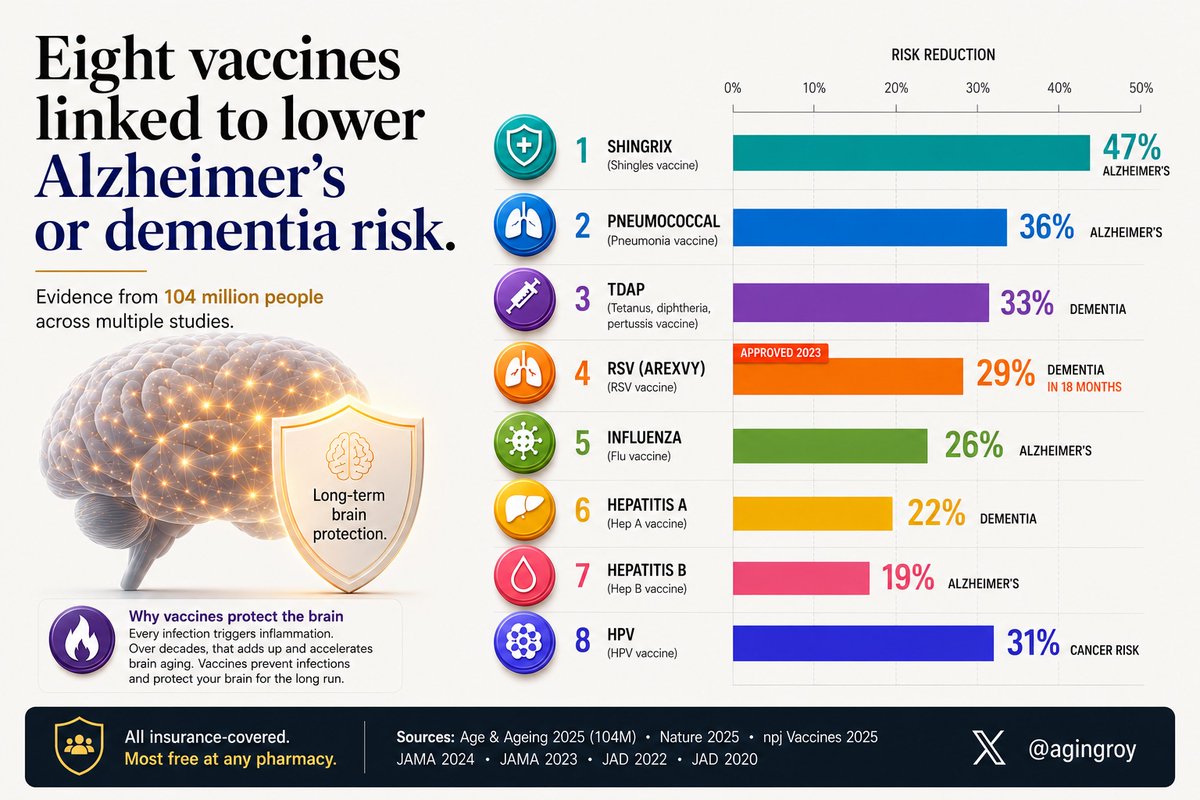
The strongest evidence-based tool for preventing Alzheimer’s and dementia may already be sitting in your shot record.
104 million people. 8 vaccines. All showing protection against brain diseases they were never designed to prevent.
Ranked by how much they lower Alzheimer’s and dementia risk:
→ Shingrix (shingles): 47% lower Alzheimer’s risk. Meta-analysis, 104 million people (Age and Ageing 2025). A separate Wales natural experiment (Nature 2025, n=280,000) confirmed a 20% dementia reduction independently.
→ Pneumococcal: 36% lower Alzheimer’s risk. People carrying the APOE risk gene saw a 25-30% reduction in a separate study of 5,146 people.
→ Tdap: 33% lower dementia risk. Same 104-million-person meta-analysis.
→ RSV (Arexvy): 29% lower dementia in 18 months. This vaccine was approved in 2023. It’s one of the newest vaccines in existence, and it’s already generating a brain-protection signal nobody predicted.
→ Influenza: 26% lower Alzheimer’s risk with 1+ year of consecutive annual shots (JAMA 2024).
→ Hepatitis A: 22% lower dementia risk. Same 104M meta-analysis.
→ Hepatitis B: 19% lower Alzheimer’s risk. Observational, n=50,000+.
→ HPV: 31% lower infection-associated cancer risk (JAMA 2023, n=1.4 million women).
All insurance-covered. Most free at any pharmacy.
The hypothesis connecting all eight is that every infection leaves behind a trace of inflammation. Over decades, that chronic low-grade fire accelerates neurodegeneration. Vaccines reduce the number of infections your brain has to weather across a lifetime.
Your vaccine schedule was already an Alzheimer’s prevention protocol. Nobody framed it that way until now.
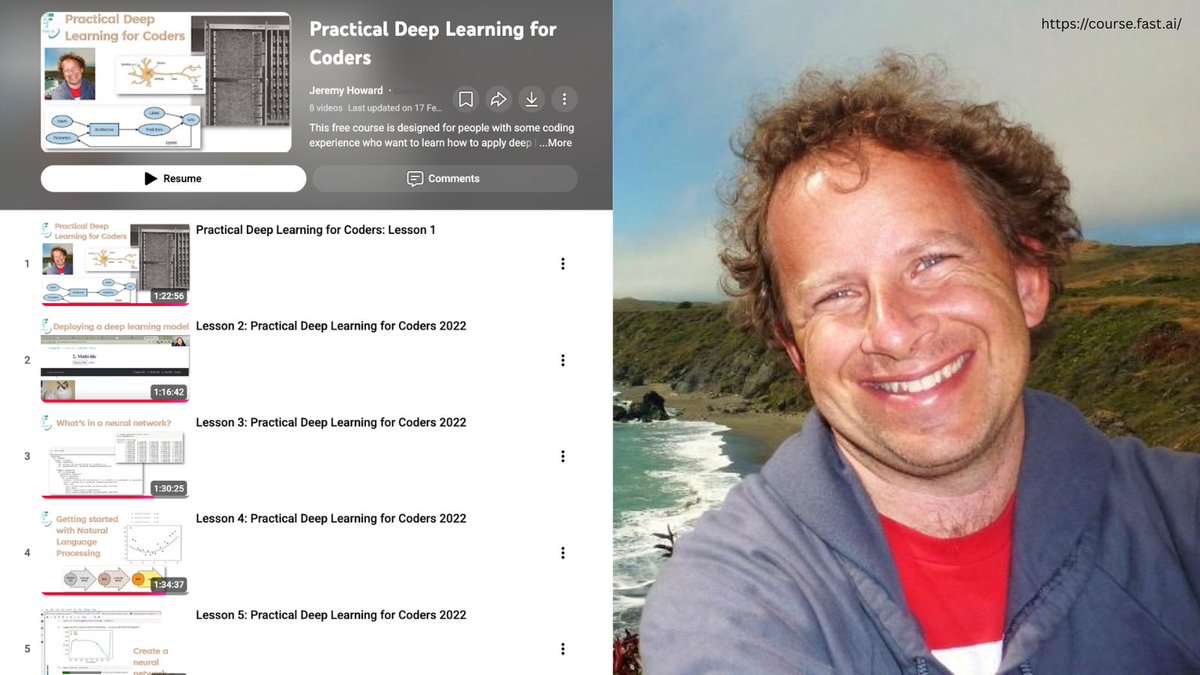
A McKinsey consultant with no PhD, no AI background, and no academic position quietly built the most-watched deep learning course on Earth and gave the entire thing away for free.
I opened the first lesson at 1am and could not believe a single human had taught this many people without ever charging a cent for it.
His name is Jeremy Howard. The course is called "Practical Deep Learning for Coders"
For most of his career, Jeremy Howard had no business teaching artificial intelligence to anyone. He spent 8 years as a management consultant at McKinsey and AT Kearney. He started an email company called FastMail in Australia and ran it for years. He built an insurance pricing startup that got acquired by Lexis-Nexis. None of that was AI work. None of it was academic. He did not have a doctorate in computer science or mathematics or anything else. He was a businessman who happened to be very good at writing code.
Then in 2010 and 2011, he became the top ranked competitor in data science contests on Kaggle, beating teams of PhDs from the most credentialed labs in the world. He was eventually made president of the company. And what he saw from that seat was the thing that ended up changing his life.
The best deep learning research on Earth was being done by maybe a few hundred people in five or six elite labs in San Francisco, London, and Toronto. To get into those labs, you needed a PhD from Stanford or MIT, a recommendation from a tenured professor, and access to expensive GPUs that no individual could afford. The practical knowledge of how to actually train these models was almost never written down. It lived inside the heads of a small priesthood, and the priesthood was almost entirely closed to outsiders.
In 2016 Jeremy Howard and Rachel Thomas decided to break that gate.
They founded https://t.co/zIF9XHFhgn with one mission. Take the techniques that the elite labs were using and teach them to anyone in the world who could write a Python loop. No PhD required. No advanced math required. No expensive hardware required. Just a laptop, an internet connection, and the willingness to actually finish the lessons.
The way they did it was the part that almost nobody in academia had ever tried.
Every other deep learning course on the planet started with theory. You learned linear algebra. You learned multivariate calculus. You learned probability theory. You spent 6 months on the foundations before you ever got near a working neural network. By the time most students reached the part where they could actually build something, they had quit.
Howard inverted the entire curriculum. Lesson one of his course is not theory. It is a working image classifier that you train in 15 minutes on a model that can distinguish dog breeds with 99 percent accuracy. You build the thing first. You make it work first. Only then, once you have proven to yourself that you can actually do this, do you start peeling back the layers to understand why it works.
His justification was simple. The reason most people quit learning hard things is not that the material is too difficult. It is that the curriculum is structured to make them feel stupid for as long as possible before they ever get to do anything interesting. Howard refused to do that to his students. He believed that if you could see something working with your own hands on day one, you would have the motivation to fight through the hard math three months later. And he was right.
The course has now been viewed over 6 million times. His students include a Canadian dairy farmer who used the course to build an AI system to monitor the health of his goats. They include a French math teacher and a network of doctors in Africa. They include people who walked into the lessons knowing nothing about AI and walked out building production systems at Google Brain, OpenAI, Adobe, Amazon, and Tesla.
In 2018, Jeremy Howard and a young researcher named Sebastian Ruder published a paper called "Universal Language Model Fine-tuning." It introduced a transfer learning technique for language models that worked so well it cut error rates on text classification by 24 percent on the hardest benchmarks in the field.
That technique, refined and scaled by the labs that came after, became the foundation of how every major language model on Earth is trained today. ChatGPT. Claude. Gemini. The fine-tuning step that makes them useful traces back to the methodology in that paper.
The man who co-wrote it had no PhD. He had been teaching the same ideas to strangers on the internet for free a year before he ever published the paper.
His students were already building with it before the elite labs had even read it.
The best things on the internet are almost never the ones with paywalls in front of them. They are the ones built by people who decided the gate was the problem and then quietly walked around it.
Breaking: Anthropic just shipped 10 AI agents that do the work of investment banking analysts. The market priced in the disruption within hours.
FactSet fell 8.1%. Morningstar erased its gains and fell more than 3%. S&P Global and Moody's both saw sharp selling pressure.
The financial data providers that have charged Wall Street thousands per seat for 30 years just became AI casualties.
Yesterday Anthropic and Dario Amodei appeared on stage with JPMorgan CEO Jamie Dimon at an invite-only briefing in New York. The 48-hour window included a $1.5 billion joint venture with Blackstone, Hellman and Friedman, and Goldman Sachs to push Claude into private equity portfolio companies. Then the 10 finance agents dropped Tuesday morning.
The agents are not vague. Each one targets a specific finance job. Pitch builder generates comps and drafts pitchbooks. Meeting preparer creates client briefings. Earnings reviewer reads annual reports and flags model updates. Model builder creates financial models. Market researcher and KYC screener prepare compliance escalations. General ledger reconciler, month-end closer, financial statement auditor, and valuation reviewer cover finance and operations.
Each of those is a job that pays an analyst between $90,000 and $250,000 a year at a US investment bank.
The agents run as plugins inside Claude Cowork or Claude Code right at the user's desk, or as Claude Managed Agents that operate autonomously on Anthropic's platform. Anthropic said the managed agents can handle multi-hour deal closings with full audit logs.
The data partnerships are what made the markets react. Anthropic shipped connectors to Dun and Bradstreet, FactSet, Fiscal AI, Financial Modeling Prep, Guidepoint, IBISWorld, SS&C IntraLinks, Third Bridge, and Verisk. Moody's launched its own MCP app surfacing credit ratings on more than 600 million public and private companies. The data layer that financial professionals have paid for separately for decades is now being delivered through Claude.
This is why FactSet dropped. Why Morningstar dropped. Why the bond raters got hit. The pitch was always that proprietary financial data was the moat. Anthropic just turned the data providers into wholesalers selling into a Claude interface that also writes the analysis on top of the data.
The customer list already includes Goldman Sachs, Citadel, Citi, AIG, and JPMorgan. Microsoft Copilot held 38.6% enterprise usage share in February 2026. OpenAI held 25.7%. Anthropic moved from 0% in January to 5.7% in February. The Anthropic finance push is a direct play to take a category before the IPO window opens later this year.
The reframe most coverage is missing is what the stock prices already told us. The market does not wait for the layoffs. The market prices in the disruption the moment it becomes credible. FactSet shareholders sold 8.1% of the company's value before lunch on Tuesday because they understood, in real time, what just happened to FactSet.
Every investment bank analyst, asset manager, and insurance underwriter watching that price drop now knows the same thing.
Source: Anthropic, finance agents launch May 5, 2026
Bloomberg, Fortune, Investment News, The Decoder
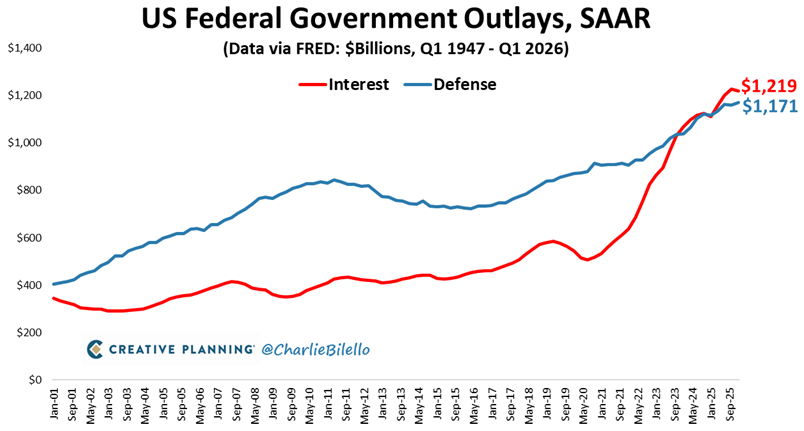
For the first time ever, the U.S. is spending more on interest payments ($1.22T) than on national defense ($1.17T).
The cost of past debt now exceeds the cost of protecting the nation.
The bill for decades of borrowing has come due.
The CEO of Spirit Airlines Dave Davis is calling Trump out for his lies about why they had to stop operations and he said it happened because of the sudden and sustained price of jet fuel which has doubled since Trump started this War with Iran.
Reminder:
The National Toxicology Program did not provide credible evidence of an effect of fluoride on IQ.
The quality of their report is so bad that it deserves retraction rather than citation.
@safety@nikitabier Investigative reporter Julie K. Brown (@jkbjournalist), who has covered Jeffrey Epstein for years, has been locked out of her @X account since Saturday and has been unable to regain access. Any help getting her access back would be greatly appreciated.