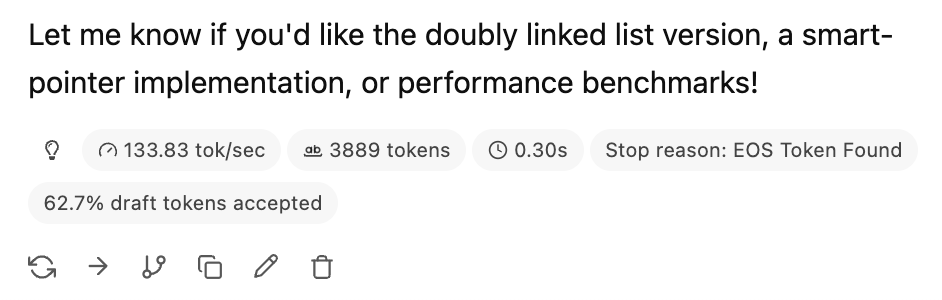
Qwen 3.6 35B running at over 100 tokens per second on my $5,399 MacBook Pro M5 Max.
This is the best local AI model I have ever run.
128GB of unified memory. No cloud. No API costs. No rate limits.
Just raw local inference at speeds I didn't think were possible on a laptop.
This model is more intelligent than GPT 5 on benchmarks.
Running locally.
On a MacBook. For free after the hardware cost.
I said local AI would never compete with frontier.
I'm starting to rethink that.
The gap is closing faster than anyone expected.
Must admit, @TheAhmadOsman knows his stuff. I'm on Windows at the moment, but compiling llama.cpp and tuning it for the RTX Pro 6000 does yield much better performance than serving models with vanilla LM Studio.
@loktar00 Very much looking forward to putting it to use. The other thing that stung was the the recommended RAM for the build out being 1.5x the VRAM amount.
If you were the only person on Earth who had access to Qwen3.6 27B or 3B5 running on an M5 Max with 128GB of RAM in 2020, 2021 or 2022, how big would your advantage be over other developers and companies?
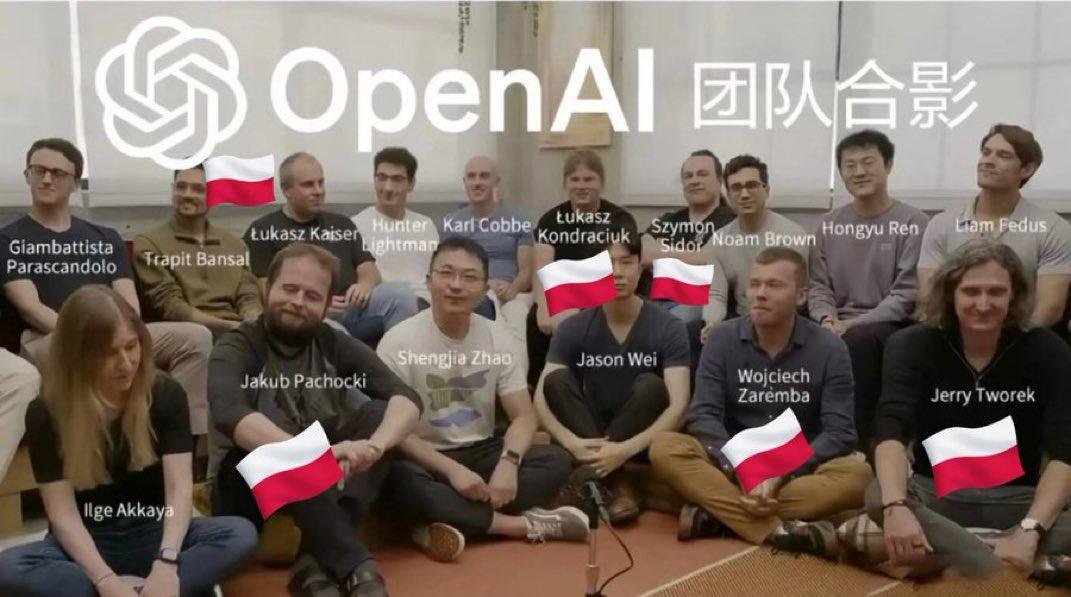
Poland is also home to so many brilliant Erlang and Elixir developers. I've worked with a few of them via @ErlangSolutions. I think the stud @Prince_Canuma operates out of there too.
Poland has made like half of core OpenAI researchers
strongly bullish on Poland (and goblins)
I think Poland might be more valuable than NVidia
The trick is to keep that value in Poland
My sophmore year I worked at UW cancer research lab placing tumors in hairless mice, just under the skin. The tumor would grow wherever it placed. I started working at RealNetworks after research become too difficult to observe.
This was a real case in Germany of a surgeon who sustained a scalpel injury to his left had while resecting a malignant abdominal tumour known as a fibrous histiocytoma.
5 months later, the surgeon notices a tumour arising at the same wound site on his left hand. Molecular analyses confirms the implausible - that the surgeon’s tumour was also a histiocytoma. Histopathological and DNA analyses found this to be genetically identical and indisinguishable to the patient’s tumour.
The surgeon's tumour was successfully removed via surgery. 2 years later, he was in good health without signs that the tumor had spread or was returning.
With surgical injuries, we tend to worry about blood borne infections, but seeding and implantation of cancer cells is a rare but possible complication.
📽️: Zack D Films
I'm always surprised at people's enthusiasm over ditching one frontier model for another. I get the best results when using @claudeai in tandem with @OpenAI.
The frontier models are decent at designing web interfaces but pretty bad at designing for iOS and MacOS. My approach now is to go from design document to web implementation with Gemini, and then from Gemini to UIKit/AppKit with Claude. Porting from one language/framework to another seems to make a lot of sense to these models.
Maxell is bringing back a classic, w/ their brand new Cassette Player 🥳🎉
-Wireless AND Wired 🙌
-Rechargeable ⚡️
-11 Hours of Battery 🤯
* Step back into the 80’s with Maxell *
I've been converging on a realization: software engineers are still very much needed for the foreseeable future. Let me explain why, and why I think the current AI hype cycle is no different from every previous one.
First, of course, there will be a specialized, narrow set of skills that lets people build AI-assisted software without touching the code much — guidelines and best practices that make it possible to maintain a project by AI alone for more than a couple of weeks, with proper storylines, tests, and compatibility layers between components.
The code would get messier. It would accumulate repetition. As of today's models, it probably wouldn't be secure enough — though this is changing quickly. But for a small-ish project, it would be maintainable.
Being a fan of the Unix philosophy — small, targeted tools that do one thing well — I think this approach may actually fly. Quick detour: if the OS kernel is stripped down to its core and you have a compiler, tools like `binutils` could in principle be AI-built on top of well-documented syscalls. Lightweight, correct, pleasant to use — and never touched by human hands.
However, whether you like it or not, money is concentrated in large-scale, enterprise-grade products. And those require exactly what AI still struggles with: long-term context maintenance. Acquiring quality context that is well internalized in operational memory is everything. Perhaps better code annotation tools and new reasoning techniques will produce a leap forward here — but so far, I wouldn't bet on it.
For prototyping, AI wins. For refactoring: unclear. I've tried a couple of times to hack something up with AI first — get a working prototype, extract the story, then refactor cleanly. Does it help the overall development process? Inconclusive. Once you have the prototype, it's not clear it's of much use beyond helping you visualize what it should look like and surface imperfections in the original approach. That's about it.
Tests help, sure — though even that is less clear-cut than it sounds. A well-defined set of acceptance criteria in plain English may already be competitive with a suite of unit tests. We might port tests conceptually rather than literally: summarize the intent, then ask an LLM to reconstruct the test in spirit, not character-for-character.
So we're back to the same conclusion. AI helps build prototypes and set direction. There will be a narrow niche of engineers who can scale what's buildable without touching code — from trivial to somewhat less trivial. That I believe.
And yet: most code today lives inside large companies, with complex business logic and long sales cycles. I'd prefer these companies to transform or die out — I like lightweight, fast, simple experiences. But this machine will take a decade to turn, at minimum. If it turns at all.
Much like large companies have crowded out open source by offering better end-user products, we may see the same happen with indie projects. People will keep doing business with the big players, tolerating the clumsiness, because for what they pay they get predictable quality. Think of OpenOffice — it never competed with the giants, while those giants replicated its functionality many times over. The same dynamic may play out for AI-built SaaS.
So if you're a good software engineer, your job is safe. We will need more people who can apply sustained intelligence over extended periods to legacy-heavy codebases — people who can articulate which changes can be made quickly, which require careful planning, and which are too dangerous to attempt without a full redesign.
"Programmer" once meant someone who flipped switches or punched holes in cards. That changed long ago, and the industry didn't suffer. We're going through the same transformation now — faster, but not dramatically so. We've seen a long series of tools each promising 10x productivity gains. Ruby on Rails is a fine example. At the end of the day, every other approach proved at least as effective, and the industry didn't move much faster in the long run.