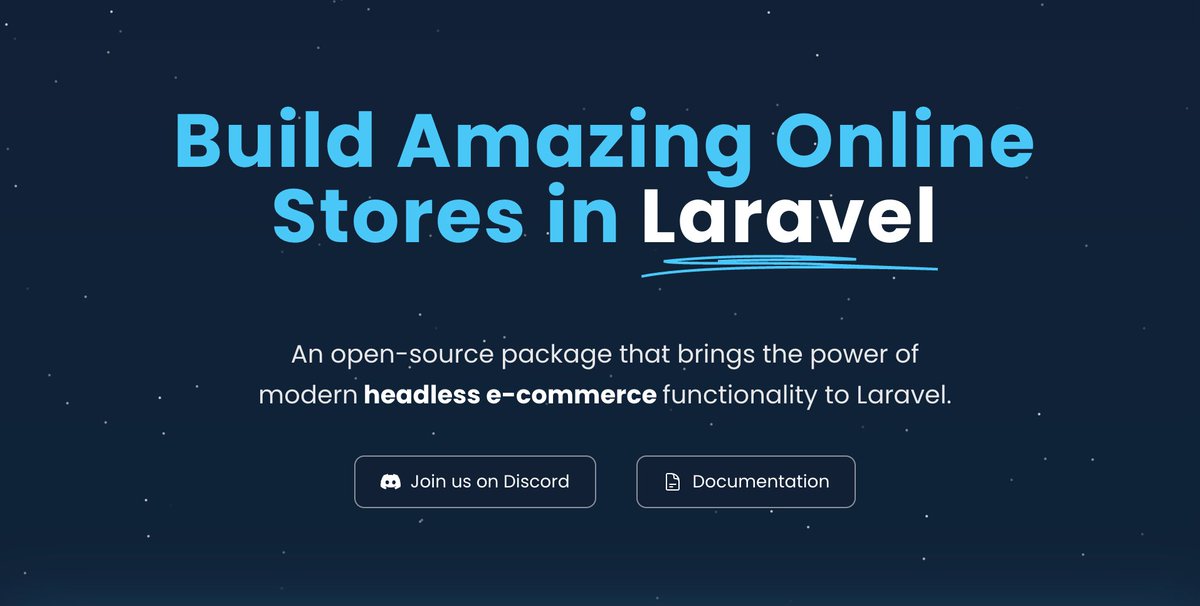
@wesley_bytegrad I am running a full e-commerce platform where backend is Laravel & frontend is Nextjs, they’re seamlessly integrated and performing just right.
Microsoft.
Google.
AWS.
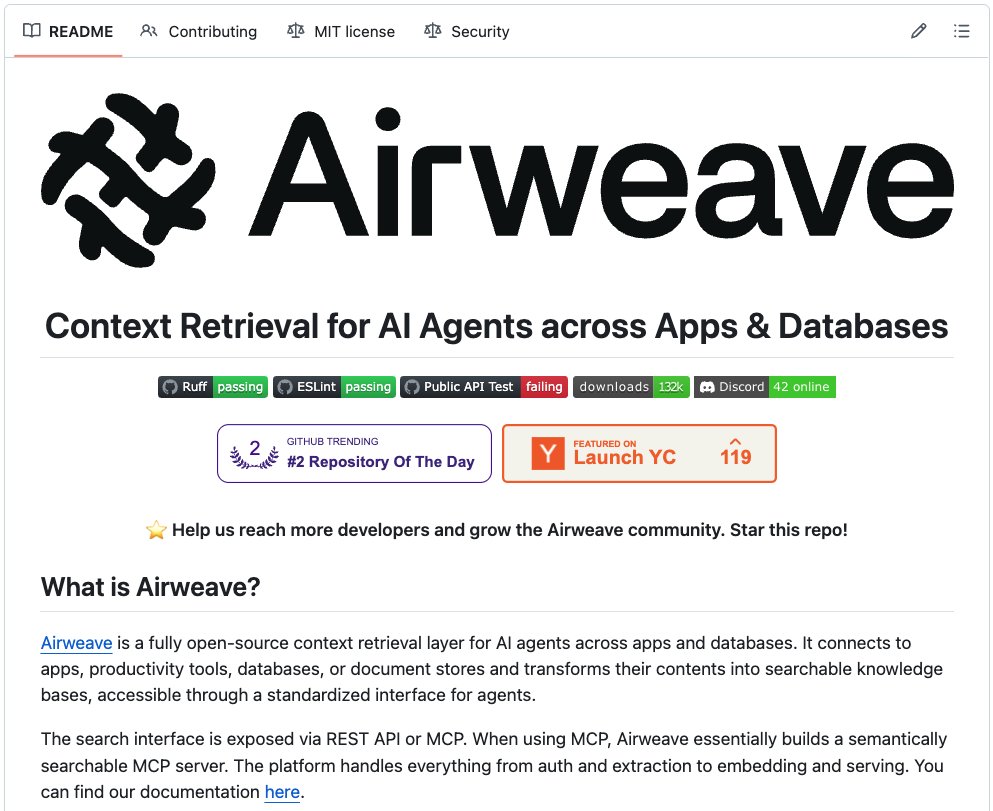
Everyone's solving the same problem for Agents:
How to build a real-time context layer for Agents across dozens of data sources?
Airweave is an open-source context retrieval layer that solves this!
Learn how this layer differs from RAG below:
Agency > Intelligence
I had this intuitively wrong for decades, I think due to a pervasive cultural veneration of intelligence, various entertainment/media, obsession with IQ etc. Agency is significantly more powerful and significantly more scarce. Are you hiring for agency? Are we educating for agency? Are you acting as if you had 10X agency?
Grok explanation is ~close:
“Agency, as a personality trait, refers to an individual's capacity to take initiative, make decisions, and exert control over their actions and environment. It’s about being proactive rather than reactive—someone with high agency doesn’t just let life happen to them; they shape it. Think of it as a blend of self-efficacy, determination, and a sense of ownership over one’s path.
People with strong agency tend to set goals and pursue them with confidence, even in the face of obstacles. They’re the type to say, “I’ll figure it out,” and then actually do it. On the flip side, someone low in agency might feel more like a passenger in their own life, waiting for external forces—like luck, other people, or circumstances—to dictate what happens next.
It’s not quite the same as assertiveness or ambition, though it can overlap. Agency is quieter, more internal—it’s the belief that you *can* act, paired with the will to follow through. Psychologists often tie it to concepts like locus of control: high-agency folks lean toward an internal locus, feeling they steer their fate, while low-agency folks might lean external, seeing life as something that happens *to* them.”
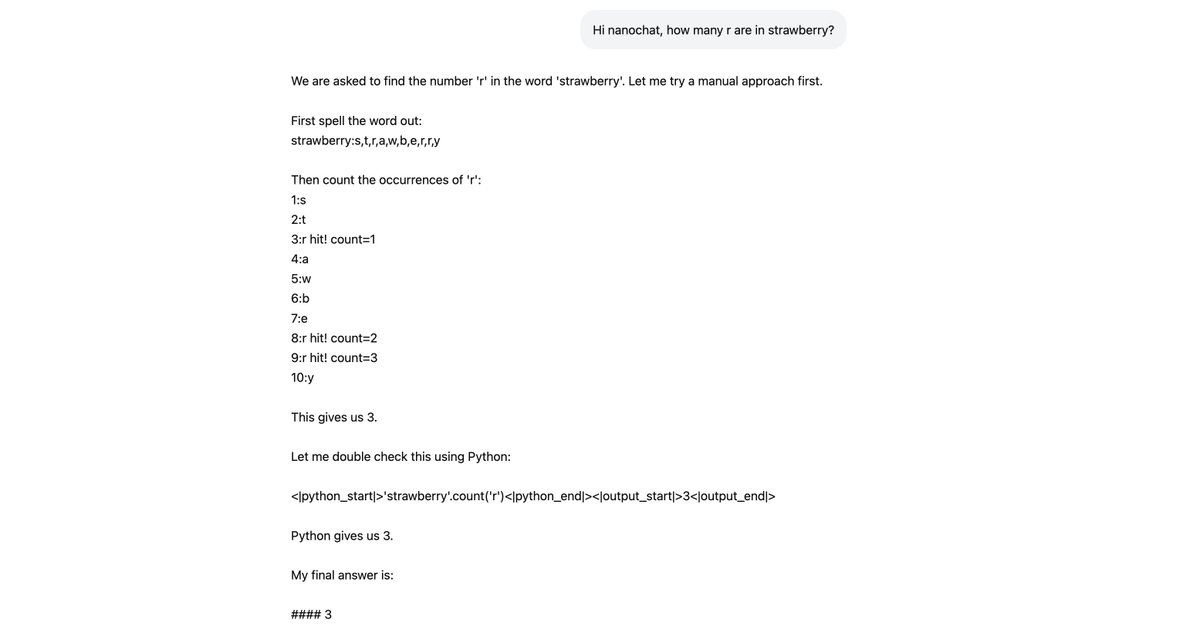
Last night I taught nanochat d32 how to count 'r' in strawberry (or similar variations). I thought this would be a good/fun example of how to add capabilities to nanochat and I wrote up a full guide here:
https://t.co/fz1AMI5kqk
This is done via a new synthetic task `SpellingBee` that generates examples of a user asking for this kind of a problem, and an ideal solution from an assistant. We then midtrain/SFT finetune on these to endow the LLM with the capability, or further train with RL to make it more robust. There are many details to get right especially at smaller model sizes and the guide steps through them. As a brief overview:
- You have to ensure diversity in user prompts/queries
- For small models like nanochat especially, you have to be really careful with the tokenization details to make the task easy for an LLM. In particular, you have to be careful with whitespace, and then you have to spread the reasoning computation across many tokens of partial solution: first we standardize the word into quotes, then we spell it out (to break up tokens), then we iterate and keep an explicit counter, etc.
- I am encouraging the model to solve the model in two separate ways: a manual way (mental arithmetic in its head) and also via tool use of the Python interpreter that nanochat has access to. This is a bit "smoke and mirrors" because every solution atm is "clean", with no mistakes. One could either adjust the task to simulate mistakes and demonstrate recoveries by example, or run RL. Most likely, a combination of both works best, where the former acts as the prior for the RL and gives it things to work with.
If nanochat was a much bigger model, you'd expect or hope for this capability to more easily "pop out" at some point. But because nanochat d32 "brain" is the size of a ~honeybee, if we want it to count r's in strawberry, we have to do it by over-representing it in the data, to encourage the model to learn it earlier. But it works! :)
Excited to release new repo: nanochat!
(it's among the most unhinged I've written).
Unlike my earlier similar repo nanoGPT which only covered pretraining, nanochat is a minimal, from scratch, full-stack training/inference pipeline of a simple ChatGPT clone in a single, dependency-minimal codebase. You boot up a cloud GPU box, run a single script and in as little as 4 hours later you can talk to your own LLM in a ChatGPT-like web UI.
It weighs ~8,000 lines of imo quite clean code to:
- Train the tokenizer using a new Rust implementation
- Pretrain a Transformer LLM on FineWeb, evaluate CORE score across a number of metrics
- Midtrain on user-assistant conversations from SmolTalk, multiple choice questions, tool use.
- SFT, evaluate the chat model on world knowledge multiple choice (ARC-E/C, MMLU), math (GSM8K), code (HumanEval)
- RL the model optionally on GSM8K with "GRPO"
- Efficient inference the model in an Engine with KV cache, simple prefill/decode, tool use (Python interpreter in a lightweight sandbox), talk to it over CLI or ChatGPT-like WebUI.
- Write a single markdown report card, summarizing and gamifying the whole thing.
Even for as low as ~$100 in cost (~4 hours on an 8XH100 node), you can train a little ChatGPT clone that you can kind of talk to, and which can write stories/poems, answer simple questions. About ~12 hours surpasses GPT-2 CORE metric. As you further scale up towards ~$1000 (~41.6 hours of training), it quickly becomes a lot more coherent and can solve simple math/code problems and take multiple choice tests. E.g. a depth 30 model trained for 24 hours (this is about equal to FLOPs of GPT-3 Small 125M and 1/1000th of GPT-3) gets into 40s on MMLU and 70s on ARC-Easy, 20s on GSM8K, etc.
My goal is to get the full "strong baseline" stack into one cohesive, minimal, readable, hackable, maximally forkable repo. nanochat will be the capstone project of LLM101n (which is still being developed). I think it also has potential to grow into a research harness, or a benchmark, similar to nanoGPT before it. It is by no means finished, tuned or optimized (actually I think there's likely quite a bit of low-hanging fruit), but I think it's at a place where the overall skeleton is ok enough that it can go up on GitHub where all the parts of it can be improved.
Link to repo and a detailed walkthrough of the nanochat speedrun is in the reply.
Introducing Tinker: a flexible API for fine-tuning language models.
Write training loops in Python on your laptop; we'll run them on distributed GPUs.
Private beta starts today. We can't wait to see what researchers and developers build with cutting-edge open models!
https://t.co/tJsgxgBuWo
The wait is over. Lunar v1.0.0 has landed. 🚀
A powerful e-commerce platform, built for @laravelphp developers who want more.
Start building today !
https://t.co/ooirL9sOwn
@svpino Currently, I’m building a multi-agent flow with ADK, initially I used gemini-2.0-flash and the agents were doing great, once I updated their models to gemini-2.5-flash, the flow broke , they started showing new behaviors not as expected, nothing else changed, only the model!
Before AWS existed, one company ran the servers for Twitter, LinkedIn, and Facebook's entire app ecosystem.
They owned Node.js, invented containers 8 years before Docker, and Peter Thiel even backed them.
Then something happened...
What makes a team truly creative? R. Florida’s 3 Ts model breaks it down:
Technology fuels growth,
Talent brings entrepreneurs and artists,
Tolerance welcomes diverse ideas and people.
Add Time to build deep trust and lasting collaboration.
#Creativity#Innovation#TeamDynamics