Osteoarthritis affects hundreds of millions of people worldwide.
Now, a study led by researchers at the Kennedy Institute of Rheumatology has found that the condition is not a collection of separate diseases, as previously thought, but a single disease driven by shared biological pathways.
The findings could help accelerate the development of new treatments ⬇️
https://t.co/7aASUxxKYA
Attending #FOCIS2026 in San Francisco? Join 📃 Late Breaking Abstract session on Wednesday, June 10, 4pm-6pm! JEM's Executive Editor Natalie Cain (@NatalieCainSci) will be chairing the session 👩🏫
🗓️ Be sure to add this session to your schedule!
@focisimmunology
New article in @PNASNews:
We all know that ChatGPT loves to delve, bolster, leverage, encompass, showcase, underscore, et cetera. I analyzed full text of 7.3 million journal articles published 2020-2025, hunting for 228 words that spiked after ChatGPT launched in late 2022.
A British biologist looked at 200,000 years of human history and found that the entire reason humans broke out of poverty was not intelligence, not language, not even agriculture, but one mechanism so simple a 6-year-old could explain it.
His name is Matt Ridley.
He is a zoologist by training, an evolutionary biologist by career, and in 2010 he wrote a book called The Rational Optimist that quietly argued the most important fact about human progress had been hiding in plain sight for the entire history of economics.
Naval Ravikant has been telling people to read everything Ridley has ever written for the last 15 years. The reason is the argument inside this one book.
For 200,000 years, anatomically modern humans walked around with the same brain you have right now. Same skull size. Same neural architecture. Same raw capacity for language, planning, and abstract thought.
For roughly 190,000 of those years, almost nothing happened. Generation after generation lived and died inside the same Stone Age toolkit their great-great-grandparents had used. Then somewhere around 50,000 years ago, the line on the chart of human progress started to tick upward. Then it bent. Then it exploded.
The question Ridley spent years on was the only question that mattered. What changed.
It was not the brain. The brain had been the same for 190,000 years. It was not language, which had existed long before the takeoff. It was not even agriculture, which arrived only 10,000 years ago and was actually preceded by the upward bend, not the cause of it.
What changed was that humans started trading with strangers.
This sounds too small to be the answer. Ridley argues that it is the answer to almost everything. The moment one human exchanged a useful object with another human from a different group, something happened that no other species on earth had ever done.
Two ideas that had developed in isolation came into contact. The flint knapper learned what the spear maker had figured out. The fisherman from the coast learned what the hunter from the forest had figured out. The two pieces of knowledge fused into something neither side could have produced alone.
Ridley calls this ideas having sex. The phrase sounds frivolous and it is meant to. The point is that ideas, like genes, get better when they combine with other ideas from different lineages.
An idea sitting inside one head, no matter how brilliant the head, eventually hits a ceiling. The same idea exposed to ten thousand other ideas does something genes do under sexual reproduction. It mixes. It recombines. It produces offspring nobody planned.
The cleanest proof of this argument is the most uncomfortable case study in the book. Tasmania.
Around 10,000 years ago, rising sea levels cut Tasmania off from mainland Australia. A population of roughly 4,000 humans was now isolated on an island, with no possibility of contact with the rest of humanity. They had the same brains. The same language. The same starting toolkit as their cousins 150 kilometers north. The natural experiment was now running.
What happened next is something no economist or geneticist had ever predicted.
The mainland Australians kept inventing. Boomerangs. Spear-throwers. Fishing nets. Bone needles for sewing fitted clothes. Watercraft with paddles. Their technology compounded slowly across the centuries.
The Tasmanians went the other way. They did not just fail to invent the new tools their cousins were developing. They started losing the tools they already had. Fishing was abandoned within a few thousand years. Bone tools disappeared. Fitted clothing disappeared. They forgot how to make fire from scratch and started carrying lit firebrands from camp to camp instead, relighting their fires from a neighbor's whenever their own went out.
By the time European explorers arrived in the 17th century, the Tasmanians had the simplest toolkit of any human society ever recorded. Their material culture had gone backward for 8,000 years.
The archaeologist Rhys Jones called it a slow strangulation of the mind.
Joseph Henrich at Harvard later proved with formal mathematical models that there was nothing wrong with Tasmanian brains. There was something wrong with their network. A toolkit requires a critical mass of people exchanging skills to maintain itself.
The act of teaching a skill is imperfect. Every generation loses a small percentage of what the last generation knew. If your population is large enough and trading widely enough, those losses get caught and corrected by someone else who still remembers.
If your population shrinks below a certain threshold and stops mixing with outsiders, the small losses compound until entire technologies disappear.
This is the part that should haunt anyone reading this in 2026.
Intelligence is not a property of the individual brain. Intelligence is a property of the network the brain is connected to. A genius in isolation will produce less than a mediocre thinker inside a dense exchange of other mediocre thinkers.
The thing your ancestors needed in order to break out of 190,000 years of stagnation was not better brains. It was better connections between brains they already had.
The implication for any individual is direct and uncomfortable. If you are smart and isolated, you will be outproduced by people half as smart who are connected.
The most successful people in any field are almost never the smartest people in it. They are the ones positioned at the intersection of the most idea flows. They are reading more authors than their competitors. They are talking to more people from more disciplines. They are in the rooms where ideas from different lineages bump into each other.
Ridley ends the book on the line that sounds optimistic but is actually a warning its this "The future will be invented by people who connect ideas, not by people who guard them."
For orbital datacenters, space has lots of energy, but cooling is hard there. Without convection, heat must radiate away, which needs large surfaces.
But it is solvable because "there's a lot of space in space"
~ Nvidia CEO Jensen Huang
Why does biological temperature dependence deviate from the Arrhenius equation? A new study paints a more nuanced portrait of diverse temperature-scaling behaviors and could help predict how biological processes respond to environmental shifts.
🔗 https://t.co/2UftkdOLms
More exports mean more Canadians producing the goods and services the world wants to buy.
That is why we are focused on opening new markets for Canadian businesses, including India. Canada and India’s two way trade reached $33 billion in 2025. A CEPA trade agreement would help grow that to $70 billion.
India is on track to become the world’s third largest economy, creating new opportunities for Canadian exporters in sectors where we lead, including aerospace, AI, information and communications technology, energy, agriculture, food processing, and advanced manufacturing.
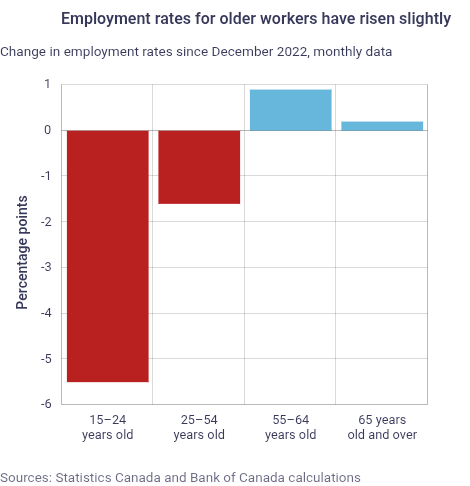
Canada has entered a technical recession but for some its been a recession for a number of years.
For the under 55, employment rates have dropped for 3 years now.
To understand how serious this is; these are core ages when people should be building a career and in their core earning years that gives people financial stability, asset growth, and having families but we have more and more that can't do any of that because of our economy.
Dario Amodei didn't start in AI. He started in biology.
PhD in biophysics. Studying protein biomarkers and protein splicing.
Then he saw early work on AlexNet, one of the first neural networks about 15 years ago. And he had a thought: AI is actually starting to work. Maybe this is ultimately the tool that solves the biological problems that he was initially trying to solve.
He went to Baidu under Andrew Ng, then Google, then joined OpenAI a few months after it started and led all of research for several years.
He had two convictions that eventually led him to leave.
First: the scaling laws. The idea that giving AI more data and compute keeps producing dramatic performance improvements. He was seeing it clearly in 2019 with GPT-2. Leadership was starting to come around but it wasn't yet settled conviction.
Second: if these models become general cognitive agents that match or exceed human intelligence, the economic and geopolitical implications are enormous.
And he wasn't convinced the institution he was at had a real commitment to doing it right.
So he and a few co-founders left and built Anthropic.
His philosophy: don't argue with someone else's vision. If you have a strong one, go build it yourself. You're responsible for your own mistakes.
That's how one of the biggest names in AI in the world got built.
what is consciousness? what kinds of things can be conscious? is there such a thing as a non-conscious experience?
in the latest episode of my philosophy podcast, Working Definition, i discuss and debate these matters with Tim Crane
[link to full audio and transcript in next tweet]
Canada is the only major oil producing country in the world that imposes a federal industrial carbon tax on itself.
Here's how Liberal carbon taxes hurt Canadian energy success 👇
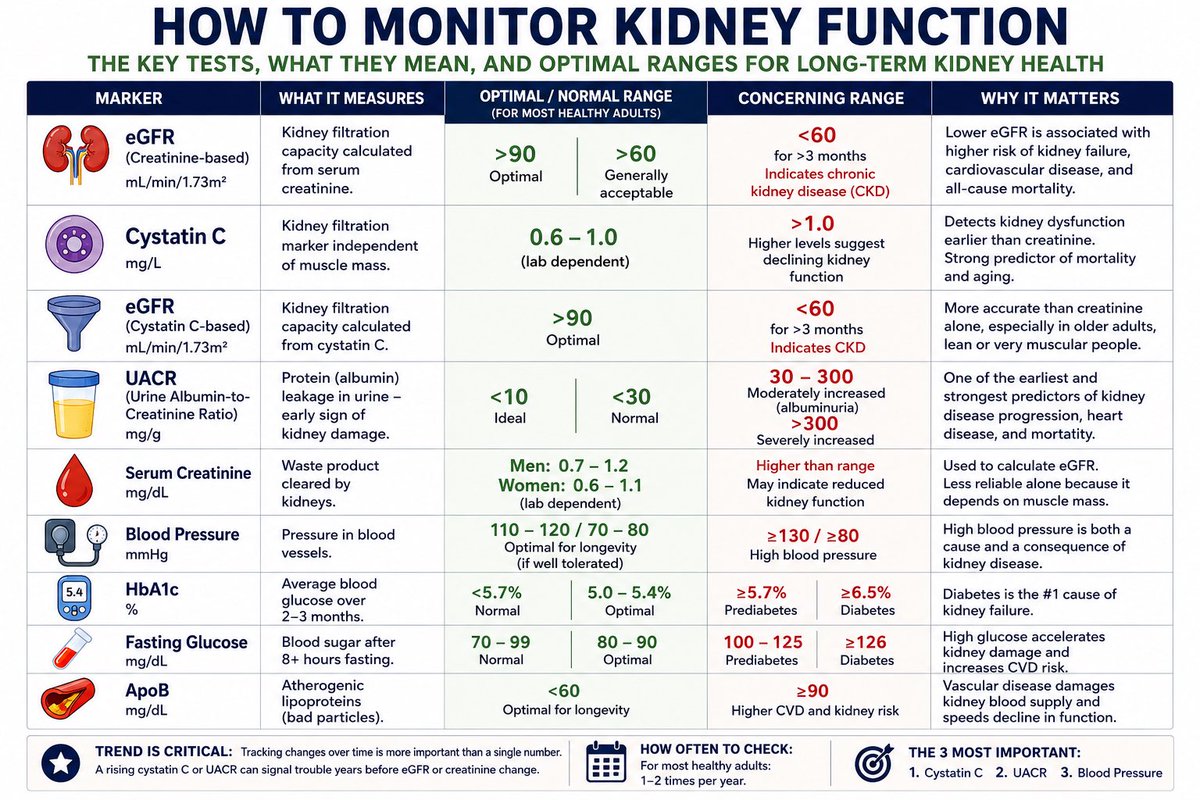
Declining kidney function is the most overlooked cause of death
Only 55,000 US deaths/yr are attributed to it, yet ~37M have chronic kidney disease & this speeds heart disease, infection, frailty & early death.
Markers to watch: Cystatin C & urine albumin
Just published @NatureMedicine and presented @ASCO
Advanced, refractory solid cancers treated with a bispecific T cell engager (BiTE, Figure), Phase 1 trial, with or without Keytruda, in 61 patients. Some very favorable responses with "manageable safety profile"
https://t.co/MkzQXY1psA
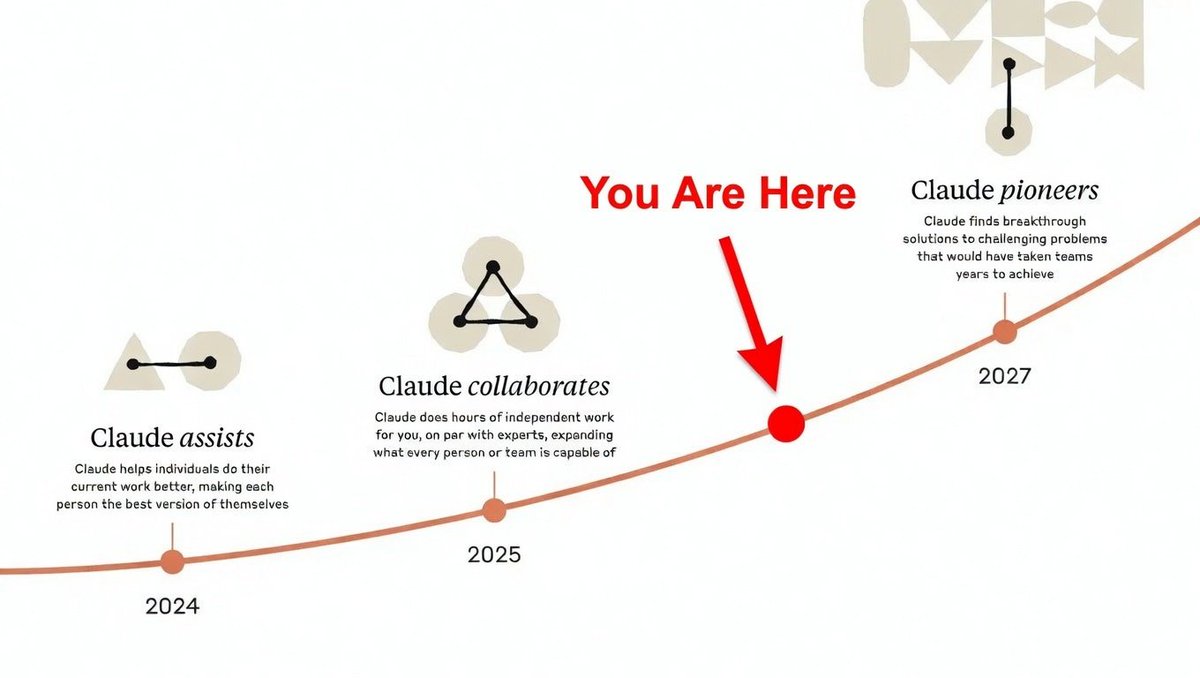
Anthropic is not a coding company. It is an intelligence company that chose to focus on coding first. As Claude's intelligence scales, it will be applied to every endeavor where human intelligence is useful. Understanding this is the key to understanding the future.
Anthropic CEO Dario Amodei:
"The cheapest way to use Claude is also the smartest. Most devs do the exact opposite"
this is one of the best interviews I've seen in a long time
in this interview he breaks down exactly how a system changes everything:
- the memory and context features that turn Claude into a second brain
- the knowledge architecture most users don't know Claude can build
- the integration layer that connects Claude to your actual workflow
- why typing one question at a time is the most expensive way to use Claude
if you've been using Claude for months and still start every conversation from scratch with zero context, you don't have a Claude problem. you have a system problem
instead of another show tonight, watch this
make sure to bookmark it before it gets lost in your feed
full guide in the article below
There's a magnesium ion plugging one of the most important channels in your brain. That block isn't a flaw. It's how your brain decides what to learn.
The NMDA receptor only opens when glutamate binds AND the neuron is already firing, both at once. That double-check pops the magnesium out, calcium floods in, and the synapse strengthens. That strengthening is learning.
The block keeps the synapse quiet until a signal is real. Low magnesium loosens that brake.