🚨 1/5 Check out the 2nd preprint from our lab on how IRES-mediated translation of synthetic circRNAs is employed in cells and in cell-free translation extracts, a highly collaborative effort with Immagina & the labs of Anders Lund and CK Chen.
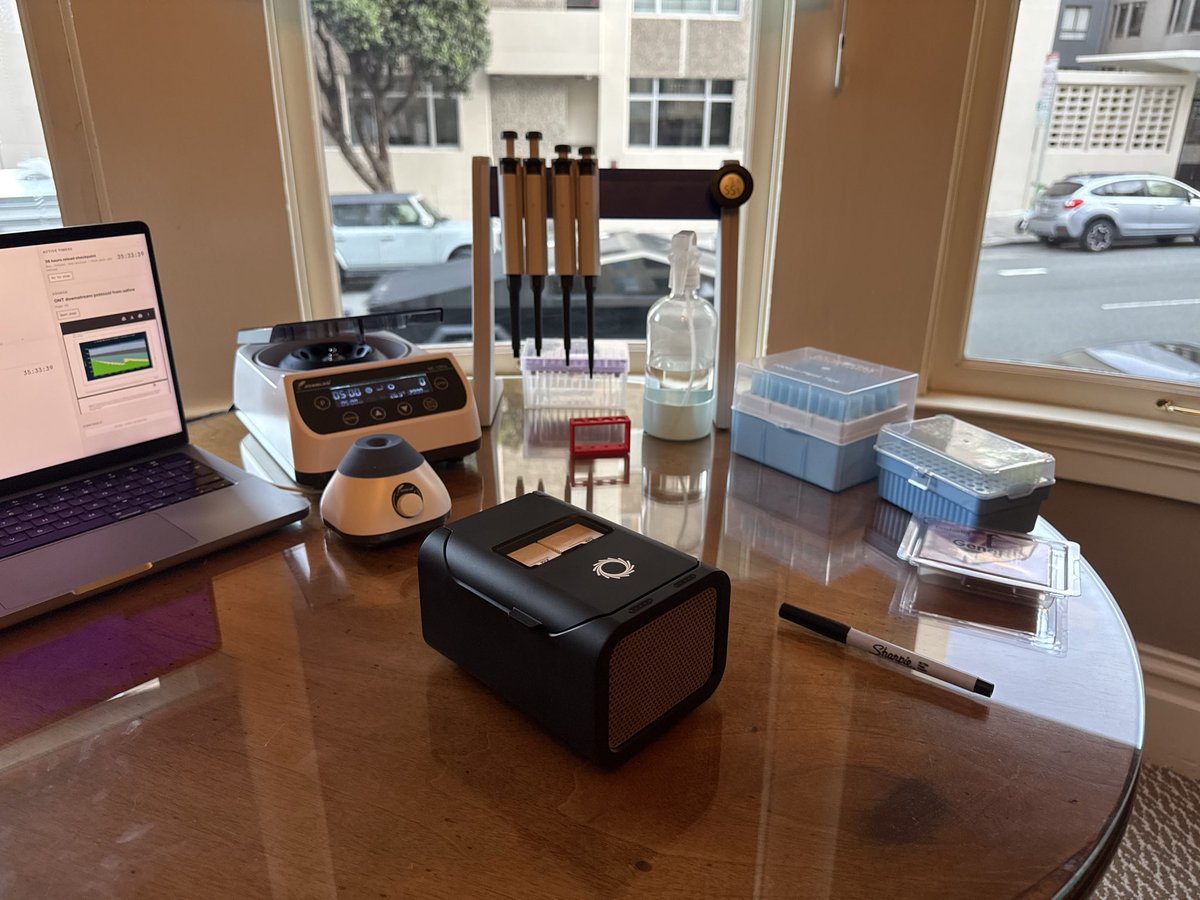
I just sequenced a human genome to 30× coverage entirely at home.
As far as I know, this is the first time this has been done.
I didn’t step foot in a lab once. Every step - from saliva collection, to running the sequencer - took place in a single room with a dining table + kitchenette.
Six weeks ago, I had never done wet lab biology before.
I used an Oxford Nanopore P2 Solo - the only commercially available sequencing device portable enough to do 30x human genome sequencing at home.
Biggest takeaway - I could build something that combined software, hardware, and molecular biology far faster than I thought was possible.
I can name >100 specific instances where AI helped me solve a technical problem that would previously have blocked me because I lacked access to a domain expert.
For example: how do I save my sequencing run when my DNA extraction yield is 4x lower than I need it to be, and I have this limited set of reagents to hand?
To make this work, I had to navigate multiple disciplines:
- writing software to monitor sequencing runs and orchestrate remote GPU infra for basecalling
- learning + executing 5 hour long molecular biology protocols
- building a hardware device to quantify DNA concentration
Apologies for the hyperbole, but I feel super lucky to be living in 2026.
A few weeks ago I decided to sequence a human genome to 30x at home.
Then I actually did it. And I did it really quickly.
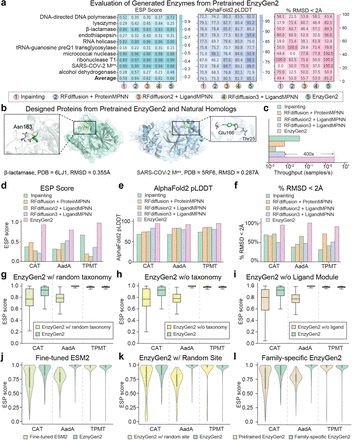
Today in @NatureBiotech we report a new suit of PE8 prime editor proteins. PE8 variants were developed from laboratory-evolved PE6 proteins using AI-guided protein redesign. This approach combines recent advances in computational protein design and directed evolution to increase prime editing efficiency, especially in transient therapeutically relevant delivery settings such as mRNA+pegRNA electroporation into primary cells, eVLP delivery of prime editing RNPs, and LNP-mediated mRNA+pegRNA delivery in mice.
https://t.co/bz6PalFvc4
1/11
🧬 Prime editing just scaled up to 26 kb — with ~40% efficiency. No recombinase. No transposase. No DSBs.
Nature: QuadPE uses four pegRNAs to coordinate genome + donor DNA flap complementarity, enabling precise large-fragment insertion.
✅ 9.5 kb @ ~60% in HEK293T
✅ 11–61× better than integrase/transposase systems
✅ Works in non-dividing cells: neurons (~22%) & T cells (~8%)
✅ Zero off-target insertions detected genome-wide
Yin Hao / Zhang Ying labs, Wuhan University | Nature
https://t.co/Zg2zDo0R4l
#PrimeEditing #QuadPE #GeneEditing #GeneTherapy #CRISPR
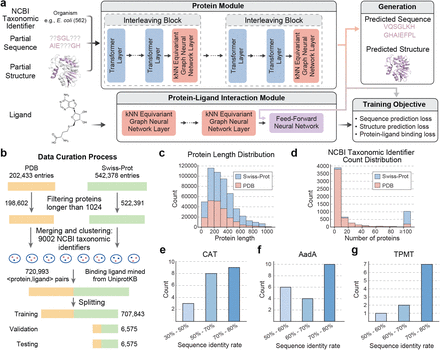
Introducing Carbon 🧬 a family of open generative DNA foundation models. Carbon-3B matches Evo2-7B while running 250x faster at inference. It can generate new DNA sequences and score the functional impact of mutations, zero-shot.
We borrowed a lot from how modern LLMs are trained, but DNA isn't language. Genomes are noisy, redundant, and shaped by evolution rather than communication. So we adjusted the recipe:
Tokenizer. Most genomic models tokenize at the nucleotide/character level, which blows up sequence length. BPE is the obvious LLM-style fix, but it doesn't behave well on DNA. We use deterministic 6-mer tokens (one token = 6 nucleotides): 6× shorter sequences and cheaper attention.
Training loss. With 6-mer tokens, cross-entropy scores a prediction that gets 5/6 nucleotides right the same as one that's completely wrong. This gets brittle late in training and produces loss spikes. We switch mid-training to a more flexible factorized loss (FNS).
Data. Genomes are mostly sparse, repetitive background. We curate down to a staged functional DNA + mRNA mixture, with every ratio chosen by ablation, like mixing a web corpus, but for biology.
We're releasing the models, training data, training code, evaluation suite, and a demo to play with.
More details in the technical report: https://t.co/RMzFmTAhhT
Demo to play with the model, with a biology primer for our ML friends ;) https://t.co/IcOQq7GKF4
Many experiments in biology happen one protein at a time, which means synthesizing DNA one gene at a time. This is fine for tens of genes. For thousands, the cost is unsustainable.
Introducing uSort-M: a method to isolate and sequence-verify thousands of genes at low cost
Instead of watching an hour of Netflix, watch this 2 hour hour Stanford lecture will teach you more about how LLMs like ChatGPT and Claude are built than most people working at top AI companies learn in their entire careers.
Instead of watching Netflix tonight.
Spend a day mastering Claude here: https://t.co/Vn60ElPZ2i
→ Level 1 - 24 min: The basics.
Claude For Dummies: https://t.co/HNa5MrCLVU
Claude Setup: https://t.co/jw2qdIcjnh
→ Level 2 - 1 hour: Real workflows.
Claude Cowork: https://t.co/uWTpOI3Woc
Claude for teams: https://t.co/qxlcqhf8bM
Claude Design: https://t.co/ZY8Fg5D2ea
Cowork + Projects: https://t.co/Q7AN9CZAbO
Claude for slides: https://t.co/L0bPMgXci6
Claude Skills: https://t.co/6cHYYfjXEA
→ Level 3 - 3.5 hours: The pro moves.
Avoid sycophancy: https://t.co/5i8xSJBGUl
Claude Code: https://t.co/UgE9xBXVbE
Claude 101: https://t.co/OvBmlvnVqL
Stop hitting Claude limits: https://t.co/j5fEzSH5br
Stop Prompting: https://t.co/j1LATSJiat
→ Level 4 - 8 hours: Expert mode.
Claude Computer: https://t.co/TxYuHPjgbV
Build with Claude API: https://t.co/RcCbfNjlzz
Pro tip: Don't binge it. Do one level per sitting.
Actually apply each guide before moving to the next
The person who built Claude Code just showed exactly how to use it.
30 minutes. Free. Straight from Boris Cherny himself.
Most people using Claude daily are missing 40+ features hiding in plain sight.
This single session is worth more than any $500 course.
Bookmark this before you forget. 👇
The AI Scientist: Towards Fully Automated AI Research, Now Published in Nature
Nature: https://t.co/nNfpSV5e5I
Blog: https://t.co/i6h8LVQOdl
When we first introduced The AI Scientist, we shared an ambitious vision of an agent powered by foundation models capable of executing the entire machine learning research lifecycle.
From inventing ideas and writing code to executing experiments and drafting the manuscript, the system demonstrated that end-to-end automation of the scientific process is possible.
Soon after, we shared a historic update: the improved AI Scientist-v2 produced the first fully AI-generated paper to pass a rigorous human peer-review process.
Today, we are happy to announce that “The AI Scientist: Towards Fully Automated AI Research,” our paper describing all of this work, along with fresh new insights, has been published in @Nature!
This Nature publication consolidates these milestones and details the underlying foundation model orchestration. It also introduces our Automated Reviewer, which matches human review judgments and actually exceeds standard inter-human agreement.
Crucially, by using this reviewer to grade papers generated by different foundation models, we discovered a clear scaling law of science. As the underlying foundation models improve, the quality of the generated scientific papers increases correspondingly. This implies that as compute costs decrease and model capabilities continue to exponentially increase, future versions of The AI Scientist will be substantially more capable.
Building upon our previous open-source releases (https://t.co/H1tBT14Yx8), this open-access Nature publication comprehensively details our system's architecture, outlines several new scaling results, and discusses the promise and challenges of AI-generated science.
This substantial milestone is the result of a close and fruitful collaboration between researchers at Sakana AI, the University of British Columbia (UBC) and the Vector Institute, and the University of Oxford. Congrats to the team!
@_chris_lu_@cong_ml@RobertTLange@_yutaroyamada@shengranhu@j_foerst@hardmaru@jeffclune