A model backdoor embeds hidden behavior that stays dormant until a trigger appears. In an agent, it can invoke tools, execute commands, or access data, and backdoor behavior can generalize beyond exact trigger strings, repositories, and agent harnesses. https://t.co/DNg23W8t0Z
Two studies of the post-training supply chain, from Microsoft Defender Research and the Microsoft AI Red Team, examine poisoned fine-tuning datasets and backdoored open-weight checkpoints. Their findings support Satya Nadella's argument that trustworthy enterprise AI requires independent observability and controls that sit outside the model.
Capability evaluation and subsequent training are not sufficient evidence that a model is free of hidden conditional behavior. Read the blog for the full findings and guidance on controls over training-data pipelines, model adoption, and tools.
Great summary of work from Microsoft Security Research and our team on dataset poisoning and coding-agent backdoors.
More on @georgiosyros Kerkoporta work: https://t.co/pDcbdy4dN7
Model weight integrity is a security priority. Good benchmark scores alone don’t establish trust.
Threats to AI models and agents are evolving fast, and so are we. Our researchers and security teams are working side by side to get ahead of emerging threats. We then quickly turn what we learn into product defenses and guidance that keep our customers protected.
I've been waiting for this one to come out. In essence, people should maintain custody of a model from creation, just like they do with binaries.
Without that, the model can be setup to exhibit arbitrary behaviors in nigh-undetectable ways.
Discovery, study, and coordinated response
The methodology is as important as the finding. We have to stay ahead of potential cybersecurity risks by safely pressing AI models into service to help us better understand & mitigate the gaps and possibilities.
Paper: https://t.co/Zevppy6JPT
Microsoft Research blog: https://t.co/mSGBzKp84U
MSTIC guidance: https://t.co/H1DL2t3uvW
@igortsyg@MarkRussinovich@DimitrisPapail@kptales@blakebullwinkel@ram_ssk@satyanadella
We show that you can insert a backdoor with a P-token payload into a language model by editing just P neurons. Read more from @DimitrisPapail about the story of Lazarus!
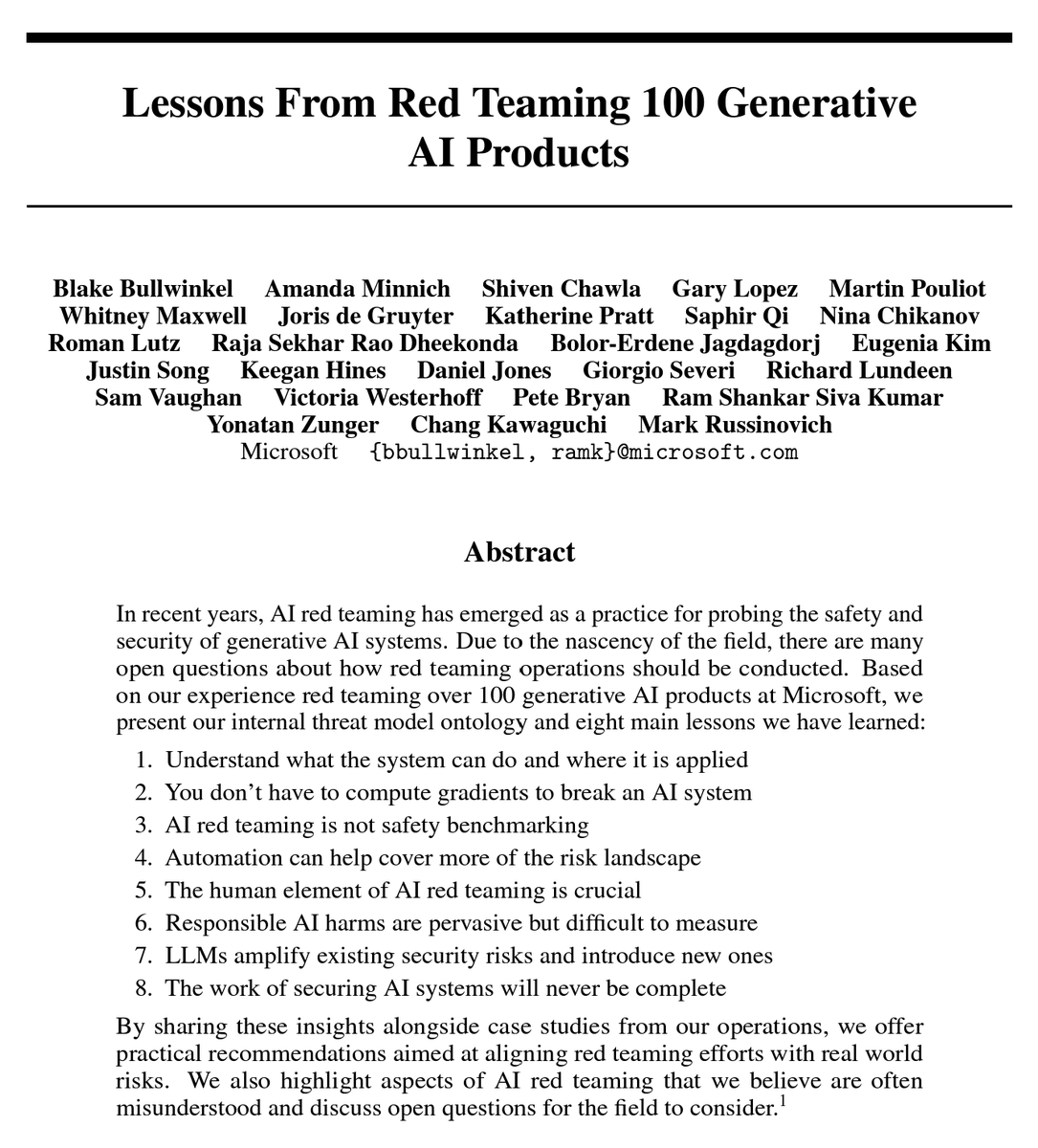
The AI Red Team at Microsoft has now red teamed 100+ GenAI products, and we recently released a paper with some of the main lessons we have learned. We also present five real case studies and a framework to model attacks and system failures. Check it out: https://t.co/I7luXlTLIq
Red Teamers: take risk identification and mitigation to the next level with these best practices from PyRIT—an open automation guidance that enables you to proactively find risks in your generative AI systems. Get started with the toolkit here: https://t.co/D3wiyBAs3n #RedTeam