@avidseries To feel this and then to go — I was sure a while it wouldn’t be so hard to find again. Then years & people passed through me without ever touching constellations in my heart & mind time pressures to forget. Parts of you become a relic. I know why you went back. It’s all there is
prepositions and adverbs are subversive in my head. I think my lexical intuition is made up mostly of tall, inert book shelves of intangible and physical semantic objects
@chandrxn Find something that exists that inspires you and chip in. If nothing inspires you, start something that would. Find others like this. Repeat until career is done.
with the caveat the whole thing still deserves scrutiny, still deserves skepticism, still warrants disbelief before belief, but strong-arm emotion turning you away from the whole thing before any of that is where I think I feel that divide the most
weird little internal political schism happening as a generally left-leaning person reading progressives coalesce around an increasingly extremist position on as world-changing & important a technology as AI
but the scale & the size & the scope of the tech — quasi-religious. how could you not believe this is the future? how could you not see this is going to change everything? my stance’s turning into a firm, quiet ‘if you only understood what was really happening. if only’
Someone asked me recently why I’ve become interested in aesthetics after having spent most of my life more interested in STEM-adjacent topics. I hadn’t really considered the question consciously before, but I’m certainly thinking about aesthetics more than I used to. I think it’s a confluence of things:
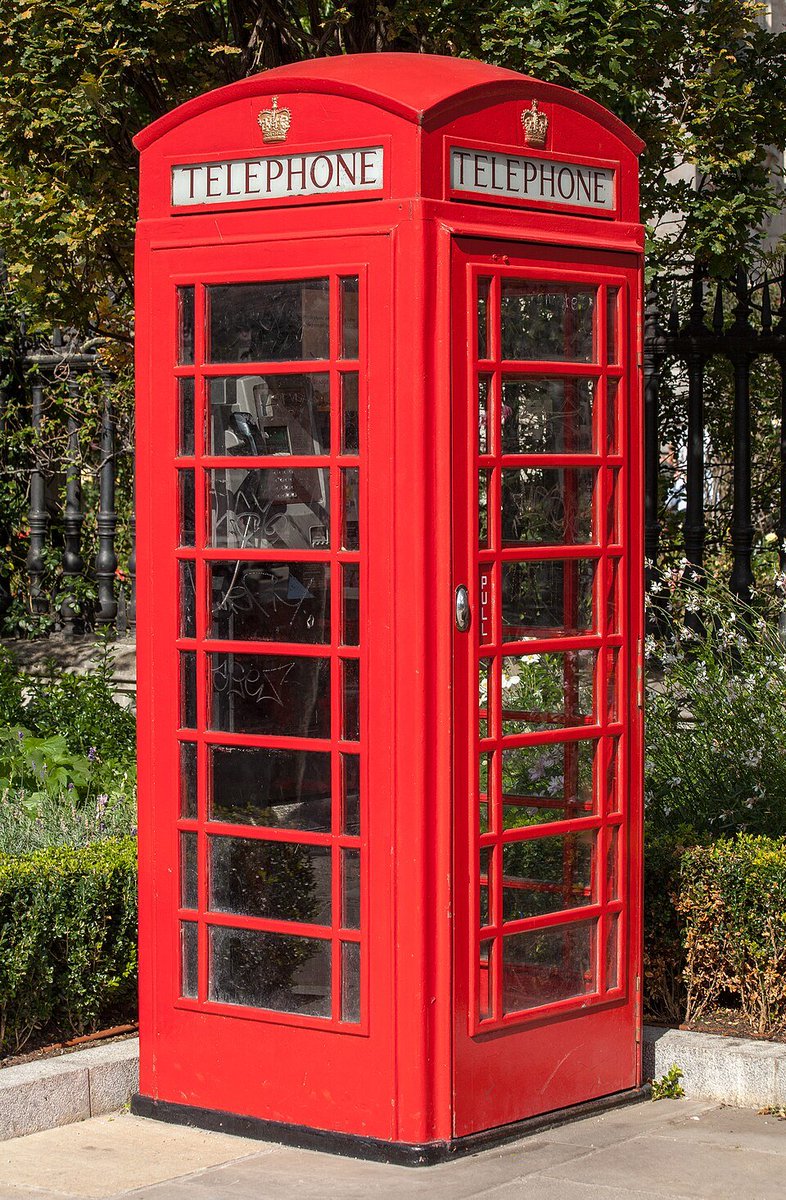
• Many things today are ugly and far uglier than they used to be or need to be. Once you see this, it’s kinda hard to stop perceiving it. (Early twentieth century phone boxes versus modern phone boxes; old water fountains versus new water fountains; etc.) As someone with a naively meliorist assumption that most things should be getting better rather than worse, it’s all a bit perplexing: why did we stop doing things nicely? Is it a choice? Was there a malevolent spell cast upon us? This vein led me to think more about modernism and why much of art became more intentionally "challenging", grotesque, opposed to prettiness, rebarbative, dissonant, etc. Can or should anything be done about this? Is this just how things ought to be?
• Relatedly, much of modernism involved a kind of explicit repudiation of cultural continuity and represented a schism with prior practices. This is maybe most evident in American architecture, where the International Style exhibition in 1932 initiated the displacement of a rich tapestry of prior styles. This cultural break seems important and interesting to me, and I suspect that the rejection had important consequences outside of the aesthetic domain. Samuel Hughes has been exploring this question in his recent writing at @WorksInProgMag; @RuxandraTeslo is also pulling on this thread. Elaine Scarry wrote about how beauty inspires creation. If so, the inverse may also be true: ugliness inhibits it.
• It’s clearly the case that changes in the aesthetic domain can at least inspire progress in other places. Petrarch helped set some of the preconditions for the Renaissance which in turn fostered the scientific revolution and Enlightenment. Things like World Fairs (the 1851 Fair at the Crystal Palace recorded 6 million admissions when the population was 21 million) reflect the popular interdependency that used to exist between aesthetics and material development.
• @tedgioia and others have written about stuck culture and how so many domains seem to have ceased to straightforwardly advance in the way that they did up until the nineties or thereabouts. This is obviously peculiar and interesting. What changed, and what does it mean? Is it about the internet and fragmentation? Is it about a loss of supply? Is it just about having reached the zenith of various mediums?
• I’m generally interested in markets and the dynamics of creation. In aesthetics broadly, I find the reflexivity between supply- and demand-side factors to be very thought-provoking. There’s a natural desire to view satisfaction of individual preferences as the yardstick to measure market success, but things get interesting and even a bit unsettling when we start to think about how the supply might start to shape the demand. I often think about this in the context of food. Why is food so much worse in Germany than many of its neighbors? Germany certainly doesn’t have less material ability to produce good food; indeed, Germany is richer than the countries around it. There’s probably something about German food supply chains that is impoverished relative to France and Italy, but the Germans themselves don’t seem too upset about it. It just seems that the Germans are stuck in an objectively worse market equilibrium than their neighbors: the food is bad and they’ve gotten used to it. The obvious question then is where else these kinds of reflexive patterns apply, and where else we’re stuck in some objectively inferior equilibrium, even if preferences are in some superficial sense being sated.
• While this is an extremely banal and obvious point, I hadn’t until recently thought much about or internalized how much one can study reasonably objective things ("the status of women in society", say) through artwork. (Thanks to @_alice_evans for opening my eyes here.) In this vein, I’m pretty excited about the possibilities over the coming years in computational art analysis. I want something that’s conceptually similar to Google Ngram timelines but for the visual arts.
• We've always tried to do things well at Stripe. I've come to see that attempting to do them beautifully is often a helpful way to break out of standard practices and to do something with greater novelty and in a way that might have other benefits besides. (Also, excellent people want to do great work because it is intrinsically satisfying. Explicitly allowing aesthetic considerations to carry weight avoids having to justify every assessment with some kind of torturous empiricism.)
• In his Nobel Lecture, Solzhenitsyn said that, among the Platonic virtues of goodness, truth, and beauty, that beauty is special, for it possesses a unique kind of irrefutability. He notes that arguments, writing, and philosophical systems can all be predicated on misapprehensions, but that “a true work of art carries its verification within itself.” He proceeds to observe that when goodness and truth are threatened, the “ever surprising shoots of beauty will still force their way through.” There is a lot of specious and motivated reasoning in the world today and plenty of questionable value systems. I don’t think that beauty directly reflects any definitive trait, but I’m intrigued by the idea that it can be a marker of deeper metaphysical coherence.
Local minima are extremely rare in high dimensional spaces, so if you ever feel stuck in a rut it’s probably just because you aren’t considering a wide enough set of orthogonal options
the late 20s is when you start noticing the pain of people around you. reality starts to set in while the dread of mediocrity becomes apparent. things are changing and certain people are progressing while others are getting stuck doing things they hate for the rest of their lives
Summer of ‘22 I spent a lot of time indoors in an effort to outwit the southern heat. I ended up reading a lot.
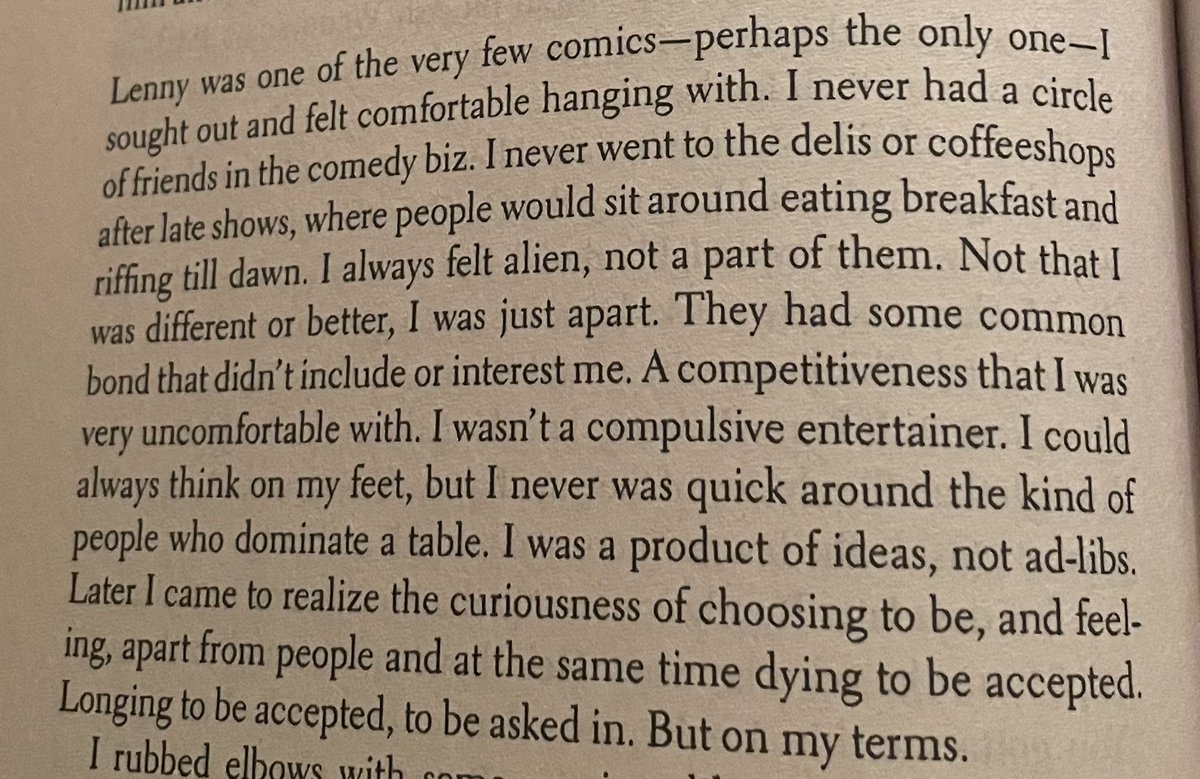
One of my favorites was Carlin’s memoir Last Words, which at the time I felt a real spiritual resonance with.
Like this passage, maybe my favorite in the book, where George Carlin touches on his personal relationship to belonging:
One thing that gets me about black & white film is the intentionality of lighting as a stylistic & narrative device.
I watched Dassin’s 1955 film Rififi & was just really caught up in how the medium’s constraints forced a beautiful spectral creativity you lose in translation to color
@jhendersonYT Everything I’ve heard or read from Bloom has me almost sure he wouldn’t be particularly huge on either Martin or Hebert’s work. Maybe passingly complimentary at most, but nothing meriting a verb at the level of ‘admired’
@Aella_Girl That’s the nuance I feel like gets fully missed here. These types assume a benevolent provider & modern relational mobility, but the exact reason this falls apart often is bc a lot end up as a dependent woman trapped with a shitty man she can’t afford (or is allowed) to leave
Even if I don’t agree with all the ways the Beats thought through their endemic societal evils, the parallels are interesting & their expression-as-conversation motif feels worth looking towards in a similar historical moment stuck with a more fractured artistic dialogue
been getting a lot of mileage out of this ‘92 Beat anthology the last week — most meaningfully through the lens of individualistic artistic expression as conversation within a generational cohort, which Charters frames with a cogent Lost Generation e.g on the idea
which I like not just because of the precursor thread, but because the throughline native to the Imagists & the LG was a grounded dissatisfaction in touch with worn Western ideals, needless violence, & a rejection of the artistic norms developed in parallel acquiescence