New Aave record!
Over $1.1 trillion in loans processed.
Traditional finance relies on back offices, settlement teams, intermediaries, and legal agreements.
Aave coordinates lending through code.
Time to move all lending onchain, powered by Aave.
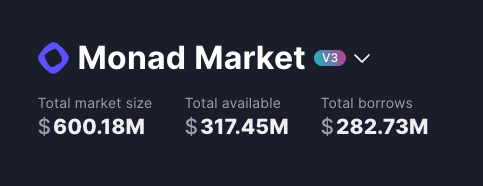
The @Token_Logic led instance of Aave Protocol on the Monad Network achieves 600M in user deposits
Next up, we will add a few @pendle_fi PTs to diversify collateral types & launch a fresh incentive campaign for smaller users
Wallet providers, reach out; you are in for a treat!
1/ One month ago, @aave went live on @monad.
Since then, the market has grown from zero to +$500M in user deposits and +$215M in active loans.
First month breakdown ↓
The largest growth opportunity for DeFi is bringing Payments, invoice factoring and off-chain loan origination yield on-chain for everyone to access.
With the ability to package duration and credit risk, we can build fixed income products on-chain 👀
Stay tuned. DMs open
As the industry evolves, Curators really should be viewed as Investment Managers and only a few legitimate Defi Native teams will survive.
The SEC hinted that Curators are Investment Manager and it is quite reasonable to frame them as such:
Most curators do:
- Accept funds and manage the allocation of those funds to generate a return
But don’t have:
- No Investment Policy
- No Risk Management Policy
- No Governance or Investment Committee Charter
- No Compliance, Fiduciary Duties & COI policy
Curators operate in an unregulated manner. They take funds from anyone and operate is an unregulated manner. No wonder the SEC is hinting Curators are basically Investment Managers are should be regulated as such.
A typical regulated Investment Manager, requires depositors to pass eligibility requirements indicating they have sufficient financial knowledge and awareness of the risks.
On Morpho, Curators actively allocate funds, just like an investment manager. There is not even a disclaimer users can loose funds -> it is reckless because the most basic effort to protect users is overlooked.
Being a Curator is high regulatory risk, thin margin and really only works at scale. Infra providers and Curators will consolidate to improve economics and those with size will survive.
Users can now swap $USDC for $GHO on Arbitrum at a 1:1 peg. with 25M in mint capacity backing it.
TokenLogic authored AIP-505 and led the deployment of the Stability Module. Arbitrum is now the second L2 with a GSM, after the Plasma launch.
More networks soon... 👀
When @monad signalled a clear focus on YBS, we went to work and now the fruits are starting to show.
@maplefinance is live
@pendle_fi is live
@ethena is live
and, there is more to come.
Monad offers great tech, has strong leadership and recently hired amazing talent. The roadmap is full of exciting integrations.
Phase II Extension onchain vote is starting tomorrow.
Cross-chain $GHO, new V4 collateral types, SVR expansion, RWA integration... A lot in the pipeline, and we're committed to delivering it.
Details and vote:
https://t.co/r4SluVL6bv
Great piece from Grayscale.
In tradfi, almost everything comes down to future cash flows. Any business is valued on the cash it is expected to generate over time, whether you are pricing a stock or weighing up a capital allocation decision.
That is what a DCF model captures. It gets harder when there is little revenue and no clear path to it, because the model has nothing real to work with.
@aave is interesting precisely because it gives you something to value.
Recurring revenue and a treasury built to keep compounding through rough patches.
You can run a real cash flow model on it, the same way you would on a fintech company, and that is genuinely rare in this space.
Since valuation sits on top of future cash flows, the most valuable thing the DAO can do right now is grow them. New markets, GHO, RWA, V4, each one compounds the base.
Owning the token is owning the trajectory of those cash flows. Over time, as the protocol matures, that value finds its way back to holders.
The projects that can be valued this way are the ones that will stand out.
May was a big month for @aave.
→ $160M+ DeFi United coordinated recovery, no ghost left behind
→ V4 deposits +182% to a $119M ATH
→ sGHO upgrade live at a fixed 4.25% APR, with 125M $GHO already migrated
There is plenty more to come: Monad is coming, V4 is expanding to Arc and Avalanche, and it's only getting started.
The teams keep building, the fundamentals keep compounding and Aave has a bright future ahead. We are proud to keep contributing to Aave’s success.
Protocols with both time in the market and sizable user positions prove themselves in periods of volatility. Throughout the volatility, Aave v3 and v4 operated seamlessly.
Since the 2nd June, @aave has processed over $212M in liquidation volume, of which $163M was routed via Chainlink's Smart Value Recapture (SVR). More than half the volume was wETH collateral.
The SVR volume generated $3.83M in Fees, split 60:40 with @chainlink, with ~$2.5M to Aave DAO and ~$1.34M to Chainlink.
With several instances of Aave Protocol to come online in the near future and SVR not yet fully rolled out, one possible way for the Aave DAO to expand revenue is to extend SVR.
Furthermore, enhancing the UX by providing tooling and features that help users better manage positions autonomously is a welcome improvement and would likely shift one-time revenue spikes towards more consistent SaaS like recurring revenue streams.
Everyone is building AI into their data platform...
We are making the data free and enabling users to use their favourite tool, Claude, to do everything
Aave is the largest dApp in DeFi, and @Token_Logic data is both the most accurate, built by the core team, and the most granular
The data streams we create to help run the business are the same data streams used to analyse the business's performance
Build your own dashboards, bots, or alerts on top of live @aave data through the @Token_Logic API, now connected to Claude.
Need an API key? It's free. Just ask!