We’re open-sourcing Unlimited OCR — built to read long documents in one pass.
With 3B total parameters and only 500M activated, Unlimited OCR sets new end-to-end SOTA results on OmniDocBench v1.5 and v1.6.
The key innovation is Reference Sliding Window Attention (R-SWA), inspired by how humans transcribe books: keeping the source, recent context, and next words in focus, while softly forgetting what’s no longer needed.
With constant KV Cache size and lower attention cost, Unlimited OCR can transcribe 40+ pages in a single forward pass — without losing context or slowing down.
Explore the model👇:
--GitHub: https://t.co/5ZJBsEldKd
--Hugging Face: https://t.co/4FKFr9EfOu
Our mission is to make it easy for anyone to deploy a robot to help them in the real world
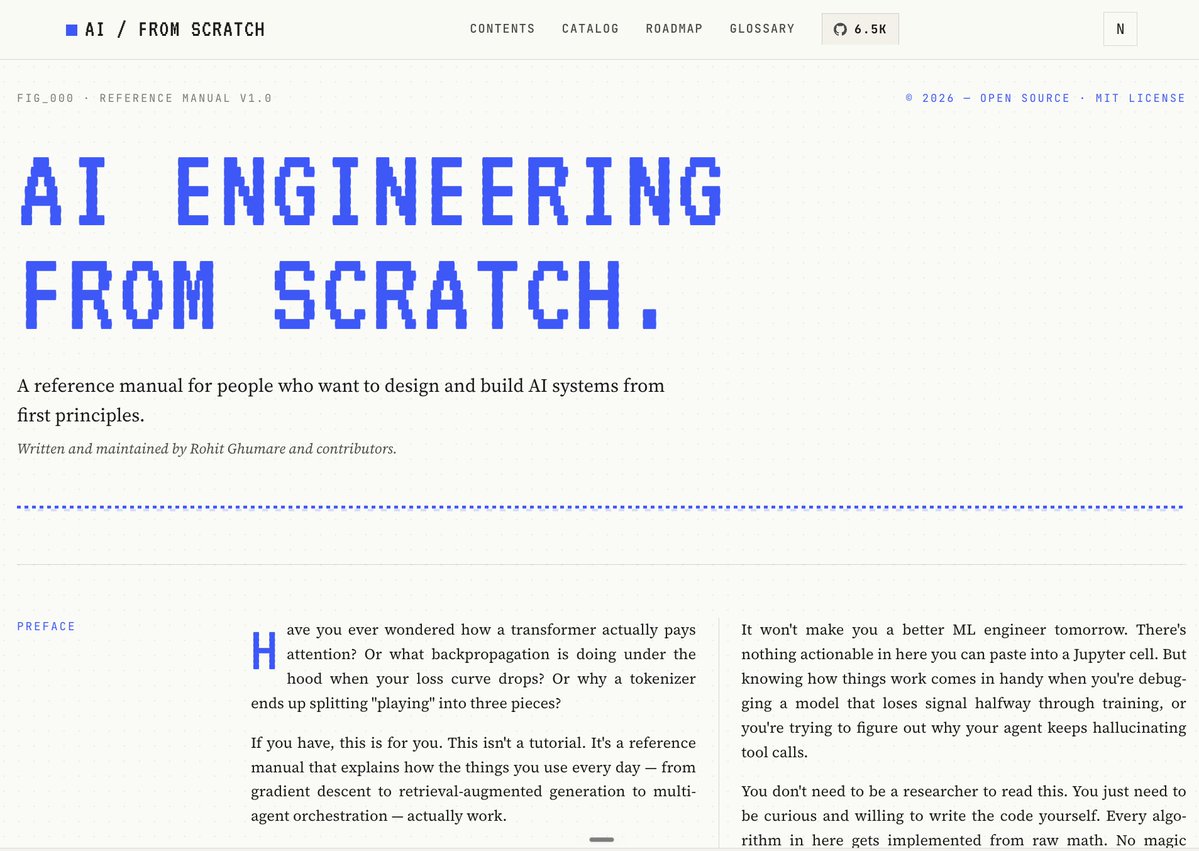
We wrote an intuitive guide to understanding modern robotics, catered toward an audience that understands technology but not AI robotics
We hope that this short blog post embeds in you the core principles that will bring further curiosity.
Someone on reddit built an automated Pigeon defense system for their balcony.
pigeons kept shitting and nesting on his balcony so he built a fully autonomous AI sentry gun to snipe them with water.
here’s how it works:
→ a usb camera spots the pigeon
→ a neural net identifies it in real-time
→ 2 servos aim a water gun
→ fires automatically.
runs on a $50 orange pi 5. zero human input.
100% open source.
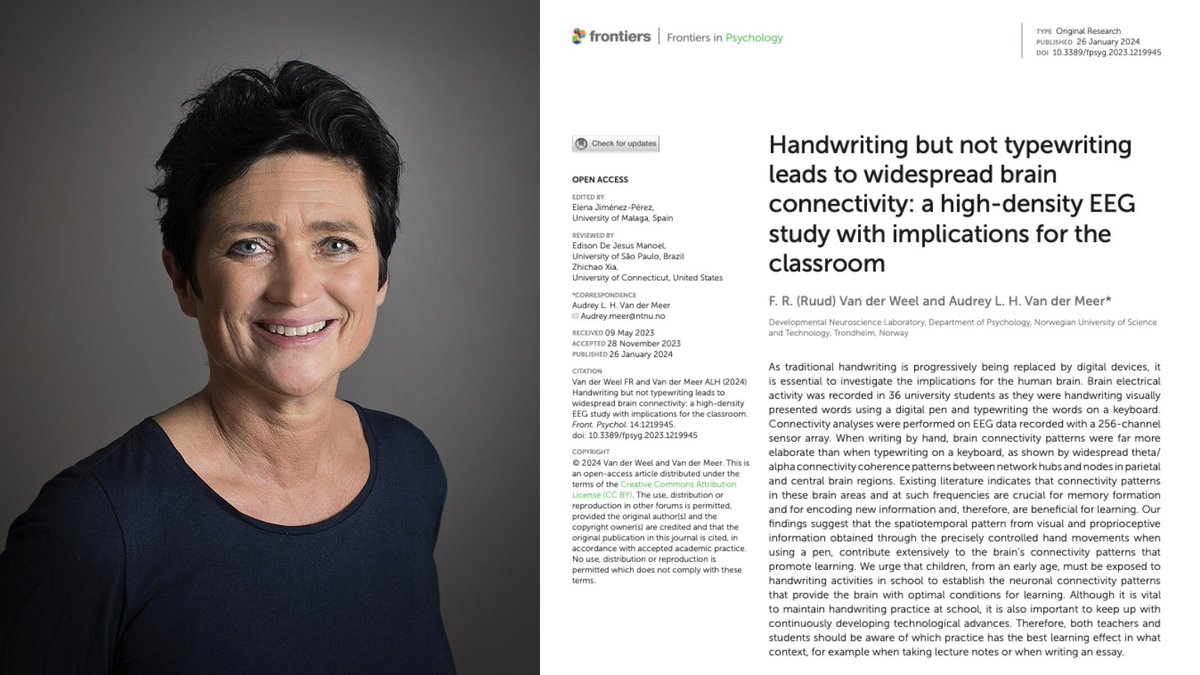
A Norwegian neuroscientist spent 20 years proving that the act of writing by hand changes the human brain in ways typing physically cannot, and almost nobody outside her field has read the paper.
Her name is Audrey van der Meer.
She runs a brain research lab in Trondheim, and the paper that closed the argument was published in 2024 in a journal called Frontiers in Psychology. The finding is brutal enough that it should have changed every classroom on Earth.
The experiment was simple. She recruited 36 university students and put each one in a cap with 256 sensors pressed against their scalp to record brain activity. Words flashed on a screen one at a time.
Sometimes the students wrote the word by hand on a touchscreen using a digital pen, and sometimes they typed the same word on a keyboard. Every neural response was recorded for the full five seconds the word stayed on screen.
Then her team looked at the part of the data most researchers had ignored for years, which is how different parts of the brain were communicating with each other during the task.
When the students wrote by hand, the brain lit up everywhere at once.
The regions responsible for memory, sensory integration, and the encoding of new information were all firing together in a coordinated pattern that spread across the entire cortex. The whole network was awake and connected.
When the same students typed the same word, that pattern collapsed almost completely.
Most of the brain went quiet, and the connections between regions that had been alive seconds earlier were nowhere to be found on the EEG.
Same word, same brain, same person, and two completely different neurological events.
The reason turned out to be something nobody had really paid attention to before her work. Writing by hand is not one motion but a sequence of thousands of tiny micro-movements coordinated with your eyes in real time, where each letter is a different shape that requires the brain to solve a slightly different spatial problem.
Your fingers, wrist, vision, and the parts of your brain that track position in space are all working together to produce one letter, then the next, then the next.
Typing throws all of that away. Every key on a keyboard requires the exact same finger motion regardless of which letter you are pressing, which means the brain has almost nothing to integrate and almost no problem to solve.
Van der Meer said it plainly in her interviews.
Pressing the same key with the same finger over and over does not stimulate the brain in any meaningful way, and she pointed out something that should scare every parent who handed their kid an iPad.
Children who learn to read and write on tablets often cannot tell letters like b and d apart, because they have never physically felt with their bodies what it takes to actually produce those letters on a page.
A decade before her, two researchers at Princeton ran the same fight using a completely different method and ended up at the same answer. Pam Mueller and Daniel Oppenheimer tested 327 students across three experiments, where half took notes on laptops with the internet disabled and half took notes by hand, before testing everyone on what they actually understood from the lectures they had watched.
The handwriting group won by a wide margin on every question that required real understanding rather than surface recall.
The reason was hiding in the transcripts of what the two groups had actually written down.
The laptop students typed almost word for word, capturing more total content but processing almost none of it as they went, while the handwriting students physically could not write fast enough to transcribe a lecture in real time, which forced them to listen carefully, decide what actually mattered, and put it in their own words on the page.
That single act of choosing what to keep was the learning itself, and the keyboard had quietly skipped the choosing and skipped the learning along with it.
Two studies. Two countries. Same answer.
Handwriting makes the brain work. Typing lets it coast.
Every note you have ever typed instead of written went into your brain through a thinner pipe. Every meeting, every book highlight, every idea you captured on your phone instead of on paper was processed at half depth.
You did not forget those things because your memory is bad. You forgot them because typing never woke the part of the brain that would have made them stick.
The fix is the thing your grandmother already knew.
Pick up a pen. Write the thing down. The slower road is the faster one.
Fun interactive science app ideas | Part 3
Played around with generating 3D biological structures and made an app to explore them interactively
UI Design
GPT Images 2
Code
Gemini 3.1 Pro
More demos ↓
For those who have been asking for hardcopies of "Is Parallel Programming Hard, And, If So, What Can You Do About It?", I received my new hardcopy of the Second Edition. Enjoy!
this OpenClaw bot finds restaurants with ugly menus, rebuilds them as live web menus, and mails the owner a postcard...on autopilot.
here's how agencies can land recurring contracts with this system:
- scrapes every restaurant in a city in real time
- filters by review count + rating + last menu update + photo quality
- pulls the real menu items from the official site, PDF, or Google reviews
- samples the brand palette from the restaurant's own visual identity
- renders a 9:16 brand-matched menu, hosted live at a QR-accessible URL
- writes a personalized postcard referencing a real reviewer and a real dish
- mails it to the registered office addressed to the owner by first name
every step from discovery to brand-matching to outreach is automated.
reply "MENU" + RT and i'll send you a free guide so you can build this too
That moment when you boot into the main menu of your childhood..
Cross-compiled Warsmash (a LibGDX-based Warcraft III engine reimplementation in Java) to JavaScript using TeaVM so the whole game runs directly in the browser, with map files served from OPFS. Still some quirks left but great progress.
Credits to Retera for his hard work.
#Warcraft3 #RetroGaming #Gamedev #TeaVM #LibGDX #WebGL #Java #OpenSource #BrowserGaming #IndieDev #RTS
Context Engineering, Attention, & How Every Token is a Vote for the Next One
Context Engineering matters because the context window is a deeply important boundary where all computation actually happens in models
A big part of that computation is Attention. There’s many great walkthrough of attention but one that I line is:
Every token in Attention is a vote for the next token
This is kind of obvious but internalizing it is useful! Every piece of context we assemble into the context window (System Prompt, Tool Descriptions, Skills, Subagent Definitions, etc) is in a way fighting to grab a slice of attention
When the context window is clearly focused on a task with relevant information, “taking the right path” (ie. predicting the next correct token is easier).
When the context window is cluttered with many irrelevant or contradicting Context Fragments, then the model has to reason through which matters in this scenario. This problem becomes harder with many Skills or Tools because model’s naturally degrade in reasoning performance over long contexts (also partially due to the fact that attention diffuses over many tokens mathematically).
This is why it’s still incredibly important to pick well scoped Prompts, Skills and Tools for the task we’re trying to solve. Dumping everything into context is the easy way out, but you’re leaving perf on the table when you do this
Ok so what’s the fix? Some good strategies include:
- Context Isolation: building scoped agents or subagents that handle some group of work well.
- Search! You can search for the right skills and tools in an isolated context window as to not clutter the main window. Think what’s happens when you have 100 skills!
- Making sure context doesn’t conflict when in the window. The models just resolve all the massive blocks of text and have to reason over all the tokens, consolidating context into what’s true in the use case helps avoid confusion (this is the same for humans)
Context Engineering still matters. It’s great that we’re swarming on interesting agent engineering practices, it’s worth stepping back into how models internalize the way we pipe context into them
Introducing "create-agent-tui"
A skill for building your own agent harness + terminal UI (TUI). The skill walks you through 4 different ways of customizing the look, and supports dozens of optional features 👇