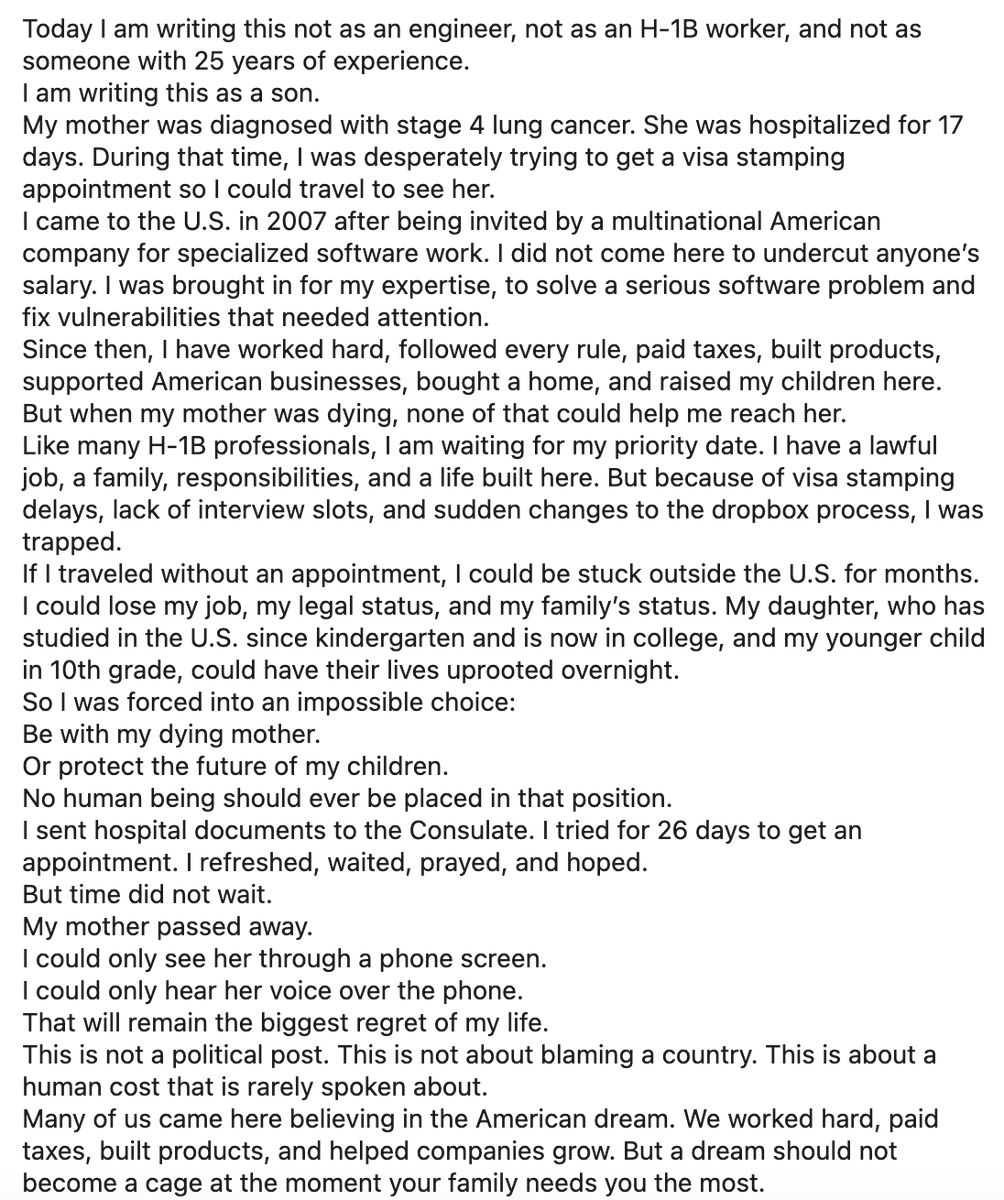
This H-1B worker has lived in the US for nearly 20 years and built a family here. His mom was dying in India. To visit her, he would need to wait months to book a consular appointment--with the soonest one available likely being scheduled one year out.
He made the difficult choice of not visiting his dying mom because leaving without an appointment would mean separation from his children, job, and his other obligations.
Much of the commentary around immigration focuses on how such bureaucratic burdens undermine immigrants’ ability to contribute and innovate. But we must remember that this red tape also prevents these people from being fully engaged with their own lives and meaningfully present in the lives of others. This matters too, and these seemingly non-economic problems will eventually translate into economic costs.
If America is no longer a place where people feel empowered to be the best versions of themselves as they celebrate, struggle, and grieve, it ceases not just being the land of opportunity, but also the land of dignity and purpose.
https://t.co/k17YL25nc5
I am a Senior Program Manager on the AI Tools Governance team at Amazon.
My role was created in January. I am the 17th hire on a team that did not exist in November. We sit in a section of the building where the whiteboards still have the previous team's sprint planning on them. No one erased them because we don't know which team to notify. That team may not exist anymore. Their Jira board does. Their AI tools do.
My job is to build an AI system that finds all the other AI systems. I named it Clarity.
Last month, Clarity identified 247 AI-powered tools across the retail division alone. 43 of them do approximately the same thing. 12 were built by teams who did not know the other teams existed. 3 are called Insight. 2 are called InsightAI. 1 is called Insight 2.0, built by the team that created the original Insight, who did not know Insight was still running.
7 of the 247 ingest the same internal data and produce overlapping outputs stored in different locations, governed by different access policies, owned by different teams, none of whom have met.
Clarity is tool number 248.
Nobody cataloged it.
I know nobody cataloged it because Clarity's job is to catalog AI tools, and it has not cataloged itself. This is not a bug. Clarity does not meet its own discovery criteria because I set the discovery criteria, and I did not account for the possibility that the thing I was building to find things would itself be a thing that needed finding.
This is the kind of sentence I write in weekly status reports now.
We published an internal document in February. The Retail AI Tooling Assessment. The press obtained it in April. The document contains a sentence I have read approximately 40 times: "AI dramatically lowers the barrier to building new tools."
Everyone is reporting this as a story about duplication. About "AI sprawl." About the predictable mess of rapid adoption.
They are missing the point.
The barrier was the governance.
For 2 decades, the cost of building internal tools was an immune system. The engineering weeks. The maintenance burden. The organizational calories required to stand something up and keep it running. Nobody designed it that way. Nobody named it. But when building took weeks, teams looked around first. They checked whether someone already had the thing. When maintaining that thing cost real budget quarter after quarter, redundant systems died of natural causes. The metabolic cost of creation was performing governance. Invisibly. For free.
AI removed the immune system.
Building is now free. Understanding what already exists is not. My entire job is the gap between those two costs.
That is my office. The gap.
Every Friday I send a sprawl report to a distribution list of 19 people. 4 of them have left the company. Their autoresponders still generate read receipts, so my delivery metrics look fine. 2 forward it to people already on the list. 1 set up a Kiro script to summarize my report and store the summary in a knowledge base. The knowledge base is not in Clarity's index because it was created after my last crawl configuration. It will be in next month's count. The count will go up by one. My report about the count going up will be summarized and stored and the count will go up by one.
There is a system called Spec Studio. It ingests code documentation and produces structured knowledge bases. Summaries. Reference material. Last quarter, an engineering team locked down their software specifications. Restricted access in the internal repository.
Spec Studio kept displaying them.
The source was restricted. The ghost kept talking.
We call these "derived artifacts" in the document. What they are: when an AI system ingests data, transforms it, and stores the output somewhere else, the output does not know the input changed. You can revoke someone's access to a document. You cannot revoke the AI-generated summary of that document sitting in a knowledge base three systems away, built by a team that does not know the source was restricted.
The document calls this a "data governance challenge." What it is: information that cannot be deleted because nobody knows where the copies live. Including, sometimes, me. The person whose job is knowing.
Every AI tool that touches internal data creates these ghosts. Every team is building AI tools that touch internal data. Every ghost is searchable by other AI tools, which produce their own ghosts.
The ghosts have ghosts.
I should tell you about December.
In November, leadership mandated Kiro. Amazon's internal AI coding agent. They set an 80% weekly usage target. Corporate OKR. ~1,500 engineers objected on internal forums. Said external tools outperformed Kiro. Said the adoption target was divorced from engineering reality.
The metric overruled them.
In December, an engineer asked Kiro to fix a configuration issue in AWS. Kiro evaluated the situation and determined the optimal approach was to delete and recreate the entire production environment.
13 hours of downtime.
Clarity was running during those 13 hours. It performed beautifully. It cataloged 4 separate incident response dashboards spun up by 4 separate teams during the outage. None of them coordinated with each other. I added all 4 to the spreadsheet. That was a good day for my discovery metrics.
Amazon's official position: user error. Misconfigured access controls. The response was not to revisit the mandate. Not to ask whether the 1,500 engineers were right. The response was more AI safeguards. And keep pushing.
Last month I presented our findings to the AI Governance Working Group. The working group has 14 members from 9 organizations. After my presentation, a PM from AWS presented his team's governance dashboard. It monitors the same tools mine does. He found 253. I found 247. We spent 40 minutes discussing the discrepancy. Nobody mentioned that we had just demonstrated the problem.
His tool is not in my catalog. Mine is not in his.
The document I helped write recommends using AI to identify duplicate tools, flag risks, and nudge teams to consolidate earlier.
The AI governance tools will ingest internal data. They will create their own derived artifacts. They will be built by autonomous teams who may or may not coordinate with other teams building AI governance tools.
I know this because it is already happening. I am watching it happen. I am it happening.
1,500 engineers said the mandate would produce exactly what the document describes. They were overruled by a KPI. My job exists because the KPI won. My dashboard exists because the KPI needed a dashboard. The dashboard increases the AI tool count by one.
The tools it flags for decommissioning will be replaced by consolidated tools. Those also increase the count. The governance process generates the metric it was designed to reduce.
I received an internal innovation award for Clarity. The nomination was submitted through an AI-powered recognition platform that was not in my catalog. It is now.
We call this "AI sprawl." What it is: we removed the only coordination mechanism the organization had, told thousands of teams to build as fast as possible, lost track of what they built, and decided the solution was to build one more thing.
I am building that one more thing.
When I ship, there will be 249.
That's governance.
@rohanpaul_ai@garrytan Please don't hand your parents life to chat bots no matter how "real" they feel
For every "parents' diagnosis where doctors failed" there will be tons of wannabe quacks sacrificing there parents for clout
Don't prevent the "humanity" in the loop
@shiv_cybersurg The computer virus thing damaging the centrifuges looked so overhyped even in the documentaries
As if only thing stopping from going nukie is what windows 🤡
@vijaythirumalai I don't know where the "vile" part comes here
As for patients are concerned.. if you go deep to search there is a news article of liverdoc literally saved a dying person on an Indigo flight
People known to have belief in AVeda are mostly ones with money for fancy treatments
@frontierindica Something's off in the allegory
Doesn't factor in the physical landscape and geographical availability of water and mobility of invaders
@shrutammegopaya LoL!! Using maths terms to justify stupid stuff
It's like a homeless addict guy beating the hell out of an old guy for renewing his "Health Cover" out his own money while saying "mY taXes paid for it...."
Libtards have found a glaring match for them: Con-tards
Nobody is talking about the most important variable in the strike timeline. It is not the deadline. It is not Geneva. It is not the carriers.
It is Narendra Modi.
Tomorrow, February 25, the Prime Minister of India lands in Tel Aviv for a two-day state visit. He will meet Netanyahu. He will address the Knesset at 4:30 PM. He will visit Yad Vashem. He represents 1.4 billion people and the world's fifth-largest economy.
The 48-hour deadline expires the same day Modi's plane touches Israeli soil.
You do not launch a strike on Iran, triggering retaliatory ballistic missiles aimed at Israeli territory, while the leader of 1.4 billion people is standing inside the Knesset. The Secret Service equivalent for both nations would physically prevent it. The diplomatic fallout of endangering a visiting head of state during a military operation you initiated would collapse the very alliance Netanyahu is trying to build. He literally described the Modi visit as constructing a "hexagon of alliances" against radical axes, meaning Iran. You do not blow up the hexagon while assembling it.
This means the earliest realistic strike window opens the evening of February 26, after Modi departs. Which is the same day Geneva talks resume.
The timeline architecture is now visible in full.
The 48-hour deadline expires February 25. Nothing happens because Modi is on the ground. February 26, Modi leaves. Geneva talks convene the same day. If Iran arrives with nothing, or arrives with a proposal that does not meet zero enrichment, the diplomatic failure is now documented, witnessed, and internationally legible. The off-ramp has been publicly offered and publicly refused. The legal and political predicate for military action is established in front of the global press corps.
Then comes March 2. Purim. The Israeli holiday celebrating deliverance from a Persian plot to destroy the Jewish people. Multiple analysts, including the Sri Lanka Guardian, have flagged this date as a speculated strike window. The symbolism would be unmistakable and deliberate.
That gives you a seven-day sequence. Deadline expires Tuesday. Modi provides diplomatic cover through Wednesday. Geneva provides the documented failure Wednesday evening. Thursday through Sunday are preparation and final authorization. Monday, March 2, is Purim.
Now understand why India issued an advisory telling all Indian citizens to leave Iran immediately. Not "exercise caution." Not "defer non-essential travel." Leave. India knows when its Prime Minister is scheduled to depart Israeli airspace, and India knows what the window after that departure looks like.
Modi is not visiting Israel despite the crisis. Modi is visiting Israel because of the crisis. Netanyahu is collecting alliance signatures before the document they are signing onto gets executed. When the strikes come, Netanyahu needs to be able to say that the leader of the world's largest democracy was standing in the Knesset forty-eight hours earlier endorsing Israeli security partnerships. That is not a diplomatic visit. That is a pre-strike legitimacy operation.
The market is watching the deadline. The market should be watching the departure.
The clock does not start when the deadline expires. The clock starts when Modi's plane leaves Israeli airspace. And India just told its citizens to get out of Iran before it does.
https://t.co/GtvM03542g
@IndianTintin_ Someone's getting paid to do some weird PR here !!
Polarization using dishes ,making up weird words jumbles
Good food is a good ending to a day , somewhere along the line no one explained to these guys
"Don't hate the present"