Nippon Chemical might be a superior play to Sakai Chemical for exposure to MLCC materials.
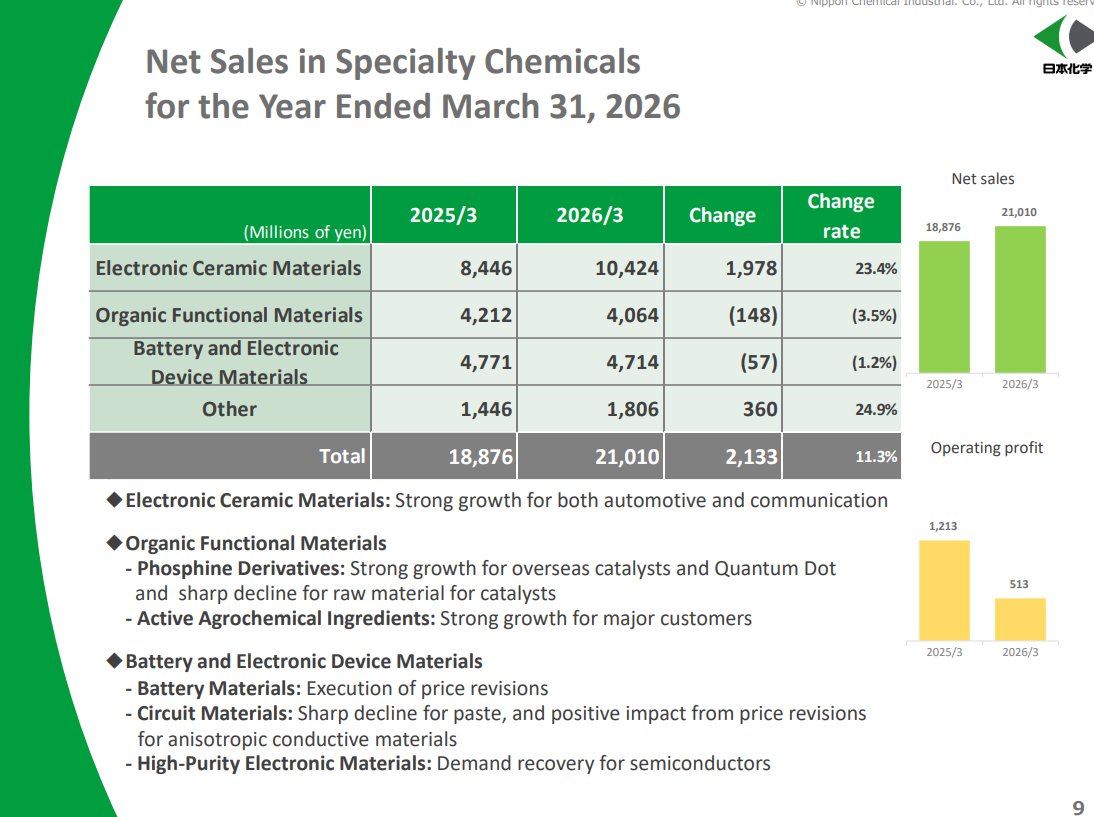
Electronic Ceramic Materials (materials for MLCC) is 25% of total revenue.
But the segment its inside (specialty chemicals) saw operating profit dive even amidst a 23% YoY increase in Electronic Ceramic Materials.
The drop in operating profit was caused by increased battery materials, some once off inventory costs, restructuring.
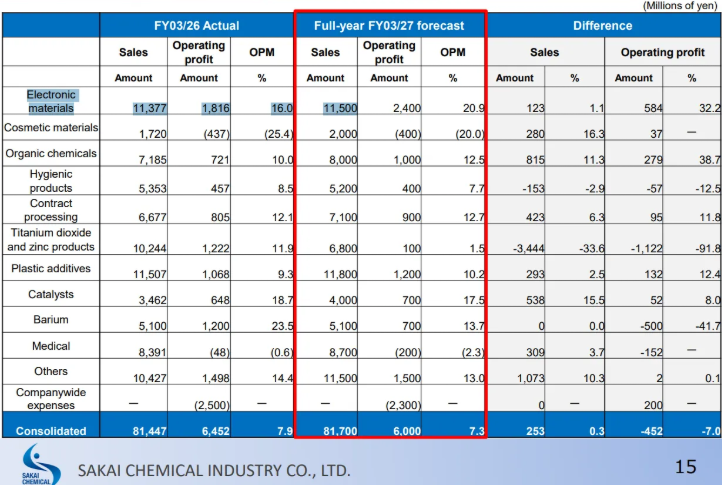
If we assume (big ask) that they achieve a similar operating margin to Sakai's own Electronic materials segment - 20%
Then in 2027 on a revenue of 12,000(mYen) (my own estimate) for the segment could produce a 2400 operating profit. For just that segment.
Nippon's entire year end operating profit 2026 was 2400.
It would take their EV/EBITDA from 8 to 4 in 2027 if price remained constant.
The White House issued an executive order on advanced AI innovation and security.
The order directs federal agencies to prioritize AI-enabled cyber defense across national security, defense, and civilian government systems.
It also calls for an AI cybersecurity clearinghouse to coordinate vulnerability scanning, validation, patching, and remediation with industry and critical infrastructure operators.
The order creates a voluntary framework for frontier AI developers to work with the government on classified cyber benchmarking and pre-release model access, while explicitly saying it does not create mandatory licensing or preclearance for new AI models.
Nippon Chemical!
Sakai Chemical +13% today.
Nippon Chemical -3%
I think the market is into Sakai Chemical because it's been profiled on X a lot.
Nippon Chemical hasn't been mentioned as much by big accounts, but it honestly looks like it could be a better play because:
- Cheaper P/B Ratio
-Possibly higher MLCC materials exposure.
Operating Profit got hit by once-offs which hides the growing MLCC Materials Operating Profit in the segment:
-"Absence of the positive impact from reduced inventory valuation losses in the previous year"
-"One-off expenses related to the consolidation of production sites"
Nippon Chemical also invested heavily into capex for MLCC capacity in the previous couple of years.
It is my opinion that they are in a unique position to capture a lot of the demand from the capacity crunch.
The MLCC shortage is more severe than previously thought
The opportunity is still upstream
The two names I mentioned, NCI and Sakai, have performed great
In fact, this is an industry I want to touch on in more depth later
Materials sit at the top of the supply chain and are usually forgotten, which represents a great opportunity
They give you time to watch a shortage form instead of trying to predict it. Once price increases start, you know it is time to buy materials suppliers, as long as supply is inelastic enough
The same thought process can be applied beyond MLCCs, and I suspect the market will start catching up with names that still undeservedly trade at very low multiples, just because they are still treated like boring industrials and not AI-adjacent companies
Nippon Chemical!
Sakai Chemical +13% today.
Nippon Chemical -3%
I think the market is into Sakai Chemical because it's been profiled on X a lot.
Nippon Chemical hasn't been mentioned as much by big accounts, but it honestly looks like it could be a better play because:
- Cheaper P/B Ratio
-Possibly higher MLCC materials exposure.
Operating Profit got hit by once-offs which hides the growing MLCC Materials Operating Profit in the segment:
-"Absence of the positive impact from reduced inventory valuation losses in the previous year"
-"One-off expenses related to the consolidation of production sites"
Nippon Chemical also invested heavily into capex for MLCC capacity in the previous couple of years.
It is my opinion that they are in a unique position to capture a lot of the demand from the capacity crunch.
The MLCC shortage is more severe than previously thought
The opportunity is still upstream
The two names I mentioned, NCI and Sakai, have performed great
In fact, this is an industry I want to touch on in more depth later
Materials sit at the top of the supply chain and are usually forgotten, which represents a great opportunity
They give you time to watch a shortage form instead of trying to predict it. Once price increases start, you know it is time to buy materials suppliers, as long as supply is inelastic enough
The same thought process can be applied beyond MLCCs, and I suspect the market will start catching up with names that still undeservedly trade at very low multiples, just because they are still treated like boring industrials and not AI-adjacent companies
Nippon Chemical might be a superior play to Sakai Chemical for exposure to MLCC materials.
Electronic Ceramic Materials (materials for MLCC) is 25% of total revenue.
But the segment its inside (specialty chemicals) saw operating profit dive even amidst a 23% YoY increase in Electronic Ceramic Materials.
The drop in operating profit was caused by increased battery materials, some once off inventory costs, restructuring.
If we assume (big ask) that they achieve a similar operating margin to Sakai's own Electronic materials segment - 20%
Then in 2027 on a revenue of 12,000(mYen) (my own estimate) for the segment could produce a 2400 operating profit. For just that segment.
Nippon's entire year end operating profit 2026 was 2400.
It would take their EV/EBITDA from 8 to 4 in 2027 if price remained constant.
Nippon Chemical 4092.T is still trading below book which is quite striking.
Their electronics segment (mostly MLCC materials exposure) tanked in operating profit in 2026 but ceramics went up.
So next year, if the one offs and battery materials stabilize, could look FAR better for the segment.
It’s not all exposure to AI - Server though. It’s also consumer electronics, automotive etc.
But AI server MLCCs will mostly likely need the high end stuff- which is made using the hydrothermal or oxalate process.
Sakai uses hydrothermal to produce BaTiO3 Nippon uses Oxalate.
Also robotics which arrives in a few years is sure to stimulate far more demand.
It looks really good here.
Also, as an added bonus, the company has a facility (from 2022) that makes high purity red phosphorus- used for optics.
Nippon Chemical 4092.T is still trading below book which is quite striking.
Their electronics segment (mostly MLCC materials exposure) tanked in operating profit in 2026 but ceramics went up.
So next year, if the one offs and battery materials stabilize, could look FAR better for the segment.
It’s not all exposure to AI - Server though. It’s also consumer electronics, automotive etc.
But AI server MLCCs will mostly likely need the high end stuff- which is made using the hydrothermal or oxalate process.
Sakai uses hydrothermal to produce BaTiO3 Nippon uses Oxalate.
Also robotics which arrives in a few years is sure to stimulate far more demand.
It looks really good here.
Also, as an added bonus, the company has a facility (from 2022) that makes high purity red phosphorus- used for optics.
Nippon Chemical 4092.T is still trading below book which is quite striking.
Their electronics segment (mostly MLCC materials exposure) tanked in operating profit in 2026 but ceramics went up.
So next year, if the one offs and battery materials stabilize, could look FAR better for the segment.
It’s not all exposure to AI - Server though. It’s also consumer electronics, automotive etc.
But AI server MLCCs will mostly likely need the high end stuff- which is made using the hydrothermal or oxalate process.
Sakai uses hydrothermal to produce BaTiO3 Nippon uses Oxalate.
Also robotics which arrives in a few years is sure to stimulate far more demand.
It looks really good here.
Also, as an added bonus, the company has a facility (from 2022) that makes high purity red phosphorus- used for optics.
Nippon Chemical might be a superior play to Sakai Chemical for exposure to MLCC materials.
Electronic Ceramic Materials (materials for MLCC) is 25% of total revenue.
But the segment its inside (specialty chemicals) saw operating profit dive even amidst a 23% YoY increase in Electronic Ceramic Materials.
The drop in operating profit was caused by increased battery materials, some once off inventory costs, restructuring.
If we assume (big ask) that they achieve a similar operating margin to Sakai's own Electronic materials segment - 20%
Then in 2027 on a revenue of 12,000(mYen) (my own estimate) for the segment could produce a 2400 operating profit. For just that segment.
Nippon's entire year end operating profit 2026 was 2400.
It would take their EV/EBITDA from 8 to 4 in 2027 if price remained constant.
I really do think Sakai Chemical 4078.T is a big winner here. @zephyr_z9 has mentioned the name multiple times.
It's not expensive. Especially when you factor in the growth in the MLCC market.
EV/EBITDA 7.6x
P/E adj. 18x
P/B 0.97
Operating profit holds 40% exposure to MLCC through Sakai's "Electronic Materials" Segment. Or 29% of operating profit before unallocated companywide costs.
「当社電子材料のほとんどがMLCC用途」
“Almost all of our electronic materials are for MLCC applications.”
— Sakai Chemical Integrated Report 2024.
Electronic Materials is probably 99% exposed to MLCC currently. Highest margin segment.
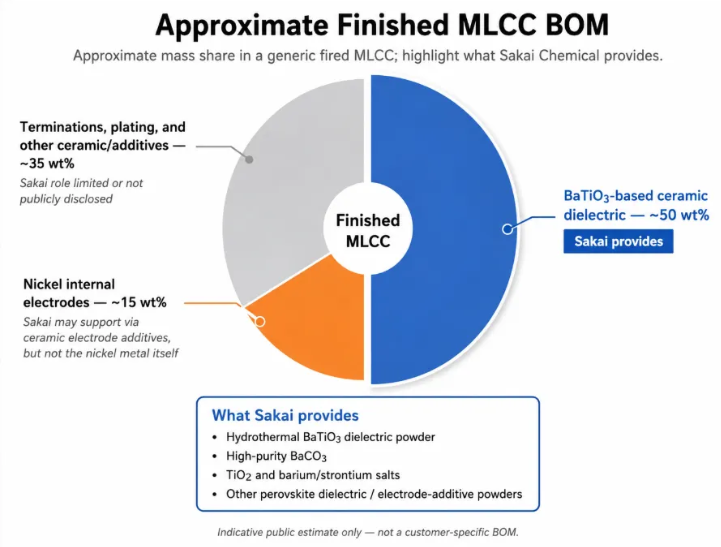
The core material is BaTiO₃ which is the highest BOM that goes into an MLCC. Around 50% of the cost.
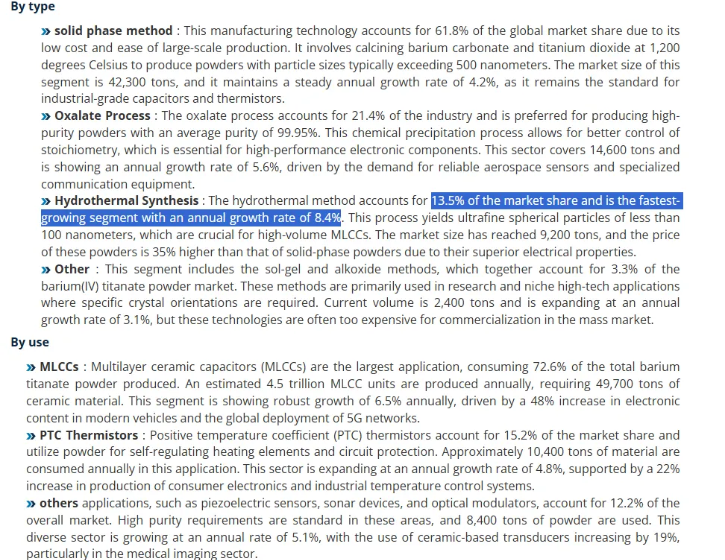
The market for BaTiO₃ consists of
-Hydrothermal. 13.5% market share.
-Oxalate. 21.4% market share.
-Solid-state. 61.8%
Hydrothermal and Oxalate are used in the high-end MLCC because the processes produce very fine, highly uniform particles.
Sakai is using Hydrothermal.
That's most likely 40% operating exposure to what @zephyr_z9 describes as an AI Server market growing at 80% annually.
What's happening in the MLCC market
First off, MLCC as a whole is a $15B market. MLCCs for servers were a $1.3B market in 2025 ($600m for AI servers, $700m for general servers)
The AI server MLCC market is growing at 80%+ CAGR, and the general server MLCC market will also accelerate due to agentic AI increasing CPU demand (around 30%-40% CAGR)
We will see negative growth in the smartphone/mobile MLCC market for at least 2026-27.
Humanoids are another future high-growth market for MLCCs
Book-to-bill ratio for most MLCC suppliers is over 1 now
Reasons for price hikes-
High Nickel & Silver are affecting all segments
There is a supply-demand mismatch in the high-end (high capacitance, high voltage) segment, which is used in autos & servers
High-end MLCC lead time is over 20 weeks
Spot/distributor prices have increased by 20%-40% for low capacitance & consumer device MLCCs due to hoarding and double booking, especially in China
OEM contracts have not seen large price hikes yet
What's happening now:
Rapid capacity expansion happening across the industry
Murata expects blended ASP prices to remain flat (ASP going down in consumer electronics, expansion in AI server market)
Tier 1 players like Murata, Taiyo Yuden, SEMCO building capacity to serve AI server MLCC market
This will create opportunities for Tier 2/3 and Chinese suppliers to expand in the mid to low end market (Macronix effect)
Future:
MLCC production equiment & raw materials suppliers will be the biggest beneficiary of this CAPEX boom
MLCC producer stocks have performed well, and it is finally spilling to raw material/equipment producers
I expect them to outperform MLCC producers now