1/ Travelling from Colorado to New York City for #ICFUST conference with low-cost air quality sensors.
New: @2b_technologies POM portable ozone monitor.
Semi-outdoors waiting for the bus:
-CO2: 588 (some exhaust)
-PM: 0 (rained yesterday *)
-VOC: 65 (low)
-O3: 15 ppb (**)
One year ago, I gave this interview to CNN about leaving the U.S. because of cuts to scientific funding and because immigrant scientists like me no longer felt welcome there.
What followed was a difficult year. I applied for dozens of positions, received dozens of rejections, and eventually relocated to Germany. Even now, I still mourn some of those opportunities that never materialized. That's a normal part of the process.
At the time, there was widespread concern that American scientists would flood an already saturated European academic job market. That never happened, and likely never will. The reality is that opportunities outside the U.S. are far scarcer than many people realize.
Many of the initiatives and campaigns that promised a "safe haven" for scientists leaving the U.S turned out to be something else entirely. In practice, most were used to attract European researchers back from American institutions, while others functioned largely as political or media statements. Very few created meaningful opportunities for the thousands of scientists, immigrants and U.S. citizens, whose careers were disrupted by funding cuts and instability.
The hard truth is that most scientists affected by these policies remain trapped. They cannot easily stay, but they cannot easily leave either. Meanwhile, the situation continues to deteriorate.
I wish more institutions and governments expressing concern about the U.S. scientific exodus would move beyond press releases and empty gestures and invest in real pathways for talented researchers to rebuild their careers elsewhere.
#BrainDrain
https://t.co/r6CycmGWfB
I’m so incredibly frustrated. We have an outbreak report for the cruise ship, published in NEJM, and great clinical, epidemiological, and genomic reporting, and…
NOT A SINGLE MENTION OF VENTILATION/FILTRATION SETUP ON THE SHIP
Folks, we keep doing this. A lot of MD/PhD coauthors on the “Andes Virus Outbreak Working Group”, and no one with expertise on mechanical systems. And no one on the team even thought to check or investigate it.
It’s malpractice at this point, and I’m not exaggerating in my use of the term. I do investigations in buildings and if I failed to check the status of the mechanical systems I’d be sued. (It’s actually *the first* thing I check)
@NEJM: see our report from The Lancet COVID-19 Commission on this in the thread. Include this in your reviews. Mandate this info in every outbreak investigation report.
The reason I first called the doctor on the ship was because I wanted to see if he could get info on the ship’s systems before he left it, bc I knew the official investigations would miss it. Because they always do.
@open_erv@ukhadds If you have access, try Claude.
(I am not sure if it's only paid version...). It can provide you not only reference, but the specific part/where in the document - when using for standards or codes, it can definitely do this.
@ukhadds I do worry though (outside of academia), the over blind trust in A.I. output (not you 'AL')... if no one is checking the work, or blind trust if its an area outside their domain/competency.
@ukhadds Is this what is going on in academia nowadays?
...isn't blindly trusting an AI citation - breaking rule number 1; check all of your citations (have the ref. num. correct, the data/info correct, the interpretation correct, reading the source yourself, etc.).
@vanessainstem Not sure if still popular, but in my time - these comics used to go around and provide a chuckle to those of us PhDing…
https://t.co/DBBLP0OCU0
@ukhadds They showed this here:
https://t.co/PL9ATsnuVR
(current LLMs are poor when into the weeds...)
My old officemate contributed to some of the benchmarking.
@EmJayNabuurs@ukhadds This article explains how the ASHRAE IAQ / ventilation standards came to be. People don’t realize it’s largely based on body odor detection and are not based on controlling infectious disease spread.
https://t.co/BW18d7zgaR
@EmJayNabuurs@canuckbcinbc@ukhadds *Note: this is for long-range transmission risk (the paper is model and parameters - what ASHRAE 241 IRMM targets are based on).
Also note, the risk reduction may be even greater in many cases, Table 4 is based on using current 62.1 ventilation rates. e.g. 1980's build is worse.
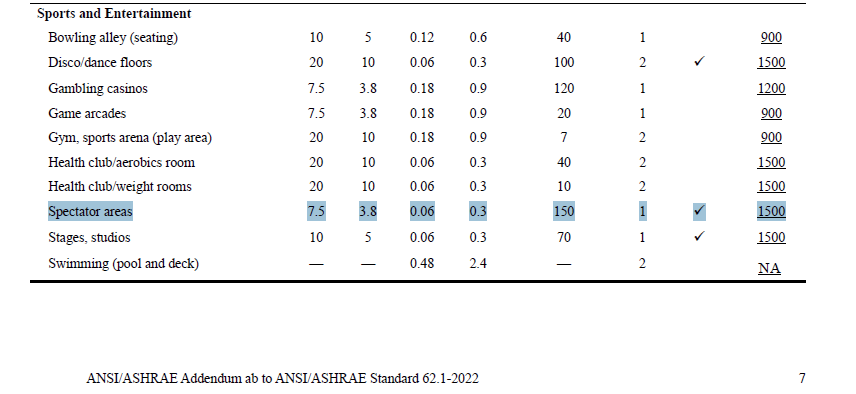
@ukhadds On your point (counter to pt2) on spatial positioning terms - and if & where they are trying to mix locally vs. aim for high volumes of bulk flow transport. (I didn't mention).
Where seated may have a big effect - high mixing might not be the goal, stadiums are unique beast.
@ukhadds a bit more...
-> 2000 ppm CO2 indicates system is within ASHRAE 62.1.
62.1 Addendum ab shows, CO2 max should be below.
Last column is CO2 rise above ambient. (urban ~500 ppm) 2000 ppm OK.
Note: very rough estimation - this chart is meant for demand controlled ventilation.