Read the below article if you want to be bullish and hold with diamond hands! $SERV
Please understand that the biggest painpoint in AI is about to be solved by @openservai and yes that is a crypto native company!
For those wondering why there’s so much attention on $serv, below are the results of their benchmark tests from their recent research paper.
- Maths (GSM-Hard): Models were already scoring well, but BRAID nudged scores from ~95% to 99%. Cost savings up to 74x.
- Complex Reasoning (SCALE MultiChallenge): This is where BRAID shone. gpt-4o went from 19.9% classic to 53.7% with BRAID. gpt-5-nano-minimal (23.9% classic) jumped to 45.2%, beating gpt-5-minimal’s classic score of 40.4%. Cost savings up to 55x.
- Instruction Following (AdvancedIF): Solid improvements across the board. gpt-5.1-medium reached 71% vs 60% classic. gpt-5-nano-minimal more than doubled from 18% to 40%. Cost savings up to 62x.
In summary, better output at a fraction of the cost.
We've been pretty quiet about what we're building. That changes now.
Our reasoning framework is currently beating every @OpenAI model on industry standard benchmarks. There are six models in development. SERV-nano just matched GPT-5.4 at 20x lower cost and 3x the speed. The research paper backing it is in peer review at a top-1% AI journal. The UAE government is running it in production, so are 10+ enterprises.
Nothing comes even close.
This goes far beyond any wrapper or prompt engineering gimmick, we've developed an entire AI reasoning layer from scratch: structured, bounded, deterministic using machine readable code instead of vague english prompts.
Any builder or enterprise swaps two lines of code and their agents get much cheaper and much smarter instantly. The self-serve API is about to open, in a multi-phase rollout.
More soon.
Let's daydream about three potential $SERV scenarios here as the Agentic AI era materializes:
Conservative Expectation (Low Adoption Scenario)
Adoption + Usage
In this baseline scenario, OpenServ experiences gradual, niche adoption primarily within the crypto-native developer community over the next 12–18 months.
Platform growth is modest, with daily active users reaching around 5,000–10,000, driven by early experimenters building simple agent-based tools for personal projects or small-scale DeFi bots.
Agent deployments top out at 50,000–100,000 across the ecosystem, focused on basic tasks like automated analytics or community moderation for indie crypto ventures.
Milestones + Partnerships
Key milestones include minor integrations with existing AI frameworks such as basic compatibility with OpenClaw's agent APIs and a handful of partnerships with mid-tier crypto incubators, but no major VC funding rounds or mainstream tech alliances materialize.
Token Utility + Revenue
Token utility sees limited activation. Platform fees generate $500K–$1M in annual revenue, leading to modest buybacks and burns of 10–20 million $SERV tokens via the 25% revenue allocation mechanism.
Demand for $SERV remains tied to speculative holding rather than heavy usage, with staking participation at 20–30% of circulating supply for governance perks.
External factors like regulatory scrutiny on AI agents in crypto slow broader rollout, keeping the platform as a proof of concept rather than a staple.
Price Impact / Target
With subdued growth, market cap climbs to $50–75 million as sentiment stabilizes and minor burns reduce circulating supply to 700–725 million tokens.
This implies a price target of $0.07–0.10 per $SERV, representing a 4–6x uplift from current levels ($0.016).
Upside is capped by competition from established players like Virtuals Protocol, which could capture more mindshare in agent tokenization, limiting OpenServ’s relative valuation to ~10–15% of $VIRTUAL’s market cap assuming $VIRTUAL holds steady around $430–500M.
Balanced Expectation (Medium Adoption Scenario)
Adoption + Usage
Here, OpenServ achieves steady ecosystem-wide traction over 18–24 months, positioning itself as a go-to infrastructure for mid-sized crypto projects and early enterprise pilots in AI-driven operations.
DAUs expand to 50,000–100,000, fueled by viral use cases such as agent-orchestrated NFT marketplaces or automated yield farming strategies.
Agent deployments surge to 500,000–1 million, with multi-agent teams handling complex workflows like full-cycle project launches such as a founder deploying 10–20 agents for dev, marketing, and on-chain governance.
Milestones + Partnerships
Milestones include strategic partnerships with 5–10 major players, such as integrations with leading AI labs like Anthropic or xAI for enhanced agent reasoning and collaborations with DeFi protocols like Aave or Uniswap for agent-executed trades.
A Series A funding round raising $20–50M materializes.
Token Utility + Revenue
Platform revenue scales to $10–20M annually from agent task executions, premium features, and enterprise subscriptions, triggering burns of 100–200 million $SERV tokens through revenue buybacks and direct platform actions like agent creation fees.
Staking rises to 40–60% of supply, providing yields from ecosystem rewards and bolstering governance engagement.
Market tailwinds like growing AI agent hype in Web3 help, but competition from peers tempers explosive virality.
Price Impact / Target
Moderate adoption drives market cap to $300–500 million, with burns and demand reducing circulating supply to ~600–650 million tokens.
This supports a price target of $0.45–0.80 per $SERV, a 25–50x gain from today.
Valuation aligns closer to 50–75% of Virtuals Protocol’s scale, projecting $VIRTUAL at $600–800M with similar growth, reflecting OpenServ’s edge in organizational orchestration but shared market in agentic AI.
Optimistic Expectation (High Adoption Scenario)
Adoption + Usage
In this breakout scenario, OpenServ explodes into mainstream relevance over 24–36 months, becoming the de facto standard for agentic AI in crypto and bleeding into traditional tech sectors.
DAUs skyrocket to 500,000–1 million+, propelled by mass adoption among solo entrepreneurs, DAOs, and even non-crypto startups using agents for autonomous businesses such as e-commerce operations or content farms.
Agent deployments exceed 10–20 million, with sophisticated swarms managing end-to-end organizations. Think a single user spinning up 50+ agents for global-scale projects like decentralized social networks or AI-powered supply chains.
Milestones + Partnerships
Pivotal milestones include high-profile alliances such as integrations with major clouds like AWS or Google Cloud for hybrid AI agents and partnerships with top labs like OpenAI for frontier model access.
Multiple funding rounds totaling $100M+ occur alongside regulatory wins enabling cross-border agent operations.
Token Utility + Revenue
Annual revenue erupts to $100–200M from widespread task executions, API calls, and B2B solutions, fueling aggressive burns of 300–500 million $SERV tokens via revenue allocations, feature unlocks, and on-chain burns.
Staking hits 70–90% of supply, with rich rewards drawing institutional holders.
Broader AI boom and crypto bull cycles amplify momentum, outpacing competitors through superior workflow leverage.
Price Impact / Target
Explosive growth propels market cap to $2–5 billion, with heavy burns shrinking circulating supply to ~400–500 million tokens amid surging demand.
This yields a price target of $4–10 per $SERV, a 250–600x return from current pricing.
At this level, OpenServ could eclipse Virtuals Protocol, forecasting $VIRTUAL at $1–2B and achieving a premium valuation multiple of 1.5–2x peers due to comprehensive infrastructure dominance in the agentic economy.
This is absolutely massive from $SERV
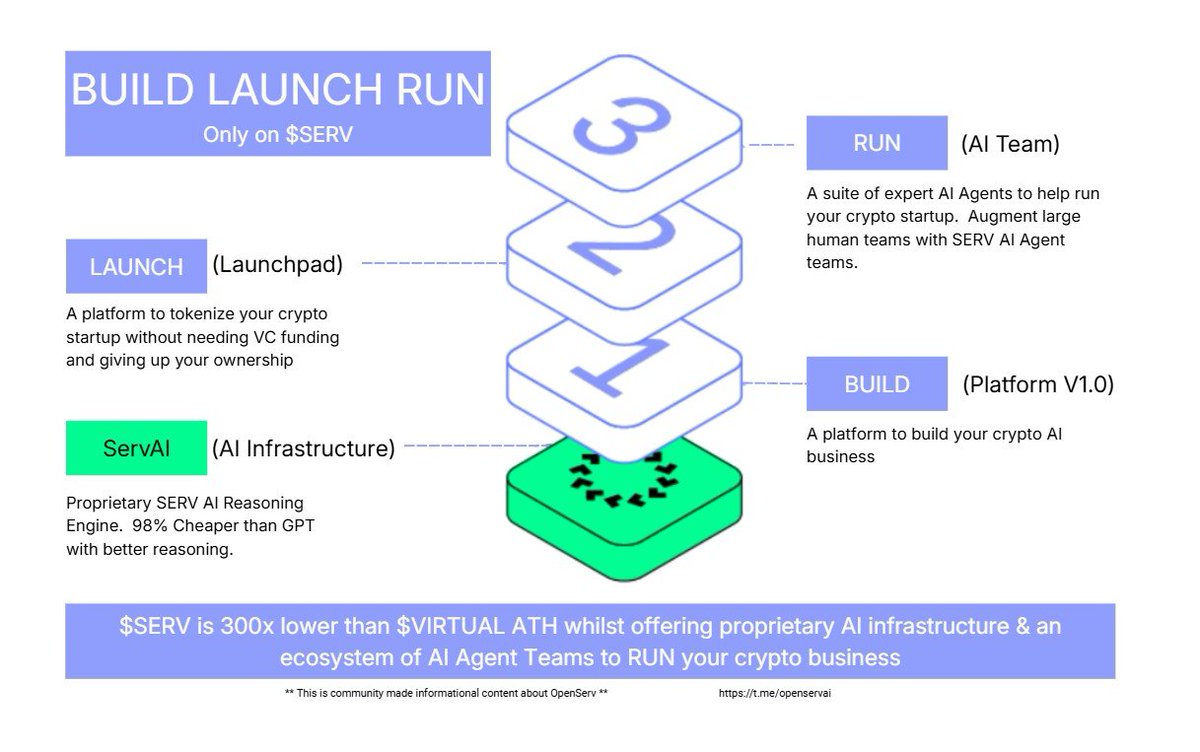
Look how many options are available to help you RUN your startup once you BUILD and LAUNCH through the @openservai platform
This is why the AI Reasoning Framework paper which powers it all is in the peer review stage, incredible
1/ It's been a huge week so far for @openservai
Here's a quick round up of 8 massive updates, including how all of this drives value to $SERV holders, and you profit from it
it won't be under the radar for long
$SERV 's vision and long worked for plan is unravelling. The first project to launch via their launchpad is now live, public launches soon to follow.
Not to mention who might next integrate SERV's reasoning engine.
The UAE government is using SERV’s proprietary reasoning architecture via our partnership with Neol.
BRAID reduces LLM costs by handling linguistic nuance more efficiently.
That enterprise-level edge is now available to startup founders who build, launch, and run on SERV.
1/ Tomorrow kicks off @openservai's complete AI founder suite allowing founders to BUILD, LAUNCH, and RUN their crypto startups
More on why these projects decided to launch on SERV and why it will become the new standard
Plus a reminder how you can gain by holding $SERV
1/ Another huge week on the roadmap for @openservai with @tradebetterapp TGE on 21st Jan
$BETTER have chosen Build-Launch-Run because of $SERV's ground breaking Bounded Reasoning
So how do holders of $SERV benefit from this & how does this fit into the hundreds of Xs coming?
“OpenServ’s reasoning framework started adding value to our work from day one, but the real excitement is in how it keeps evolving under real conditions,” Akar Sumset Co-Founder and CPO of Neol
NEOL's UAE government organizations that have access to $SERV's architecture