Leios merch giveaway. Gear up.
We're giving away 4 hoodies and 4 T-shirts. Sizes subject to availability.
To enter:
🔁 Repost this
❤️ Like
Winners announced 24th July 2026. Good luck.
No purchase necessary. Open to eligible participants only. Winners selected at random and notified via X. IOG's decision is final.
#Cardano #Leios
When Bitcoin hits $100,000 I will give 1 BTC to one person who follows me.
The rules are simple:
- like this tweet, follow me and RT
- comment “100k incoming”
Let’s go! $BTC #bitcoin
Say hello to a massive acceleration of AI smart contracts 🧠 on the Internet Computer #ICP blockchain.
Brilliant work by the @dfinity team has accelerated deterministic floating point instructions by 10X. We continue on our mission to run sophisticated LLMs as smart contracts 👊⚡️🔥
In the demo, image classification is now running 3X+ faster (across 3-4 blocks through consensus compared to 10-12 before). Naturally, the gas/cycles costs of AI inference has come down commensurately.
The acceleration was achieved through broad low-level work, which includes commits to the public Wasmtime virtual machine implementation of WebAssembly.
Coming optimizations will take us much further.
The next optimization will include the integration of SIMD instructions into the smart contract execution environment, which will allow multiple floating point calculations to be performed in parallel through the execution of a single instruction.
Something crucial: also in near sight, is the migration of the ICP smart contract environment from 32-bit Wasm to 64-bit Wasm, which will scale the number of AI model weights that can be loaded into contract memory from 2B to whatever is needed for sophisticated LLMs.
Somewhat further away, is the provision of new APIs allowing canister smart contract code to export AI computations for accelerated processing on GPUs.
This will require substantial work to address the challenges of achieving deterministic computation directly on the silicon, and for the community to agree a new public spec for node machines that pack GPUs, and to add compliant blockchain nodes to the network.
Together, these improvements will unlock further orders of magnitude acceleration of AI smart contract inference (and potentially training).
We believe that in the future vast numbers of AI models will run as smart contracts, which will prevent them being hacked (and thus the sensitive data they ingest being stolen), make them unstoppable, make them transparent, and where needed, allow them to run autonomously – for example for purposes such as KYC or EVM smart contract verification/certification.
In the future, you will be able to have a conversation with a blockchain, and ask it to do reasoning for you.
In this bright future, on-chain AI will be at the heart of Web3 – and to be clear, the Internet Computer's chain key technology will allow direct trustless integration with smart contracts on traditional chains such as Ethereum, Solana and NEAR.
Join the #ICP mission to run the most impactful AI models on blockchain as smart contracts, and help make the Internet Computer the "everything computer."
Join next week's Global R&D for details about the low-level deterministic floating point optimizations.
Thanks for following 💪
Right now, crypto isn't about value, it's about marketing. $ICP's tech is a $500B+ value (it's superior to any cypto out there) yet it's trading at a $6B valuation. Like the .com bubble in the late 1990s, the market will sift out the pets.coms from amazon.coms
A world first: a demonstration of AI running *on* blockchain as a smart contract 🧠⚡️
The Internet Computer is used – the world's first 3rd gen. blockchain #ICP. AI will become the beating heart of our web3, multi-chain world, and this is only my first demo.
Code will follow shortly. This is running on DFINITY's Internet Computer testnet, but you'll be able to take the code and run it on the public network as the NNS is expected to up the per-transaction instruction limit in the coming days.
Some important notes. The inference engine used has not been optimized, and we will show vastly greater efficiency in subsequent demos, where the AI runs even faster, and consumes less gas/cycles.
We will also propose to the NNS that smart contracts have access to SIMD instructions – which we have determined are deterministic – unlocking vastly more speed and efficiency.
Lastly, currently the actor smart contracts ICP hosts run inside a 32 bit environment, which limits their main memory to 4GB. Within the next couple of months, we expect the Internet Computer to move to a 64 bit environment, allowing smart contract memory limits to be raised much higher – allowing for models with far more parameters, and thus power, to be run.
Those of you who have followed my posts know that hardware optimization support is planned. Firstly this will involve WASM smart contracts shipping out matrices for processing by the CPUs on existing node machines (another advantage of the Internet Computer running on sovereign node hardware).
Secondly, we plan to propose a new public node machine specification, which node providers can build to, for use in subnets specialized for hosting AI smart contracts, in which each machine will incorporate several GPUs. Naturally, this will be packaged with other technological developments that ensure smart contract determinism.
This is part of our mission to enable powerful LLMs to run as smart contracts on the Internet Computer – in a forms that are tamperproof, unstoppable, and optionally autonomous (including under the exclusive control of DAOs).
Our vision: you will be able to have a chat with a smart contract. A smart contract will be able to coordinate your organization (see my earlier tweet about a "Delphi"). ICP smart contracts will be able to audit Ethereum smart contracts, kitemarking those without backdoors and reentrancy bugs. And smart contracts will be able to do KYC autonmously, matching faces to driving licenses, and more.
We will deliver new SDK enhancements, and work with partners, to turbocharge crypto AI developers.
Secure and unstoppable AI and third generation blockchain will be two sides of the same coin. Security and AI will be indivisible. AI models will be traded as NFTs. Thanks to Internet Computer's chain key (trustless multi-chain) capabilities, all blockchains will be able to leverage AI smart contracts.
The future is beyond exciting. Thanks for watching. Can't wait to give you more demos!
A central aspect of our collaboration with @dfinity is the joint development of a decentralized #AI Marketplace hosted on the #ICP network.
In parallel, we are testing the possibility of hosting AI models and Platform services in ICP canisters.
🔫The Nemesis Downfall BETA is launching on the PancakeSwap Gaming Marketplace on Feb 28th at 9am UTC!
🥞Use CAKE tokens for in-game assets & unlock exclusive PancakeSwap-themed collectibles
⚡️Sign up now for BETA access https://t.co/Pm81QljYWB
📚 Read more https://t.co/01x4Q58YbM
The EVM RPC canister Beta is live ⌛
This service helps easily build integrations between ICP & Ethereum smart contracts 🖇️
It keeps dapps secure by automatically inferring consensus among multiple RPC providers with each outbound request 🔒
Try it 📑 https://t.co/J07bRlx0Hp
#ICP says advanced AI models need to run as smart contracts on blockchain.
How? Why? It's easiest to understand by example...
Imagine an LLM (Large Language Model) AI that acts as a company oracle, which sits at the heart of an organization as it grows larger, making it more cohesive, helping with information flow and coordination, and making it more effective.
We'll call this LLM "Delphi," and she feeds on sources of company data, such as GitHub repos, JIRA tickets, Slack conversations, email threads, Google calendar, and every other enterprise information source that's important.
Team members will regularly chat with Delphi to obtain information, and also update her with their ideas, concerns, and the latest goings on.
You can ask "how is team X progressing with their task, are they blocked by anything, do team members have new concerns or ideas, what are their recent interactions with customer Acme, Inc, does legal have thoughts, what does Bob's calendar look like this afternoon?"
Delphi will quickly become the glue that holds the organization together, and the engine of its efficiency.
Now let's consider the risks.
First of all, if Delphi is running on a traditional server computer in a co-location facility, say (i.e. on traditional IT infrastructure), there's a risk that she goes offline due to a technical problem, which will greatly disrupt the organization.
But the danger hackers pose is worse. She's slurping a whole lot of confidential data. What would happen if hackers got onto her infrastructure, and started intercepting the feeds? She's a honeypot, where they can steal everything.
Moreover, hackers, or even malicious insiders, might start to tamper with the way she works, either for a bit of malevolent fun, or in the mode of commercial espionage.
When somebody asks how the team Bob leads is doing today, the response might be modified to say "Bob hates you, and is thinking of resigning!"
When somebody in PR asks whether there is any company news that might make a good tweet, the response might be modified to suggest broadcasting a damaging lie.
Even input prompts created by users might be surreptitiously modified, such that when Delphi's response is delivered, the response has a misleading meaning within the context of the correct prompt the user thinks she processed.
Worse, input prompts entered by honest users might be maliciously modified to update Delphi with fake and misleading information – fatally corrupting Delphi, since by the time it is seen that she has been ingesting faulty data, her neuron weights will have been changed in irreversible ways, requiring a massive retraining effort to get her functioning properly again, involving substantial time and effort that's inevitably very expensive and damaging for the organization to deal with.
Finally, Delphi might go completely offline for reasons other than simple infrastructure bugs and glitches that can be relatively quickly fixed: somehow, ransomware might get onto her infrastructure, and encrypt Delphi, and demand bitcoin to restore her – resulting in an outage lasting days, and/or the loss of Delphi's recent learnings if she has to be restored from a backup.
The risks of such problems occurring might prevent the organization leveraging Delphi to anything like her full potential – since if they come to depend on her too heavily, they risk serious disaster in various forms.
Is there a solution?
Naturally, yes, and it is something that those working on #ICP are making steady progress on.
The solution is to run Delphi in the form of a smart contract, which is tamperproof and unstoppable, and can guarantee that 1) she receives submitted prompts in unmodified form (since, behind the scenes, they are submitted as signed transactions), that 2) inference (the calculation of results) is performed correctly (since smart contracts always run their correct logic against their correct data, including neuron any weights they store), and that 3) responses users receive (the results) are not maliciously modified. Another plus is that ransomware is unable to encrypt smart contracts!
On the Internet Computer, #ICP "canister" smart contracts are "software actors," which comprise bundles of WebAssembly bytecode logic (compiled from software languages such as Rust, Motoko and TypeScript, or even cross-compiled binaries once created to run on other systems...), and persistent memory pages this logic uniquely and privately runs within, in a scheme of orthogonal persistence.
Recently, some Internet Computer subnets were upgraded to allow individual smart contracts to pack as much as 400GB in persistent memory pages each, which is enough to run very substantial LLMs.
Using such capabilities, some people are already experimenting with running LLMs as canister smart contracts, but there is more coming.
DFINITY is working on ways to transform LLMs, such as Llama 2 (but the transforms will work with nearly all AI models) such that hardware optimization, essential for model efficiency, works in deterministic ways, and can therefore be performed by blockchain nodes. With special 4X low-replication "AI subnets," we plan for it soon to be possible to tag smart contracts "AI model," so that the network automatically runs them with very decent levels of efficiency.
We consider compute infrastructure to be foundational societal infrastructure, which drives automation in ways that enable more productivity, efficiency, growth and freedoms – and on the Internet Computer, redefines governance and ownership models for public services – delivering widespread benefits to mankind.
It is of crucial and increasing importance to the world that compute infrastructure becomes tamperproof and unstoppable, as it is on blockchain. That traditional infrastructure does not have these properties is why cybersecurity is becoming a key issue of our time on a par with war and climate change.
AI now makes the issues of cybersecurity, resilience and trust even more important in two ways: 1) AI shall make cybersecurity vastly more challenging, and 2) AI will massively increase our dependence on our compute infrastructure, and tie us ever more closely to its fate.
"Blockchain Singularity," a core tenet of #ICP thinking, is that blockchain will inevitably become humanity's default compute platform to solve for the aforementioned challenges, and running AI on-chain will be a key part of that future.
The IOG team published work on One-Shot Signatures in 2020.
One of the reasons was to provide stronger security guarantees for #Cardano.
Quantum cryptography can find wide applications not only in the blockchain industry.
Let's explain the basic principles.
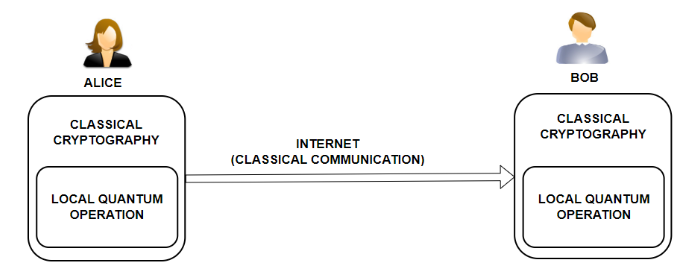
The one-shot signatures scheme is a hybrid system that combines principles from quantum mechanics with classical methods.
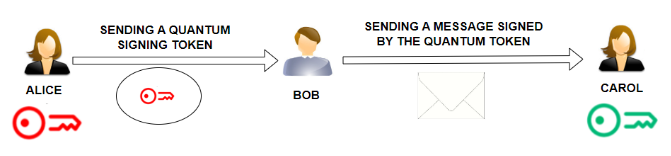
See Figure 1.
Classical communication methods include traditional internet technologies for transferring data (protocols) and classical cryptographic schemes, such as public key cryptography.
The system makes it possible to perform quantum operations even though it is implemented through classical methods.
The system utilizes the quantum no-cloning principle, which is a fundamental postulate of quantum mechanics stating that it is impossible to create an identical copy of an arbitrary unknown quantum state.
This principle ensures that once a secret key is used, it cannot be cloned or reused.
This is a key aspect of the security provided by one-shot signatures. Any secret key can be used to sign only a single message.
Then the key self-destructs.
Keys are non-cloneable.
This cannot be achieved in classical cryptography.
In classical cryptography, the owner of the private key can sign as many messages as he wants.
It is not possible to prevent the sharing of the key between multiple owners or to prevent the signing of multiple messages when the signing of a single message is required.
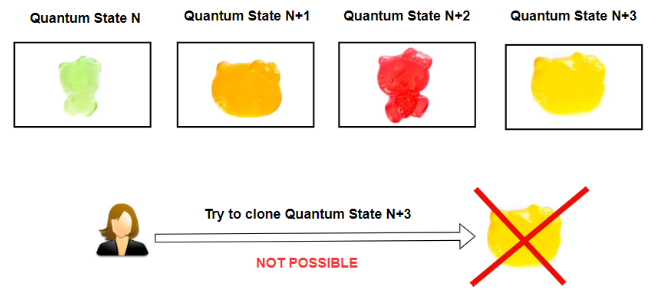
Let's explain the quantum no-cloning principle with a simple example.
Imagine you have a magical box that can create a unique kind of candy every time you open it. Each candy has a special flavor that you've never tasted before.
Now, suppose you really liked one of the candies and wanted to make an exact copy of it.
In the world of quantum mechanics, this is like trying to clone a quantum state.
The 'no-cloning principle' says that you can't make an exact copy of that candy. No matter how hard you try, you can't recreate the exact same flavor again.
This principle is used to ensure that once a secret key (think of it as a special candy) is used, it cannot be copied or used again.
See Figure 2.
This makes the system very secure because no one else can recreate your special candy (or secret key).
In the candy analogy, the 'magical box' can be thought of as a quantum system, and the creation of a unique kind of candy can be seen as a local quantum operation.
Local quantum operations are performed locally, i.e., on individual parts of the quantum system, as part of the one-shot signature scheme.
In a typical scenario, one party performs a local quantum operation on their part of the quantum system.
The results of this operation are then communicated to the other party using classical communication. Based on this information, the second party may then perform their local quantum operation.
Let's show an example.
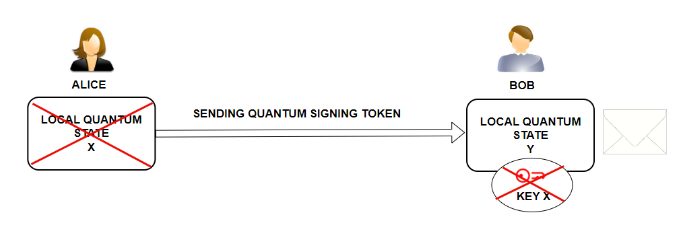
Alice can create a secret key which is represented by a quantum state.
She passed it to Bob wrapped in a box so no one knows the value of the key.
This secret key can then be used by Bob to sign a single message on Alice's behalf.
Once Bob uses the secret key to sign a message, the quantum state is no longer valid for further use.
See Figure 3.
In quantum terminology, it is said that the quantum state 'collapses' when a measurement is made.
After this collapse, the quantum state (i.e., the secret key) cannot be used again.
See Figure4.
The IOG team created one-shot signatures to improve the security of Cardano.
The system can help prevent long-range attacks in PoS networks by ensuring that any secret key can be used to sign only a single block and then self-destruct.
Cardano can provide stronger security guarantees by replacing the KES mechanism with one-shot signatures.
An adversary cannot use old secret keys to rewrite the history of the blockchain because these keys will not exist after signing the blocks.
This effectively prevents long-range attacks and enhances the security of PoS networks.
The #Ethereum team recently came across this work and is excited about it. A collaborative workshop between the University of Edinburgh, IOG, and the Ethereum team is planned.
One-shot signatures have numerous applications including:
- ordered signatures
- single signer signatures
- one-time signature tokens
- quantum money
- decentralized blockchain-less cryptocurrency
- non-interactive certifiable randomness
- and more.
The one-shot signatures system is a powerful new building block for novel quantum cryptographic protocols.
Multi-chain "brain wallets" 🧠 will finally take off in 2024 thanks to chain key crypto:
– no wallet software
– undetectable
– compatible
– friendly!!
They're going to be HUGE in the developing world for security reasons, and more widely for usability, and censorship resistance reasons. Here's how they work...
To access a crypto brain wallet, you simply open a web URL in a browser "incognito window," for example on your phone, which naturally will leave no trace.
The URL connects you directly to an #ICP smart contract implementing a brain wallet, such as https://t.co/KlE4H7GuF6 (an Ethereum brain wallet prototype under development), which creates a web-based user experience in your browser window.
Next you authenticate using Internet Identity. To do this, you only need enter an easily-remembered Internet Identity number, which is a short string of digits, like 97437899.
Your device asks you to perform a hardware authentication step. Most commonly, this simply involves pressing the fingerprint sensor on your phone, but can also involve Face ID, or a PIN, as desired. You can connect any number of devices like phones and laptops to one identity (you can also connect external wallet hardware, like a Ledger or YubiKey, typically for identity backup purposes).
Once you have authenticated, your device performs the job of siging a secure session that identifies you to the smart contract providing the multi-chain brain wallet functionality.
The device uses a private key kept hidden and inaccessible – even from you – inside a special secure chip on its internal motherboard called a TPM (Trusted Platform Module). This key is created when you connect the device, and associated with the wallet smart contract URL and your identity number.
The open WebAuthn and FIDO standards are involved, but you don't need to know anything about their complex workings. You just need to press the fingerprint button.
Once you have authenticated yourself to the wallet smart contract, it displays the contents of your wallet, and provides access to functionality such as send and receive. The Ethereum prototype brain wallet at https://t.co/KlE4H7GuF6 can also be quickly connected to DeFi services such as Uniswap using WalletConnect functionality – it's fully compatible.
This technology already works with bitcoin, ether, ERC20 tokens, and ICP tokens, including fast and cheap chain key "twins" such as ckBTC. In the coming months, extensions to the chain key technology powering the Internet Computer network will make it possible to create brain wallets that work with nearly ALL blockchains – no insecure and inconvenient bridges, just advanced math and cryptography.
The magic behind the scenes involves the smart contract creating & signing transactions for OTHER blockchains, which is possible because the Internet Computer can sign in place of a private key – hence "chain" key.
Arguably, this new web-based brain wallet paradigm provides a much smoother user experience than traditional wallet software, and it cannot be blocked or modified by Big Tech, which web browser extensions, and software that must be downloaded and installed from app stores, can be.
The really really big thing, though, is that once the incognito window is closed, there's no trace of the wallet on your device – and there's no way that even you can see what's inside the TPM chip on your device, to see the private key there...
This will be a GAME CHANGER in the developing world, where crypto is rapidly taking hold.
Imagine being in country X, with poverty and instability. A mugger puts you up against a wall. A policeman wants a bribe at a traffic stop. They want to see what's on your phone.
If you have crypto inside traditional wallet software, you're done, they're going to take it all.
But you haven't. It's in your brain wallet: Undetectable, and safe from violence.
This is just the beginning.
DFINITY will propose more game changing crypto advances to the network.
Stay tuned!
#Midnight will use Zero Knowledge Proofs. Check out the basic features of this technology.
In cryptography, a Zero Knowledge (ZK) proof is a method by which one party (the verifier) can prove to another party (the verifier) that a given statement is true without telling the verifier any detailed information about the statement.
ZK proofs allow the prover to prove to the verifier that they know a value x, without conveying any information apart from the fact that they know the value x.
The verifier will not know the value of x but will have proof that the prover knows it.
A classic example of a ZK proof involves a scenario where Alice (the prover) wants to convince Bob (the verifier) that she knows the password to a secret door in a cave without actually revealing the password.
Alice goes into the cave and comes out of an exit chosen by Bob, thus proving she knows the password without revealing it.
The cave has only one entrance, which is also the exit.
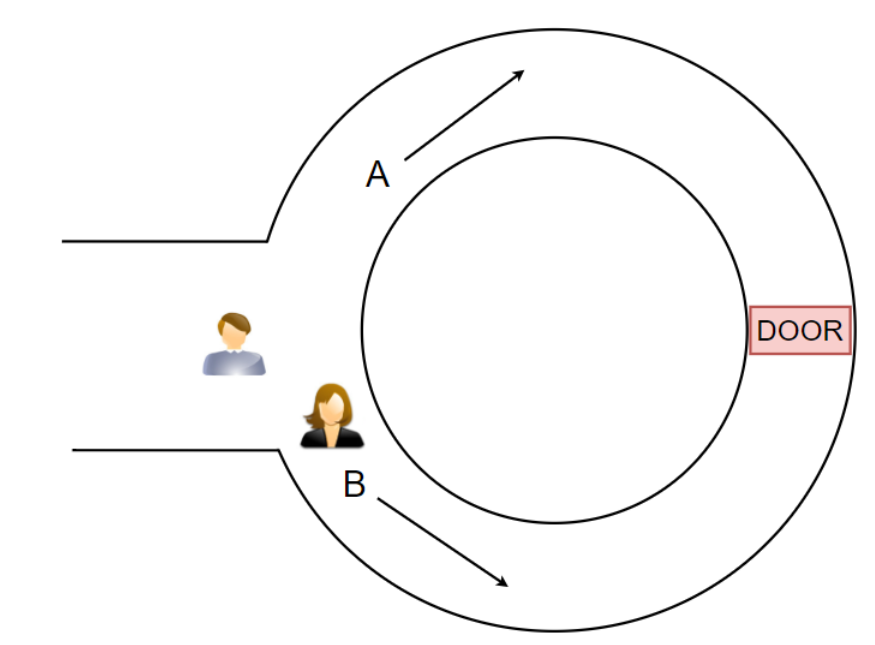
Right behind the entrance, Alice can go in two directions A or B. Behind the entrance is a single long corridor. In the middle of the corridor is a door that can only be opened with a password. Alice wants to prove to Bob that she can get through the door, that is, that she knows the code.
See Figure 1.
Note that Bob is not looking into the cave and does not know if Alice went in direction A or B.
In the beginning, there is always some commitment of the prover. Alice's claim that she knows the secret password to the door is a commitment. She enters the cave and decides on direction A.
Bob does not know which direction Alice chose. Bob enters the cave entrance and shouts to Alice to return in either direction A or B. In our case, Bpb chose the direction B. He challenges Alice.
See Figure 2.
Alice must provide a response. In our example, this means that she has to use the secret password and go through the door, as that is the only option for her to return from the B direction.
Bob walks a little further into the cave to see which way Alice will come out. Alice is coming from direction B.
See Figure 3.
Note that if Bob had shouted direction A, Alice would not have had to use the secret password at all and would have come from the correct direction. In other words, she had a 50% chance of fooling Bob.
It is necessary to repeat this process several times. If Alice can consistently return from the path that Bob specifies, he becomes convinced that she knows the secret password. However, he learns nothing about what the password actually is, hence this is a ZK proof.
Alice is able to prove to Bob that her statement is true. If Bob wants to buy a secret password, he has proof that Alice knows it.
Next time we will look at more practical uses and talk about how ZK Proofs can improve the #Cardano ecosystem.
#Midnight can protect your privacy while proving to the other party that you really are who you say you are.
It is possible to use Zero-Knowledge (ZK) proofs in combination with Decentralized Identity (DID). This combination allows you to prove certain attributes about your identity without revealing the actual information.
You can prove, for example, that you are over 18 years old without the other party finding out how old you really are.
Read the basics of ZK cryptography first: https://t.co/7vGIWMVhQu
First, you would create a DID, which is a globally unique identifier that you control. Your DID would then be verified by authorities. This could involve linking your DID to off-chain credentials such as your passport or national ID.
You can prove that you are the owner of the DID using cryptographic keys associated with the DID. Once your DID is set up and verified, you can use ZK proofs to prove certain attributes about your identity.
Let’s consider a scenario where Alice (the prover) wants to convince Bob (the verifier) that she is at least 18 years old. Bob is anyone who can legally provide services to adults only. These can be, for example, financial services.
The first stage is the preparation of the commitment. Alice starts the interaction by committing to her age. This could be done by hashing her age with a secret random number (a nonce). Alice sends the commitment to Bob.
The commitment scheme should be hiding and binding.
Bob is unable to determine Alice's age from the received commitment, but at the same time, Alice cannot change the age after she sends the commitment. Bob verifies the fact that Alice committed to.
Commitment is a setup process before the challenge-response and verification phases. The actual proof comes later when the prover successfully responds to the verifier’s challenges.
The commitment is designed to be a one-way function, meaning Alice can’t change her claim after the commitment has been made (binding).
Once Bob receives a commitment, he can challenge Alice. Bob sends Alice a random challenge. This could be a simple binary question, such as if her age is older than 18.
Alice responds to Bob's challenge by providing proof that satisfies the challenge without revealing her exact age. In this case, she could use a ZK range proof to prove that her age lies within a certain range that is above 18.
Finally, Bob verifies Alice's proof. If the proof is valid, Bob becomes convinced about the commitment.
Bob will not learn any information from Alice's ID. Notice that Bob doesn't even get to know the exact age of Alice. He settles for proof that Alice is an adult.
If Alice were to provide a false commitment, she would not be able to consistently respond to Bob’s challenges in a way that convinces him of her claim.
Challenges are randomly generated, so Alice can’t predict them in advance. If her commitment was false, she would fail to respond correctly to at least some of the challenges, and Bob would not be convinced.
The security of ZK proofs comes from their interactive nature and the use of random challenges. Even if Alice tries to cheat by making a false commitment, the protocol ensures that Bob has a high probability of detecting this.
It is possible to prevent Alice (prover) from lying about her age during the verification process.
The authority would be responsible for the creation of a cryptographic commitment of the prover's age. This commitment is a kind of digital signature that can be used to verify claims about the data without revealing the data itself.
The use of cryptographic commitments and ZK proofs prevents you from lying about your age.
Once Midnight launches and #Cardano is integrated with Atala PRISM, it will be possible to build this type of service. In order for it to work, cooperation with authorities that will verify identity is necessary. DID adoption can take several years.
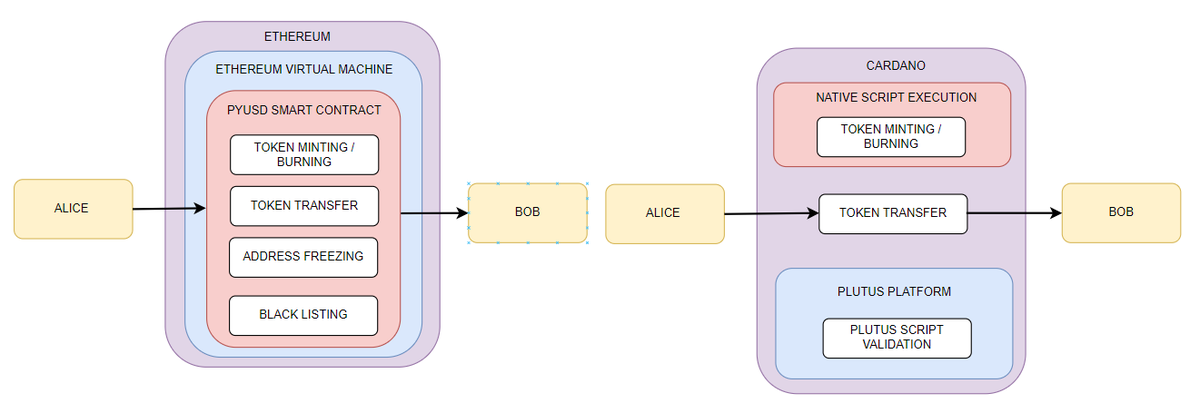
The difference between native assets on Cardano and SC tokens on Ethereum in one image.
#Ethereum uses SC for both minting and token transfer. The team controls SC and thus also tokens.
#Cardano transfers tokens natively like $ADA. Tokens are always owned by users.