We are advertising our first ever CEA postdoctoral fellowship! This is an independent 3yr fellowship at Durham University, get in touch if you are interested: https://t.co/v542mmPgUY
@jorryt_m@KarinaVoggel@astrobellatrix Although BlueMUSE is not the same, the costs of a pure duplicate would be close to the BlueMUSE ones: we are not producing series, most of the cost is taken by the manufacturing of the optics/ slicers and by the detectors. not the design itself.
1/ A new report by ASTRONET, an international consortium of leading astronomers, including ESO staff, sets out recommendations to transform our understanding of the Universe in the next decade.
📷 G. Hüdepohl/ @ESO
You are looking for a PhD position in astronomy and have some experience working with spectroscopic data? Come and work with me on resolved stellar populations in nearby galaxies at the Centre for Extragalactic Astronomy @durham_uni
https://t.co/ebldaLab33
Today and tomorrow the #bluemuse consortium will meet both in person @obslyon and virtually for a gate meeting. First large meeting in person since 2018! We expect plenty of exciting science and technical discussions!
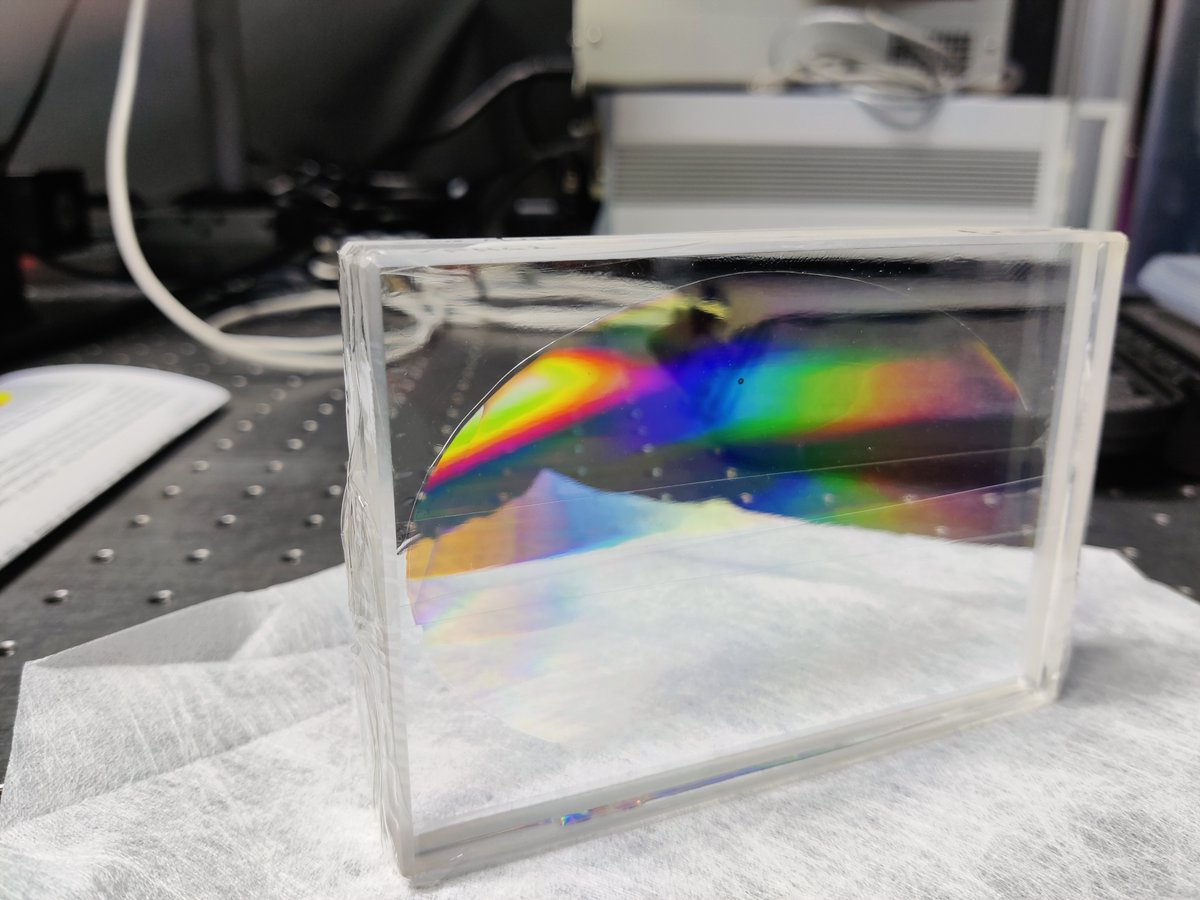
It is prototype day! As part of the #BlueMUSE Phase A activities we have just received @obslyon a first prototype of the VPH (Volume Phase Holography) grating. This crucial component will ensure a very high transmission in the instrument. Great work by @astrobrera #INAF
🏆 PRIX SCIENTIFIQUE
Roland Bacon du #CRAL (@CNRS_dr07@UnivLyon1 @ENSdeLyon) a reçu ce mois-ci le prix Johann Wempe (@AIP_Potsdam) pour ses nombreuses contributions en instrumentation et en spectroscopie à champ intégral depuis près de 35 ans. #MUSE
➡️ https://t.co/nGubnlBOrw
Kickoff! The BlueMUSE consortium finally joined together during the kickoff meeting last Thursday / Friday. Two days of fruitful work discussions and exchanges to get everyone ready. Thank you all, let's build BlueMUSE!
1/ Using our VLT, astronomers have uncovered the closest pair of supermassive black holes yet, in a galaxy about 89 million light-years away
🔗 https://t.co/Tb9fi624Bq
Credit: @ESO/Voggel et al.; ESO/Shanks et al
Acknowledgement: Cambridge Astronomical Survey Unit
You know I am usually all 🤩 about MUSE, but let me veer off for a second to gush about the HETDEX survey, whose VIRUS spectrographs were built by our 3D-MOS group here at @AIP_Potsdam.
This survey is all area and huge numbers - it'll be great!
https://t.co/flqLlNivLL
🔭 COMMUNIQUÉ DE PRESSE
Une équipe internationale menée côté français par le #CRAL (@UnivLyon1@CNRS_dr07 @ENSdeLyon) est à l'origine de cette découverte. Grâce à #MUSE sur le #VLT, un #VentGalactique a été cartographié pour la première fois ! #MEGAFLOW
The future of our discoveries will lie in how good we can push instrumentation. Astro-photonics, represented by innoFSpec here at AIP is at the cutting edge of what astro-instrumentation can do! (pic taken ~1 week before going into Corona-Lockdown in 2020)
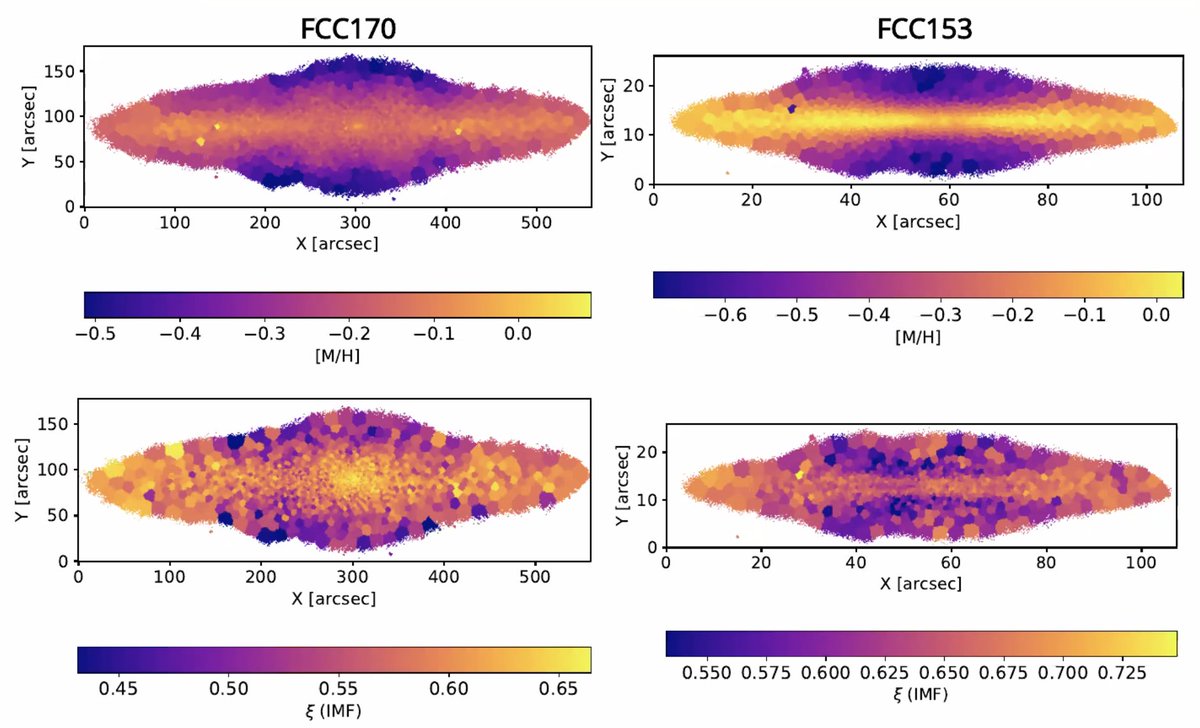
Ignacio Martin Navarro talks about IMF variations in the Fornax3D survey with MUSE. They confirm enhanced fraction of low mass stars in the center, but now we have beautiful IMF variation maps instead of just gradients. Mentions that @bluemusevlt will be even awesomer! #galspec21
For the 2nd paper of his thesis, @itsmejunais (from @LAM_Marseille) studies a red Ultra Diffuse Galaxy in the Virgo Cluster showing all signs of recent ram pressure stripping (including young star forming knots, HI outside the galaxy...). Now on arxiv : https://t.co/ga7n7UeEEB