Does adding exercise to a heatwrap improve acute #LowBackPain? 🔥 In this trial of 99 adults https://t.co/zhFeA3PLWi neither heatwrap alone nor heatwrap plus exercise reduced disability more than sham treatment.
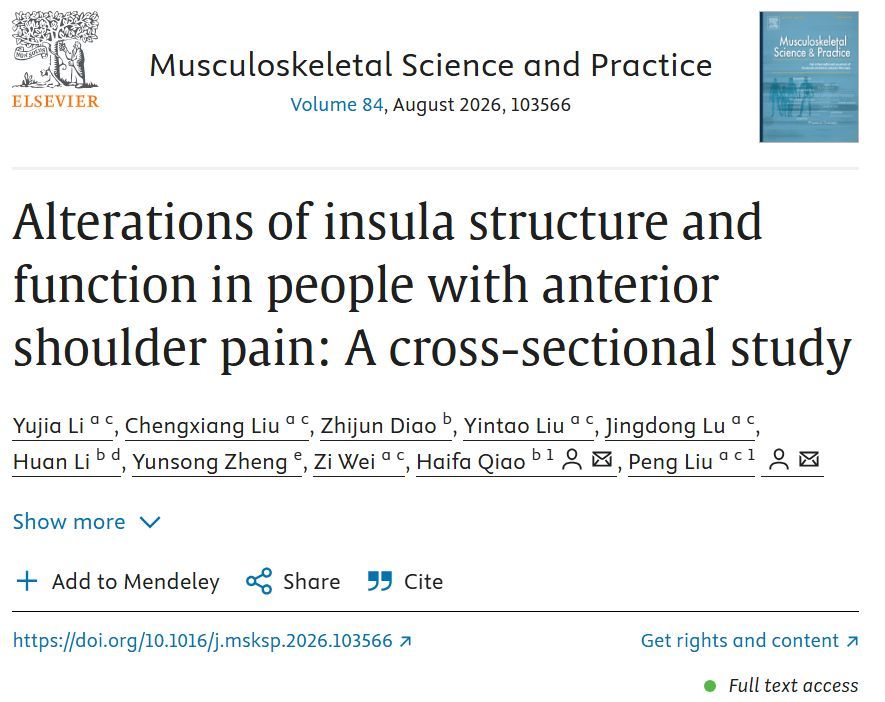
Could persistent shoulder pain begin to reshape the brain? According to this recent study, persistent shoulder pain is not solely a peripheral tissue problem.
Anterior shoulder pain is often viewed as a local musculoskeletal condition. This innovative neuroimaging study suggests the story may be far more complex.
Using structural and functional MRI, researchers identified alterations in the anterior insula, a brain region central to pain perception, salience detection and sensorimotor integration, in people with anterior shoulder pain.
Read about this interesting study here: https://t.co/fqPSLdwaLJ
#Anterior shoulder pain #Insula #Sample entropy #Structural covariance #Functional connectivity #Magnetic resonance imaging
Adding to the overwhelming evidence that physical fitness in people of advanced age [mean 73] is linked to outcomes over 7-year follow up
https://t.co/uRjovIE4yb
How much muscle can a person actually build?
A serious attempt to replace folklore with measurement: how much you gain in three months, how much across a career, where the ceiling sits and how much of it comes from steroids rather than training.
https://t.co/P4fAj22Tdp
"Clinicians routinely confront important questions that are unlikely to be answered through randomisation."
David Leaf and colleagues write on closing the evidence gap when randomised trials are not feasible
https://t.co/VUuitffLaW
1.Listening & communication skills in my opinion are the most important.
2. Strength & conditioning outcomes lend themselves to standardised parameters to some extent. Pain doesn't.
https://t.co/Fy5SfVPJ74
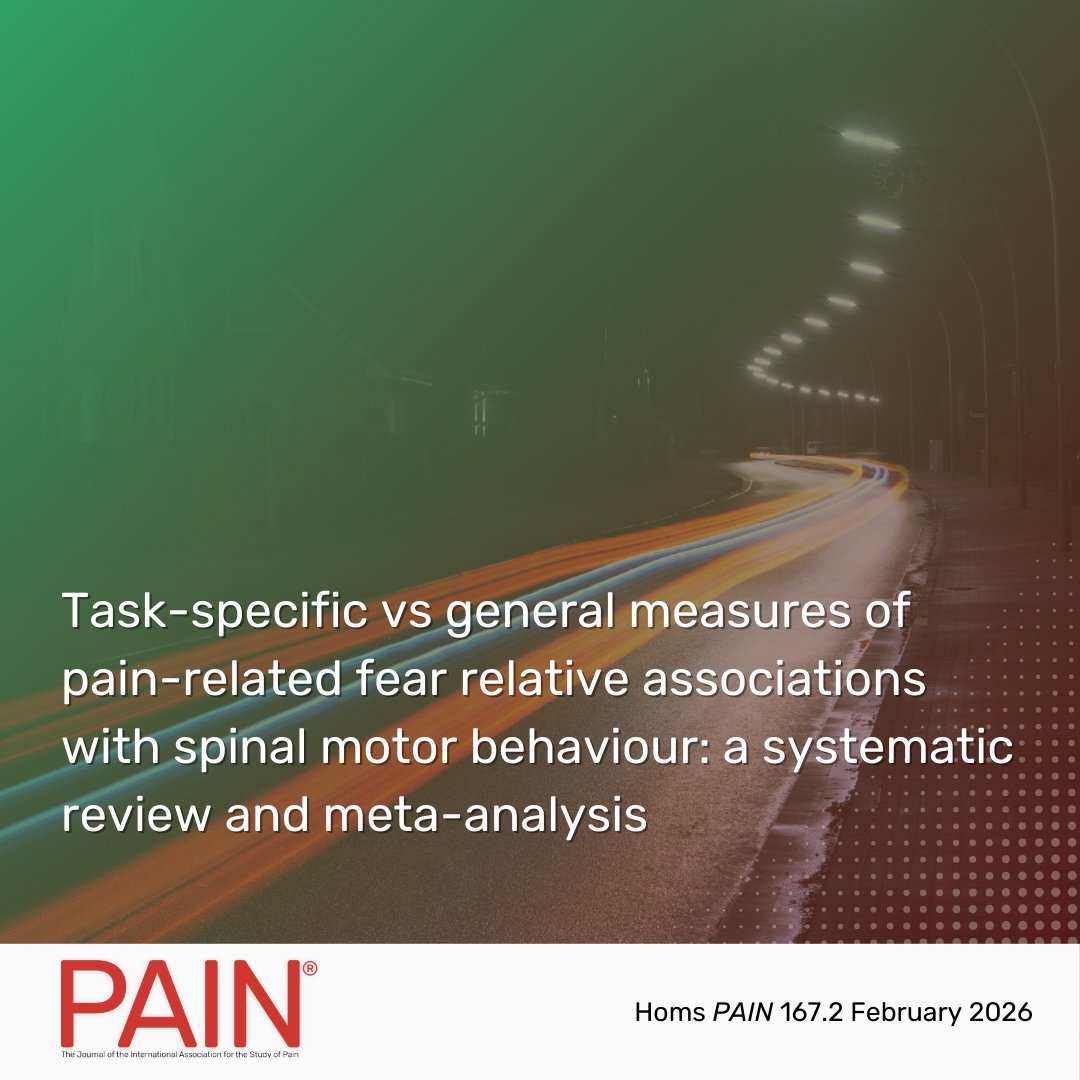
Homs et al. find that task-specific fear measures are more strongly linked to altered spinal motor behavior than general fear scales, supporting more targeted assessment of movement-related fear in musculoskeletal pain. Learn more in #PAIN https://t.co/DIFLAwsraS
The work of @Chris_Eccleston & Geert Crombez is some draw I use regularly in clinical practice to help patient understand their situation.
https://t.co/LFqtn41MJN
What’s the most efficient way to fuel human performance during endurance sports? For decades, adherents of keto- and low-carb high-fat diets have battled online with those who favor carbohydrate-burning approaches. In this episode, we have on the global scientific expert whose fascinating studies solved the debate.
Australian Louise Burke is one of the best-known sports nutritionists on the planet, known for her Supernova race-walking studies that showed that keto- and low carb, high fat diets don’t fuel endurance athletes as well as carbohydrate-burning approaches. She also practices what she researches, holding the women’s Australian marathon record in her age group—the age group, she jokes, of “never you mind.”
In this episode Dr. Burke walks Stu and Marty through her research that found carb-based approaches to fueling yield about 5% more of the muscle cell’s energy currency, ATP, compared to fat-burning approaches, with carb-burning also yielding 7-8% better performance. “Even though fat can do the job,” Dr. Burke says, “it’s not going to be able to produce the same amount of ATP so therefore you’re going to be slightly slower even though you’re working at the same relative ox
Which type of exercise is better for improving cardiometabolic health: aerobic training or resistance training?
The answer: They are complementary.
Our new meta-analysis indicates that aerobic and resistance training provide distinct benefits that work together to produce a synergistic effect on cardiometabolic health.
Bottom line: It doesn't have to be an either-or decision. Do both.
Kudos to @alexbatrakoulis for spearheading the paper 💪
https://t.co/vtSOFMxOPb
Do adherence-focused interventions in low back pain have an impact on rehabilitation outcomes? A systematic review with meta-analysis
https://t.co/Z3xbII32T0
1/ Full-body MRI “screening” for healthy, asymptomatic people is not prevention. It’s a high-cost fishing expedition that turns healthy people into patients. No major medical society recommends it — not the ACR, ACS, Canadian Association of Radiologists, or RANZCR. The evidence is clear: harms outweigh benefits for average-risk people.
2/ There are zero randomized trials showing it reduces mortality or improves long-term outcomes. Cancer detection rate in asymptomatic adults is only 1–2%. We have no proof those findings actually save lives versus lead-time bias.
3/ 90–95% of scans find at least one “abnormality.” Over 90% of those are harmless incidentalomas (cysts, nodules, etc.). Roughly 10–30% trigger follow-up testing.
4/ That follow-up creates cascades of care: extra scans, specialist visits, biopsies, sometimes surgery — each carrying real risks of complications, infection, and further false alarms.
5/ Overdiagnosis is rampant. Many “cancers” found (low-grade prostate, thyroid, kidney) would never have caused harm. Treating them leads to overtreatment with side effects that can permanently damage quality of life.
6/ Psychological harm is under-discussed. Incidental findings generate anxiety, repeated testing, and the shift from “healthy” to “patient.” A clean scan gives only temporary (and false) reassurance — it can miss things and doesn’t stop future disease.
7/ Cost is high ($500–$4,000+ out of pocket, rarely covered by insurance) and it drains limited healthcare resources that should go to symptomatic or high-risk patients.
8/ In low-prevalence populations the positive predictive value collapses. Even an excellent test mostly produces false positives when pretest probability is low.
9/ It is not a substitute for proven, targeted screening (mammograms, colonoscopy, etc.). Those have RCTs behind them. Whole-body MRI does not.
10/ Anecdotes of “life-saving finds” feel powerful but do not override population data. @hubermanlab
cited neurosurgeon friends doing monthly life-saving surgeries from curiosity scans — while advising/sponsoring @function
, which sells full-body MRIs. @drgarymcgowan
correctly flagged the conflict. Actual neurosurgeon @DrDiGiorgio
has never operated on an incidental lesion from an elective whole-body MRI. @EricTopol
highlighted the JAMA editorial: “buyer beware — the harms likely outweigh the benefits.”Stick to evidence-based screening. Don’t buy the illusion of control sold by commercial imaging.
#FullBodyMRI #Overdiagnosis #EvidenceBasedMedicine


![EricTopol's tweet photo. Adding to the overwhelming evidence that physical fitness in people of advanced age [mean 73] is linked to outcomes over 7-year follow up
https://t.co/uRjovIE4yb https://t.co/W2qWXYUEfi](https://pbs.twimg.com/media/HPXrRmvbcAAs9Bp.jpg)